EV Charger Cable Management for Facilities in France
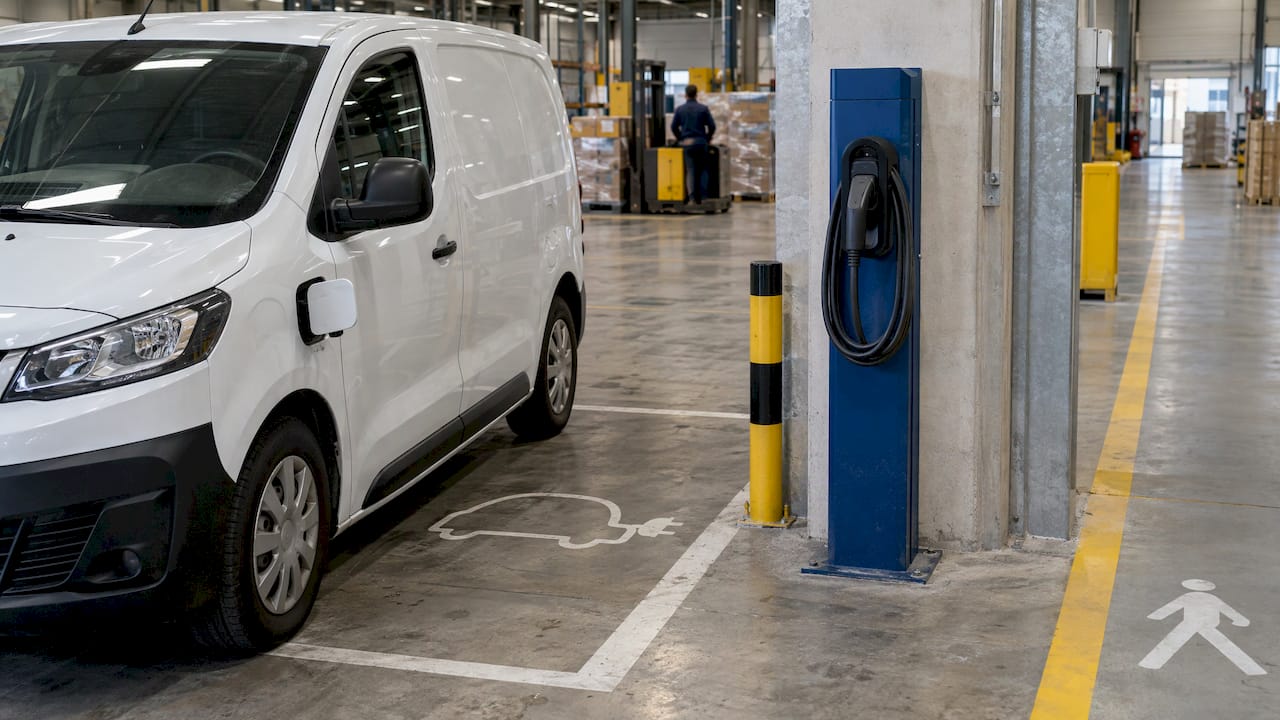
Good charger cable management comes down to four decisions: where the cable rests when it is not in use, the route it takes when it is charging, how it is protected from vehicles, weather and tampering, and who inspects it and how often. Get those four right at design stage and you remove most trip hazards, cable replacements and downtime. This guide is written for facility managers, contractors and consultancies equipping car parks, depots and company sites in France.
TL;DR
- Plan the cable’s resting point and its charging path before you fix the charger: clear of walkways, vehicle lanes, doors and sharp edges.
- Keep the connector and cable off the ground with a holder, retractor or boom, so it is not driven over, soaked or stepped on.
- Protect cables and supports mechanically (shocks, vandalism, weather) and keep emergency cut-off devices accessible and signposted.
- Charging points open to the public must be inspected at least once a year in France, with a visible mark recording the check.
- Cable management is part of the electrical design: dedicated circuit, 30 mA residual current device, earthing and surge protection come first.
Table of Contents
- Why cable management matters more on a site than at home
- Start with the layout, not the accessories
- Fixed cable or detachable cable: what changes for management
- Solutions to keep cables off the ground
- Protect cables and supports from shocks, weather and tampering
- French and European rules that frame cable decisions
- Inspection and maintenance routine for cables and supports
- Perspective
- Getting the layout and the electrical design right together
- How Indelec can help
- FAQ
- Sources
Why cable management matters more on a site than at home
On a household wall, a charger cable is a tidiness issue. On an industrial site or public car park, it is a risk and cost issue. Many drivers, often untrained, plug in and out every day. Vehicles maneuver around the bay. Staff walk between rows. Rain, mud, snow, salt and dust reach everything that lies on the ground.
The French electricity industry guide for charging infrastructure (Guide TLF, UFE) recommends training staff in good usage practices. That includes checking that the cable does not hinder operations, is not positioned where vehicles will roll over it, and that the connector is properly latched. It also recommends that the charger location be easily accessible and mechanically protected against possible impacts before installation. Both points are cable management decisions, taken before a single cable is pulled.
Start with the layout, not the accessories
Cable organizers and clips are the last 10% of the job. The first 90% is the position of the charger relative to the parking bay, the charge inlet of the vehicles and the pedestrian routes.
Measure the real path
A cable never runs in a straight line from charger to inlet. Measure along the path the cable will actually take, from the charger to the charging flap, rather than as a diagonal across the car. Vehicles park differently, and inlet positions differ: front wing, rear wing, grille. On a mixed fleet, test the layout with the two or three most different vehicles you operate.
The accessibility specification PAS 1889, a British document, uses a useful benchmark when evaluating a charge point: the cable should be able to extend up to 4 m with the cable suspended in the air, or less if the total cable length is shorter. It is not a French requirement, but it is a practical reach test for any bay layout.

Keep routes clear
The cable should not cross a pedestrian route, a vehicle lane, a door or a gate. If a bay sits across a footpath, move the charger rather than adding a cable cover. Where a route cannot be avoided, treat it as a design flaw to correct, not a hazard to signpost.
Plan the resting point
With a tethered (attached) cable, decide where the connector sits when not charging. A good holder:
- protects the contacts from water and dirt;
- keeps the connector and cable off the driving surface;
- is at a height reachable by the shortest and the tallest user;
- can be operated with one hand, including with gloves.
Avoid leaving a tight coil on the charger or on the ground during charging. A loosely hung cable with soft loops near the car is easier to handle and avoids trapping heat.
Fixed cable or detachable cable: what changes for management
The choice affects who is responsible for the cable, and therefore your management routine.
| Point | Tethered (attached) cable | Socket with driver’s own cable |
|---|---|---|
| Who handles the cable | The site, so it needs a holder and inspection | The driver, so the site needs a clean socket and a storage rule |
| Typical risk | Dropped, driven over, left on the ground | Cables left plugged in, tangled or stolen |
| Site task | Support, retractor or boom, routine inspection | Socket cover, signage, cable hooks for tidy use |
| Fleet use | Predictable, one cable type for all vehicles | Needs compatible cables for every vehicle |
For professional fleets, an attached cable usually keeps things predictable, as every driver finds the same equipment in the same place. Where drivers bring their own cable, give them a hook or a bracket for it and a written rule: unplug, coil loosely, hang it.
Indoor versus outdoor
Indoors, the main concerns are fire compartments, ceiling height, cable trays and sharing space with pedestrians. Outdoors, add rain, frost, UV, dirt and vandalism. A cable left on wet ground exposes the connector to moisture, mud and snow, which can promote corrosion according to a support article on retractable cable systems. The same article notes that suspended cables reduce the trip risk and protect both cable and connector. Whatever the location, the principle is the same: the connector never rests on the floor.
Solutions to keep cables off the ground
Three families of solutions cover most professional sites.
- Wall or post holders. Simple brackets for the connector and cable loops. Best for low-traffic bays and small fleets. Low cost, but they depend on user discipline.
- Retractors and reels. The cable returns by itself, so it is not left on the ground. A manufacturer of reel systems explains that this avoids putting a dirty, wet cable back into the vehicle and reduces the cost of replacing cables damaged in car parks, according to its charging reel page.
- Overhead booms and rails. The cable hangs above the bay and follows the vehicle. Best for wide bays, heavy cables and high-turnover sites, but they need structural fixing and clearance for tall vehicles.
The right choice depends on cable diameter, bay width, user profile and the weather. Heavier cables, such as those for higher-power charging, need support rather than just a hook.
Protect cables and supports from shocks, weather and tampering
Mechanical protection
Bollards, wheel stops and protective barriers in front of the charger prevent the most common damage: a vehicle backing into the unit. Keep the wheel stop at a distance that leaves the cable slack but out of the wheel path. Where cables run in the ground or along walls, use conduits and covers rated for the impact they will face. One manufacturer of insulating solutions describes protecting cables with an IK10 enclosure, and says its flame non-propagating solutions reduce possible fire sources.

Bending radius and cable entries
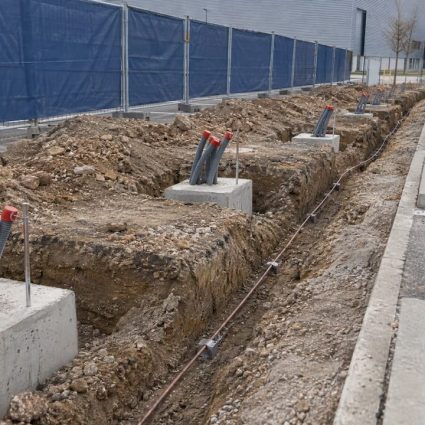
When larger cables enter a charger or a trench, check the bending radius and choose the unit configuration to suit the cable cross-section. A cable forced round a tight bend ages faster and heats up. During civil works, leave extra cable length at the base: one manufacturer’s installation guidance recommends minimum lengths of at least 50 cm of supply cable and at least 150 cm of optical or UTP cable (if the station does not use wireless communication) to allow later connection, according to its cable management guide. Apply that principle to your own worksite: always leave slack at the chamber.
Vandalism and theft
Exposed cables and copper are targets. The U.S. National Renewable Energy Laboratory, in a physical security guide for charging sites, recommends vandal-resistant equipment, such as tamper-proof screws and locked enclosures, and fencing or barriers with locked access to keep unauthorized people away from supporting electrical equipment such as transformers and cabinets. This is American guidance, but the logic transfers to any site: put the electrical cabinets out of reach and lock them, and use tamper-resistant fixings on the visible parts.
If cabinets sit in hot rooms or enclosures, consider thermal design as well. Engineers sizing enclosures can use control panel cooling calculations to check that a cabinet next to the chargers will not overheat.
French and European rules that frame cable decisions
Cable management is not a separate regulatory topic. It sits inside the rules for charging infrastructure (IRVE), and a few of them directly shape layout.
- Dedicated circuit and residual current protection. The French standard NF C 15-100, part 7-722, requires a dedicated circuit supplying a socket or charging station, and each charging point protected by a dedicated 30 mA residual current device, according to a Hager summary of the standard. The same sheet gives the residual current device types by charging mode and says cables and protection are sized according to the values on the charging station.
- Fire safety in public buildings. For car parks in ERP (public-access buildings), BatiFire explains that supply cables need suitable fire resistance, notably where they cross fire-rated walls, and that an accessible, clearly signposted emergency cut-off lets rescue teams cut power quickly. Do not let a cable organizer block that cut-off.
- Qualified installers. The TLF guide states that installations must be carried out by qualified professionals, and in some cases certified ones for certain subsidies. Check IRVE qualification requirements before signing.
- Earthing and surge protection. A cable is only as safe as the electrical system behind it. Our guides on earthing for IRVE and surge protection for French EV chargers cover these two points.
Note that the Hager sheet comes from the housing section of the standard and the data for each site depend on its type. Have the design validated by a qualified installer or consultant.
Inspection and maintenance routine for cables and supports
In France, charging infrastructure open to the public must be checked at least once a year. The check is recorded with a visible marking showing that the inspection took place, the date and the identity of the person or organization that carried it out, and the operator must guarantee a maximum intervention time if an anomaly appears, according to Decree no. 2017-26 of 12 January 2017, as reproduced by SiteSecurite.com. Private sites are not necessarily subject to the same obligation, but the annual cycle is a sensible baseline for any fleet.
A maintenance article by an installer describes preventive steps: visual inspection of the connector and cable, electrical tests (insulation and a 30 mA differential test), cleaning of contacts, a function test and software updates, with intervals of 12 to 18 months depending on the manufacturer and more often for public stations (VoltWork). It also lists earth continuity as part of the checks.
A weekly walk-round for site teams
Between formal inspections, a five-minute walk-round by the facility team catches most issues:
- Look for cuts, crushed sections, kinks or exposed conductors on every cable.
- Check connectors for cracked housings, bent pins, dirt or water inside.
- Confirm holders and retractors still move freely and are securely fixed.
- Make sure no cable lies on the ground or across a route.
- Check that signage, emergency cut-off and lighting are visible and unobstructed.
- Log the result and report any damaged cable to your maintenance provider immediately, taking the point out of service until it is checked.
Matching maintenance to the site
The level of maintenance depends on how critical the chargers are. For help choosing between maintenance levels, see our guide on enterprise EV charger maintenance in France.
Perspective
We design and install lightning protection and earthing systems, and we also audit and install EV charging infrastructure for professional fleets. That combination shapes how we look at cables.
In our experience, a cable problem on a site is rarely only a cable problem. A connector that gets dragged across wet ground is an inspection issue today and an earthing or insulation fault tomorrow. A charger without proper surge protection can suffer damage that looks like a cable failure. So we start from the electrical system and work out to the cable, not the other way around.
We recommend that facility owners treat the cable path as part of the design: define where each cable rests, where it travels, and who checks it. Build that into the specification and the maintenance contract from the start. It costs less than retrofitting holders and barriers after the first incident, and it gives your team one documented routine.
With more than 280,000 installations behind us and an R&D center that follows changing standards, we aim to bring that engineering discipline to every charging site, from a small company car park to a large industrial campus.
INDELEC
Getting the layout and the electrical design right together
Cable layout and electrical sizing influence each other. The number of chargers, the grid connection and the parking geometry determine where chargers go, and so how long cables must be. Two of our guides help at this stage: sizing an IRVE grid connection and IRVE sizing for fleets under 36 kVA. For parking lots, see sizing with the 20% rule, and for company sites, EV charging in a company parking lot.
How Indelec can help
If you are planning or upgrading charging bays, we support professional fleets with audit, installation and supervision of EV charging stations, as part of our electric mobility services. We can review your site layout, electrical protection, earthing and surge protection together, so that cable routes, holders and protection are specified as one package.

For sites that also need lightning protection or earthing, our teams can cover risk analysis, installation, verification and maintenance under one roof. See all of our services or contact us through indelec.com.
FAQ
How long should an EV charger cable be at a company site?
Measure along the real path from the charger to the charging flap, not in a straight line. Test with the vehicles whose inlets are furthest apart. As a reach benchmark, PAS 1889 evaluates cables extended up to 4 m while suspended in the air, or less if the cable is shorter.
How do I stop people tripping over charging cables?
Keep cables off walkways by positioning chargers so the cable path avoids pedestrian routes, then use a holder, retractor or overhead boom so the cable is suspended rather than lying on the ground. Add a weekly visual check and train drivers to hang the cable back after use.
How often must charging cables be inspected in France?
Charging infrastructure open to the public must be inspected at least once a year under Decree 2017-26, with a visible mark recording the check. Installer guidance suggests maintenance every 12 to 18 months depending on the manufacturer, and more often for public stations.
Can I leave the cable plugged in or on the ground overnight?
We recommend against leaving a cable on the ground: moisture, mud and vehicles can damage the connector and cable. Hang it on its holder after use, and do not let it cross a driveway, a door or a footpath. If a cable is damaged, take the point out of service and call a qualified installer.
Sources
- Guide TLF, UFE (French electricity industry)
- PAS 1889 Accessible charging specification, BSI
- Retractable cables for EV chargers, best practices
- Charging reel page, Conductix-Wampfler France
- Unex solutions for EV charging infrastructure
- Cable Management, Etrel Knowledge Centre
- Physical Safety and Security at EV Charging Sites, NREL via AFDC
- Control panel cooling for engineers
- Hager NF C 15-100 guide
- BatiFire: IRVE in ERP, authorizations and fire safety
- Decree no. 2017-26 of 12 January 2017, via SiteSecurite.com
- Maintenance borne de recharge, VoltWork