Lightning Protection Inspection Frequency in France: What the Rules Require
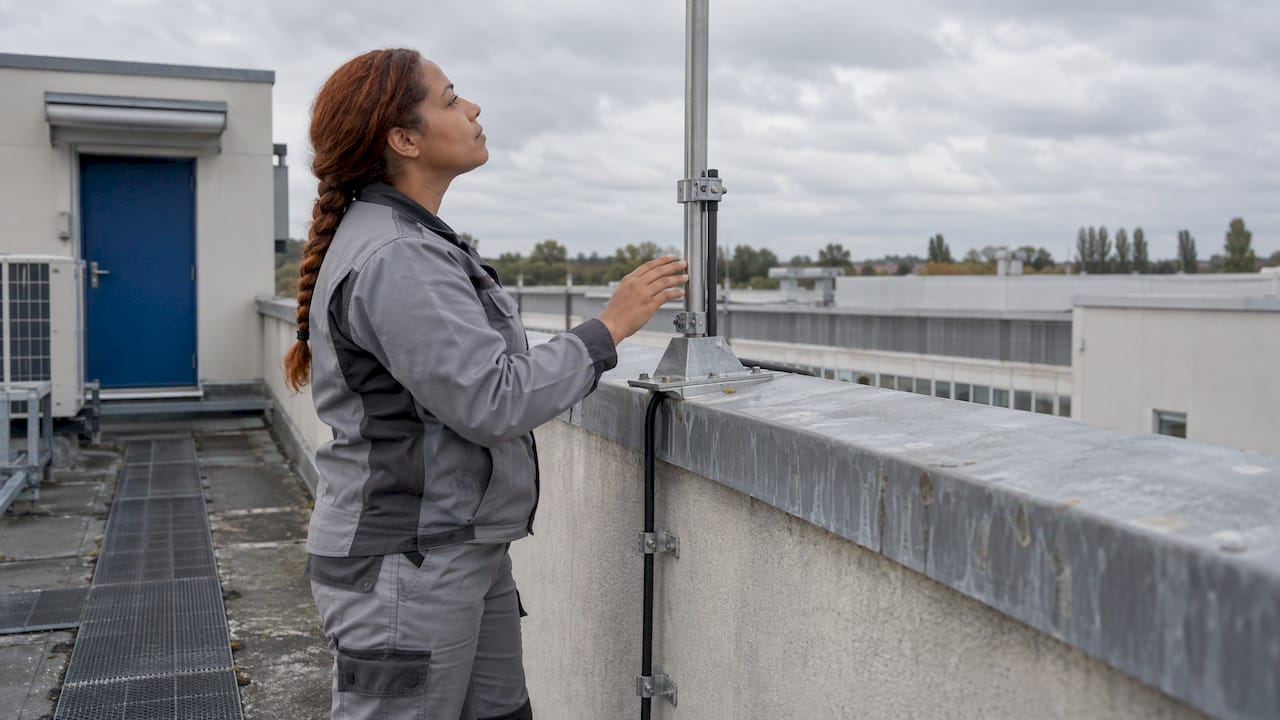
For a lightning protection system covered by the French order of 4 October 2010, the schedule has four fixed points: a complete verification within six months of installation, a visual verification every year, a complete verification every two years, and a visual verification within one month after any recorded lightning strike. Public-access buildings (ERP) follow a separate annual rule. The sections below show how each interval works, who may carry it out, and which records an auditor or insurer will ask to see. Indelec has worked in lightning protection since 1955, and its verification and maintenance service is built around this cycle.
TL;DR
- Article 21 of the 4 October 2010 order requires a complete verification no later than 6 months after installation, then every 2 years, with a visual verification every year in between.
- After a recorded lightning strike, the affected devices need a visual verification within one month.
- ERP (buildings open to the public) are subject to a yearly compliance verification, with dates written in the safety register and the report attached.
- The initial complete verification must be done by a competent body independent of the installer. Surge protectors and early streamer emission (ESE) air terminals have to be tested during the complete verification.
- Keep the technical study, the verification and maintenance notice, the strike log and every report in one file. Missing paperwork is the most common gap.
Table of Contents
- The intervals at a glance
- Which rule applies to your site
- The initial verification: within six months
- The annual visual verification
- The complete verification every two years
- After a lightning strike: within one month
- Who may carry out each check
- The records that make the schedule provable
- A worked example: a logistics warehouse
- Recent changes in the standards
- How Indelec supports the cycle
- Our perspective
- FAQ
- Sources
The intervals at a glance
The table below sums up the cycle. Each line is explained in the sections that follow.
| Trigger | Type of check | Deadline | Source of the rule |
|---|---|---|---|
| New installation | Complete verification | No later than 6 months after installation | Article 21, order of 4 October 2010 |
| Every year | Visual verification | Annually | Same article |
| Every 2 years | Complete verification | Every 2 years | Same article |
| Recorded lightning strike | Visual verification of the devices concerned | Within 1 month | Same article |
| ERP building | Compliance verification of the lightning protection system | Annually | Order of 19 November 2001, summarized by ADEE |
The two-year and one-year cycles run side by side. In a two-year period you therefore have one complete verification and one visual verification, and the complete one replaces the visual one in its year.
Which rule applies to your site
Two regimes cover most of what facility teams manage in France.
Classified installations (ICPE). The order of 4 October 2010 sets the verification cycle above. If your site is an ICPE, this is the schedule that inspectors, your insurer and your operating permit will refer to. We cover the wider compliance picture for these sites in our guide to lightning protection for ICPE sites, and the gaps that most often appear at the six-month, annual and two-year marks in our article on closing French lightning compliance gaps.
Public-access buildings (ERP). The order of 19 November 2001 requires that the compliance of lightning protection systems be verified at commissioning and then periodically, on an annual basis. The dates go in the safety register, and the matching report is attached to it, according to the ADEE summary of French lightning regulations. The safety register is the mandatory reference document in every ERP, under article R.143-44 of the construction and housing code, as set out in the Oise prefecture ERP booklet.

Whether an ERP needs lightning protection at all depends on its type. Protection is compulsory for ERP of type REF and OA. For the other types, a lightning risk analysis under standard NF EN 62305-2, or the simplified FDC 17-108 guide, decides whether a system is needed (ADEE). Architects and engineering consultancies who run this analysis at the design stage will find a useful planning guide for lightning protection on how the risk assessment feeds the project phases.
The initial verification: within six months
The first complete verification must take place no later than six months after the system is installed (article 21). Two points matter for contractors and owners.
First, it is done by a competent body that is separate from the installer. An installer cannot sign off its own work for this step. Plan the verification as its own line in the project schedule and budget, not as part of the installation handover.
Second, the six months are counted from installation, so a delay in commissioning, a late handover or a change of contractor can eat the margin quickly. Build the date into the contract and put the verifier’s name on the project file as soon as the technical study is approved.
The verification checks two things: that the system matches the technical study, and that every component is in good condition and working. The scope is written in a verification and maintenance notice. Carrying out the checks according to NF EN 62305-3, NF EN 62305-4 or NF C 17-102 meets the order’s requirements (article 21).

The annual visual verification
Every year, a visual verification covers the system’s visible components: air terminals, masts, down conductors, fixings, connections, equipotential bonding and the condition of surge protectors. It looks for corrosion, mechanical damage, loose or broken connections, and changes to the building or its roof that could affect the protection (new equipment, new roof structures, extensions).
The visual verification is a lighter job than the complete one, but it is a compliance step in its own right. The competent-body certification scheme QUALIFOUDRE sets out a level 2 qualification for exactly this annual visual verification, and for the one after a lightning strike (QUALIFOUDRE reference document, INERIS).
Can your own team do it?
Sometimes. According to the INERIS QUALIFOUDRE FAQ of November 2023, an operator can carry out visual verifications itself if it is recognized as competent under article 17 of the order. That recognition requires a file submitted to INERIS, specific lightning training and a dedicated multiple-choice test (INERIS FAQ). Without that recognition, the visual verification belongs to a qualified provider. The same FAQ stresses that the verification and maintenance notice is indispensable for any verification in a regulated setting such as an ICPE.
For most facility teams, the training and file are a larger commitment than the verification itself. Our verification and maintenance service takes the annual cycle off your maintenance team’s plate, so that the date is not lost between production priorities.
The complete verification every two years
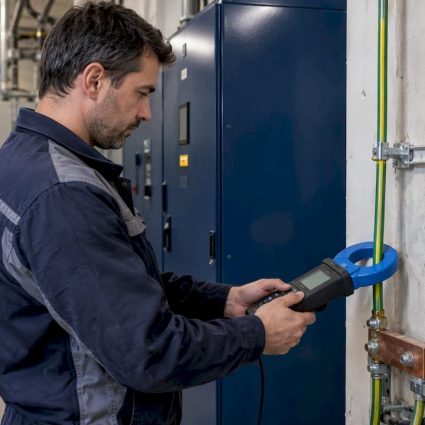
Every two years, the verification is complete: it includes the visual examination, but also electrical continuity and earthing measurements, and the functional test of the active components. The order requires it as the periodic step of the cycle (article 21).
In practice, the earth connection is where complete verifications most often turn up findings, because buried components cannot be seen and degrade with soil conditions. If your earthing network is old or the soil is aggressive, the measured values deserve attention before the date, not on it. Our article on maintaining grounding systems explains what drives the drift.
Testing ESE air terminals
If your system uses early streamer emission air terminals (PDA in French), the functional test is part of every complete verification. INERIS states that the test must be done systematically during complete verifications, every two years, following the manufacturer’s notice, on the day of the verification or with the verifier present. Omitting it on the grounds that on-site testing is difficult is not acceptable (INERIS FAQ, November 2023).
This has a scheduling consequence: the verifier needs access to the air terminal, often at height, and the manufacturer’s test equipment or procedure. Book access, lifting equipment and working-at-height safety arrangements together with the verification date.
Which standard version applies
Existing ESE air terminals are verified against the version of the standard used for their technical study. Studies performed from October 2011 onward must apply NF C 17-102 of September 2011, and for installations under the amended 2010 order a 40% safety coefficient applies to the calculated protection radii for levels 1 to 4 (INERIS information note). So an older installation is not measured against today’s edition by default. The technical study on file decides which reference the verifier uses, which is one more reason to keep it with the system.
After a lightning strike: within one month
Article 21 requires lightning strikes to be recorded. After a recorded strike, a visual verification of the devices concerned must take place within a month (article 21).
This only works if the strike is actually recorded. A lightning strike counter on the down conductor gives you a count, so that a strike at night or over a weekend does not go unnoticed until the next scheduled visit. Our range includes lightning strike counters for exactly this purpose.
Treat the following as triggers for an extra check, even where the count is unclear:
- a strike on or next to the building or a mast, reported by staff or visible damage;
- a surge protector that has tripped, been disconnected or shows its end-of-life indicator;
- unexplained failures of electronic equipment, control systems or communications after a storm.
These checks are the moment when surge protection devices need attention. If you manage industrial electronics, our guide to surge protection for industrial facilities shows how protection levels are organized.
Who may carry out each check
| Check | Who |
|---|---|
| Initial complete verification | Competent body, independent of the installer |
| Periodic complete verification | Competent body |
| Annual visual verification | Competent body (QUALIFOUDRE level 2), or an operator recognized as competent under article 17 |
| Visual verification after a strike | Same as annual visual verification |
The QUALIFOUDRE certification lets a body and its certified staff become a competent body in the sense of the amended order (reference document, INERIS). When you select a verifier, ask for the certification of the individual who will actually come on site, not only the company’s.
In an ERP, remember that the periodic verification is also recorded in the safety register. A report that is not attached to the register is a report an inspection commission may not accept.
The records that make the schedule provable
An interval is only met if you can show it was. For each system, keep one file containing:
- the lightning risk analysis and the technical study the system was built from;
- the verification and maintenance notice;
- every verification report, with date, type (initial, complete, visual), name and certification of the verifier;
- the strike log, with the follow-up visual verification for each recorded strike;
- the corrective actions taken after each finding, with dates;
- for ERP, the safety register with dates entered and reports annexed.
Two practical habits help. Put the next two verification dates in your maintenance system on the day each report arrives, with a reminder at least two months ahead to allow for access and scheduling. And close findings in writing: a report that lists a defect and a file that shows nothing happened afterward is worse than no report.
Insurers read these files too. For ICPE operators, our note on the insurers’ two-year rule for lightning protection looks at how the two-year cycle appears in coverage discussions.
A worked example: a logistics warehouse
Take a warehouse with a lightning protection system installed in March of year one.
- By September of year one: initial complete verification by a competent body that is not the installer.
- March of year two: annual visual verification. Nothing found.
- June of year two: the strike counter reads one more strike than at the last visit. A visual verification of the affected devices follows within a month, and the result goes into the strike log.
- March of year three: two years after the initial period, the periodic complete verification, with continuity and earth measurements and the functional test of the air terminal if it is an ESE type.
- March of year four: annual visual verification again, and the cycle continues.
The strike-triggered check is additional to the calendar, not a replacement for it. That is the part that most often gets lost, because it depends on someone noticing the counter.
Recent changes in the standards
The rules on frequency themselves have not changed, but the standards around them keep moving. INERIS published in October 2024 a note on the classification of the LD, LF and LO losses in annex C of NF EN IEC 62305-2 (edition 3), and in July 2024 acceptance criteria for components under NF EN 62561-x (INERIS QUALIFOUDRE page). These matter at the risk analysis and design stage, so a new project or a major modification should be studied against the current editions. For an existing system, the reference in the technical study still governs verification. Our page on lightning standards keeps the main references together.
How Indelec supports the cycle
The schedule above is a chain of dependent steps: study, installation, independent verification, annual visual checks, two-yearly complete checks and strike follow-up. Indelec, active since 1955 and with more than 280,000 installations behind it, covers the lightning risk analysis and technical study, installation, and verification and maintenance under one roof. Our teams can set up the maintenance side of the cycle so the dates, the access and the paperwork are handled together. You can see the full scope on our lightning protection services page.

If you are planning a new system or taking over an existing one, start with a conversation about the study and the verification calendar through Indelec.
Our perspective
Most missed lightning verifications are not missed because nobody cared. They are missed because the system belongs to everyone and no one: the installer has left, the maintenance team changed, and the strike counter is on a roof nobody visits.
We design for that. A lightning protection system should arrive with its technical study, its verification and maintenance notice and a calendar that a facility manager can hand to a successor. That is why we treat the risk analysis, the technical study, the installation and the verification and maintenance as one continuous service rather than separate jobs.
The regulation sets the minimum: six months, one year, two years, one month after a strike. Our experience across a very large number of installations is that sites that treat these as fixed points in their maintenance plan, not as occasional events, reach the next audit calmly.
INDELEC
FAQ
How often must a lightning protection system be inspected in France?
Under article 21 of the order of 4 October 2010, a complete verification is due within six months of installation and then every two years, with a visual verification each year. After a recorded lightning strike, a visual verification of the devices concerned is due within one month. ERP also have an annual verification under the order of 19 November 2001.
How often should lightning protection testing be done?
Electrical testing is part of the complete verification, so every two years for systems under the 2010 order. ESE air terminals must also be functionally tested at each complete verification, following the manufacturer’s notice. Test results go into the verification report kept in the system file.
Can the installer carry out the first verification?
No. The initial complete verification is performed by a competent body distinct from the installer. For later checks, the competent body can be a QUALIFOUDRE-certified organization, and an operator may do visual verifications only if recognized as competent under article 17.
What records should I keep?
Keep the risk analysis, technical study, verification and maintenance notice, every report, the strike log and the record of corrective actions. In an ERP, the dates of verifications are written in the safety register and the report is annexed to it.
Sources
- Article 21, order of 4 October 2010: verification of lightning protection systems
- ADEE, Lightning regulations in France (2017)
- INERIS, QUALIFOUDRE FAQ (November 2023)
- INERIS, QUALIFOUDRE reference document v4.0
- INERIS, information note on NF C 17-102 of September 2011
- INERIS, lightning protection and QUALIFOUDRE page