EV Charging Civil Works: Foundations, Trenches and Earthing
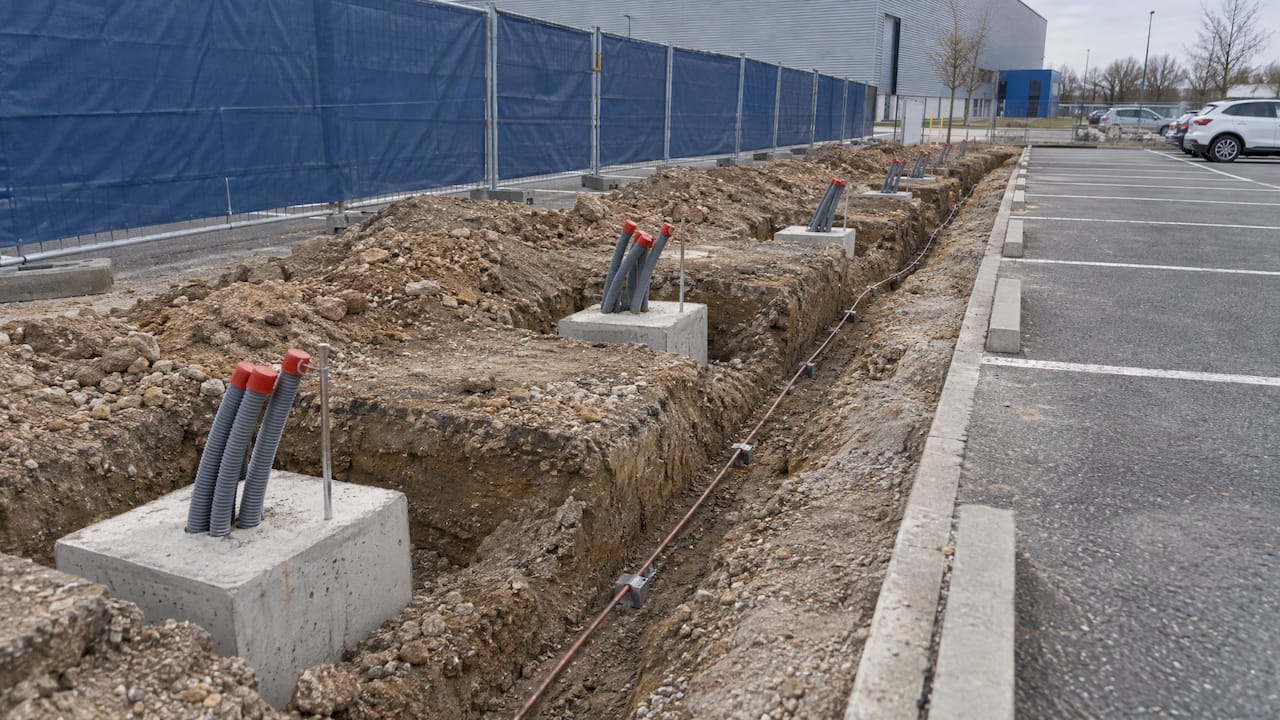
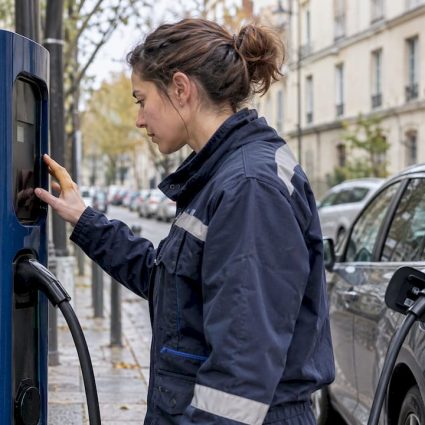
EV charging civil works are everything built before the charger is powered: surveys, trenches, ducts, foundations or plinths, surface reinstatement, drainage, and the earthing and lightning protection the station connects to. On a professional site, the work that decides cost and schedule is rarely the charger. It is the ground, the underground networks and the electrical protection around it. Get those three decisions right before quotes are issued. We design, install and supervise EV charging infrastructure for professional fleets, and we treat the civil scope and the protection scope as one project rather than two.
TL;DR
- Survey first: parking layout, available power, and buried or overhead networks must be known before quotes, not after the first excavation.
- A charger foundation needs load-bearing, settlement-free, frost-protected ground. Concrete is needed under asphalt, because screws do not hold in the surfacing alone.
- Place ducts in the foundation, plug both ends during pouring, and plan spare ducts so expansion does not mean reopening the ground.
- The station must be connected to an effective earthing system, with lightning and surge protection considered, and in France the installer must hold the IRVE qualification (the French qualification for EV charging installers).
- Drainage, level changes and clearances around the post are part of the civil design, not finishing touches.
Table of Contents
- What civil works cover for an EV charging site
- Survey before you design
- Foundations: the three options and what the ground must offer
- Ducts, trenches and drainage
- Earthing and lightning protection belong in the civil scope
- Electrical and regulatory coordination
- Who may do the work, and what you must hand over
- A sequence that keeps the ground closed
- Our view
- Talk to us before the trench is opened
- FAQ
- Sources
What civil works cover for an EV charging site
Civil works split into five blocks. Each one belongs to a different trade, which is why they get lost between the electrician, the groundworker and the charger supplier.
| Block | What it includes | Typical risk if missed |
|---|---|---|
| Survey and permissions | Parking plan, network location, power available | Strike on a buried line, redesign |
| Groundwork | Trenches, ducts, chambers, core drilling | Water ingress, cable damage |
| Foundations or plinths | Cast-in-place, existing, or precast base | Settlement, tilted post, unsafe fixings |
| Earthing and protection | Earth electrode, bonding, surge and lightning protection | Failed inspection, equipment loss |
| Reinstatement | Surfacing, drainage, markings, protective barriers | Puddles, blocked access, vehicle impact |
The IET’s guidance for local authorities in the UK notes that civil works are needed for most charging deployments, except wall-mounted units fed through existing structures. The same logic applies to a French depot or company car park: if the charger is not on an existing wall, expect ground to be opened.
Survey before you design
The cheapest civil work is the one designed around what is already there. Three checks come first.
Existing networks
France runs a dedicated anti-damage regime for works near utilities. Part 2 of the official application guide covers preparing and carrying out works near networks and sets technical requirements for working close to buried and overhead structures. The same document estimates that network damage exceeded 65,000 incidents a year in France in 2016. A trench for a row of chargers crosses car parks where gas, water, telecom and power lines often run side by side, so locating them is a design input.
For site coordination on the contractor side, daily reports, permits and subcontractor paperwork are easier to keep together in construction management software, which is useful when several trades share one trench window.
Power and parking layout
Enedis, the French distribution network operator, recommends a technical visit of the car park and a sizing study by an IRVE-qualified professional before quotes, to check available power, safety and implementation constraints. Its checklist, written for apartment buildings, transfers well to any site: number of users, target charging power, construction date, indoor or outdoor parking, levels, bays, site plan, access management, the subscribed power of the common-services meter, maintenance requirements and the communication infrastructure.
Sizing drives civil works directly. The number of cables and the distance they travel decide trench length, duct count and chamber positions. If you are sizing a company car park, our article on sizing IRVE for French parking lots explains the 20% rule, and the one on EV charging in a company parking lot covers the wider project.
Network reinforcement
Grid reinforcement is the cost owners fear most. A 2019 report from the French Directorate-General for Enterprise found that installing 22 kVA chargers required network reinforcement only in a few cases, and that nearly 8 in 10 respondents did not pay for reinforcement works. The survey is how you find out which group your site belongs to before the contract is signed.
Foundations: the three options and what the ground must offer
A charging post is a tall, narrow object that vehicles reverse into. Its foundation has to resist overturning, impact and frost heave.
One manufacturer’s foundation guide sets the baseline that applies to any pedestal charger: the ground must be load-bearing, free of settlement and protected against frost. Beyond that, three routes exist:
- A new cast-in-place foundation. The most flexible option, and the one where anchor positions can be set to the post.
- An existing foundation. Reusable, but only after inspection and approval by a qualified engineer, with screw connections suited to the design and the load. Insufficient bearing capacity can endanger the supply line and create dangerous situations.
- A precast base. Quicker on site, but the surface must be load-bearing, settlement-free, frost-resistant, flat and level. That guide also states that the base has no earth point, so the installer must connect the station to the earthing system.
Practical details for a cast foundation
An installation guide from another charger maker gives useful field detail. The excavation must be at least 600 mm deep and larger where safety arches are planned. The concrete must cure at least 48 hours before cables are inserted and the station is set. The finished surface should not sit lower than the surrounding ground, or water collects around the base.

The same guide recommends anchors cast into fresh concrete, which makes station mounting significantly easier and faster, and says a concrete base is essential: asphalt alone does not hold the screws. On a retrofit in an asphalt car park, that means cutting, casting and reinstating, not just bolting down.
Ducts, trenches and drainage
Duct placement
Ducts are the part you cannot fix later. The same guide says the installation tube must follow the power cable alignment inside the foundation, finish above the foundation and not below it, and account for cable bending radius. Where stations are grouped, plan two power cables per tube, and plug the tube at both ends during pouring so concrete does not enter.
Build in spare capacity at this stage. The Geneva state technical standard for electrical installations recommends designing so a site can be extended without heavy civil works such as excavation, and, for projects with many bays, considering a flat cable up to 63 A or an energy rail with quick connection per charge point. It is a Swiss document, but the principle holds anywhere: a spare duct costs little during the first opening and a lot during the second.
For power and communication, the French reference specification for individual residential charging, which cites decree no. 2017-26 of 12 January 2017, requires separate conduits for high-current and low-current cables, with an extra conduit reserved for a future charge point. For example, a 7.4 kW point uses at least a 3G10 cable, with the section adjusted to the length, and control runs on shielded category 6A cable. A fleet depot has bigger loads, but the separation of power and data and the reserved conduit are worth copying.

Water and heights
The Geneva standard also asks that basic civil provisions for outdoor chargers (core drilling, chamber, buried tubing) be designed so water cannot enter the building, and that connection points and the charger sit between 1.0 m and 1.6 m high. Those figures come from a Swiss reference, so treat them as a design benchmark and confirm the requirements applying to your project.
Surface, level and access
The European Commission’s Alternative Fuels Observatory recommends that public stations stand on a flat, stable, non-sloping, slip-resistant surface, with drainage that prevents puddles, and that level differences be handled with compliant ramps without blocking access. The same guidance warns that protective posts, plinths, wheel stops, drainage and kerbs must be positioned so users can get close: a barrier that stops a wheelchair user coming within 25 cm of the charge point significantly limits access.
This is where civil and electrical design collide. A bollard that protects the charger from vehicles can also block the person who needs to use it, so place both on one drawing.
Earthing and lightning protection belong in the civil scope
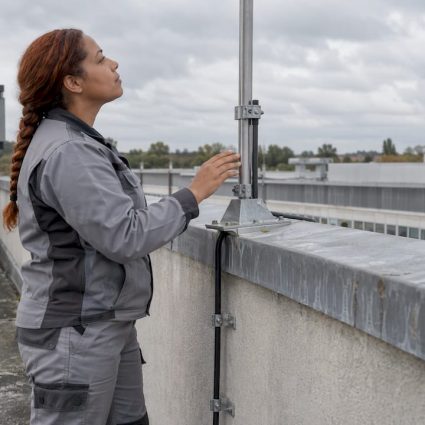
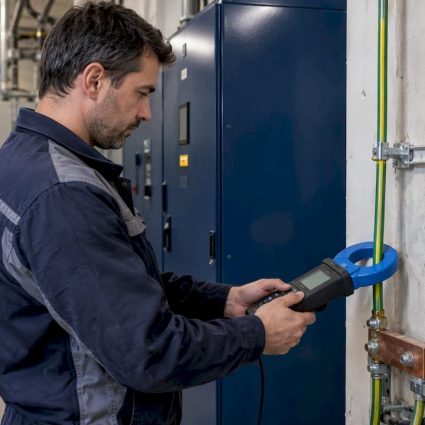
Earthing is buried work. It is far cheaper to lay the electrode in the open trench than to drill later. The foundation guide cited above says the operator or installer must provide effective earthing and lightning protection and connect the station to them, in line with normative and legal requirements.
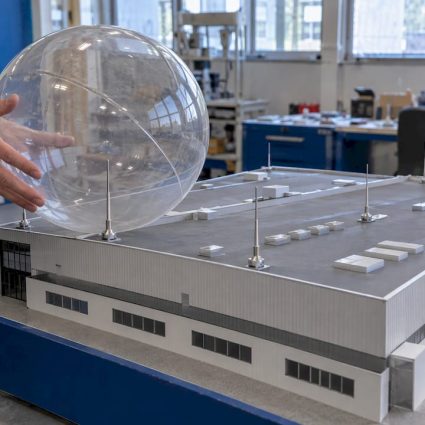
That sentence is easy to skip in a civil specification, and it is the one that causes retrofits. Outdoor chargers stand in open car parks, often the highest point around, and are wired into building installations. We cover this in more detail in our guides to earthing for EV charging stations, surge protection for EV chargers and avoiding Consuel rejections. Consuel is the body that issues the conformity certificate in France.
Electrical and regulatory coordination
Civil works end where the electrical standard begins, and the two must agree on drawings.
- Protection ratings and standards. The residential reference specification calls for chargers rated IP55 to be installed indoors or outdoors, wall- or pedestal-mounted, and for installation in line with NF C 15-100, mainly part 7-722, plus IEC 61851-1, IEC 62196-2 and NF C 61-314.
- Circuits and residual-current protection. Promotelec states that each charger or socket is fed by a dedicated circuit with overcurrent protection at the origin, and each charge point needs its own 30 mA or lower residual-current device, whose type depends on the charging mode and supply.
- Power category. The same Promotelec sheet defines normal charging as up to 22 kW and fast charging as above 22 kW, the latter suited to publicly open stations such as shopping centers and motorway areas. Your category affects cable size, and therefore ducts and trench width.
- Multi-level car parks. The Legrand practical guide on charging infrastructure sets constraints on charging stations in raised car parks around the fire-service reference level and the levels above and below it.
- Tertiary buildings. For offices and commercial premises, see our IRVE standards guide for tertiary buildings.
Who may do the work, and what you must hand over
French law makes qualification part of the civil-works decision, because the earthing, ducts and cabling are the installation. Under decree no. 2017-26, charge points are installed by authorized professionals, and in most cases by professionals holding an IRVE qualification from an accredited body. The exception is infrastructure of 3.7 kW or less in private housing not open to the public. That exception rarely applies on a professional site.
On documentation, Promotelec states that a conformity certificate is mandatory for any new charging installation in collective housing whatever the power, and elsewhere (individual house, workplace or public-access building, public space) when the installation exceeds 36 kW. Our guide on checking IRVE qualification before you sign explains what to ask for. Once the works are in service, plan upkeep with our guide to matching MA1, MA2 or MA3 maintenance.
A sequence that keeps the ground closed
- Survey and network location. Parking plan, available power, network records and a sizing study.
- Single design drawing. Charger positions, trench routes, ducts, plinths, earth electrode, protective barriers, drainage and accessible routes on one plan.
- Ground and foundation verification. Bearing capacity, frost depth, and engineer approval for any reused base.
- Open the trench once. Lay power and data ducts, spare ducts, earthing conductors and chambers together.
- Cast and cure. Anchors in fresh concrete, tubes plugged, curing time observed before cables are inserted.
- Reinstate and drain. Surface at or above surrounding level, markings, barriers placed for access.
- Connect, test, certify. Protection devices, earth connection, conformity certificate where required.
Our view
Civil works for charging are usually quoted as one line and discovered as five problems. On the sites we see in our work, the costly surprises sit at the boundaries: the foundation that has no earth point, the duct nobody reserved, the post that stands in the highest, most exposed spot of the car park.
That is why we treat the ground, the earthing and the protection as one design. Indelec has worked in lightning protection and earthing since 1955, and our offer covers lightning risk analysis, earthing, surge protection, installation, verification and maintenance, alongside audit, installation and supervision of charging infrastructure for professional fleets. One team looking at the whole site means the earth electrode goes in while the trench is open.
Our advice to owners: ask for the civil, electrical and protection scope on one drawing before anyone mobilizes.
INDELEC
Talk to us before the trench is opened
If you are preparing a fleet or company charging site in France, our electric mobility solutions cover audit, installation and supervision for professional fleets, and our earthing, surge protection and lightning protection offers cover the protective scope the station connects to. Bringing us in at survey stage lets the earthing and protection go into the first excavation.

For the protective side, see our earthing range and surge protection range.
FAQ
Do all EV chargers need a concrete foundation?
No. Wall-mounted units fed through existing structures often need little or no excavation. Pedestal chargers need a foundation, which can be cast in place, existing and approved by an engineer, or precast. In asphalt car parks, a concrete base is needed because screws do not hold in the surfacing alone.
How long must concrete cure before the charger is installed?
One installation guide specifies at least 48 hours before cables are inserted and the station is set. Always follow the instructions of the charger you are installing, because they can differ by model and anchor type.
Why include earthing in civil works?
The charger must be connected to an effective earthing system, and some precast bases have no earth point at all. Laying the electrode while the trench is open avoids drilling and reinstating later. Lightning and surge protection should be designed at the same time.
Who can carry out the installation in France?
Under decree no. 2017-26, installers must be authorized and, apart from small private-housing cases up to 3.7 kW, hold an IRVE qualification from an accredited body. Check it before signing.
Sources
- Application guide to anti-damage regulation, part 2 (Ineris)
- Enedis guide to installing charging points in apartment buildings
- IET guide to EV charging infrastructure for local authorities
- DGE report on IRVE, 2019
- Foundation construction guide, version 08, 2024
- Guide to preparing a foundation, 2024
- Precast foundation installation instructions, 2024
- Construction works installation guide
- Geneva electrical installations standard, CFC 23
- EU Alternative Fuels Observatory accessibility guidelines, 2025
- Reference specification for individual residential IRVE
- Promotelec sheet on good installation practice for charging points
- Practical guide to charging infrastructure, 2018
- Construction management software