Lightning Protection Specification: What to Write Into a Tender

A sound lightning protection specification does five things. It names the standards and their editions. It fixes the design basis through a documented risk analysis. It lists the components and interfaces the bidder must price. It sets the submittals the bidder must hand over. It defines how the system is verified and accepted. Leave one out and bidders will fill the gap differently, so you end up comparing prices for different systems.
This guide is written for owners, architects, engineering consultancies and facility teams preparing tender documents for a site in France. It follows the order of a specification section, so you can lift the structure straight into your own documents.
TL;DR
- Cite the standard series (NF EN IEC 62305 and NF EN IEC 62561 for components) and state that the edition in force at the time of the work applies.
- Make a risk analysis the design basis: it sets whether protection is needed and which protection level the bidder must meet.
- Cover the whole chain: air termination, down conductors, earthing, equipotential bonding and surge protection, with the interfaces to roofing, electrical and structural trades.
- Require an execution file, test records and a verification report as submittals, and tie final payment to them.
- Define who designs, who installs, who verifies, and what qualifications each must show.
Table of Contents
- Start with the standards and their editions
- Make the risk analysis the design basis
- Define the scope: external and internal protection
- Technical requirements for materials, design and installation
- Submittals bidders must provide
- Inspection, testing and acceptance
- Allocating responsibilities and qualifications
- From specification to contract
- FAQ
- Sources
Start with the standards and their editions
The specification should open with a short list of normative references. In France, the reference series for lightning protection is NF EN IEC 62305. AFNOR’s Norm’Info catalogue lists its four parts, all published in French on 26 November 2024: general principles, risk assessment, physical damage to structures and life hazard, and electrical and electronic systems within structures.
Components have their own series. The same catalogue lists NF EN IEC 62561 Parts 1 to 8 for lightning protection system components, published between 2023 and 2026. Ask bidders to supply components that conform to the relevant part for each item: connectors, conductors, earth electrodes, and so on.
Two drafting points save disputes later:
- Name the edition rule. Write that, unless the contract says otherwise, work is executed to the standards in force at the time of execution, in their current version. If you want a frozen edition because the design was approved earlier, say so and give the date.
- Say which approach you accept for air termination. The French national standard NF C 17-102 covers early streamer emission (ESE) systems. Its 2011 edition states that no international or specific European standard exists for ESE systems and sets minimum requirements for their design, selection and installation. If your design uses ESE air terminals, cite it. If you want a conventional design (rods, meshed cage), cite NF EN IEC 62305-3. Do not leave bidders to choose, because the two approaches cost and install differently.
If the site is a classified installation (ICPE), add the regulatory frame. Prefecture files show that lightning risk analyses for facilities subject to authorization are carried out under the arrêté of 4 October 2010 as amended, using NF EN 62305-2, then followed by a technical study. Your specification should reference that sequence and require the bidder’s work to align with the study the site already holds.
For a deeper look at how these documents fit together, see our page on lightning standards.
Make the risk analysis the design basis
A specification that says “install a lightning protection system” without a protection level invites guesswork. The level comes from a risk analysis, and the specification should require it or attach it.
The logic is set out in IEC 62305-2:2024. Whether protection is needed, and to what extent, is determined by risk assessment. The procedure identifies the structure, identifies the types of loss (R1 to R4), evaluates the risk for each, compares it with the tolerable risk RT, and, if the risk exceeds RT, requires protection measures that bring it to or below RT. The French standard NF C 17-102 also requires a risk analysis to determine the minimum protection level of each installation.
For human life (R1), the French ICPE analyses we found use a tolerable risk of 10⁻⁵ per year. Other loss types and any non-regulatory targets are for the owner to set.
In the tender, write the following:
- The risk analysis reference, its date and the author, attached as an appendix.
- The resulting protection level (I to IV), stated as a requirement.
- The loss types considered, so a bidder does not reduce scope by ignoring service continuity or economic loss.
- A rule for changes: if the building’s use, height, contents or surroundings change before or during works, the analysis is revisited and the design adjusted by variation.
If you do not yet have the analysis, make it a first lot or a preliminary phase. Our lightning risk assessment guide explains what the analysis should contain before you commission it.
Define the scope: external and internal protection
Bidders price what you list. A complete lightning protection specification covers both the external system and the internal measures, and states where one ends and the other begins.
| Element | What the specification should state |
|---|---|
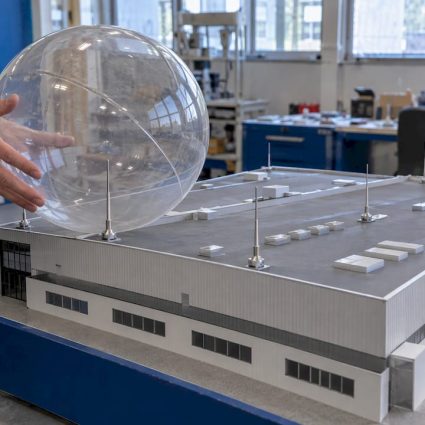
| Air termination | Type (ESE terminals, rods, meshed cage), positions, mast and fixing details, protection radii or mesh size according to the protection level |
| Down conductors | Number, routing, material and cross-section, test joints, fixings, clearances from openings and cladding |
| Earth termination | Electrode type and layout, target resistance, interconnection with the building’s main earthing, soil conditions |
| Equipotential bonding | Bonding of metallic services, structures and conductive parts, bonding bars and connection points |
| Surge protection | SPD types and locations at service entrances and sensitive equipment, coordination between stages |
| Lightning event counter | Whether one is required and where it is installed |
| Aerial marking and other roof equipment | Interfaces with obstruction lights, antennas, solar arrays |
On surge protection, be explicit. IEC 62305-2:2024 notes that IEC 60364-4-44 always requires an SPD at the power line entrance of the structure when overvoltage consequences affect human life, public services, cultural heritage, or commercial or industrial activity. For most industrial and commercial sites, that means an SPD line item belongs in the specification, not in a later electrical lot. Our surge protection devices range and our surge protection installation guide show how entrance and downstream stages are usually arranged.
Sensitive sites need a stricter brief. A data center, an airport or a process plant often needs additional shielding, segregation and coordination requirements. Examples are in our pages on highly sensitive site design and airport lightning protection design.
Technical requirements for materials, design and installation
This is where specifications are often vague. Keep each requirement checkable.
Air termination
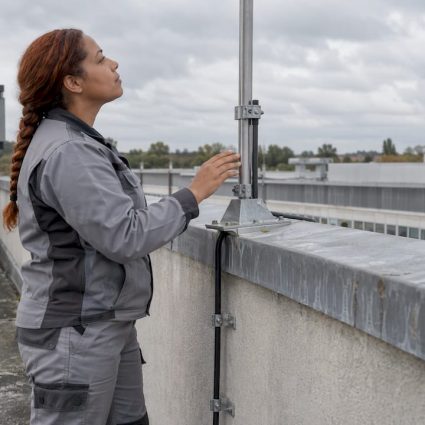
Under NF C 17-102 (2011), the ESE air terminal should preferably be installed on the highest part of the structure and must be the highest point of the area to protect. Protection radii depend on the building’s features. Your specification should require the bidder to state the terminal model, its characteristics and the radius claimed, and to show on a drawing that the whole protected area falls within it.
Down conductors and routing
Specify the number of down conductors, their routing and the material. Ask for test joints so continuity can be measured later without dismantling anything. Require clearances or equipotential bonding where conductors pass near metallic parts. Our down conductors range covers the conductors and the fixings that go with them.
Earthing
Set a target and a method of proof. Common practice under IEC 62305-3 aims for an earth resistance below 10 Ω, and NF C 17-102 asks the contractor to justify the earth termination dimensions in the execution file when the value is higher than 10 Ω. Write the same rule: bidders must either reach 10 Ω or document why the design remains valid. State the soil assumptions you are giving them, and say whether deep earthing is acceptable where space or soil resistivity is a constraint. See our earthing products and deep earth grounding drilling service.

Coordination with other trades
Lightning protection touches the roof, the facade, the structure and the electrical installation. Put the interfaces in writing:
- Roofing contractor: fixings, penetrations, waterproofing around mast bases.
- Structural engineer: use of reinforcement or steel frame as natural components, and where they are accessible.
- Electrical contractor: the main earthing terminal, bonding bar and SPD cabinet connection.
- Fire and safety engineer: compatibility with explosive atmosphere zones or storage areas.
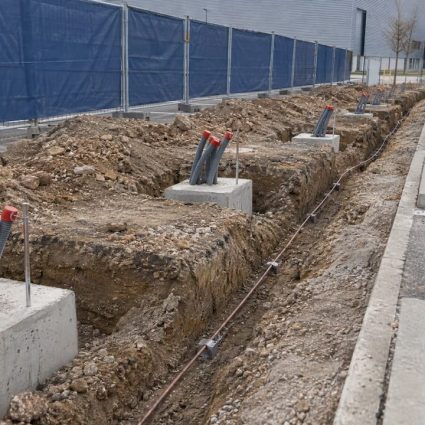
The sequence matters too. Earth electrodes and foundation bonding are installed early, and they are impossible to inspect once concrete is poured. Require the bidder to give notice before covering any buried or hidden conductor.
Submittals bidders must provide
Split submittals into those required with the tender, before work, and at handover.
With the tender: the proposed design principle, a list of components with the reference of their conformity to the NF EN IEC 62561 series or the relevant standard, a method statement, a programme, and references for comparable sites.
Before work: detailed drawings showing air termination, down conductors, earth terminations and bonding, plus the interfaces agreed with other trades.
At handover: NF C 17-102 requires the contractor to prepare an execution file once the installation is complete. It includes:
- the required protection level and its justification,
- the type and characteristics of the air terminal and its test procedure,
- the number and location of down conductors,
- the presence and location of a lightning event counter,
- justification of electrical insulation and of equipotential bonding, including SPDs,
- the type and value of earth terminations, with a justification if the value is above 10 Ω.
Copy that list into your specification and add as-built drawings and the test records. Our article on documenting lightning protection systems goes further on file structure.
Inspection, testing and acceptance
A specification without acceptance criteria leaves the owner with a system nobody has proved. NF C 17-102 requires verification at three moments: initially once installation is complete, periodically according to a table based on protection level, and whenever the structure is modified, repaired or struck by lightning.
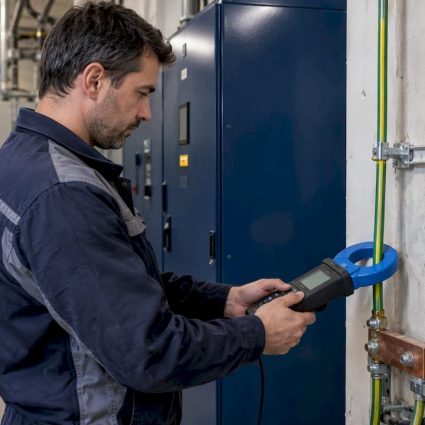
The initial verification checks, among other things, the air terminal height and characteristics, the number of down conductors, compliance of components, routing and electrical continuity, fixings, separation distances, the earth termination and its link to the main equipotential bonding. The same standard says the air terminal must sit 2 meters or more above any object in the protected area. A complete verification adds measurements of continuity on hidden conductors, of earth resistance (a variation above 50% should be analyzed) and a check that the air terminal works.
A public-sector example shows how precise an acceptance clause can be. Sydney Water’s earthing and lightning specification is Australian, so it is a drafting model, not a French rule. It asks for test instruments traceable to an accredited laboratory, a test procedure submitted for approval before testing begins, and the right for the client to witness tests with 14 calendar days’ notice. You can adapt those three ideas to a French contract through COFRAC-accredited calibration and a witness-point clause.
A workable acceptance clause includes:
- A list of hold points (before burying electrodes, before covering conductors, at final connection).
- Calibration certificates for every instrument used.
- A written verification report stored with the design file.
- A rule that defects are corrected and the affected tests repeated before the acceptance is signed.
- The date of the first periodic verification, then the interval, based on the protection level.
Our page on why to maintain lightning protection systems explains how to turn that last point into a maintenance contract.
Our view: specify the process, not only the product
Over decades of work on industrial, commercial and infrastructure sites, we have seen the same pattern: tenders that list products but skip the risk analysis and the verification plan produce systems that are hard to defend after an incident or an audit.
That is why we treat the lightning risk analysis and the technical study as the base of every project, then move to supply, installation, verification and maintenance. A specification that follows this chain gives every bidder the same starting point and gives you documents you can keep.
We also recommend writing the interfaces and the hold points into the contract. Earthing, hidden conductors and bonding are the parts that cannot be corrected cheaply later, so they deserve the most precise wording.
INDELEC
Allocating responsibilities and qualifications
This is the part tenders most often leave open. Decide it before you issue the documents.
One contractor for design and installation, or two separate roles? A single design-and-build lot is simpler to coordinate and makes one party responsible for the whole system. A separate study by an independent consultancy followed by an installation lot gives you a stable design reference and a neutral view at verification. Either works. What fails is not stating which one applies.
Who owns each deliverable? A clear split looks like this:
| Task | Typical owner |
|---|---|
| Risk analysis and protection level | Owner or consultancy |
| Technical study and detailed design | Study office or design-and-build contractor |
| Supply and installation | Installing contractor |
| Execution file | Installing contractor |
| Initial verification | Party independent from the installer, where the contract requires it |
| Periodic verification | Maintenance contractor or independent inspector |
Qualifications. Ask bidders to show experience on comparable structures, the training of site supervisors and the competence of the person who signs the execution file. Do not invent a certification requirement that does not exist for your project type. If the project is a classified installation, check what your regulatory file and your insurer require, and write that.
Compliance obligations. State that the standards in force at the time of the service apply unless otherwise agreed, as noted above. Require the bidder to flag any conflict between the specification and a standard in writing, before pricing, rather than resolving it silently on site.
Note that NF C 17-102 itself says an installation built to it cannot guarantee absolute protection of structures, people or objects. It says the provisions are minimum requirements that significantly reduce the risk of damage. Write your specification in that spirit: a clear risk-reduction target, verified and maintained, not a promise of immunity.
From specification to contract
If you would rather not draft every clause alone, we support owners, contractors and consultancies at each step. Our lightning protection services cover the lightning risk analysis and technical study, installation, and verification and maintenance, and our product lines include lightning rods, earthing and surge protection. For the principles behind an end-to-end project, see our lightning protection system application page.

To discuss a tender in preparation, start from our services page and tell us the type of site, its location and the stage you are at.
FAQ
Should the specification require an ESE system or a conventional one?
Decide it in the design phase and state it. If you choose ESE air terminals, NF C 17-102 is the French reference. If you choose rods or a meshed cage, NF EN IEC 62305-3 is the reference. Allowing both without a rule makes bids hard to compare.
Which edition of the standard should the tender cite?
By default, the edition in force when the work is executed. If a design was approved under an earlier edition and you want to keep it, name that edition and its date in the specification. For the current NF EN IEC 62305 and 62561 publications, check AFNOR’s catalogue before issuing.
What should bidders hand over at completion?
An execution file with the protection level and its justification, the air terminal characteristics, down conductor layout, bonding and SPD justification, earth termination values, plus as-built drawings and test records. Ask for a verification report to be filed with the design documents.
How often must the system be verified?
NF C 17-102 requires verification after installation, periodically according to a table based on protection level, and after any modification, repair or lightning strike. Write the first periodic date and the interval into the maintenance part of the contract, using the protection level from your risk analysis.
Sources
- AFNOR Norm’Info: published standards, NF EN IEC 62305 and 62561 series
- NF C 17-102, September 2011 edition (full text)
- NF C 17-102, September 2011, English version (verification and execution file)
- IEC 62305-2:2024 sample
- Sydney Water technical specification for earthing and lightning