French Building Surge Protection: Panel or Earthing Work Can Top €600
A simple installed parafoudre typically lands between €200 and €350, while a retrofit with panel work or earthing can reach €600 and beyond, and complex tertiary sites go higher. Where your tableau électrique has free DIN rail space, you sit at the low end. Old panels, weak earthing and high exposure push you up. Your next step is a site quote or a lightning risk analysis.
TL;DR:
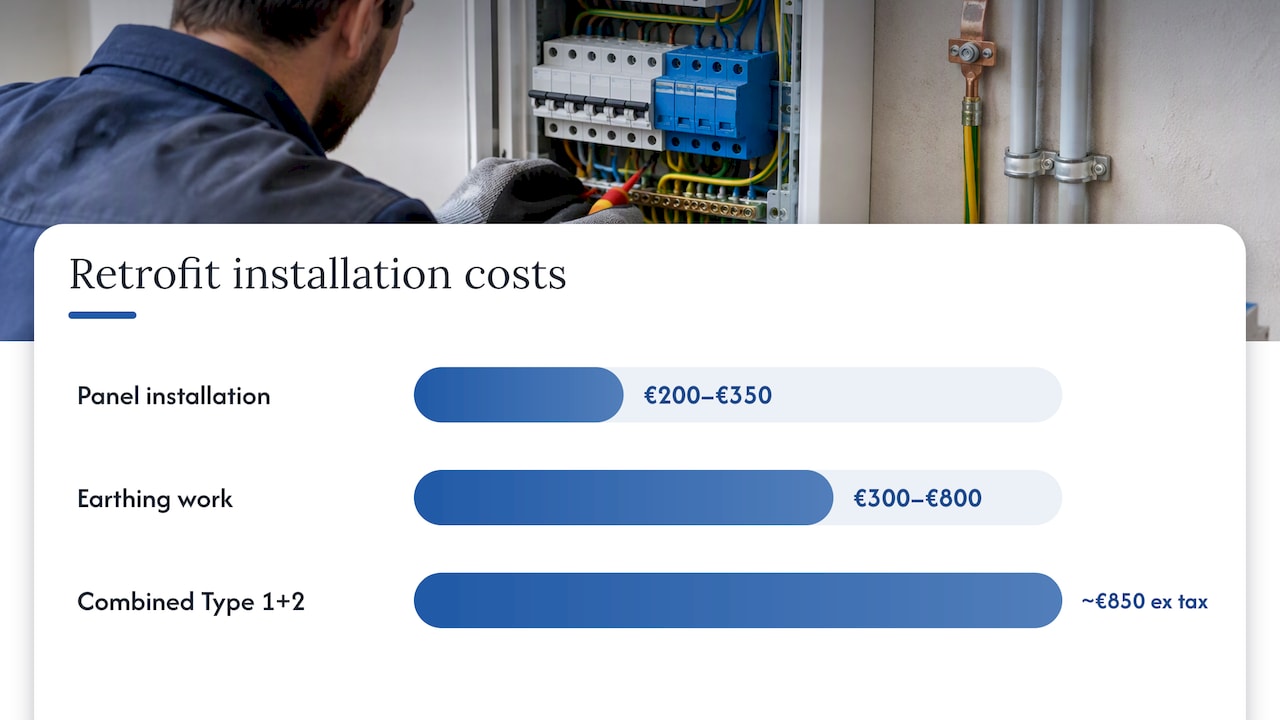
- A simple Type 2 installation in a panel with spare rail space costs €200 to €350; earthing work alone can add €300 to €800.
- Choose Type 1 where a lightning rod or overhead supply creates direct exposure, Type 2 for the main panel, and Type 3 near sensitive equipment.
- French rules do not require surge protection everywhere; obligations apply when a building has a lightning protection system or overhead lines in designated risk zones.
- Require written quotes to separate equipment, labor, panel work, and earthing, and list device ratings, measured ground resistance, certification, warranty, and exclusions.
Table of Contents
- Typical price ranges: hardware versus installed project
- What drives total cost: panel, earthing, exposure, labor and access
- Parafoudre types and why their prices differ
- Regulatory context in France: NF C 15-100, FD C17-109 and conditional obligations
- Representative installation scenarios with sample budgets
- How to request and compare quotes: the checklist every quote should include
- What does upgrading an existing installation to include a parafoudre cost?
- How do costs compare between different parafoudre technologies and brands?
- How do building size and electrical load affect total parafoudre cost?
- What are the lifetime maintenance costs and typical schedules for parafoudre systems?
- Indelec’s practitioner view: why a technical study avoids surprises
- How we help with ARF, installation, earthing and certification
- FAQ
- Sources
Typical price ranges: hardware versus installed project
Hardware and installed prices tell two different stories, so keep them apart when you compare offers. Price guides list modules for electrical panels from €40 to €1,350, with the spread depending on type:
- Type 1: €110 to €1,350
- Type 2: €40 to €750
- Type 3: €40 to €350
- Plug-in protectors and small modules:about €5 to €60 for basic socket strips, and €150 to €700 for broader protection modules
Installed projects span a much wider band. Installer price surveys report a minimum near €200, an average around €1,350 and a maximum near €2,500. The low end is a simple Type 2 swap in a roomy panel. The middle covers a retrofit with some panel reorganization. The top covers tertiary sites with earthing and certification work.
Our practitioner view: hardware is a minor part of the total, and a simple install in a panel with space takes about one hour and costs €200 to €350. When earthing or panel work enters the scope, hardware often falls below half of the project cost.
What drives total cost: panel, earthing, exposure, labor and access
When two quotes for the same building differ by hundreds of euros, the gap rarely comes from the module itself. These are the lines to watch:
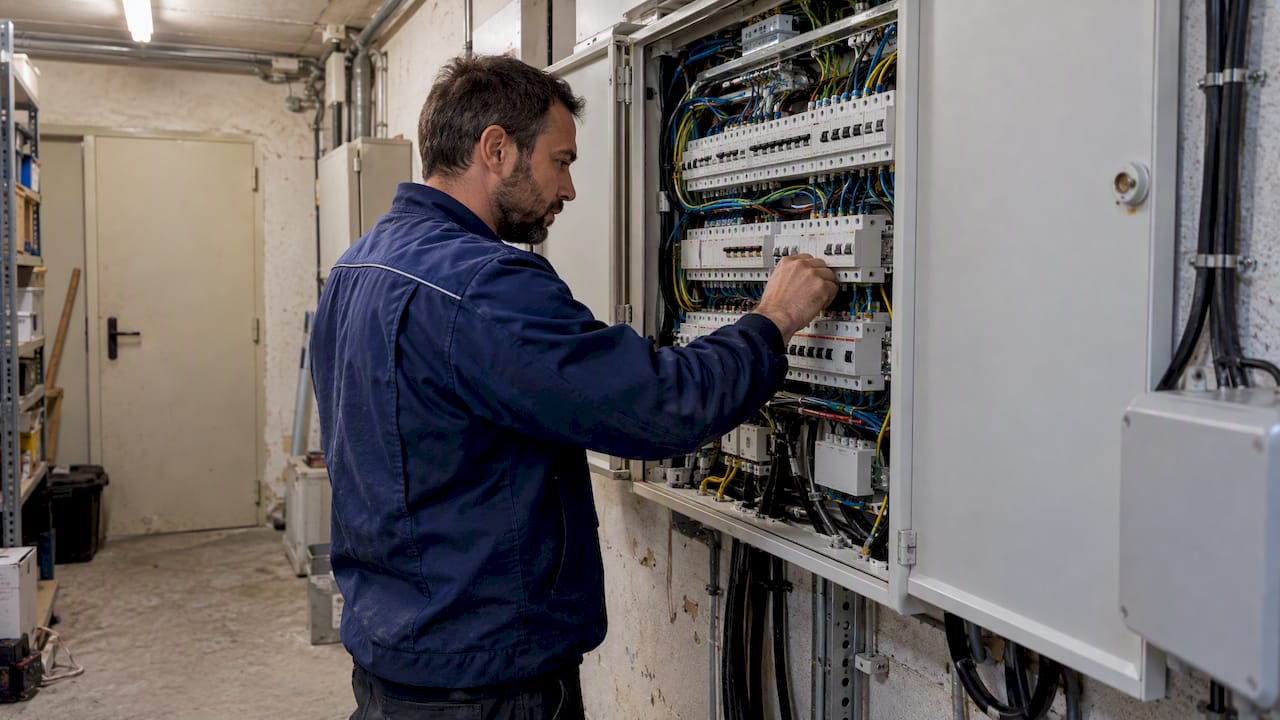
- Panel condition: Free space on the DIN rail keeps the job short. A crowded or outdated tableau électrique may need reorganizing or replacing, and our experience is that a full panel upgrade can push a project toward a higher cost.
- Earthing (mise à la terre): A surge device only works as well as the ground behind it. Extra rods or deep grounding drilling add real money. See our earthing range for what that hardware looks like.
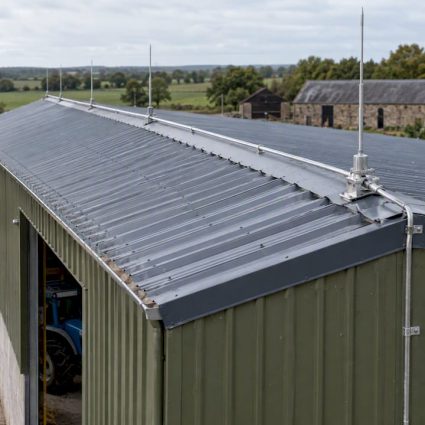
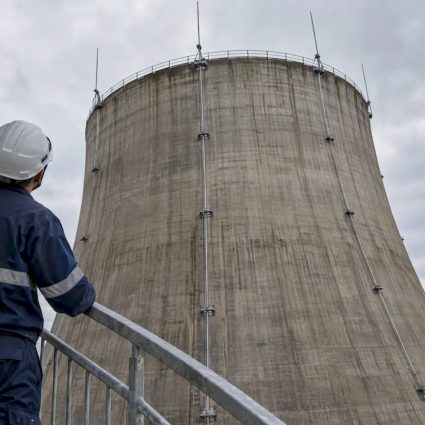
- Exposure: A paratonnerre on the roof, overhead supply lines or a higher keraunic zone widen the protection scope.
- Access and complexity: Roof access, triphasé systems, extra downconductors, testing and certification all add labor hours.
- Extras: Remote contacts, replaceable cartridges, Type 1 modules and coordinated protections raise the bill line by line.
Pro Tip:Ask the installer to price the panel work and the earthing work as separate lines, so you can see exactly what you pay for beyond the device itself.
Parafoudre types and why their prices differ
Each type sits at a different point of the installation and handles a different kind of surge. Knowing which one your building needs is the fastest way to read a quote.
- Type 1: Installed at the origin of the installation, mainly where a paratonnerre or overhead supply exposes the building to direct lightning currents. It is built for the heaviest impulse load, which explains its top-end price.
- Type 2: The standard choice in the main tableau électrique, protecting against indirect surges. It is the most common device in residential and light commercial work.
- Type 3: A fine protection placed close to sensitive equipment, such as electronics or IT racks, as a second line behind Type 2.
Prices move because of impulse current capacity (Iimp), the number of poles, the protection level (Up) and whether the cartridges are replaceable. A three-phase board needs more poles than a single-phase one, and a higher Iimp rating costs more to build.
Combining Type 1 and Type 2 is common in higher-exposure cases. Installers report around €850 excluding tax for a combined Type 1+2 in some situations, against roughly €450 for a single Type 2 added during a panel replacement. You can browse our surge protection devices to see how the families are organized.
Regulatory context in France: NF C 15-100, FD C17-109 and conditional obligations
Surge protection in French buildings is governed mainly by NF C 15-100, the low-voltage installation standard. The current NF C15-100-10 edition covers surge protection coordination and installation examples, and Norm’Info lists the clauses on atmospheric surges and TT earthing schemes.
- The obligation is conditional.It applies where a paratonnerre is installed or where the building is fed by overhead lines in designated risk zones, tied to local keraunic levels.
- Individual houses:FD C17-109 gives implementation guidance for lightning protection of single-family housing.
Be wary of any claim that a parafoudre is mandatory everywhere in France.The standard does not say that. Check your building’s situation instead.
Representative installation scenarios with sample budgets
These are illustrative ranges drawn from installer reports, not fixed prices. Your written quote is what counts.
- Scenario A, simple: A Type 2 in a modern residential panel with free rail space, hardware plus about one hour of labor. Expect roughly €200 to €350.
- Scenario B, retrofit: An older panel that needs reorganizing, with a Type 2 added during replacement at about €450 excluding tax, or a combined Type 1+2 around €850 excluding tax.
- Scenario C, tertiary: A larger site with earthing work, several downconductors and certification. Local reports show earthing improvement at €300 to €800 on top of a complete installation of €150 to €350, and total projects can approach the €2,500 ceiling seen in installer surveys.
These bands show that earthing, not the device, separates scenario B from scenario C. Get a written quote before you commit.
How to request and compare quotes: the checklist every quote should include
A fair comparison starts with quotes that cover the same scope. Ask every installer to state:
- The equipment references and type (1, 2 or 3), with the Iimp and Up ratings
- Labor hours and any panel reorganization
- Earthing works, with the measured earth resistance before and after
- Certification or inspection, the timeline and the warranty
- A written NF C 15-100 compliance statement and a copy of the post-install verification
For buildings with a paratonnerre, high exposure or complex loads, ask whether a lightning risk analysis (ARF) or a full technical study (ET) is warranted. A simple site visit tells you the panel state. An ARF tells you what the building actually needs. Our installation guide for facilities walks through the steps in detail.
Pro Tip:If two quotes differ widely, ask both installers to list what is excluded. Missing earthing or certification lines explain most gaps.
What does upgrading an existing installation to include a parafoudre cost?
Upgrading an older building costs more than fitting a device into a new one, because the existing panel and ground set the scope. The cheapest case is a panel with free rail space, where the work is close to a new install at €200 to €350.
Costs can climb for several reasons. First, a cramped or obsolete tableau may need reorganizing or replacing, which can push the job toward a higher cost. Second, weak earthing may call for new rods or deeper grounding, with improvements reported at €300 to €800. Third, a building that later gains a paratonnerre or overhead feed may need a Type 1 added, moving the budget toward the combined Type 1+2 figure of around €850 excluding tax.
Retrofits also bring a logistics cost. The power may need cutting during the work, which matters for shops, offices and care facilities. Plan the intervention outside opening hours, and ask the installer to confirm the earth resistance before closing the job. Bundling the surge device with other panel work, such as a planned upgrade for EV charging, usually costs less than two separate visits. Our note on surge rules for EV chargers shows how this plays out on a typical site.
How do costs compare between different parafoudre technologies and brands?
Technology tends to explain price gaps better than brand names. Across the market, Type 2 devices span €40 to €750, and the spread comes from what is inside the housing, not the logo on it.
Look at several technical points when you compare offers:
- Replaceable cartridges: A pluggable cartridge costs more up front, but after a surge you replace the cartridge instead of the whole module.
- Remote contact: A signaling contact lets a supervision system or a technician see that the device has reached end of life.
- Poles and mains scheme: Triphasé protection needs more poles than single-phase, and it is priced accordingly.
- Protection level and impulse rating: Lower Up and higher Iimp mean better performance and a higher price.
Two products of different brands with matching ratings should price within a similar band. A large gap between them usually means a difference in cartridge design, certification or warranty, so ask for the datasheet and compare line by line. Cheap plug-in protectors have their place for a single appliance, but basic socket strips at €5 to €60 do not replace a panel-level device. Keep in mind the value side too: professionals describe a device under €200 as protection for household electronics worth thousands of euros.
How do building size and electrical load affect total parafoudre cost?
Size and load change the cost mainly through the number of protection points and the poles required. A small single-phase home usually needs one Type 2 in its main board. A larger building with several sub-panels may need a device at each board, so the quantity of modules grows with the layout.
Electrical load matters in a different way. A three-phase supply needs multi-pole devices, and a site with sensitive loads such as servers, medical equipment or production lines often calls for coordinated protection: Type 1 or 2 at the origin and a Type 3 near the equipment. That coordination raises both hardware and labor lines, and it follows the coordination principles in NF C15-100-10.
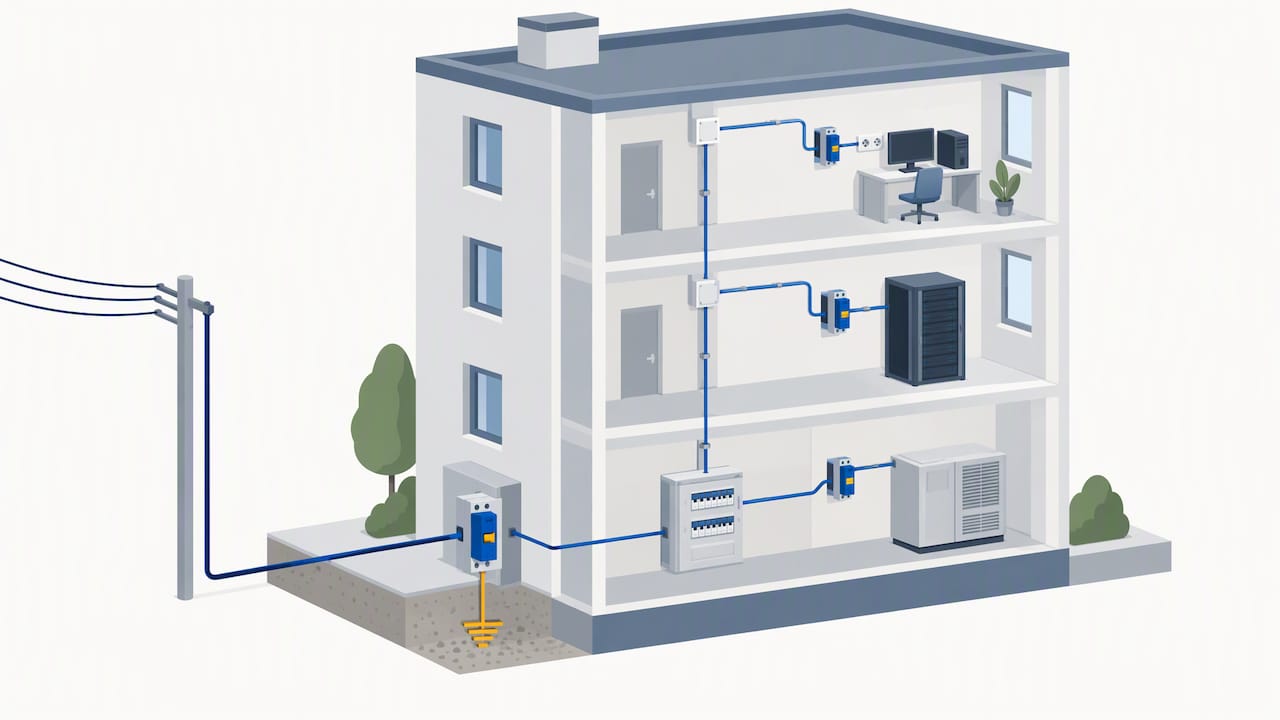
Distance is a hidden driver. The longer the cable run between the device and the earth connection, the more the protection level suffers, so large buildings may need extra earthing points or a nearer ground bar. That is where tertiary projects drift toward the upper installer band, with surveys showing a ceiling near €2,500. For multi-building or industrial sites, our guide to surge protection in industrial facilities shows how we scope the protection levels.
What are the lifetime maintenance costs and typical schedules for parafoudre systems?
A parafoudre is a consumable protection: it absorbs surges and ages. Its maintenance cost is modest compared with its purchase, but it should not be ignored. We have no published per-visit price to quote, and the cost depends on the number of devices and the site, so ask your installer for it on the quote.
A sensible schedule has three parts:
- Regular visual check: Most devices show their state through a status window, and a remote contact reports it to a technician or a supervision system.
- Periodic inspection: Check the device, the wiring and the earth resistance at planned intervals, and after any storm or strong surge event.
- Replacement: Swap the cartridge or module when the indicator shows end of life. Replaceable cartridges keep this cost low.
The earthing deserves the same attention. A surge device depends on a well-maintained grounding system, so earth resistance should be measured at each inspection. For sites with a paratonnerre, a lightning strike counter helps track activity and decide when to inspect. See our lightning strike counters for options. A maintenance contract bundling verification with an annual visit keeps the cost predictable.
Indelec’s practitioner view: why a technical study avoids surprises
In our experience, panel and earthing issues explain most of the gap between a low quote and a high one. A surprise at the end of a project usually comes from something nobody checked at the start. A lightning risk analysis fixes that by defining the scope before anyone prices it, which prevents scope creep and gives you a deliverable you can compare quotes against.
If your building is older or sits in a high-exposure area, set aside a margin for possible earthing work. Treat it as a probable line, not a remote one. We suggest starting with an ARF so the quote you receive matches the real need.
— INDELEC
How we help with ARF, installation, earthing and certification
If you are ready to move from estimates to a firm figure, we can take the project from analysis to certification. Our lightning protection services cover:
- Lightning risk analysis (ARF) and technical study (ET)
- Installation of surge protection and lightning protection systems
- Earthing works, including deep grounding
- Verification, maintenance and certification

When you contact us, we begin with a site visit and the scope of the study, then send a clear written quote that separates equipment, labor and earthing. Prices are available on request. Request a quote or an ARF and we will tell you what your building needs.
FAQ
How much does a parafoudre cost?
Hardware depends on the type, with panel modules ranging widely from €40 to €1,350. The installed price also covers labor and any panel or earthing work.
What is the principle of a parafoudre?
A parafoudre limits sudden voltage spikes by diverting the surge current to earth before it reaches your equipment. It protects the installation from lightning-related and switching surges.
How can I protect my electrical panel against lightning?
Install a Type 2 parafoudre in the tableau électrique, with Type 1 added where a paratonnerre or overhead supply exposes the building. Make sure the earthing is sound, since the device relies on it.
How much does it cost to install a parafoudre?
A simple install in a panel with space typically costs €200 to €350. Panel upgrades or earthing work raise that figure.
Sources
- Legifrance
- Combien coûte installer le parafoudre? Prix 2025
- Prix d’un parafoudre – parasurtenseur en 2026 | Guide de prix
- Devis parafoudre : trouvez le bon pro & devis gratuit en ligne