4 Lightning Protection Deliverables French Facility Managers Must Keep
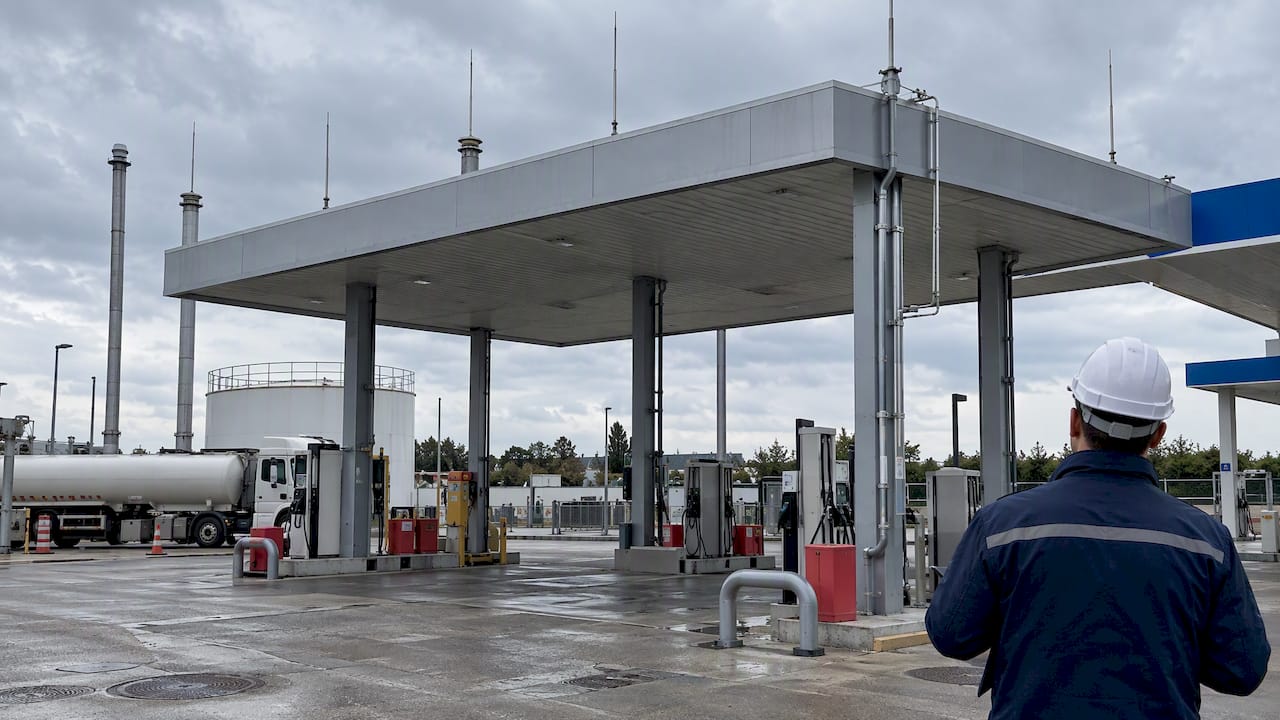
If lightning can affect your fuel station, you need a Lightning Risk Analysis (ARF) built on NF EN 62305-2, a technical study (étude technique) translating that analysis into hardware, installed protections, a verification schedule, and a carnet de bord ready for inspection. These four deliverables are the baseline every operator of a classified fuel station (ICPE) must maintain, and the first move is commissioning the ARF.
TL;DR:
- An up-to-date lightning risk analysis and technical study are mandatory within two years of the site’s ARF, especially after equipment additions like EV chargers.
- Proper grounding, surge protection, and air terminal placement depend on accurate site data and risk levels set by the NF EN 62305-2 standard.
- Inspection readiness requires maintaining a complete, traceable documentation trail, including the étude technique, verification reports, and maintenance logs.
- Adding new electrical equipment or infrastructure triggers the need for reassessment and potential updates to protection measures.
- Ongoing verification, maintenance, and staff procedures are essential to ensure protection effectiveness and compliance over time.
Table of Contents
- Regulatory framework and standards that govern station protection
- How to carry out a lightning risk analysis for your site
- Technical protection measures for service stations
- Installation timing, verification, and maintenance schedule
- Operational measures, monitoring, and human factors
- What inspectors expect in your documentation
- A practical checklist for compliance and procurement
- Weighing protection costs against long-term risk
- How our team supports your compliance work
- FAQ
- Sources
Regulatory framework and standards that govern station protection
Fuel stations fall under France’s Installations Classées pour la Protection de l’Environnement (ICPE) regime, and several ministerial texts define what lightning protection looks like in practice. The foundational text is the arrêté du 15 janvier 2008, which requires an ARF based on a structured risk evaluation under NF EN 62305-2 for installations where a lightning strike could trigger a major accident. That risk evaluation identifies the assets needing protection and sets the protection level the site must reach.
Stations operating under rubrique 1435 carry their own general prescriptions through the arrêté du 15/04/2010, which covers safety systems at fuel-dispensing sites and folds in lightning protection whenever the ARF flags it as necessary. An older companion text, the arrêté du 07/01/03, sets general prescriptions for classified installations and references protection measures wherever a hazard exists, so operators of older sites should check which version of the prescriptions applies to their permit.
NF EN 62305-2 and NF EN 62305-3 work together in practice. The first standard drives the risk calculation itself, weighing strike frequency, site exposure, and the consequences of a strike against the fuel inventories, equipment, and occupancy on site. The second standard translates the resulting protection level into physical specifications: where air terminals go, how down conductors route, and what the grounding network must achieve. An ARF without a matching étude technique is incomplete, since the risk number means nothing until it is converted into a parts list and an installation drawing.
A few thresholds determine whether these obligations apply at all:
- Classification trigger: sites storing fuel volumes or handling operations covered under rubrique 1435 generally require an ARF unless a prior analysis already excludes the lightning hazard.
- Equipment-driven reassessment: adding EV chargers, canopies, or new electronic systems can push a site that previously scored low risk into a category requiring new protections.
- Auxiliary storage: heating oil tanks or other non-distribution fuel storage inside the perimeter are sometimes counted toward classification thresholds, a detail inspectors check closely according to AIDA inspection guidance.
Inspectors reviewing a station file expect the regulatory chain to be traceable: which arrêté applies, what the ARF concluded, and whether the installed protections match the étude technique’s recommendations. A gap anywhere in that chain is the most common finding in ICPE inspection reports, including those listed on the Georisques inspection database for station-service sites.
How to carry out a lightning risk analysis for your site
A valid ARF starts with accurate site data. Skipping or underestimating any input produces a risk score that understates the real exposure, and that error surfaces later as a nonconformity finding.
- Gather site plans showing canopy footprint, tank field layout, dispenser positions, and building outlines.
- Compile fuel inventories, including underground tank capacities and any auxiliary storage such as heating oil.
- List electrical and electronic equipment: point-of-sale systems, pump controllers, telemetry, tank-level sensors, and security systems.
- Document EV charging infrastructure, since charger cabinets and their control electronics add exposed conductive paths and sensitive equipment that change the risk profile.
- Record occupancy patterns, including staff hours, average customer dwell time, and whether the site operates unattended overnight.
- Note prior incidents, including any history of lightning-related damage or near misses.
With that data in hand, the risk evaluation under NF EN 62305-2 weighs the probability of a strike against the consequences: loss of life, loss of service, and physical damage to structures and contents. The output is a required protection level, typically expressed as one of four standardized levels, with higher levels calling for tighter interception and grounding performance.
The ARF’s conclusions then feed the étude technique, which is where the abstract risk number becomes a parts list and a drawing. This is also the stage where financial loss and business interruption risk get weighed against the cost of protection, since a station that cannot process payments or dispense fuel for days after a strike carries a real operating cost beyond the physical damage.
Pro Tip:Bring your EV charger specifications and installation date to the ARF meeting, even if chargers were added after the last risk study. A missed equipment update is the single most common reason an ARF needs to be redone within a year.
The ARF’s final output names the specific assets requiring protection, the protection level each must meet, and whether the findings are severe enough to require an immediate étude technique rather than a scheduled one. For a site with no prior study, this is the point where the two-year implementation clock starts.
Technical protection measures for service stations
Once the étude technique sets the target protection level, the physical measures fall into a few predictable categories, each with its own placement logic.
Air terminals and zones of protection. Air terminals (paratonnerres) are positioned to create a protective volume covering the canopy, the tank vent pipes, and any elevated signage or masts.
Air terminals and zones of protection. Air terminals (paratonnerres) are positioned to create a protective volume covering the canopy, the tank vent pipes, and any elevated signage or masts. The protection level set by the ARF determines how tight that coverage must be, since higher levels require a denser interception network or a taller, better-positioned terminal. Mast placement and fixation need to account for wind loads and the canopy’s own structure, which is where Mâts and Fixation des mâts hardware gets specified alongside the terminal itself.
Down conductors. These carry the strike current from the air terminal to ground and must follow the shortest practical path, avoid sharp bends, and stay clear of flammable vapor zones around tank vents and dispenser islands. Where a mesh cage approach is used instead of a single terminal, the cage maillée method distributes current paths across multiple conductors, which can simplify routing around complex canopy structures.
Grounding systems. The grounding network is what actually dissipates the strike energy into the earth, and its design depends heavily on soil resistivity at the site. Deep electrodes, copper-clad rods, or grounding rings are chosen based on what the soil survey shows, with treatment sometimes applied to improve conductivity in dry or rocky ground. Some international technical specifications for fuel stations, such as DB4117/T 427-2024, set grounding resistance targets as tight as 4 ohms for specialized petrochemical sites, though these figures come from a non-French specification and should be treated as an illustrative benchmark rather than a French requirement. The binding target for any given station is whatever the étude technique specifies based on the ARF’s protection level and the site’s own soil data.
Equipotential bonding. Tanks, canopies, dispensers, and EV chargers all need to sit on the same electrical reference point, because a voltage difference between two “grounded” structures during a strike is what causes arcing and equipment failure. Bonding connects metal tank fittings, canopy steelwork, dispenser housings, and charger cabinets into a single network rather than treating each as independently grounded.
Surge protection devices (SPDs). Power and signal lines need separate SPD tiers. A common hierarchy runs:
- A coarse SPD at the main electrical service entrance to absorb the bulk of an incoming surge.
- A secondary SPD closer to sensitive equipment, such as point-of-sale terminals, pump controllers, and tank telemetry.
- A dedicated SPD on signal and data lines feeding EV charger management systems, since these circuits are often the most exposed and the least tolerant of transient voltage.
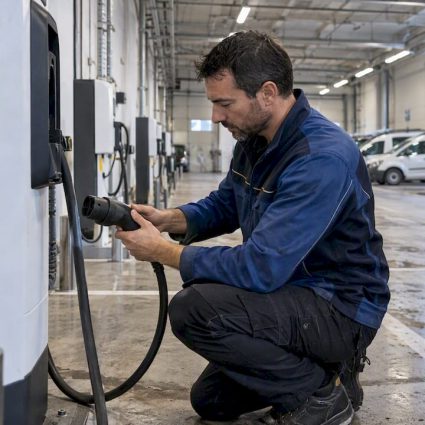
EV chargers change the equation. Adding charging infrastructure introduces new conductive runs, new control electronics, and often a new point where lightning-induced surges can enter the site’s network. A station that added chargers after its last ARF should treat that addition as a trigger for reassessment rather than an afterthought bolted onto the existing protection scheme.
One figure worth remembering: when an ARF identifies electronic systems as critical assets, pairing SPD protection on both power and signal lines is one of the more reliable ways to protect point-of-sale and telemetry systems from induced surges, rather than relying on power-line SPDs alone.
Installation timing, verification, and maintenance schedule
French regulation sets a clear clock once an ARF is complete, and missing these windows is one of the more common findings inspectors flag during ICPE audits.
- Within two years of the ARF, the protections identified by the étude technique must be installed, unless the station is a new installation, in which case protections are required before the site goes into operation, per the arrêté du 19 juillet 2011.
- Within six months of installation, an initial verification by an independent competent organization confirms the system matches the étude technique’s specifications.
- Every year, a visual check confirms conductors, bonding points, and terminals remain intact and free of corrosion or mechanical damage.
- Every two years, a full verification repeats the initial commissioning checks, including continuity and grounding resistance measurements.
- After any recorded lightning strike, an inspection must confirm the system performed as designed, with repairs completed within one month when damage is found.
The roles here split cleanly between the operator and the verifying body:
- The operator maintains the carnet de bord, schedules inspections on time, and keeps the site accessible for the competent organization’s checks.
- The competent organization performs the independent verification, measures grounding resistance, and issues a report documenting conformity or listing corrective actions.
- The installer delivers an as-built record matching the étude technique, which becomes the baseline the first verification checks against.
Inspectors reviewing a station file expect to see these dates lining up: ARF date, installation completion date, first verification date, and the running log of annual and two-year checks. A missing or late verification is treated the same as a missing protection, since it signals the system’s condition is unknown rather than confirmed.
Operational measures, monitoring, and human factors
Hardware alone does not make a station compliant or safe. Staff need clear procedures for what to do when a storm approaches, since human response during the event itself matters as much as the physical protection installed beforehand.
- Storm procedures: staff should know when to pause fueling operations, how to safely step away from dispensers and canopy structures, and when to activate emergency stop controls.
- EV charger shutdown: charging sessions in progress during a storm warning should have a defined pause or stop procedure, since charger cabinets present an additional exposed point.
- Lightning counters and detectors: devices that log strike activity near the site give the operator a record to cross-reference against the verification schedule and help justify an out-of-cycle inspection after a nearby event.
- Post-event checks: any confirmed or suspected strike should trigger an immediate visual inspection, independent of the scheduled annual or two-year check.
- Staff training and drills: periodic refreshers on storm procedures keep the human side of the protection plan current, especially at sites with staff turnover.
Pro Tip:Log every storm warning your site receives, even when no strike is confirmed, since a documented pattern of near misses strengthens the case for prioritizing protection upgrades during budget planning.
What inspectors expect in your documentation
Inspectors reviewing a station file look for a complete, dated paper trail rather than a single certificate. The arrêté du 19 juillet 2011 and related inspection practice point to a consistent set of records:
- The étude technique, showing how the ARF’s protection level translated into specific hardware and placement decisions.
- The notice of verification and maintenance, listing what gets checked, how often, and by whom.
- The carnet de bord, a running log of every inspection, repair, and strike event, kept available on site for inspectors to review without delay.
- Post-strike records, showing the inspection date following any confirmed event and the completion date of any resulting repairs, ideally within the one-month window.
An up-to-date set of these four items is consistently what separates a clean inspection from one flagged for corrective action.
A practical checklist for compliance and procurement
Turning the regulatory chain into action means handing procurement or a competent organization a clear scope. The sequence below maps directly onto what the ARF and étude technique require.
- Confirm whether an ARF exists and whether it reflects current site equipment, including any EV chargers added since the last study.
- Commission or update the ARF under NF EN 62305-2 if more than a few years old or if the site layout has changed.
- Request an étude technique that translates the ARF’s protection level into air terminal placement, down-conductor routing, grounding specification, and SPD tiers.
- Schedule installation to complete within the two-year window following the ARF.
- Book the initial verification with an independent competent organization within six months of installation.
- Set calendar reminders for annual visual checks and the two-year full verification.
- Assign responsibility for maintaining the carnet de bord and keeping it accessible on site.
- Define a post-strike inspection and repair protocol, including the one-month corrective action deadline.
| Checklist item | Who owns it | Typical trigger |
|---|---|---|
| ARF commissioning or update | Facility manager | New site, layout change, or added equipment such as EV chargers |
| Étude technique | Engineering consultant or protection provider | Completed ARF |
| Installation of protections | Installer or contractor | Étude technique sign-off |
| Initial verification | Independent competent organization | Within six months of installation |
| Annual visual check | Competent organization or trained staff | Every year |
| Full verification | Independent competent organization | Every two years |
| Post-strike inspection | Competent organization | Within days of a confirmed strike |
| Carnet de bord maintenance | Facility manager | Ongoing |
With over 280,000 installations completed internationally, our engineering teams at Indelec built this checklist format from the same ARF-to-hardware logic we apply on every project, which is why we default to it whenever a site asks for a procurement scope rather than a sales pitch.
Weighing protection costs against long-term risk
The instinct to treat lightning protection as a one-time capital expense misses how station operations actually evolve. A protection scheme sized for a site’s original layout stops matching reality the moment chargers, new canopies, or additional electronics get added, and an outdated ARF is functionally the same as having none at all when an inspector or an insurer asks for current documentation.

Insurers increasingly weigh documentation quality as heavily as the hardware itself, since a station that can produce a current étude technique, verification history, and carnet de bord demonstrates a managed risk rather than an unknown one. Budgeting for protection should include not just installation but the recurring cost of verification, spare SPD modules for quick replacement after a surge event, and a standing line item for reassessment whenever the site’s equipment changes meaningfully.
The stations that avoid repeat compliance costs are the ones that treat the ARF as a living document rather than a box checked once at commissioning.
— INDELEC
How our team supports your compliance work
We built our services around the exact sequence this guide walks through: the analysis du risque foudre (ARF) and the étude technique, installation, and ongoing verification and maintenance, so you are not coordinating separate vendors for each step. Our teams also cover electric vehicle charging infrastructure audits, deep grounding work, and working-at-height safety for canopy and mast installations, which matters when your protection scope spans more than lightning rods alone.

Before reaching out, it helps to have your site plans, fuel inventories, equipment lists including any EV chargers, and any prior ARF or verification reports on hand. With those in front of us, we can scope an updated risk analysis or a full technical study without a second round of data gathering. If your last ARF predates a layout change, an equipment addition, or simply predates the current year, request a technical audit from our services team and we will tell you exactly where your current documentation stands against what an inspector will expect to see.
FAQ
Quelle est la réglementation concernant la protection contre la foudre ?
Lightning protection for classified installations in France is governed by a chain of ministerial arrêtés, starting with the arrêté du 15 janvier 2008, which requires a risk analysis (ARF) under NF EN 62305-2 wherever a strike could trigger a major accident. That analysis then drives a technical study specifying the physical protections the site must install.
Quels sont les protocoles de sécurité à respecter en station-service ?
Station safety protocols combine physical protection measures with operational procedures: staff need clear steps for pausing fueling and EV charging during storm warnings, emergency stop access, and a defined post-strike inspection process. These human-factor protocols work alongside the installed grounding and surge protection measures rather than replacing them.
Quelle est la meilleure protection contre la foudre ?
There is no single best protection scheme, since the right combination of air terminals, grounding, and surge protection depends entirely on what the site-specific ARF concludes under NF EN 62305-2. A protection level sized correctly for the actual risk and kept current as equipment changes serves a station better than any specific product choice made without that analysis.
Quelle est la réglementation applicable aux stations-service de carburant ?
Fuel stations classified under rubrique 1435 fall under the arrêté du 15/04/2010, which sets general prescriptions including safety systems and lightning protection where an ARF identifies the need. Older or auxiliary installations may still reference the arrêté du 07/01/03 depending on the site’s permit history.
Sources
- Arrêté du 15 janvier 2008 relatif à la protection contre la foudre de certaines installations classées
- Arrêté du 15/04/2010 relatif aux prescriptions générales applicables aux stations-service (AIDA)
- Inspection report entry: Station-service – Protection contre la foudre