Aluminothermic Welding: Process, Uses, and Safety Rules
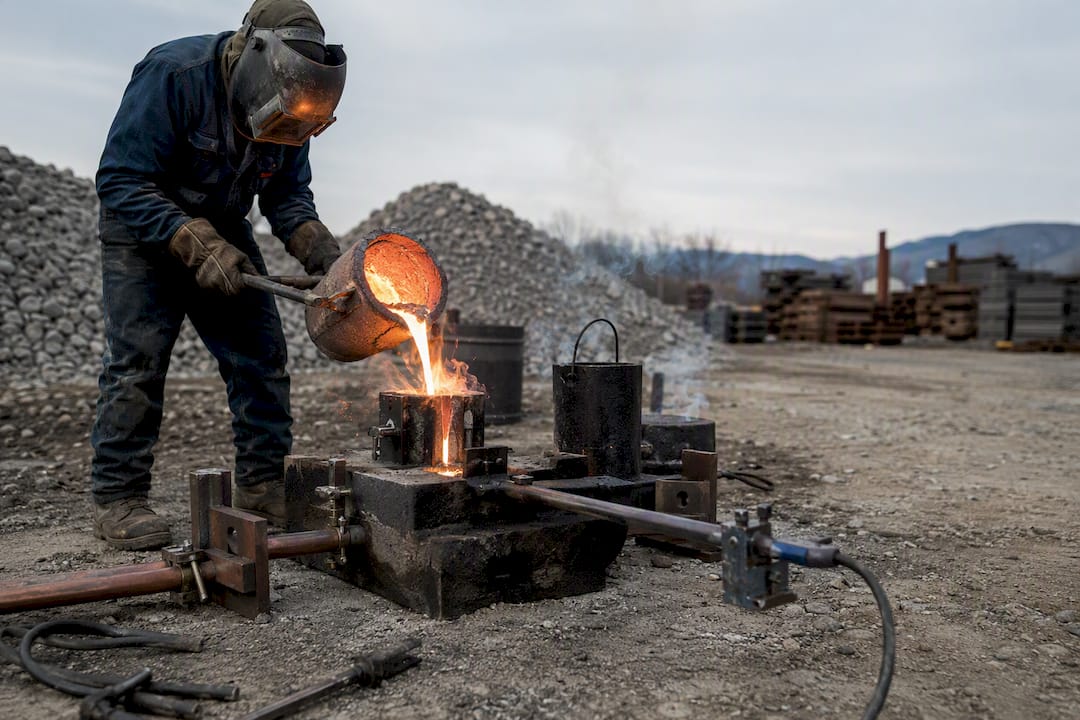
Aluminothermic welding, also called thermit welding, is a fusion process that produces molten weld metal through an exothermic reaction between aluminum powder and metal oxide, with no arc, gas flame, or external power source required. It’s the field standard for joining rails on continuous track and for creating permanent, low-resistance grounding connections in exothermic copper bonding. The same underlying chemistry also handles large-section steel repairs where portable equipment can’t reach or where downtime has to be measured in minutes, not hours.
- Rail welding: joins two rail ends into a continuous, load-bearing weld
- Grounding and bonding: creates permanent copper-to-copper or copper-to-steel electrical connections
- Heavy structural repair: fixes large-section steel components on-site without cranes or power grids
Key Takeaways
Aluminothermic welding works because the exothermic aluminum-oxide reaction generates enough superheated metal to fuse rail or copper joints permanently without external power.
| Point | Details |
|---|---|
| Chemistry drives quality | Alloying additions like ferromanganese are required to match rail steel properties; raw thermit alone is not enough. |
| Cooling rate controls integrity | Manage thermal gradients carefully to avoid brittle heat-affected zones that crack under service loading. |
| Grounding uses copper-oxide thermit | Exothermic copper bonding creates permanent, corrosion-resistant grounding connections with no mechanical failure point. |
| Moisture ruins reactions | Store thermit powder sealed and dry, since a damp charge causes incomplete or uneven reactions. |
| Training must be recurring | Certification should be renewed periodically, not treated as a one-time qualification. |
Table of Contents
- What Is the Aluminothermic Reaction and Why Does It Get So Hot?
- What Materials and Equipment Does a Thermit Weld Require?
- How Does the Step-by-Step Welding Procedure Work?
- Where Is Aluminothermic Welding Actually Used?
- What Determines Weld Metallurgy and Quality?
- What Safety Measures and Training Does This Work Require?
- How Do You Spot and Fix Common Weld Defects?
- How Does Indelec Apply This to Grounding and Lightning Protection?
- Ready to Secure Your Grounding System?
- What the Industry Gets Wrong About Thermit Welding
- Sources
What Is the Aluminothermic Reaction and Why Does It Get So Hot?
The reaction that powers soudure aluminothermique is straightforward on paper: aluminum powder reacts with a metal oxide, stealing its oxygen and releasing enough heat to melt the resulting metal instantly. For rail welding, that oxide is iron oxide; for grounding work, it’s copper oxide. Same principle, different metal chemistry, different acceptance standards.
Reaction snapshot: Thermit reactions typically produce liquid metal in the 2,200°C to 2,800°C range, a superheat margin high enough to fuse cleanly with the base rail or conductor without any preheating flame doing the actual melting.
That superheat matters because raw thermit alone won’t match the mechanical properties of rail steel. Welders add alloying materials, usually ferromanganese, ferrosilicon, and steel turnings, to the charge before ignition. Skip that step and the weld metal ends up chemically closer to cast iron than to rail steel, which is a problem the moment a train rolls over it.
- Iron-oxide thermit: produces steel-like weld metal for rail and structural joins
- Copper-oxide thermit: produces pure molten copper for exothermic welding in grounding applications, prized for corrosion resistance and zero degradation over decades
- Alloying additions: bring carbon and manganese content in line with common rail steel grades
What Materials and Equipment Does a Thermit Weld Require?
A competent crew shows up with more than a bag of powder and a match. The thermit mix itself needs to be checked for moisture and particle size before use, because a damp charge can react unevenly or fail to ignite cleanly, a known failure point in aluminothermic reactions. Beyond the mix, the job needs a refractory mould (sand-based for one-off jobs, prefabricated ceramic shells for repeatable rail production), a magnesite crucible thimble that controls the tap rate, and a reaction crucible sized to the joint.
Round out the kit with a preheat burner (propane or oxy-propane), rail clamps or conductor fixtures, tapping pins, and full PPE: face shield, flame-resistant gloves, and protective clothing rated for molten metal splash.
- Thermit powder mix, moisture-checked and correctly graded
- Sand or prefabricated refractory mould matched to the joint profile
- Magnesite crucible and thimble assembly
- Preheat burner, alignment clamps, tapping tools
- Face shield, fire-resistant gloves, and flame-retardant workwear
Pro Tip:Store thermit powder in sealed, moisture-proof containers and rotate stock. A charge that’s absorbed ambient humidity over a few months in a damp site trailer is the single most common cause of a sluggish or incomplete reaction.
How Does the Step-by-Step Welding Procedure Work?
The sequence rarely changes, whether you’re closing a rail gap or bonding a grounding conductor. What changes is scale and tolerance.
- Align and gap the joint. Rail welds typically need a small gap, typically held square with fixturing clamps; grounding conductors need tight, clean contact with no oxide film.
- Install and seal the mould. The refractory mould clamps around the joint and gets sealed with fireclay or a sand mix to prevent metal leakage during pour.
- Preheat the joint. A propane or oxy-propane torch brings the base metal to the target temperature, usually judged by color and time rather than a fixed instrument reading, following the standard sequence used across thermit welding practice.
- Charge and ignite the crucible. The thermit mix goes into the crucible with an ignition powder or sparkler, and the reaction runs in seconds.
- Tap and cast. Molten metal sinks below the slag layer by density, and the crucible’s thimble releases the metal into the mould while the lighter aluminum oxide slag stays behind, a separation mechanism well documented in thermit process reviews.
- Cool, strip, and finish. After a controlled cooling period, the mould comes off, risers get sheared, and the weld gets ground to final profile.
- Inspect. A visual check for surface defects, plus a quick geometric check against rail or conductor tolerance, closes out the job.
Pro Tip:Never rush the cooling stage on a rail weld to reopen a track faster. A joint cooled too quickly locks in a brittle heat-affected zone that won’t show up until months later, usually as a crack under repeated wheel loading.
Where Is Aluminothermic Welding Actually Used?

Rail welding remains the dominant application, and for good reason: it produces a continuous, jointless rail without the fixed infrastructure that flash-butt welding demands. There’s no need to haul a rail in for a factory weld or run high-current arc equipment off a generator. A crew sets up, welds, and moves to the next gap.
Grounding work runs on the same chemistry with copper oxide instead of iron oxide. Exothermic welding creates a molecular bond between copper conductors that won’t loosen, corrode, or degrade in resistance the way a mechanical clamp connection can over decades underground. That’s precisely why it’s the preferred method for permanent earthing systems and lightning protection grounding grids.
- Rail joins: preferred where flash-butt or arc welding equipment can’t reach or would cost more to mobilize
- Grounding and bonding: copper-to-copper connections for earthing grids and lightning protection systems
- Large steel repairs: heavy-section structural joins where portability outweighs speed
One practical note supervisors underestimate: ordering the wrong thermit grade for the job is a common and entirely avoidable error. A rail-grade mix with alloying additions will not perform correctly on a pure copper grounding job, and vice versa.
What Determines Weld Metallurgy and Quality?
The metal chemistry inside a thermit weld isn’t automatic. Off-the-shelf mixes are often inadequate for structural rail welds on their own, which is why controlled alloying is added to reproduce the mechanical properties of the surrounding rail steel, a point metallurgists have raised directly in patent literature on thermit alloying methods.
Cooling rate is the other lever that decides whether a weld survives service loading or cracks early. Too fast, and the heat-affected zone hardens into a brittle structure prone to fatigue cracking. Too slow, and grain growth can weaken the joint. Numerical modelling using CFD and phase-change simulation now lets engineers predict thermal fields during preheat and cooling, which is increasingly standard practice on high-traffic rail corridors and other high-risk joins.
- Match alloying additions to the target carbon and manganese range for the rail grade in service
- Control cooling rate to avoid brittle heat-affected zone formation
- Run visual and dimensional acceptance checks before returning a joint to service
- Escalate to metallurgical lab testing (hardness, microstructure) for any weld carrying unusual load or safety criticality
What Safety Measures and Training Does This Work Require?
Molten metal at close range demands more than a hard hat. Crews need face shields, flame-resistant gloves, and clothing rated against splash, plus a defined hot-work exclusion zone around every pour. Fire watch and an emergency response plan aren’t optional extras on a live track or an occupied industrial site.
Training pathways generally combine classroom instruction on reaction chemistry and safety with supervised on-site practice, ending in a certification that documents competency for a specific weld type. That certification should be recurring, not a one-time credential, because technique and judgment both degrade without regular field practice. A factory electrical safety checklist is a useful starting reference for site-level controls before any hot work begins.
- Face shield, fire-resistant PPE, and a marked exclusion zone around every pour
- A documented permit-to-work and active fire watch for the duration of the job
- Classroom instruction plus supervised field practice, closed out with certification
- Recurrent recertification rather than a single lifetime qualification
How Do You Spot and Fix Common Weld Defects?
Porosity, slag inclusions, and cold fusion are the three defects that show up most often, and all three usually trace back to the same causes: a damp thermit charge, insufficient preheat, or a mould that sealed poorly. Catch porosity or slag inclusion at the grinding stage and it’s often correctable with rework and re-finishing. Cold fusion, where the weld metal never properly bonded to the base rail or conductor, is a different story and usually means the joint gets cut out and rewelded.
- Porosity: caused by moisture in the mix or trapped gas; grind and inspect, reweld if it recurs
- Slag inclusions: usually from poor tapping technique; correctable at finishing in most cases
- Cold fusion: insufficient preheat is the typical cause; escalate to full rework, not patch repair
- Go/no-go check: visual surface inspection plus dimensional tolerance before returning to service
How Does Indelec Apply This to Grounding and Lightning Protection?
Structural thermit rail welds and copper exothermic grounding bonds share a reaction principle but serve entirely different jobs: one carries wheel loads, the other carries fault current safely to earth for decades without maintenance. Indelec works specifically in that second category, where connection integrity determines whether a grounding grid actually performs when a lightning strike hits.
Indelec’s tinned copper welding clip is built for exactly this kind of permanent bonding workflow, pairing with exothermic connections in deep earth grounding installations where a mechanical clamp simply won’t hold up over the system’s service life.
A grounding connection is only as reliable as its weakest joint. Exothermic bonding removes the joint as a failure point entirely, which is why it’s the connection method specified across Indelec’s grounding and lightning protection installations.
- Product design matched to field exothermic bonding practice, not adapted from unrelated hardware
- Technical training programs that build practical, documented competency for installation crews
- R&D focus on connection reliability under real fault-current and environmental stress
Ready to Secure Your Grounding System?
A weld is only as good as the grounding grid it connects to, and a grounding grid is only as good as its worst joint. If your site needs permanent, corrosion-resistant connections that won’t loosen over decades underground, Indelec’s lightning protection risk assessment, installation, and maintenance services cover the full scope from design through certification. For projects requiring deep grounding infrastructure specifically, the deep earth grounding drilling service handles installations where soil conditions or system scale demand specialized equipment.
What the Industry Gets Wrong About Thermit Welding
Most guides on this process treat the chemistry as the interesting part and the metallurgy as an afterthought. That’s backward. The reaction itself is remarkably forgiving; getting alloying and cooling rate right is where welds actually fail or succeed. A crew that nails ignition technique but skips proper alloying additions produces a weld that looks fine on day one and cracks under fatigue loading eighteen months later.

The other gap: safety training gets treated as a box to check once, rather than a skill that decays. A welder certified three years ago on a different rail grade or a different site’s ground conditions isn’t automatically qualified for today’s job. Recurrent, documented competency checks matter more than the initial certificate.
For grounding specifically, the industry conversation focuses too much on the weld and not enough on what it connects to. A perfect exothermic bond on a poorly designed grounding grid still fails the system. Prioritize grid design and soil conditions first, then treat connection method as the detail that makes the design actually last.
— INDELEC
Sources
- Thermit Welding – an overview | ScienceDirect Topics
- Thermit Welding — Process, Chemistry, Equipment & Applications: The Complete Guide – Welding Fabrication World