Why Lightning Causes Equipment Failure: A Facility Guide
TL;DR:
- Lightning causes equipment failure mainly through voltage surges, electromagnetic induction, and transient stress. Proper protection requires layered systems including air terminals, service entrance devices, and point-of-use suppressors bonded to a common ground. Regular inspection and maintenance are essential to ensure ongoing effective lightning protection.
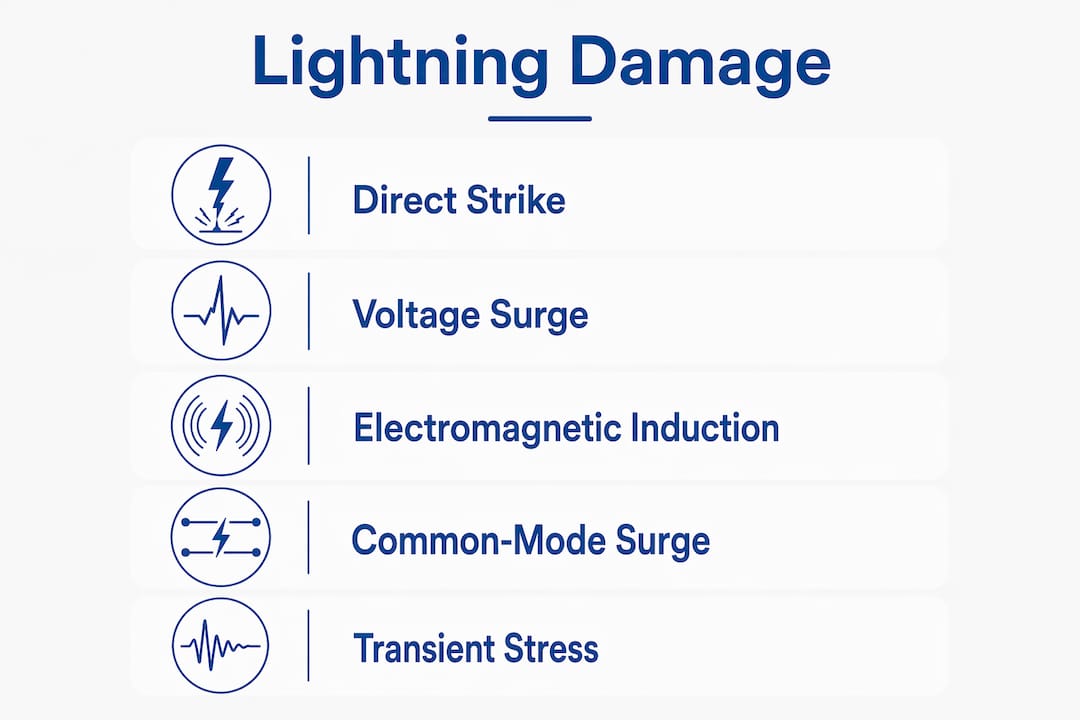
Lightning is defined as a massive electrical discharge that subjects connected equipment to voltage surges reaching up to 1 billion volts, making it one of the most destructive forces industrial facilities face. Understanding why lightning causes equipment failure goes beyond the obvious image of a direct strike. The real threat is electrical overstress: a cascade of voltage spikes, current surges, and electromagnetic pulses that destroy semiconductors, burn insulation, and corrupt control systems in milliseconds. Facility managers who treat lightning as a rare, visible event consistently underestimate the damage. The mechanisms are physical, predictable, and preventable with the right approach to lightning protection for equipment.
Why lightning causes equipment failure: the core physics
Lightning delivers destruction through three simultaneous mechanisms: extreme voltage, extreme current, and extreme heat. A single strike can carry 100 million to 1 billion volts and up to 50,000 amps of current. That combination of voltage and current produces temperatures exceeding 50,000°F at the strike point. Equipment connected to any conductive path near that strike absorbs a fraction of that energy, and a fraction is more than enough to cause failure.
The damage modes split into two categories depending on the duration of the surge. Short, high-energy transients punch microscopic holes through insulation, a failure pattern called pinhole breakdown. Longer surges cause catastrophic failure through excessive heating, melting conductors, and burning out components entirely. Both failure types require different suppression strategies, which is why a single protective device rarely covers the full threat.
Electromagnetic induction adds a third pathway that most facility managers overlook. When lightning strikes near a facility, the rapidly changing magnetic field induces voltage in any nearby conductor, including wiring inside conduit, cable trays, and even unplugged equipment. Electromagnetic pulses induce damaging currents in disconnected wiring, which means physical disconnection alone does not protect sensitive devices during a storm. This is the mechanism behind failures that seem to have no obvious cause.
Near strikes also generate common-mode surges, where voltage rises simultaneously on all conductors relative to ground. Effective surge suppression must address both common-mode and normal-mode transients separately, covering neutral and earth conductors, not just the live lines. Most basic surge strips do not meet this requirement.
How do indirect strikes and transient surges reach your equipment?
A direct strike on your building is not required to destroy your equipment. Lightning striking the ground or a utility pole several miles away injects voltage spikes into the power grid, and those spikes travel along power and communication lines directly into your facility. Voltage spikes from distant strikes propagate through power supplies and network interfaces, damaging sensitive electronics far from the original strike point. This is the most common cause of lightning-related equipment failure in industrial settings.
The pathways are more numerous than most operators realize:
- Power lines carry surges from utility switching events and nearby strikes directly to every connected device.
- Ethernet and data cables act as antennas, picking up induced voltages and delivering them to network cards, PLCs, and control systems.
- Coaxial cables for communications or monitoring systems provide a direct conductive path from an outdoor antenna or junction box into sensitive indoor equipment.
- Telecom lines entering the building bypass power protection entirely if they are not independently suppressed.
A well-documented failure pattern involves lightning entry through internet cables, destroying motherboards and network interfaces while leaving power supplies intact. This happens because the surge travels the communication line, not the power line, and most facilities protect only the power side.
Switching surges compound the problem. Every time a large motor, transformer, or HVAC unit cycles on or off, it generates a transient on the electrical system. These events happen dozens of times per day. Frequent low-magnitude transients stress insulation and semiconductor junctions cumulatively, shortening equipment life even when no single event causes visible damage.
Pro Tip:Audit every cable entering your facility, not just power cables. Ethernet, coax, and telecom lines each need their own surge protection device bonded to the same ground reference as your power protection. Mismatched ground references create voltage differences that cause additional damage during a surge event.
Which types of equipment are most vulnerable?
Not all equipment fails equally. The effects of lightning on electronics vary by component type, and knowing which assets carry the highest risk helps you prioritize protection spending.
Semiconductors and microprocessors. These components operate at voltages between 1.8V and 5V. A transient of even a few hundred volts destroys junction layers instantly. PLCs, variable frequency drives, and industrial computers all rely on semiconductor components and rank among the most vulnerable assets in any facility.
Power supplies and rectifiers. These sit at the boundary between the utility grid and internal equipment. They absorb the first wave of a surge, and when they fail, the surge often continues into downstream equipment. A failed power supply is frequently a symptom, not the root cause.
Network interface cards and communication modules. These connect directly to external cable runs, making them the most exposed components in a networked facility. A single unprotected Ethernet port can deliver a surge to an entire control network.
Motors and variable frequency drives. Repeated transients degrade winding insulation over time. The failure does not appear immediately. Instead, insulation resistance drops gradually until the motor fails during a routine operating cycle, with no obvious connection to lightning activity.
Sensors and instrumentation. Field sensors connected to long cable runs act as antennas for induced voltages. A 4–20mA loop running 200 meters through a cable tray picks up significant induced voltage during a nearby strike, corrupting readings or destroying the transmitter.
The pattern across all these components is the same: repeated exposure stresses insulation and electronics, causing malfunction or shortened service life long before a catastrophic failure occurs. Facilities that track mean time between failures on their electronic assets often find a correlation with storm activity that only becomes visible when they look for it.
What are the best practices for lightning protection for equipment?
Effective lightning damage prevention requires a layered system, not a single device. Each layer addresses a different threat level, and gaps between layers are where failures occur.
Layer 1: External lightning protection
Lightning rods and air terminals intercept direct strikes and route current safely to ground through a dedicated down conductor and grounding system. Indelec’s Prevectron3 air terminal, for example, uses early streamer emission technology to extend the protection radius beyond what a passive rod achieves. This layer prevents the direct strike from entering the facility’s electrical system at all.
Layer 2: Service entrance protection
Surge protective devices installed at the main electrical panel clamp large transients arriving from the utility grid. These devices handle the high-energy portion of a surge but cannot suppress the residual voltage that remains after clamping. That residual voltage is still high enough to damage sensitive electronics.
Layer 3: Point-of-use protection
Suppressors installed at individual panels, equipment cabinets, and communication entry points handle the residual transients that pass through service entrance protection. Layered protection targeting both short and long transients outperforms any single-method solution. This is the layer most facilities skip, and it is the layer that protects PLCs, drives, and network equipment directly.
Grounding and bonding tie the entire system together. All surge protective devices must connect to a common ground reference. Grounding and bonding of all connected lines, including communication cables, blocks surge pathways that would otherwise bypass power protection entirely. IEEE standards and Indelec’s published lightning protection guidelines both specify bonding requirements for communication infrastructure, not just power systems.
Lightning arresters alone are insufficient for complete equipment protection. A system-level arrester handles the largest events but leaves equipment exposed to the routine transients that cause cumulative damage over months and years.
Pro Tip:Schedule an annual inspection of all surge protective devices. Most SPDs contain metal oxide varistors that degrade with each surge event and provide no indication of failure until they stop working entirely. Replacing them on a schedule costs far less than replacing the equipment they protect.
Key Takeaways
Lightning destroys industrial equipment through voltage surges, electromagnetic induction, and cumulative transient stress, and only a layered protection system addresses all three pathways.
| Point | Details |
|---|---|
| Direct strikes are not required | Voltage spikes from distant lightning travel through power and communication lines to damage equipment miles away. |
| Communication lines are high-risk entry points | Ethernet, coax, and telecom cables each need independent surge protection bonded to a common ground. |
| Cumulative transients cause hidden damage | Repeated low-magnitude surges degrade semiconductors and insulation long before a visible failure occurs. |
| Layered protection is the standard | Service entrance arresters, point-of-use suppressors, and proper grounding must work together for effective defense. |
| Disconnecting devices is not enough | Electromagnetic induction induces damaging currents in wiring even when equipment is unplugged. |
What facility managers consistently get wrong about lightning damage
After decades of work in lightning protection, the pattern Indelec sees most often is not ignorance of lightning risk. It is a narrow definition of what lightning damage looks like.
Facility managers picture a direct strike, a burned panel, and an obvious failure. The reality is that indirect surges produce cascading failures and unplanned shutdowns across multiple systems simultaneously, with no single point of entry that is easy to identify. A PLC fails on a Tuesday morning. A network switch goes offline the same week. A sensor starts reading incorrectly. Each event gets logged separately, diagnosed separately, and repaired separately. The connection to a storm three days earlier never gets made.
The second mistake is treating communication line protection as optional. Power protection gets budgeted. Communication protection gets deferred. Then a surge enters through an unprotected Ethernet port and takes down a control network that the power protection never touched.
The third mistake is confusing installation with protection. A surge protective device installed five years ago and never inspected may have absorbed enough transients to be completely degraded. It looks like protection. It provides none. Integrating inspection and maintenance into your lightning protection plan is not overhead. It is the difference between a system that works and one that only appears to work.
The facilities that handle lightning risk well treat it the same way they treat fire suppression: as a system that requires design, installation, commissioning, and ongoing maintenance, not a one-time purchase.
— Indelec
Indelec’s solutions for industrial lightning protection
Protecting industrial equipment from lightning requires a system designed for the specific risks of your facility, not a generic off-the-shelf product.

Indelec has delivered lightning protection systems for industrial facilities, substations, and critical infrastructure since 1955. Each solution covers the full protection chain: air terminals, grounding systems, surge protective devices, and communication line protection, all designed to meet applicable IEEE and IEC standards. Indelec’s approach also includes risk assessment, installation, and maintenance services, so your protection system stays effective over time, not just on day one. For facilities looking at long-term reliability, Indelec also offers environmentally sustainable protection options that align with modern infrastructure goals.
FAQ
What makes lightning so destructive to electronic equipment?
Lightning delivers up to 1 billion volts and 50,000 amps in milliseconds, creating voltage surges that far exceed the operating limits of any semiconductor or insulation material. The result is immediate physical destruction or accelerated degradation that leads to failure over time.
Can lightning damage equipment without a direct strike?
Yes. Voltage spikes from strikes miles away travel through power and communication lines and damage equipment inside a facility. Electromagnetic induction also induces damaging currents in wiring even when devices are unplugged.
Which industrial equipment fails most often from lightning?
PLCs, variable frequency drives, network interface cards, and field sensors are the most vulnerable. These components operate at low voltages and connect to long cable runs that act as antennas for induced surges.
Is a surge protector at the main panel enough?
No. Service entrance protection handles large transients but leaves residual voltage that still damages sensitive electronics. Point-of-use suppressors at individual equipment locations are required to complete the protection chain.
How often should lightning protection systems be inspected?
Annual inspection is the standard practice for surge protective devices, grounding connections, and air terminals. Metal oxide varistors inside SPDs degrade silently with each surge event and must be replaced on a schedule to maintain protection.