Public Liability in Lightning Safety: 2026 Business Guide

TL;DR:
- Public liability in lightning safety requires property owners to implement documented emergency plans and trained staff to prevent injuries. Negligence, not a lightning strike itself, determines legal liability, emphasizing the importance of compliance and thorough documentation. Facility managers should maintain coordinated safety procedures and insurance coverage to reduce lightning-related risks effectively.
Public liability in lightning safety is a property owner’s or manager’s legal obligation to protect the public from lightning-related harm on their premises. This duty extends beyond installing a lightning rod. It requires documented emergency plans, trained staff, and compliance with standards like OSHA’s General Duty Clause. Business owners and facility managers who understand what is public liability in lightning safety can reduce lawsuit exposure, satisfy insurer requirements, and demonstrate genuine duty of care. Negligence, not the strike itself, is what courts and insurers examine when a lightning incident results in injury or property damage.
What legal responsibilities do businesses have for lightning safety?
Public liability in the context of lightning safety is grounded in negligence law. To establish liability, a claimant must prove four elements: a duty of care existed, that duty was breached, the breach caused harm, and measurable damages resulted. Breach of duty, causation, and damages are all required. Proximity to a lightning strike alone does not create legal responsibility.
OSHA’s General Duty Clause requires employers to provide a workplace free from recognized hazards. For outdoor environments, OSHA’s 2026 guidance enforces the 30/30 rule for lightning: suspend outdoor work when thunder follows lightning by 30 seconds or less, and do not resume until 30 minutes after the last thunder. This rule applies to construction sites, sports facilities, outdoor events, and any operation with workers or visitors exposed to open sky.
Failure to follow these protocols carries serious consequences. Facility managers face personal injury lawsuits, regulatory penalties, and potential loss of operating licenses. Courts look specifically at whether a written emergency action plan existed and whether staff received documented training. A facility with an expensive lightning rod system but no emergency plan has been found negligent in multiple lawsuits.
Pro Tip:Document every lightning safety drill, staff briefing, and weather monitoring check. A dated log is your first line of defense in a negligence claim.
- Duty of care applies to employees, visitors, contractors, and members of the public on your premises.
- OSHA’s General Duty Clause covers both direct employees and any person exposed to hazards you control.
- Regulatory penalties for non-compliance can compound if a lightning incident triggers an OSHA inspection.
- Courts weigh the quality of your documentation as heavily as the physical protection systems you have installed.
How does public liability insurance work for lightning risks?
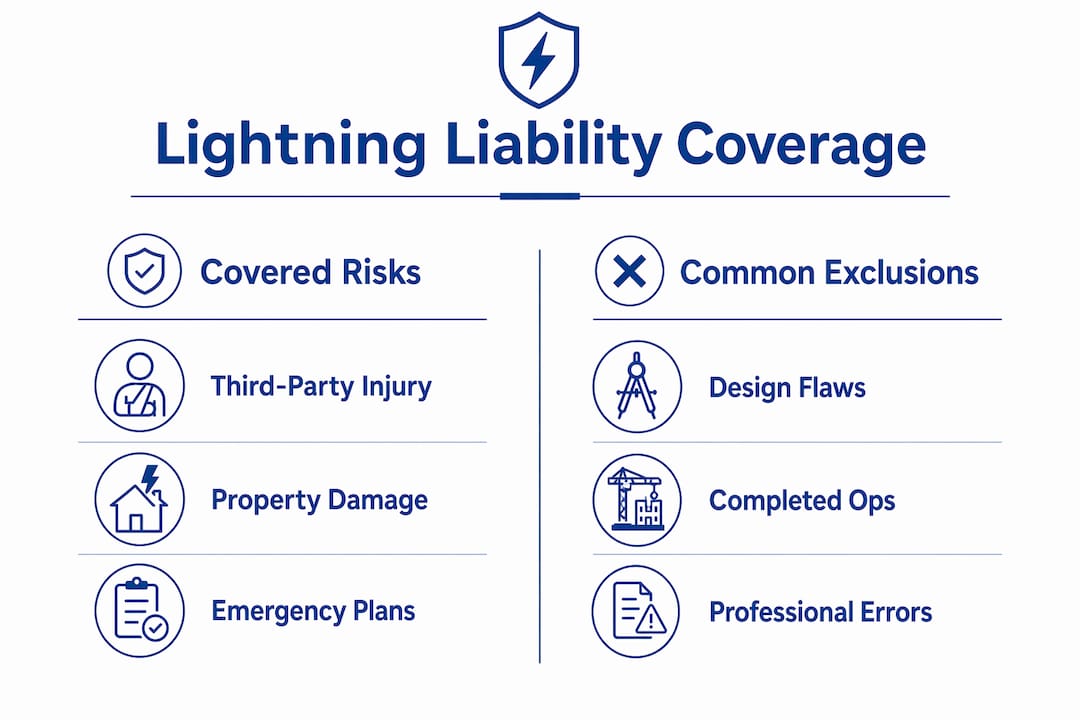
Standard general liability insurance and specialized lightning protection insurance are not the same product. General liability covers bodily injury and property damage claims from third parties. It does not automatically cover professional errors in lightning protection design, installation failures, or damage that surfaces after a project is completed.

Professional liability coverage, also called errors and omissions (E&O), addresses claims arising from design flaws or engineering mistakes in a lightning protection system. Coverage limits for specialized lightning protection insurance typically range from $5M to $10M, with E&O limits often set at $1M to $5M per claim. Those figures reflect the scale of property damage and injury claims that grounding failures and design errors can generate.
Completed operations coverage is another gap that catches facility managers off guard. This coverage applies when a lightning protection system fails after installation is finished and the contractor has left the site. Standard general liability policies frequently exclude it. Without completed operations coverage, a post-installation lightning strike that causes a fire or equipment loss may fall entirely outside your policy.
Pro Tip:Request a certificate of insurance from every lightning protection contractor you hire. Verify that it includes both E&O and completed operations coverage before work begins.
| Coverage type | What it addresses | Common exclusion risk |
|---|---|---|
| General liability | Third-party bodily injury and property damage | Design errors and post-installation failures |
| Professional liability (E&O) | Engineering and design mistakes in system planning | Often absent from standard policies |
| Completed operations | Damage occurring after installation is finished | Frequently excluded unless specifically added |
| Product liability | Defective components in a lightning protection system | May require separate endorsement |
Insurance policies also support compliance. Insurers increasingly require documented emergency action plans and proof of staff training before issuing or renewing coverage. A policy that aligns with OSHA standards gives you a stronger defense in court and a cleaner claims process when an incident does occur.
What are best practices for reducing lightning liability?
The most significant public liability risk in lightning safety is often inadequate emergency action planning, not the strike itself. Courts and insurers both weight documented procedures and staff training heavily when evaluating a claim. Physical protection systems matter, but they do not substitute for a written plan.
A comprehensive lightning safety plan includes four operational components that OSHA requires to be incorporated into workplace emergency action plans:
- Assign a designated lightning monitor. This person tracks weather forecasts and real-time conditions, triggers the 30/30 rule, and has authority to suspend operations without management approval.
- Install continuous weather tracking. Real-time lightning detection systems provide advance warning beyond what a visible storm delivers. Integrate alerts into your facility’s communication channels.
- Conduct quarterly drills. Drills test evacuation routes, shelter locations, and staff response times. Document every drill with attendance records and corrective actions.
- Maintain clear shelter evacuation procedures. Identify fully enclosed, substantial structures or hard-topped vehicles as designated shelters. Post evacuation maps at all outdoor work areas and public access points.
Cross-functional coordination is equally critical. A siloed approach to lightning safety in collegiate athletics increased liability exposure when facility management, coaching staff, and spectator safety teams each operated separate and inconsistent policies. The lesson applies directly to commercial facilities: when departments manage lightning safety independently, gaps appear. Assign one cross-functional team with representatives from operations, HR, and safety to own the emergency action plan.
- Review your emergency action plan annually and after every lightning incident.
- Integrate lightning safety into your broader facility safety workflow to avoid fragmented management.
- Verify that your physical lightning protection system meets current lightning standards and is inspected on a regular schedule.
- Keep inspection and maintenance records on file for at least five years to support insurance claims and legal defense.
What are common misconceptions about lightning liability?
The most persistent misconception is that a lightning strike automatically creates legal liability for the property owner. Liability is not automatic. A claimant must demonstrate that the property owner failed to take reasonable precautions. If your emergency action plan was followed, your staff was trained, and your physical protection systems were properly installed and maintained, a court is far less likely to find negligence.
A second misconception is that installing a lightning rod eliminates liability. Physical protection systems reduce risk, but they do not replace procedural compliance. Facilities with expensive rod systems but lacking emergency plans have been found negligent in lawsuits. The rod addresses the strike. The emergency plan addresses the people.
“Legal liability in lightning incidents hinges on negligence rather than the mere occurrence of a weather event. This distinction often surprises facility managers who are unprepared with formal safety documentation.”
A third misconception involves landowner responsibility and proximity. Some facility managers assume that if a person is struck while standing near their property boundary, rather than on it, liability does not apply. Courts examine control over the hazard, not just legal property lines. If your facility’s operations or events drew that person to the location, duty of care may still apply.
The practical guidance from case law and insurer experience is consistent: document everything, train everyone, and treat lightning safety as a year-round program rather than a seasonal checklist. A lightning risk assessment conducted by a qualified professional gives you a defensible baseline and identifies gaps before an incident occurs.
Key Takeaways
Public liability in lightning safety is determined by negligence, not by the strike itself. Documented emergency plans, trained staff, and compliant protection systems are the three factors courts and insurers weigh most heavily.
| Point | Details |
|---|---|
| Negligence drives liability | A lightning strike alone does not create legal responsibility. Breach of duty must be proven. |
| Emergency plans are non-negotiable | OSHA requires written lightning safety protocols in workplace emergency action plans. |
| Insurance gaps are common | Standard general liability rarely covers E&O or completed operations for lightning systems. |
| Cross-functional planning reduces risk | Siloed safety management increases liability exposure in complex facilities. |
| Documentation is your legal defense | Dated training logs, inspection records, and drill reports are weighted heavily in court. |
Indelec’s perspective on lightning liability and risk management
After nearly seven decades working with industrial and commercial facilities worldwide, the pattern Indelec sees most often is not a failure of technology. It is a failure of process. A facility installs a certified lightning protection system, checks that box, and then treats lightning safety as solved. Two years later, there is no current emergency action plan, no documented drills, and no designated weather monitor. When an incident occurs, the physical system is irrelevant to the legal outcome.
The regulatory environment is tightening. OSHA’s 2026 guidance on the 30/30 rule is more explicit than previous versions, and insurers are increasingly requiring documented compliance before issuing coverage. Facilities that treat lightning safety as a one-time capital expense rather than an ongoing operational program are building liability exposure every year they delay updating their procedures.
The cross-functional lesson from collegiate athletics applies to every complex facility. When operations, HR, and safety teams each manage a piece of lightning policy without coordination, the gaps between those pieces are where claims originate. Indelec recommends assigning a single owner for the lightning safety program with authority across departments and a direct line to facility leadership.
The uncomfortable truth is that a well-documented, modestly equipped facility often has stronger legal protection than a facility with a premium system and no paperwork. Technology and process must work together. Neither substitutes for the other.
— Indelec
How Indelec supports lightning liability compliance
Indelec has protected commercial and industrial facilities from lightning risk since 1955, combining certified hardware with the technical services that insurers and regulators require.

The Prevectron3 air terminal uses Indelec’s patented OptiMax technology to provide reliable, certified protection for facilities of all sizes. Beyond hardware, Indelec’s team delivers full protection services including system design, installation, grounding, and certification documentation. Every installation is backed by compliance records that support both insurance requirements and legal defense. Facility managers who need a complete, auditable lightning protection program can work with Indelec from initial risk assessment through ongoing maintenance and staff training support.
FAQ
What is public liability in lightning safety?
Public liability in lightning safety is the legal obligation a property owner or manager has to protect the public from lightning-related harm on their premises. Liability is established through negligence, meaning a breach of duty of care must be proven.
Does a lightning strike automatically make a business liable?
No. A lightning strike does not automatically create legal liability. A claimant must demonstrate that the business failed to take reasonable precautions, such as maintaining an emergency action plan or following OSHA’s 30/30 rule.
What does public liability insurance cover for lightning incidents?
Standard general liability insurance covers third-party bodily injury and property damage but typically excludes professional errors in system design and completed operations failures. Specialized lightning protection insurance adds E&O and completed operations coverage to address those gaps.
What is OSHA’s 30/30 rule for lightning safety?
OSHA’s 30/30 rule requires suspending outdoor work when thunder follows lightning by 30 seconds or less, and not resuming until 30 minutes after the last thunder. This rule is incorporated into OSHA’s General Duty Clause requirements for workplace emergency action plans.
How can facility managers reduce lightning liability exposure?
Facility managers reduce exposure by maintaining a written emergency action plan, conducting quarterly drills, assigning a designated lightning monitor, and keeping dated records of all training and inspections. Courts and insurers weigh documentation as heavily as physical protection systems.