Preventive Actions for Facility Protection: 2026 Guide

TL;DR:
- Effective facility protection involves implementing layered security measures, conducting semi-annual risk assessments, and integrating lightning protection into maintenance routines. Regular testing, immediate correction protocols, and staff training are essential to prevent preventable failures and reduce operational disruptions. Prioritizing proactive strategies transforms facility safety from a cost center into a vital operational asset.
Preventive actions for facility protection are systematic measures designed to minimize damage and operational disruption from physical threats, environmental hazards, and security failures before they occur. For industrial and commercial facility managers, this means combining layered security measures, scheduled preventive maintenance practices, and specialized systems like lightning protection into one coordinated program. Facilities that treat protection as a reactive task pay far more in downtime, liability, and repair costs than those that build proactive protection strategies into their standard operations. This guide covers the core actions, assessment methods, integration approaches, and common errors that define effective facility protection in 2026.
What are the essential preventive actions for facility protection?
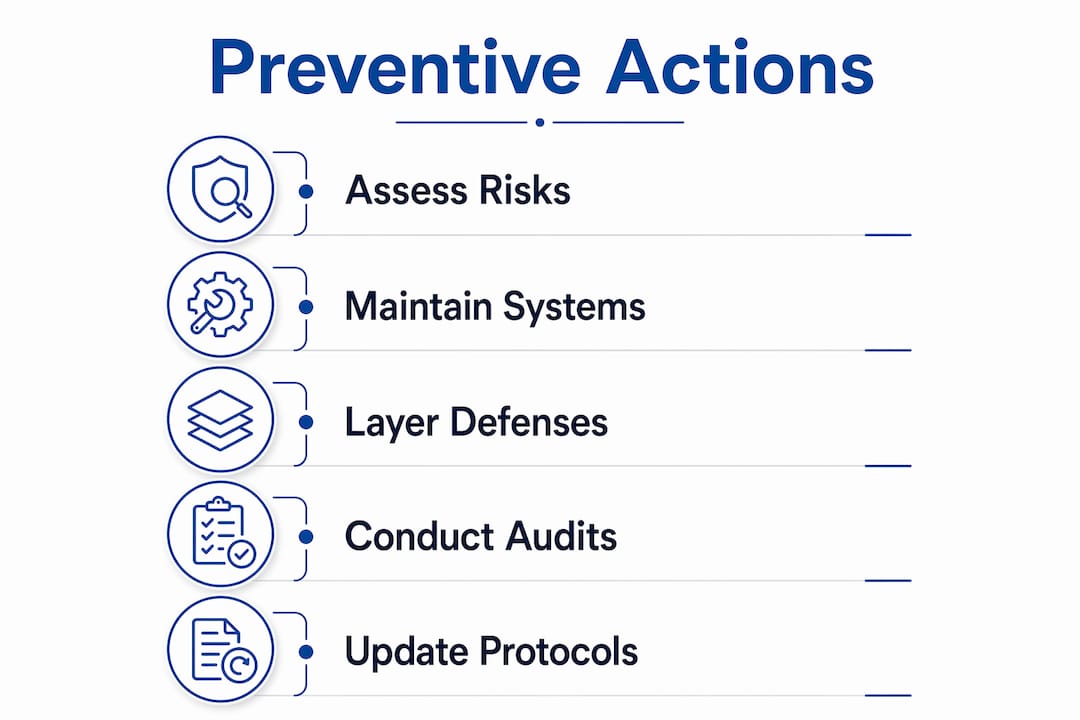
The foundation of any protection program is a layered security approach that combines physical barriers, electronic access control, surveillance, and lighting rather than relying on any single tool. No individual measure covers every threat vector. A perimeter fence stops casual intrusion but does nothing against a tailgating employee. A camera system records events but cannot prevent them without active monitoring behind it. Layering these elements creates overlapping defenses where one system compensates for the gaps in another.
The core preventive actions every facility manager should have in place include:
- Physical security risk assessments conducted at least semi-annually, covering perimeter walkthroughs, alarm checks, camera coverage reviews, and access log audits
- Electronic access control with biometric authentication, which 68% of Fortune 500 companies now use as a standard facility security measure
- Surveillance with active monitoring, not just recording, so incidents trigger real-time responses rather than post-event reviews
- Preventive maintenance inspections covering fire alarm systems, emergency lighting, sprinkler heads, and HVAC components on a documented schedule
- Immediate correction protocols for identified failures such as broken door latches, faulty cameras, or expired fire extinguisher certifications
Properly maintained facilities experience fewer safety incidents and carry lower liability exposure than those operating on a fix-it-when-it-breaks model. That gap widens significantly when environmental hazards like lightning are factored in, since a single strike can disable unprotected electrical infrastructure across an entire building.
Pro Tip:Create a single master checklist that combines your security assessment items and your preventive maintenance schedule. Reviewing both in one walkthrough saves time and surfaces cross-system vulnerabilities that separate reviews miss.
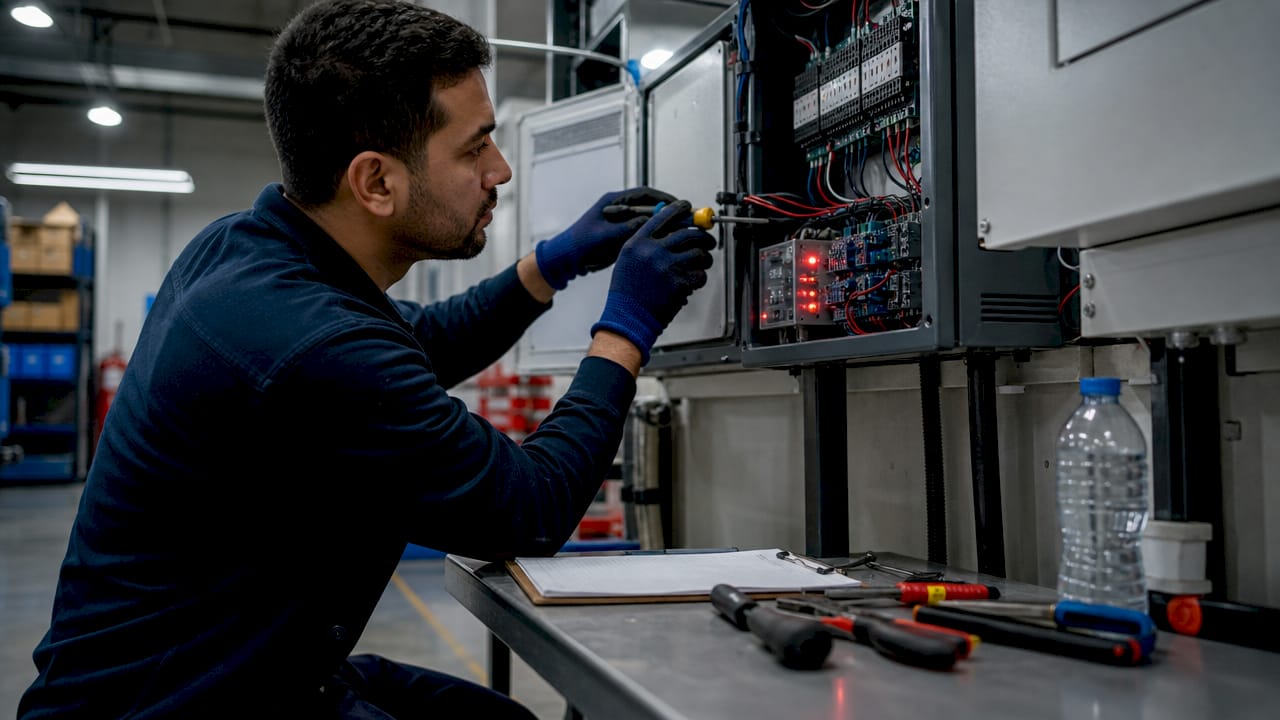
How to conduct effective facility security assessments
A security assessment is only as useful as the method behind it. Generic checklists produce generic results. Site-specific threat profiles tied to your facility’s actual operational demands consistently outperform standard templates because they account for the real movement patterns, access points, and environmental exposures unique to your site.
Follow this sequence for a thorough facility assessment:
- Map all entry and exit points, including loading docks, utility access panels, and roof hatches that standard security reviews often overlook
- Simulate an intruder path through the facility to identify blind spots in camera coverage and gaps in physical barriers that documented policies may not reflect
- Test every alarm system under realistic conditions, since untested alarms frequently fail during actual incidents when response speed matters most
- Audit access logs against current personnel records to confirm that former employees and contractors no longer hold active credentials
- Review communication channels between on-site staff, off-site monitoring services, and emergency responders to confirm response times meet your incident protocols
- Document all findings with photographs, timestamps, and assigned corrective actions with deadlines
The table below outlines a practical maintenance and testing schedule for the most critical facility protection systems:
| System | Testing frequency | Key check items |
|---|---|---|
| Fire alarm panels | Monthly | Sensor triggers, panel communication, battery backup |
| Emergency lighting | Quarterly | Battery duration, coverage area, bulb condition |
| Sprinkler systems | Semi-annually | Pressure levels, head condition, valve operation |
| Access control logs | Monthly | Active credentials, anomalous entry times, failed attempts |
| Lightning protection systems | Annually | Conductor continuity, ground resistance, connection integrity |
| Surveillance cameras | Quarterly | Image quality, coverage angles, recording storage capacity |
Combining physical walkthroughs with system audits closes the gap between what your documentation says is protected and what is actually protected. Facility security gaps most often arise from a mismatch between written policies and real staff behaviors, and only a physical simulation reveals that difference.
How to integrate lightning protection with your facility program
Lightning protection is not a standalone add-on. It is a core component of any safety protocol for facilities exposed to storm activity, and it belongs inside your broader preventive maintenance and risk management program from the start. A direct strike on an unprotected industrial building can destroy control systems, ignite fires, and trigger cascading failures across interconnected equipment. The financial and operational consequences extend well beyond the physical damage.
A complete lightning protection system includes several interdependent components:
- Air termination systems (lightning rods or early streamer emission devices) that intercept strikes before they reach the structure
- Down conductors that carry current safely from the air termination to the ground without passing through the building’s electrical infrastructure
- Grounding systems that dissipate the electrical charge into the earth, with ground resistance verified during annual inspections
- Surge protection devices installed at electrical panels and sensitive equipment connections to block secondary voltage surges caused by nearby strikes
Indelec’s Prevectron3 early streamer emission technology represents one of the more advanced approaches to air termination, designed to extend the protection radius while reducing the material footprint of the installation. For facilities with sensitive installations, Indelec also provides protection for highly sensitive sites where standard rod configurations are insufficient.
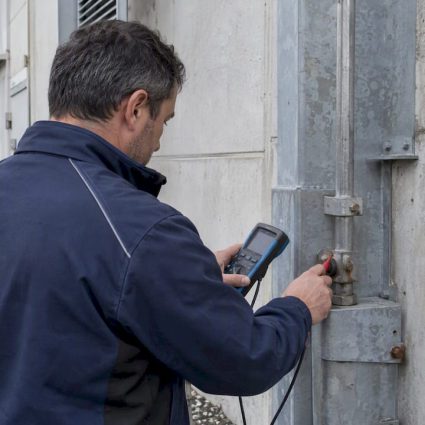
Annual inspections of lightning protection systems should verify conductor continuity, check all mechanical connections for corrosion, and measure ground resistance against the values established at installation. Any reading outside the acceptable range requires immediate remediation, not a note for the next inspection cycle. Integrating these checks into your existing semi-annual security assessment schedule keeps the entire protection program synchronized.
Pro Tip:After any significant storm event, conduct an unscheduled visual inspection of your lightning protection system’s down conductors and grounding connections. Storm-force winds can loosen mechanical connections that pass an annual test but fail under real conditions.
Common mistakes in preventive facility protection
The most expensive protection failures are not caused by missing equipment. They are caused by systems that exist but are not maintained, tested, or updated as the facility evolves. Recognizing these patterns before they become incidents is what separates a functional protection program from a paper one.
The most frequent errors facility managers make include relying on recorded surveillance footage without active monitoring behind it. Recorded footage without active monitoring delays response until after an incident is over, which is too late for prevention. Verified alarm detection paired with off-site monitoring converts a documentation tool into an actual deterrent.
Access credential management is another persistent failure point. Timely revocation of access permissions upon employee or contractor departure is one of the simplest and most frequently neglected security protocols for facilities. Every active credential belonging to a former employee is an open door.
“Tailgating remains one of the most underestimated physical security threats in commercial facilities. The technology to prevent it exists. The gap is almost always in enforcement and staff training, not in the equipment itself.”
61% of organizations identify tailgating as a major security concern, yet many rely on posted signs rather than physical or biometric controls to address it. That disconnect between awareness and action is where most preventable incidents originate.
Two additional mistakes deserve direct attention. First, ignoring false alarms rather than investigating their cause trains staff to treat all alarms as noise, which creates a critical gap when a real event occurs. Second, failing to update response protocols as operations grow or shift introduces new access points and vulnerabilities that existing plans do not cover. A facility that added a new loading bay or expanded its workforce in the past 12 months but has not revised its security plan is operating with an outdated map.
Key takeaways
Effective facility protection requires layered, site-specific preventive actions maintained on a documented schedule, with lightning protection integrated as a core system rather than an afterthought.
| Point | Details |
|---|---|
| Layer your defenses | Combine physical barriers, access control, surveillance, and lighting rather than relying on any single system. |
| Assess semi-annually | Conduct formal risk assessments every six months, including physical walkthroughs and system audits. |
| Integrate lightning protection | Include air termination, down conductors, grounding, and surge protection in your annual maintenance schedule. |
| Revoke access immediately | Remove credentials for departing employees and contractors the same day they leave the facility. |
| Update protocols as you grow | Revise security and emergency response plans whenever operations, staffing, or facility layout changes. |
Indelec’s perspective on proactive facility protection
After nearly seven decades working with industrial and commercial facilities across multiple continents, the pattern we see most consistently is this: facilities that treat protection as a cost center get surprised. Facilities that treat it as operational infrastructure do not.
The shift from reactive to proactive protection is not a philosophical stance. It is operational life insurance. Every dollar spent on a scheduled lightning protection inspection, a semi-annual security walkthrough, or a staff training session on tailgating prevention represents a fraction of what a single undetected failure costs in downtime, equipment replacement, and liability exposure.
What we have also learned is that generic programs fail in specific ways. A warehouse in a high-lightning-density region has fundamentally different risk priorities than a data center in an urban environment. Scenario-based training calibrated to role-specific threats produces measurably better staff response than annual compliance videos. And a lightning protection system designed around your facility’s actual ground resistance and structural geometry performs better than one sized to a standard template.
The facilities we see maintain the strongest protection records are not the ones with the largest budgets. They are the ones with the most disciplined maintenance schedules, the clearest escalation protocols, and the habit of treating every inspection finding as a priority rather than a suggestion.
— Indelec
Protect your facility with Indelec’s lightning protection services
Indelec has designed, installed, and maintained lightning protection systems for industrial and commercial facilities since 1955, with projects spanning energy infrastructure, manufacturing plants, data centers, and public buildings worldwide.
Whether you need a full lightning risk assessment and installation for a new facility or a maintenance audit of an existing system, Indelec’s technical teams deliver solutions built to your site’s specific exposure profile and compliance requirements. Explore Indelec’s lightning protection system applications to see how a properly integrated protection program can reduce your facility’s risk exposure and keep operations running through severe weather events.
FAQ
What are the most important preventive actions for facility protection?
The most critical preventive actions are semi-annual security risk assessments, layered physical and electronic security controls, scheduled preventive maintenance for safety systems, and integrated lightning protection with annual inspections. Immediate correction of identified failures is equally important as the assessments themselves.
How often should facility security assessments be conducted?
Formal security assessments should be conducted at least semi-annually, covering perimeter walkthroughs, alarm and camera testing, and access log reviews. Additional unscheduled checks are recommended after significant weather events or operational changes.
Why is lightning protection part of a facility security program?
Lightning protection addresses one of the most damaging environmental hazards for industrial and commercial buildings, with a single strike capable of disabling electrical infrastructure, igniting fires, and triggering equipment failures across an entire facility. Integrating it into your preventive maintenance schedule keeps it current and compliant.
What is the biggest mistake in facility access control?
Failing to revoke access credentials immediately when an employee or contractor leaves the facility is the most common and preventable access control failure. Active credentials belonging to former personnel represent a direct insider risk that no surveillance system can fully compensate for.
How does active monitoring differ from recorded surveillance?
Active monitoring means a person or automated system reviews camera feeds and alarm signals in real time, enabling an immediate response. Recorded surveillance only documents what happened after the fact, which is useful for investigation but provides no preventive value during an incident.