How to Document Electrical Hazards for Compliance

TL;DR:
- Effective electrical hazard documentation involves precise, signed, and dated records that link hazard identification to control measures and worker training. Proper organization, regular updates, and task-specific details ensure compliance and support safety programs during audits. Cultivating a safety documentation culture integrates record-keeping into daily workflows, enhancing both safety and audit readiness.
Electrical hazard documentation is the formal process of identifying, recording, and tracking workplace electrical risks to satisfy OSHA and NFPA 70E requirements and prevent injury. Every facility manager and safety professional needs a structured system for this, because absence of documentation is treated as evidence that safety procedures never occurred. The core tools are the Job Hazard Analysis (JHA), risk registers with pre and post mitigation scores, lockout/tagout (LOTO) records, and PPE hazard assessment certifications. Getting these records right is not just about passing audits. It is the difference between a defensible safety program and a liability.
How to document electrical hazards: what must be recorded
Thorough electrical hazard documentation starts with knowing exactly what information belongs in each record. Vague entries like “checked panel” or “area inspected” fail compliance reviews and leave workers unprotected.
The following categories represent the minimum required content for a complete electrical safety record set:
- Hazard identification entries: Classify each hazard by type, specifically shock, arc flash, or arc blast, and note the location, equipment involved, voltage level, and date of discovery.
- Risk register: A risk register with pre and post mitigation scores is mandatory. Record the baseline risk score, the control measures applied, and the residual risk score with the implementation date.
- PPE specifications: Generic entries like “wear PPE” fail compliance audits. Each task record must specify PPE category tied directly to incident energy levels, as required by NFPA 70E.
- Electrical diagrams and labels: One-line diagrams must be current and reflect actual installed equipment. Outdated diagrams are a frequent audit finding and a genuine safety hazard.
- Training records: Document who was trained, the topics covered, the instructor, and the date. Training documentation is one of the first requests during OSHA audits, and general training logs are not sufficient. You must show task-specific training for each worker.
- Maintenance and inspection logs: For RCD testing in particular, records must include test date, trip time, trip current, and notes on any failures. Failed RCDs must be tagged and documented until replaced.
- Live-dead-live verification records: Simply recording a circuit as “dead” is insufficient. The record must show that the voltage tester was confirmed on a known live source before and after testing the de-energized circuit.
| Document type | Minimum required content |
|---|---|
| Risk register | Hazard description, pre-mitigation score, control measures, post-mitigation score, date |
| JHA | Task steps, associated hazards, controls, worker sign-off, review date |
| LOTO procedure | Isolation points, padlock numbers, sequence of steps, authorized personnel |
| Training record | Worker name, topics, instructor, date, task specificity |
| Inspection log | Equipment ID, test results, technician, date, corrective actions |
Pro Tip:Create a documentation checklist for each task type, such as panel work, RCD testing, or energized work, so workers capture every required field before leaving the job site.

How to assess electrical risks and record the findings
Analyzing electrical hazards follows a defined sequence. Skipping steps or recording results after the fact produces records that cannot withstand scrutiny.
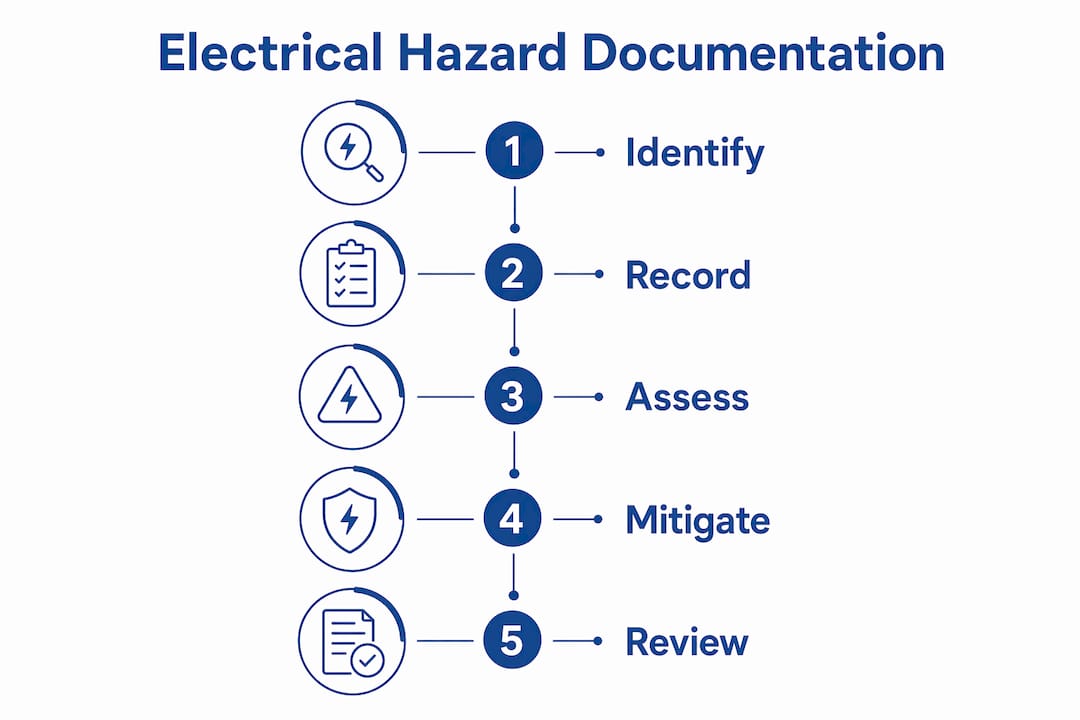
- Conduct a facility walk-through. Walk every area where electrical equipment is present. Note exposed conductors, overloaded circuits, missing labels, damaged insulation, and inadequate clearances. Photograph each finding and assign a unique identifier.
- Use infrared thermography. Thermal imaging of switchgear and distribution panels reveals hot spots invisible to the naked eye. Record the equipment ID, temperature differential, ambient conditions, and the technician’s name and calibration data for the camera.
- Apply FMEA tables. Failure Mode and Effects Analysis (FMEA) tables document failure scenarios and their safety consequences systematically. Each row captures the failure mode, its effect, its cause, and the current controls in place.
- Assign risk scores. Use a consistent risk matrix, such as a 5×5 likelihood-by-severity grid, and record both the pre-control and post-control scores. Risk registers without both scores fail to demonstrate that controls actually reduced risk.
- Involve maintenance personnel and safety officers. Their field knowledge surfaces hazards that walk-throughs miss. Document their input with names and dates to show the assessment was collaborative.
- Create and maintain a dynamic risk register. A risk register must reflect baseline risk and residual risk after controls, with dates confirming when mitigation measures were implemented. Review it whenever site conditions change.
- Record energized work permits. Any energized electrical work requires formal justification signed by management to comply with safety standards and minimize liability. The permit must reference the specific task, the risk assessment, and the PPE category assigned.
The JHA is the anchor document for this process. JHA must be treated as a live document, reviewed with the team before each task and updated whenever conditions change. It functions as an active communication tool, not a static form filed in a drawer.
Pro Tip:When updating a risk register after a near-miss or incident, preserve the original entry and add a dated revision note. Overwriting original scores destroys the audit trail.
What makes lockout/tagout documentation defensible
LOTO documentation is the most scrutinized category in electrical safety audits. Generic procedures that list steps without specifics are the single most common reason facilities fail OSHA inspections.
A compliant LOTO procedure must include:
- The specific isolation points for each piece of equipment, identified by panel number, breaker number, or disconnect label
- Unique padlock numbers assigned to each isolation point, so every lock in the sequence is traceable to a specific worker and location
- The exact sequence of de-energization steps, written in the order they must be performed
- Verification steps, including the live-dead-live verification sequence with voltage tester serial number and calibration date
- Emergency response and rescue procedures specific to the equipment and location
- Sign-off lines for the authorized employee, the affected employees, and the supervisor
Method statements for electrical work must be linked directly to the relevant risk assessment revision. If the risk assessment is updated, the method statement must be reviewed and re-approved. A live-working method statement must specify PPE category per incident energy levels to comply with NFPA 70E. Listing “appropriate PPE” without specifying the arc flash category is a compliance failure.
Test instruments used during LOTO verification must be documented with their serial number, calibration due date, and the name of the person who performed the check. This detail is frequently missing and frequently cited during inspections.
Pro Tip:Attach a laminated copy of the LOTO procedure directly to the equipment it covers. Workers are far more likely to follow a procedure they can read on-site than one stored in a binder in the safety office.
How to organize electrical hazard records for audits
Keeping documentation current and retrievable is as important as creating it in the first place. A well-written risk register buried in an unindexed folder provides no protection during an inspection.
Effective organization requires a few non-negotiable practices:
- Establish a document retention schedule aligned with OSHA and NFPA guidance. OSHA requires certain records to be retained for specific periods. Electrical safety programs, LOTO procedures, and PPE certifications should be retained for a minimum of three years, with training records kept for the duration of employment plus three years.
- Centralize records in a searchable system. Whether you use a digital safety management platform or a structured shared drive, every document must be retrievable by equipment ID, location, date, and document type within two minutes. Auditors do not wait.
- Separate active from archived documents. Current risk registers, active LOTO procedures, and valid training records belong in a clearly labeled active section. Superseded versions must be archived, not deleted, to preserve the audit trail.
- Schedule periodic reviews. Risk registers and safety programs must be reviewed at least annually and after any incident, equipment change, or regulatory update. Document the review date, the reviewer’s name, and any changes made.
- Track PPE testing intervals. Arc flash suits, insulated gloves, and voltage-rated tools all have mandatory testing intervals. Record the test date, the testing standard used, and the next due date for each item.
For facilities managing electrical safety documentation across multiple buildings or sites, a consistent naming convention and folder structure across all locations prevents the retrieval failures that derail audits.
Pro Tip:Assign a single document controller for electrical safety records. Shared ownership of documentation almost always produces gaps. One person responsible means one person accountable.
Common mistakes that undermine electrical hazard documentation
Most documentation failures are predictable. The same errors appear repeatedly across facility types and industries.
- Vague hazard descriptions: “Electrical hazard present” tells an auditor nothing. Specify the hazard type, the equipment, the voltage, and the exposure scenario.
- Missing live-dead-live records: Simply recording a circuit as dead is insufficient for compliance. The verification sequence must be documented in full.
- Disconnected method statements: A method statement that references an outdated risk assessment revision is non-compliant. Every update to the risk assessment triggers a mandatory method statement review.
- No calibration data for test instruments: Serial numbers and calibration dates for voltage testers are required. Their absence signals to auditors that verification procedures may not have been performed correctly.
- Missing signatures: Briefing attendance records, permit authorizations, and LOTO sign-offs without signatures are unenforceable and non-compliant.
- Static risk registers:Organizations must document that specific procedures were followed for each task, not just that workers received general training. A risk register that has not been updated in 18 months raises immediate red flags.
The most defensible documentation is specific, dated, signed, and linked to the actual task performed. If a record could apply to any task on any day, it is not adequate.
Pro Tip:Conduct a quarterly internal documentation audit using the same checklist an OSHA compliance officer would use. Catching gaps internally costs far less than discovering them during an inspection.
Key takeaways
Effective electrical hazard documentation requires specific, dated, signed records that link hazard identification directly to the controls applied and the workers involved.
| Point | Details |
|---|---|
| Risk registers need both scores | Record pre-mitigation and post-mitigation risk scores with implementation dates to prove controls worked. |
| LOTO procedures must be specific | Include isolation point IDs, unique padlock numbers, and live-dead-live verification with tester calibration data. |
| Training records must be task-specific | General training logs are insufficient. Document who was trained, on what task, and when. |
| JHA is a living document | Review and update the JHA with workers before each task and after any site condition change. |
| Organize for retrieval speed | Every record must be retrievable by equipment ID, location, and date within two minutes during an audit. |
Why documentation culture matters more than documentation volume
At Indelec, we have worked alongside facility managers and safety teams across industrial and infrastructure sectors for decades. The pattern we see most often is not a shortage of paperwork. It is paperwork that cannot be connected to actual events.
Facilities that pass audits consistently share one trait: their documentation tells a story. You can pick up a LOTO procedure, trace it to a risk assessment, find the training record for the worker who performed the task, and locate the inspection log that confirmed the equipment was safe before work began. Every record links to another. That chain of evidence is what protects workers and what protects the organization.
The facilities that struggle are those that treat documentation as a compliance checkbox rather than a safety tool. They produce records after the fact, use generic templates without task-specific details, and store everything in a system nobody can navigate under pressure. When an incident occurs or an auditor arrives, the gaps become immediately visible.
Our recommendation is to integrate documentation into the physical workflow. The JHA review happens at the job site, not in the office the night before. The LOTO sign-off happens at the equipment, not at a desk. The risk register update happens the same day a new hazard is identified. When documentation is part of the work rather than separate from it, quality improves and gaps disappear.
For facilities managing lightning protection systems alongside general electrical safety programs, the same documentation discipline applies. Every system, every inspection, every test result belongs in a traceable record.
— Indelec
Protect your facility with Indelec’s electrical safety expertise
Indelec has been designing and delivering electrical protection solutions since 1955, with a product line that includes the Prevectron 3 air terminal and advanced grounding systems built for industrial and infrastructure environments. Our technical consulting services support facility managers in building compliant, audit-ready electrical safety programs from the ground up.

Whether you need guidance on lightning protection system applications or support structuring your electrical hazard documentation to meet OSHA and NFPA 70E standards, Indelec’s team of specialists is equipped to help. Explore our catalog and service offerings to find the protection solutions your facility requires.
FAQ
What does OSHA require for electrical hazard documentation?
OSHA requires written electrical safety programs, LOTO procedures, and PPE hazard assessment certifications. Absence of these records is treated as evidence that the safety procedures were never performed.
How often should a risk register be updated?
A risk register must be reviewed at least annually and immediately after any incident, equipment change, or modification to site conditions. Each update must include the reviewer’s name and the date of revision.
What is live-dead-live verification and why must it be documented?
Live-dead-live verification confirms a circuit is de-energized by testing a voltage tester on a known live source before and after checking the de-energized circuit. Documentation must include the tester’s serial number, calibration date, and the results of both checks.
Why is a generic “wear PPE” entry a compliance failure?
NFPA 70E requires PPE specifications to be tied to incident energy levels and arc flash categories for each specific task. A generic entry does not demonstrate that the correct protection was selected and provides no defense during an audit.
What is the best way to organize electrical safety records for audits?
Centralize all records in a searchable system organized by equipment ID, location, date, and document type. Every active document must be retrievable within two minutes, and superseded versions must be archived rather than deleted to preserve the audit trail. You can also reference a factory electrical safety checklist to verify your record set is complete before an inspection.