Architectural Design Tips for Protection That Work

TL;DR:
- Effective protective architecture integrates defensible space, impact-resistant systems, PtD principles, and lightning protection from the earliest design stage to ensure building resilience against environmental hazards. It involves creating non-combustible buffers, specifying impact-rated windows and vents, and designing redundant security measures that are maintained over the building’s lifecycle. Early coordination and thorough documentation are essential to prevent costly retrofits and ensure long-term safety and performance.
Protective architectural design is defined as the deliberate integration of structural, material, and spatial strategies to reduce a building’s vulnerability to fire, wind, blast, and other environmental hazards. Architects, facility managers, and building owners who apply these architectural design tips for protection early in the design process consistently achieve better outcomes than those who retrofit safety features after construction. The core disciplines involved include defensible space planning, impact-resistant fenestration, and Prevention through Design (PtD), each supported by current standards from CAL FIRE, ASTM International, and the National Institute for Occupational Safety and Health (NIOSH). Getting these strategies right from the start is not a luxury. It is the difference between a building that survives a wildfire or hurricane and one that does not.
1. Create a two-zone defensible space around every structure
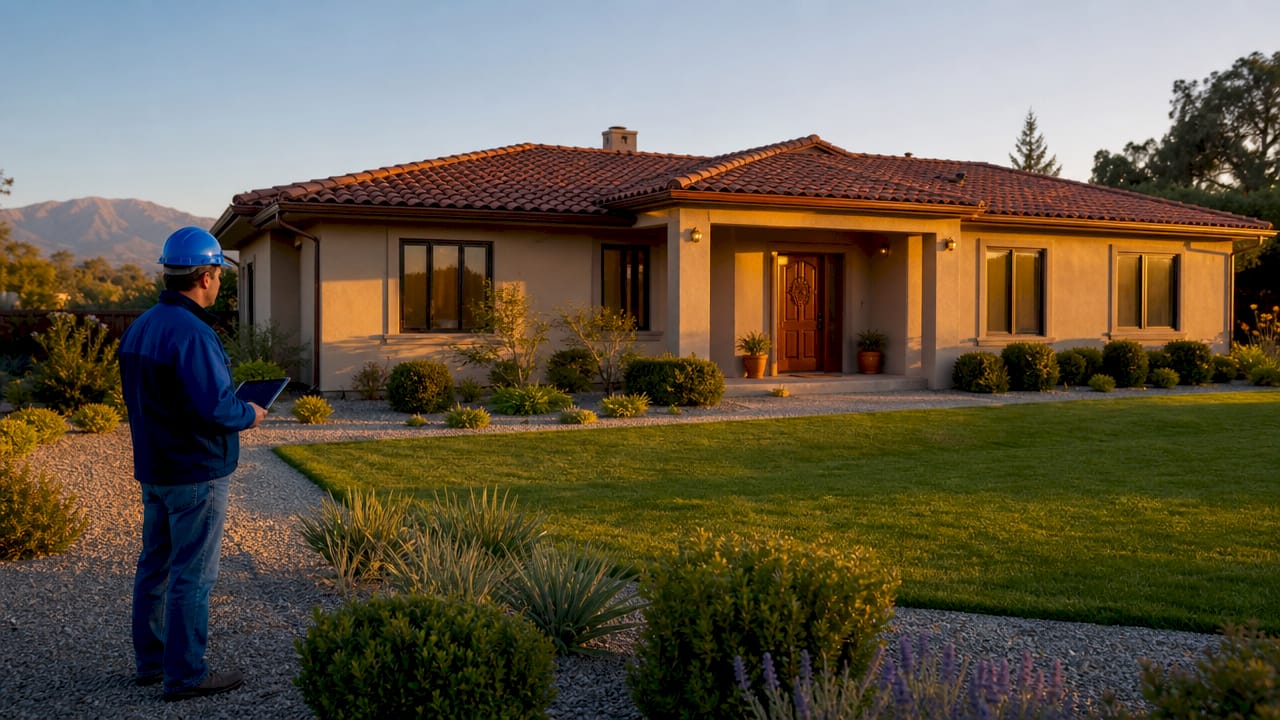
Defensible space is the buffer between a building and the vegetation or combustible materials that could fuel a wildfire. CAL FIRE and related guidance define a two-zone approach that every architect and facility manager should treat as non-negotiable on fire-prone sites.
The first zone extends from the foundation outward to 5 feet. Within this band, all combustible mulch, wood chips, and plants are replaced with gravel, concrete pavers, or stone. This non-combustible zone prevents direct flame contact with the structure’s base. The second zone runs from 5 to 30 feet and follows a “lean, clean, and green” standard: low-fuel plants spaced to prevent fire from traveling horizontally, dead material removed regularly, and no continuous ladder fuels connecting ground cover to tree canopies.
- Remove all wood mulch within 5 feet of the foundation and replace with decomposed granite or concrete
- Space shrubs so that canopies do not touch, breaking the horizontal fire path
- Prune tree branches to a minimum height of 6 feet from the ground to eliminate ladder fuels
- Clear dead leaves, pine needles, and debris from gutters and roof valleys every season
Pro Tip:Hardscaping like stone firebreaks is more effective than complex mechanical suppression systems within the immediate 5-foot zone because it requires no activation, no maintenance cycle, and no power source.
2. Specify impact-resistant windows, doors, and vents
Building codes in hurricane and high-wind zones increasingly require impact-resistant glazing with wind-rated reinforcements and properly installed roof-to-wall connections. The performance standard for windows and doors centers on laminated glass bonded with a polyvinyl butyral (PVB) interlayer, which holds the pane together on impact rather than shattering into projectiles.
Frames matter as much as glass. Aluminum and fiberglass frames with reinforced corner joints and continuous anchoring to the structural wall maintain the glazing’s rated performance under missile-test conditions. Vents and louvers are the most overlooked vulnerability in this category. Symmetric louver configurations direct blast waves outward from the centerline and provide measurably better attenuation than asymmetric designs. Ember-resistant vents with fine mesh screens prevent ignition pathways during wildfire events.
| Feature | Standard protection | Impact-rated protection |
|---|---|---|
| Window glazing | Single or double-pane annealed glass | Laminated glass with PVB interlayer |
| Frame material | Standard aluminum | Reinforced aluminum or fiberglass |
| Vent design | Open louver | Ember-resistant mesh, symmetric louver |
| Door construction | Hollow-core or standard solid | Steel-reinforced, multi-point locking |
Pro Tip:Flood vents that are improperly sized or poorly maintained can cause foundation pressure imbalances that buckle the structure rather than protect it. Size flood vents to FEMA P-55 standards and inspect them annually.
3. Apply Prevention through Design (PtD) from day one
Prevention through Design is a NIOSH-led framework that requires design teams to engineer hazards out of a building before relying on administrative controls or personal protective equipment (PPE). The hierarchy runs from elimination at the top down through substitution, engineering controls, administrative controls, and PPE at the bottom.
The critical discipline in PtD is documentation. Engineering controls must be evaluated and formally rejected before a design team can justify moving to a lower-order control. This creates an auditable record that protects the design team legally and forces genuine engagement with hazard reduction rather than defaulting to warning signs and safety training.
PtD also requires that design reviews cover maintenance and non-operational phases, not just occupancy. A rooftop mechanical unit that requires a technician to lean over an unguarded edge for routine filter replacement is a design failure, regardless of how safe the building is during normal use. Facility managers should insist on maintenance access reviews at the 30%, 60%, and 90% design milestones.
- Eliminate fall hazards by designing permanent guardrails and anchor points into rooftop structures
- Substitute hazardous materials with lower-risk alternatives during the specification phase
- Engineer out confined-space entry requirements by designing accessible utility corridors
- Document every rejected engineering control with a written rationale before specifying administrative measures
4. Build security redundancy into spatial organization
Early integration of security features in architectural design avoids the costly and often ineffective practice of retrofitting security after construction is complete. Secondary stairwells, service corridors, and compartmentalized floor plates are not just code compliance items. They are life-safety systems that improve emergency response capacity and limit the spread of threats.
Security redundancy means designing so that no single point of failure disables the entire protective system. A building with only one egress stair is a liability in a fire or active-threat scenario. A data center or hospital with a single service corridor creates a chokepoint that can be exploited or blocked. Spatial redundancy also supports protection of highly sensitive installations by separating critical infrastructure from public-access zones through deliberate circulation design.
High-risk facilities benefit from a dedicated risk register for Serious Injury and Fatality (SIF) exposures, maintained separately from general risk scores. This register ensures that fatal-consequence hazards receive higher scrutiny during design reviews and are not buried in a general risk matrix alongside minor slip-and-fall items.
5. Use traditional architectural elements as active protective features
Perforated screens, including jali, mashrabiya, and brise soleils, are among the most underutilized protective architectural features in contemporary practice. These elements originated as climate-responsive solutions in South Asian and Middle Eastern architecture, but their protective functions extend well beyond aesthetics. Proper perforation density in these screens balances light filtration, ventilation, and visibility while also functioning as a physical security barrier.
Brise soleils reduce solar heat gain on west and south facades, cutting cooling loads and reducing the thermal stress on glazing systems. When designed with the correct depth-to-spacing ratio, they also deflect wind-driven rain and reduce the pressure differential across the building envelope during storm events. The protective and aesthetic functions are not in competition. They reinforce each other when the design is modeled correctly.
“Traditional architectural elements, when properly modeled and designed, perform multi-functional protective roles beyond decoration.” This principle applies directly to contemporary blast and wind mitigation challenges, where a well-designed perforated screen can reduce facade pressure loads while maintaining the building’s visual identity.
Natural physical barriers, including water features, dense vegetation rows, and earthen berms, serve as site-level security elements that deter vehicle intrusion and reduce blast overpressure at the building perimeter. These features work best when integrated into the landscape plan from the earliest site design phase rather than added as afterthoughts.
6. Integrate lightning protection into the structural design
Lightning protection is a structural resilience requirement, not an add-on. Buildings in exposed locations, including those on elevated terrain, near water, or with large roof areas, face climate-driven increases in lightning strike frequency that make passive protection strategies insufficient on their own.
The standard approach combines an air termination system, down conductors, and an earth termination network. What separates effective lightning protection from minimal compliance is the coordination between the lightning protection system and the building’s structural, electrical, and mechanical systems. A lightning rod positioned without accounting for the building’s roof geometry, HVAC equipment, and facade materials will underperform regardless of its rated protection radius.
Architects specifying lightning protection for daring architecture need to coordinate with structural engineers early to route down conductors through the building fabric without compromising the thermal envelope or creating galvanic corrosion risks at material interfaces. This is a design coordination task, not a post-construction installation task.
7. Compare protective strategies by risk profile and budget
Not every protective design strategy is appropriate for every site. The table below maps the four primary strategies against their cost profile, primary hazard addressed, and situational fit.
| Strategy | Primary hazard | Upfront cost | Best application |
|---|---|---|---|
| Defensible space landscaping | Wildfire | Low to medium | Wildland-urban interface sites |
| Impact-resistant fenestration | Wind, blast, debris | Medium to high | Hurricane zones, urban blast-risk sites |
| PtD engineering controls | Fall, confined space, fire | Variable | All building types, highest value in new builds |
| Traditional perforated screens | Solar, wind, security | Medium | Commercial facades, institutional buildings |
The most common mistake in protective design is treating these strategies as mutually exclusive. A building in a wildfire-prone coastal zone needs defensible space landscaping, impact-resistant windows, and a coordinated lightning protection system simultaneously. Phased implementation works when budget constrains the initial build, but the design must account for all strategies from the start so that later phases do not require demolition of earlier work.
Late-stage security retrofits consistently underperform compared to integrated designs. A security consultant brought in after the structural drawings are complete cannot relocate a stairwell or redesign the circulation to create the spatial redundancy the building needs. The cost of early integration is always lower than the cost of retrofitting.
Key takeaways
Effective architectural protection requires integrating defensible space, impact-resistant systems, PtD controls, and lightning protection from the earliest design phase rather than adding them as retrofits.
| Point | Details |
|---|---|
| Start with defensible space | Replace combustible materials within 5 feet of the foundation with gravel or concrete before specifying any other fire protection measure. |
| Specify impact-rated fenestration | Laminated glass with PVB interlayers and symmetric ember-resistant vents address wind, blast, and wildfire ignition simultaneously. |
| Apply PtD documentation discipline | Formally reject engineering controls in writing before specifying administrative measures to create an auditable, legally defensible record. |
| Integrate lightning protection early | Coordinate air termination systems and down conductor routing with structural and mechanical engineers at the schematic design phase. |
| Avoid late-stage security retrofits | Security redundancy through spatial organization costs far less when designed in than when retrofitted after construction is complete. |
Indelec’s perspective on protection as a lifecycle commitment
The most persistent mistake we see across projects is treating protection as a commissioning checklist rather than a lifecycle attribute. A building that passes its fire resistance rating test on day one can fail catastrophically five years later because a maintenance contractor replaced ember-resistant vent screens with standard mesh, or because a renovation punched through a fire-rated wall without restoring the rating. Safety by Design principles are explicit on this point: safety must be embedded as a dynamic attribute that the building maintains under uncertainty, not a static feature that exists only at handover.
From Indelec’s experience working across industrial, commercial, and infrastructure sectors since 1955, the projects that perform best over time share one characteristic. The design team maintained a documented protection register that included not just the systems installed, but the engineering controls that were evaluated and rejected. That register becomes the facility manager’s operating manual for understanding why the building is designed the way it is, and what cannot be changed without reassessing the protection strategy.
The uncomfortable truth about protective design is that most degradation is self-inflicted. It happens during routine maintenance, minor renovations, and operational changes that no one flags as protection-relevant. Building owners who treat their protection register as a living document, updated at every significant change, consistently outperform those who treat it as a construction-phase deliverable.
— Indelec
How Indelec supports your building protection strategy
Indelec has delivered lightning protection solutions across industrial, commercial, and infrastructure projects worldwide for over 70 years. Its Prevectron3 lightning rod uses patented OptiMax technology to provide a verified protection radius that integrates with complex roof geometries and sensitive building systems. For architects and facility managers designing for climate resilience, Indelec’s technical consulting team coordinates lightning protection system design with structural, electrical, and mechanical disciplines from the schematic phase forward.

Indelec’s certification and maintenance services keep protection systems performing to their rated specifications across the building’s full lifecycle, addressing exactly the degradation risk that undermines most protection strategies over time. Explore Indelec’s lightning protection applications to find the right system for your site’s risk profile.
FAQ
What is the first step in designing a fire-resistant building?
The first step is establishing a non-combustible zone within 5 feet of the foundation by replacing all combustible mulch and vegetation with gravel, concrete, or stone, following CAL FIRE defensible space standards.
How do impact-resistant windows differ from standard windows?
Impact-resistant windows use laminated glass with a polyvinyl butyral interlayer bonded to reinforced frames, meeting missile-test standards that standard annealed glass cannot satisfy under wind-driven debris or blast loads.
What does Prevention through Design require from architects?
PtD requires architects to evaluate and formally document the rejection of engineering controls before specifying administrative measures or PPE, creating an auditable record that hazards were addressed at the highest possible level of the hierarchy.
Can traditional architectural screens provide real blast protection?
Yes. Perforated screens like brise soleils and jali, when designed with the correct perforation density and depth-to-spacing ratio, reduce facade pressure loads from wind and blast events while simultaneously managing solar heat gain and privacy.
When should lightning protection be integrated into building design?
Lightning protection system design should be coordinated with structural and mechanical engineers at the schematic design phase, not specified as a post-construction installation, to avoid conflicts with the thermal envelope, roof geometry, and electrical systems.