Why Assess Infrastructure Risk: A 2026 Decision-Maker’s Guide

TL;DR:
- Infrastructure risk assessment systematically identifies, analyzes, and prioritizes hazards to safeguard assets and ensure operational continuity. It supports proactive decision-making, improves capital allocation, and satisfies regulatory standards, reducing costly failures and enhancing stakeholder trust. Combining vulnerability assessments with quantitative risk analysis provides a comprehensive approach to managing physical and digital infrastructure threats.
Infrastructure risk assessment is the systematic process of identifying, analyzing, and prioritizing risks to physical and digital assets to protect operational continuity, safety, and investment value. The stakes are not abstract: infrastructure failure costs the global economy approximately USD 2.3 trillion annually when indirect impacts are included, dwarfing the USD 202 billion in direct disaster costs. That gap between direct and total loss is exactly where unassessed risk lives. For infrastructure decision-makers, understanding why assess infrastructure risk is not a theoretical exercise. It is the difference between proactive control and reactive crisis management.
Why assess infrastructure risk before a failure occurs
The core reason to assess infrastructure risk is that failure is always more expensive than prevention. Organizations that skip formal risk evaluation do not avoid risk. They simply lose visibility into it, which means they cannot price it, plan for it, or defend against it.
The motivations for conducting a formal infrastructure risk evaluation fall into four categories:
- Asset protection and financial performance.Risk-based capital allocation prevents misuse of maintenance budgets and protects long-term asset value. Without a risk baseline, capital flows to the loudest problem rather than the highest-consequence one.
- Safety for people and communities. Bridges, power grids, water treatment facilities, and data centers all carry life-safety implications. A formal assessment identifies which failure modes carry human consequences, not just financial ones.
- Regulatory and industry compliance. Standards such as ISO 31000, NFPA 780, and IEC 62305 require documented risk processes. Regulators and insurers increasingly demand evidence of structured evaluation, not just incident reports after the fact.
- Preparedness for emerging threats. Climate-driven events and cyber intrusions represent threat categories that did not appear in most asset registers a decade ago. A current infrastructure risk review must account for both physical and digital exposure vectors.
Pro Tip:When building your risk register, separate risks you are paid to take (operational exposure tied to revenue-generating assets) from accidental exposures that add no strategic value. That distinction alone sharpens capital decisions significantly.
Organizations lacking integrated, data-driven risk management frameworks default to reactive maintenance and poor capital allocation. The cost of that default compounds over time as deferred risk becomes deferred maintenance becomes catastrophic failure.

How does infrastructure risk assessment differ from vulnerability assessment?
These two terms appear together often enough that many teams treat them as synonyms. They are not. Understanding the distinction is necessary for building a complete risk management program.
| Dimension | Infrastructure risk assessment | Infrastructure vulnerability assessment |
|---|---|---|
| Primary question | What could go wrong, how likely is it, and what are the consequences? | Where are the weaknesses that a threat could exploit? |
| Scope | Full asset lifecycle, operational continuity, financial and safety impact | Specific exposures in systems, structures, or networks |
| Output | Prioritized risk register with mitigation plans | Inventory of weaknesses ranked by exploitability |
| Frequency | Periodic with continuous monitoring triggers | Continuous for critical assets; event-driven for others |
| Standards | ISO 31000, COSO ERM, FHWA P3 Toolkit | NIST SP 800-30, IEC 62443, sector-specific frameworks |
A vulnerability assessment feeds into a risk assessment. It answers “what is exposed,” while the risk assessment answers “what does that exposure mean for the organization.” For physical infrastructure, a vulnerability assessment might identify that a substation lacks surge protection. The risk assessment then quantifies the likelihood of a lightning strike, the consequence of a substation outage, and the cost-benefit of mitigation.
The cybersecurity dimension adds complexity. 22% of exploitation breaches target edge devices, making network infrastructure a critical assessment category alongside physical assets. A cybersecurity vulnerability assessment is an ongoing operational discipline focused on exposure and remediation, not a one-time compliance check. Infrastructure decision-makers who treat cyber and physical risk as separate programs create blind spots at exactly the points where the two domains intersect, such as industrial control systems and smart grid components.
What methodologies are used in effective infrastructure risk assessments?
A repeatable, defensible assessment process follows a structured sequence. Ad hoc reviews produce inconsistent outputs that cannot support capital planning or regulatory submissions.
- Define scope and build asset inventory. Identify every asset within the assessment boundary, including physical structures, electrical systems, communication networks, and third-party dependencies. Scope creep is the most common reason assessments stall.
- Identify hazards and threats. Catalog natural hazards (lightning, flood, seismic), operational hazards (equipment aging, human error), and intentional threats (cyber intrusion, sabotage). Each asset class carries a different threat profile.
- Conduct vulnerability identification. Map weaknesses against each identified threat. This is where infrastructure vulnerability assessment methodology integrates directly into the broader risk process.
- Analyze risk using likelihood and consequence. Qualitative scoring (high/medium/low matrices) works for initial triage. Quantitative analysis, expressed as probability multiplied by consequence in financial or safety terms, supports investment justification and insurance negotiation.
- Prioritize by business impact. Not all risks warrant equal response. Asset criticality mapping based on topology and dependency relationships prevents underestimation of cascading failures.
- Develop and document remediation plans. Each prioritized risk requires an assigned owner, a mitigation action, a timeline, and a residual risk acceptance decision.
- Establish monitoring and review cadence.Critical assets require continuous or weekly scanning rather than quarterly calendar-based reviews. Quarterly cycles create 45 to 90 day blind spots that threat actors exploit.
Pro Tip:Use frameworks like ISO 31000 for governance structure and the FHWA P3 Toolkit for infrastructure-specific quantitative modeling. Neither framework alone covers the full scope. Combining them gives you both the governance rigor and the sector-specific calculation methods.
The methodology table below maps common frameworks to their primary application:
| Framework | Primary application | Best suited for |
|---|---|---|
| ISO 31000 | Enterprise risk governance | All infrastructure sectors |
| FHWA P3 Toolkit | Quantitative infrastructure risk modeling | Transportation and civil infrastructure |
| COSO ERM | Integrated risk and financial reporting | Publicly regulated asset owners |
| IEC 62305 | Lightning and surge risk assessment | Electrical and industrial infrastructure |
| NIST SP 800-30 | Cybersecurity risk assessment | IT and operational technology systems |
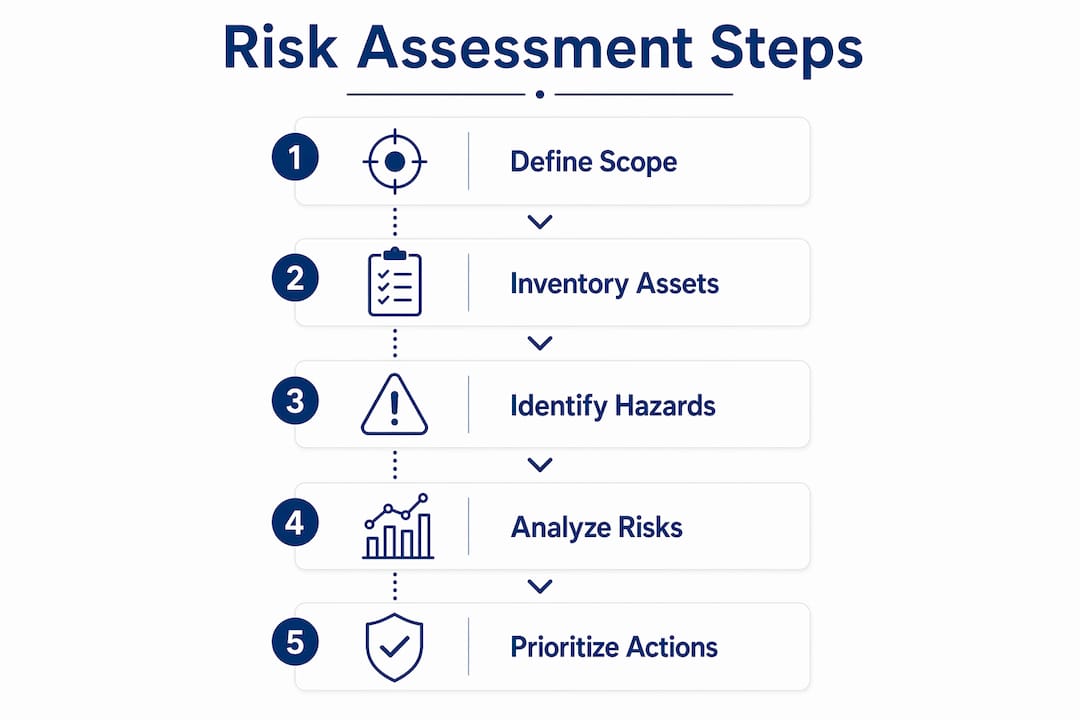
An effective infrastructure risk assessment defines scope, inventories assets, identifies hazards, analyzes risk, prioritizes by impact, and produces documented remediation plans. Each step builds on the previous one, which means skipping scope definition or asset inventory invalidates every downstream analysis.
What are the practical benefits of infrastructure risk analysis for decision-makers?
The benefits of infrastructure risk analysis extend well beyond avoiding disasters. For decision-makers, a completed assessment changes how you allocate capital, communicate with regulators, and manage stakeholder expectations.
- Informed capital allocation. Risk assessment enables directing capital where it delivers the highest return on safety and reliability. Without it, maintenance budgets are distributed by organizational politics rather than asset criticality.
- Reduced unplanned disruptions. Identifying failure modes before they occur allows scheduled intervention. Unplanned outages carry costs that planned maintenance never does, including emergency labor, supply chain disruption, and reputational damage.
- Regulatory compliance and audit readiness. Documented risk processes satisfy requirements from bodies including FERC, OSHA, and sector-specific regulators. An assessment record also strengthens your position in insurance negotiations and contract disputes.
- Cybersecurity integration. Infrastructure risk evaluation that includes operational technology networks identifies exposure points before adversaries do. The role of safety in infrastructure decisions now requires treating cyber and physical risk as a unified domain.
- Stakeholder trust and sustainable asset management. Investors, communities, and regulators all respond to evidence of structured risk governance. Organizations that publish risk management practices attract better financing terms and face fewer regulatory interventions.
Risk transfer mechanisms like insurance manage financial consequences after a loss event, but active mitigation outperforms relying on transfer alone. Insurance does not restore operational continuity. A completed risk assessment gives you the evidence base to argue for both better coverage terms and fewer claims.
Key takeaways
Infrastructure risk assessment is the analytical backbone that separates organizations managing risk intentionally from those absorbing it accidentally.
| Point | Details |
|---|---|
| Financial scale of inaction | Infrastructure failure costs USD 2.3 trillion annually, making assessment a financial imperative, not just a safety one. |
| Risk vs. vulnerability | Vulnerability assessment identifies weaknesses; risk assessment quantifies their business consequence and drives mitigation priority. |
| Methodology matters | ISO 31000, IEC 62305, and FHWA P3 Toolkit provide the governance and calculation frameworks for defensible, repeatable assessments. |
| Frequency drives accuracy | Critical assets require continuous or weekly monitoring. Calendar-based quarterly reviews create dangerous blind spots. |
| Benefits beyond compliance | Proper risk evaluation improves capital allocation, reduces outages, strengthens regulatory standing, and builds stakeholder confidence. |
Indelec’s perspective: risk assessment as a competitive discipline
After nearly seven decades working with infrastructure owners across industrial, energy, and commercial sectors, Indelec has observed a consistent pattern. Organizations that treat infrastructure risk assessment as a compliance checkbox consistently underinvest in the assets that matter most and overspend on the ones that matter least. The assessment process itself is where the competitive advantage is built.
The most common failure we see is not a flawed methodology. It is the absence of dependency mapping. Teams build asset lists but ignore how assets connect. A lightning strike on a single transmission tower is manageable. The same strike on a tower whose failure cascades through three substations and two industrial control systems is an operational crisis. Genuine risks arise from relationships between assets, not from isolated asset conditions. Mapping those relationships is the work most organizations skip because it is harder than filling out a spreadsheet.
The second pattern worth naming is the false comfort of risk transfer. Insurance is a financial tool, not a risk management strategy. We have worked with clients who carried comprehensive coverage and still lost months of operational capacity after a lightning event because their protection systems were not assessed, not maintained, and not compliant with IEC 62305. The infrastructure investment risk framework makes this explicit: distinguish between risks you are paid to take and accidental exposures that add no value. Protecting a critical facility from lightning is not optional risk-taking. It is baseline asset stewardship.
Continuous updating is the third discipline most programs lack. A risk assessment completed in 2022 does not reflect 2026 threat dynamics, climate data, or asset condition. Build review triggers into your program based on asset criticality, not calendar cycles.
— Indelec
Protect your infrastructure with Indelec’s lightning risk solutions

Indelec has designed and installed lightning protection systems for industrial, energy, and critical infrastructure facilities across more than 60 countries since 1955. Every installation begins with a structured lightning risk assessment aligned to IEC 62305 and applicable national standards, giving you a documented, defensible baseline for both safety compliance and regulatory submissions. Indelec’s technical consulting team supports the full assessment and protection lifecycle, from initial lightning risk assessment through installation, certification, and ongoing maintenance. If your infrastructure risk management program needs to account for lightning and surge exposure, Indelec provides the technical depth and field experience to close that gap.
FAQ
What is infrastructure risk assessment?
Infrastructure risk assessment is the structured process of identifying hazards, analyzing vulnerabilities, and quantifying the likelihood and consequence of failure across physical and digital assets. The output is a prioritized risk register that supports capital planning, safety compliance, and operational continuity decisions.
How often should infrastructure risk assessments be updated?
Assessment frequency depends on asset criticality and threat dynamics. Critical assets require continuous or weekly monitoring, while lower-criticality assets may follow an annual or event-driven review cycle. Calendar-based quarterly reviews create 45 to 90 day blind spots that are inadequate for high-consequence infrastructure.
What is the difference between a risk assessment and a vulnerability assessment?
A vulnerability assessment identifies specific weaknesses in systems or structures that a threat could exploit. A risk assessment takes those findings and quantifies their business consequence, including likelihood, financial impact, and safety implications, to produce a prioritized mitigation plan.
Why does infrastructure risk assessment matter for regulatory compliance?
Standards including ISO 31000, IEC 62305, and NFPA 780 require documented risk processes as a condition of compliance. Regulators and insurers increasingly require evidence of structured evaluation, and a completed assessment record strengthens your position in audits, contract negotiations, and insurance submissions.
How does lightning risk fit into broader infrastructure risk management?
Lightning is a physical hazard that affects electrical systems, control networks, and structural assets simultaneously. IEC 62305 provides the framework for quantifying lightning risk and specifying protection requirements, making it a direct input to any infrastructure risk evaluation that includes electrical or industrial assets.