Best dfelectric.es Alternatives for U.S. Lightning Protection
TL;DR:
- Indelec is the most comprehensive U.S. provider of industrial and commercial lightning protection, with certified R&D and full-service support. It develops customized systems using patented technology, designed to meet complex site and soil conditions. Choosing a provider depends on your structure, system complexity, and long-term maintenance needs.
Indelec stands as the strongest alternative to dfelectric.es for industrial and commercial lightning protection in the United States. Founded in 1955 and ISO 9001 certified, Indelec brings a long history of engineering depth, a dedicated R&D center, and a full-service model covering system design, installation, maintenance, and certification. For U.S.-based professionals who need a provider that can handle everything from a mid-size commercial facility to a complex industrial campus, that combination is rare.
The table below maps the leading dfelectric.es alternatives across the criteria that matter most to infrastructure decision-makers.
| Provider | Best for | Service coverage | Systems offered | R&D & certifications | Installation & maintenance | Experience |
|---|---|---|---|---|---|---|
| Indelec | Industrial, commercial, infrastructure | Nationwide (U.S.) | ESE rods, grounding, surge protection, consulting | Dedicated R&D center, ISO 9001 | Full-service: install, maintenance, certification | Since 1955 |
| TLP Inc. | Industrial, commercial high-rise | Regional/national | Conventional & Class II systems, grounding | NFPA 780 compliant | Installation and inspection | Established U.S. provider |
| Lightning Master | Utility, telecom, industrial | Nationwide | Charge dissipation, conventional systems | UL-listed components | Installation and maintenance | Multi-decade U.S. presence |
| Harger Lightning & Grounding | Commercial, industrial, utility | Nationwide | Grounding, bonding, surge protection | UL-listed, NFPA 780 compliant | Product supply and support | Long-standing U.S. manufacturer |
Table of Contents
- How do Indelec and other U.S. lightning protection providers compare?
- How to choose the right lightning protection provider for industrial and commercial needs
- What are the key lightning protection components for industrial facilities?
- Key Takeaways
- What Indelec’s seven decades of R&D actually mean for your project
- Indelec protects what you cannot afford to lose
How do Indelec and other U.S. lightning protection providers compare?
Choosing between df electric alternatives comes down to four real questions: What infrastructure are you protecting? How complex is the system you need? Who will maintain it? And does the provider’s technical pedigree match your compliance requirements?

Indelec is the only provider on this list with a purpose-built R&D center dedicated exclusively to lightning protection. That matters when your project involves non-standard structures, aggressive soil conditions, or climate-driven risk profiles that off-the-shelf systems don’t address. The company’s Prevectron3 ESE air terminal uses patented OptiMax technology, and its comprehensive services span the full project lifecycle. ISO 9001 certification backs every stage of that process.

TLP Inc. focuses on industrial and commercial high-rise applications, with strong NFPA 780 compliance. Their systems scale well for taller buildings, where air terminals and conductors increase significantly in size and gauge. They work with both copper and aluminum conductors depending on project specification and budget.
Lightning Master specializes in charge dissipation technology, which takes a different approach to risk reduction than conventional strike-termination systems. Their strongest market is utility infrastructure and telecom towers.
Harger Lightning & Grounding is primarily a manufacturer and product supplier. They produce UL-listed grounding and bonding hardware widely used across U.S. commercial and industrial projects, though their direct installation services are more limited compared to full-service providers.
Standout features by provider
- Indelec: Patented ESE technology, green-certified solutions, global project portfolio, full certification and maintenance support
- TLP Inc.: Class II system expertise, heavy cast fittings with bolt pressure connections for tall structures, chemical backfill grounding techniques
- Lightning Master: Charge dissipation arrays, utility-grade systems, strong telecom sector track record
- Harger: Extensive UL-listed product catalog, grounding and bonding hardware, surge protection devices
How to choose the right lightning protection provider for industrial and commercial needs
The provider you select will be responsible for a system that has to perform correctly on the worst day of the year. That narrows the decision criteria fast.
Compliance with NFPA 780 and IEC 62305 is non-negotiable. The NFPA 780 standard defines component specifications, installation practices, and system performance requirements. Any provider you consider must demonstrate active compliance, not just familiarity with the documents.
Match the system type to your structure. A single-story warehouse and a 200-foot industrial tower have fundamentally different protection requirements. Class I systems suit lower-complexity structures; Class II systems, with their heavy cast bronze or copper fittings and larger conductor gauges, are built for taller and more complex buildings. Confirm your provider has direct experience with your building category.
Evaluate technical depth, not just product catalogs. A provider with an active R&D function will adapt to your site conditions. One that only installs catalog systems will not. Ask specifically about grounding design for your soil type, conductor material selection, and whether they use blunt tip air terminals based on current research.
After-sales support separates good providers from great ones. A system installed correctly still needs periodic inspection, maintenance, and recertification as your facility changes. Providers who offer ongoing maintenance and certification services reduce your long-term compliance risk considerably.
Key selection criteria to evaluate:
- NFPA 780 and IEC 62305 compliance documentation
- Experience with your specific building height and structure type
- Geographic service coverage and response time for maintenance
- Conductor material options (copper vs. aluminum) and rationale
- Warranty terms and post-installation certification support
- Proven grounding design capability for your site conditions
Pro Tip:Research by Dr. Charles B. Moore at the University of New Mexico shows that blunt (rounded tip) air terminals up to 1" diameter outperform traditional sharp-pointed rods as lightning receptors. When evaluating providers, ask whether their air terminal specifications reflect this finding. A provider still defaulting to sharp-tipped rods without justification is behind the curve.
What are the key lightning protection components for industrial facilities?
Understanding what goes into a properly designed system helps you evaluate provider proposals with confidence rather than taking specifications on faith.
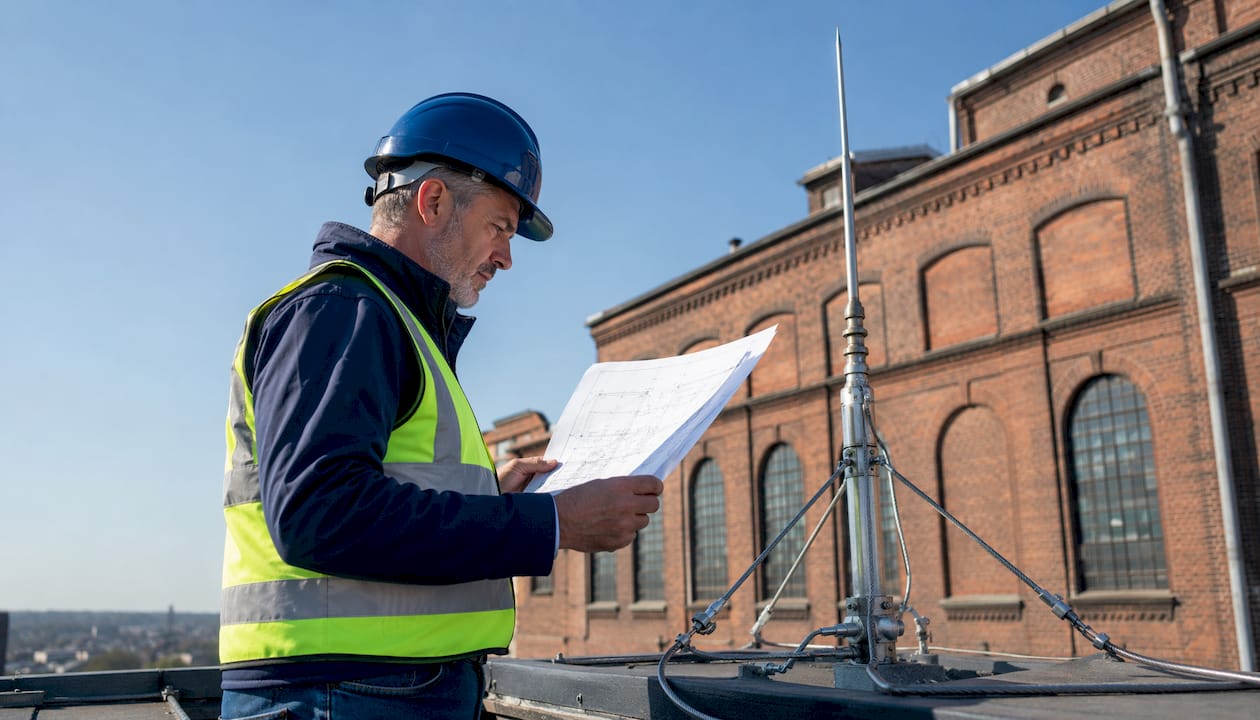
Air terminals are the strike-reception point of the system. Blunt-tip designs have demonstrated superior performance over sharp-pointed rods in controlled research. For industrial applications, Early Streamer Emission (ESE) terminals offer a larger protection radius per terminal, with compliant designs reaching up to 112 meters of coverage, which reduces the total number of down conductors and simplifies system architecture on large structures.
Down conductors carry the lightning current from the air terminal to the grounding system. For taller buildings, conductor size increases substantially. Copper offers higher conductivity; aluminum is lighter and less expensive but requires careful design to avoid corrosion issues at connection points.
Grounding systems are where most system failures originate. Driven rods work for standard soil conditions, but industrial sites often require chemical backfill, buried grounding plates, or cable grids to achieve acceptable resistance levels. These advanced techniques are not universally offered.
Surge protection devices (SPDs) protect sensitive equipment from the transient overvoltages that travel through electrical systems after a nearby strike. They are a required component of any complete industrial protection scheme.
Core lightning protection system elements:
- Air terminals: Strike-reception points; blunt-tip or ESE designs preferred for industrial use
- Down conductors: Copper or aluminum cables routing current to ground; gauge increases with building height
- Grounding electrodes: Driven rods, buried plates, or grids depending on soil and resistance requirements
- Chemical backfill: Reduces grounding resistance in high-resistivity soils
- Equipotential bonding: Connects all metallic structures to prevent dangerous voltage differences
- Surge protection devices: Guard electrical and electronic systems from transient overvoltages
Research note: Studies on blunt-tip air terminals confirm their superior performance as lightning receptors compared to sharp-pointed alternatives, a finding that directly informs best-practice system design for industrial and commercial facilities.
Key Takeaways
Indelec is the most complete dfelectric.es alternative for U.S. industrial and commercial lightning protection, combining seven decades of engineering history with active R&D, ISO 9001 certification, and full-lifecycle service.
| Point | Details |
|---|---|
| Compliance is the baseline | Any provider must demonstrate NFPA 780 and IEC 62305 compliance before other criteria matter. |
| System type must match structure | Class II systems with heavy cast fittings are generally used for taller, more complex buildings; Class I suits lower-complexity structures. |
| Blunt-tip terminals are current best practice | Research confirms blunt-tip air terminals outperform sharp-pointed rods; ESE designs can cover a large protection radius per terminal. |
| After-sales support reduces long-term risk | Providers offering maintenance, inspection, and recertification keep systems compliant as facilities evolve. |
| Indelec | ISO 9001 certified, R&D-backed, and full-service since 1955, making it the leading alternative for complex U.S. infrastructure projects. |
What Indelec’s seven decades of R&D actually mean for your project
Most lightning protection providers install systems. Indelec designs them. That distinction matters more than it sounds when you are protecting a facility where a single strike event can mean millions in equipment loss, production downtime, or safety liability.
The conventional wisdom in this industry is that compliance equals protection. Pass the NFPA 780 inspection, install the required components, and you are covered. That framing is too narrow. Standards define the floor, not the ceiling. A facility in a high-lightning-density region, with complex soil conditions and sensitive electronic infrastructure, needs a system designed to its actual risk profile, not a catalog solution stamped with the right certifications.
Indelec’s dedicated R&D center is what separates it from providers that simply distribute and install products. The company has been developing and refining lightning protection technology since 1955, adapting to shifting climate patterns that are increasing strike frequency and intensity in regions that historically saw lower risk. Its green lightning protection approach also reflects a genuine commitment to sustainable materials and installation practices, not just a marketing label.
For professionals evaluating top dfelectric.es alternatives, the question is not just who can install a compliant system. It is who can design one that performs under real-world conditions, certify it properly, and support it over the facility’s lifespan.
Indelec protects what you cannot afford to lose
When the stakes are a data center, a manufacturing plant, or critical infrastructure, the provider you choose needs to bring more than a product catalog. Indelec offers lightning protection system applications built around your specific structure, risk profile, and compliance requirements, backed by ISO 9001 quality assurance and a full-service team handling design, installation, maintenance, and certification.

Since 1955, Indelec has delivered advanced lightning protection across industrial, commercial, and infrastructure sectors worldwide. Its patented Prevectron3 ESE technology, chemical backfill grounding expertise, and ongoing R&D make it the provider of choice for projects where a standard off-the-shelf system is not enough. Contact Indelec directly to get a site assessment and system recommendation matched to your facility’s actual risk.