What is a lightning strike? A facility manager’s guide
TL;DR:
- Lightning strikes involve complex electrical discharges that can cause severe damage and pose risks to facilities. Proper understanding of strike types, behaviors, and hazards is essential for developing effective protection and safety protocols. Regular risk assessments, site-specific systems, and staff training are critical for mitigating lightning-related dangers effectively.
Most facility managers have watched a thunderstorm roll in and thought little beyond “get the outdoor workers inside.” But a lightning strike is not a single flash of light followed by a boom. It is a sequence of rapid, violent electrical events that can kill someone standing 50 feet from the point of impact, fry control systems inside a fully enclosed building, and start fires in places the bolt never directly touched. Understanding what you are actually up against changes how you plan for it.
Table of Contents
- Understanding what a lightning strike is
- The electrical intensity and physical effects of lightning strikes
- Conditions that trigger lightning strikes
- Types of lightning strikes and associated hazards for facilities
- Practical safety measures and lightning protection for industrial sites
- Rethinking lightning risk management: beyond the basics
- How Indelec solutions enhance your lightning protection strategy
- Frequently asked questions
Key Takeaways
| Point | Details |
|---|---|
| Lightning strike basics | A lightning strike is a powerful electric discharge from cloud to ground involving multiple rapid stages. |
| Electrical intensity | Lightning bolts carry immense voltage and heat, causing thunder and potential destructive hazards. |
| Strike types and risks | Direct strike, side flash, ground current, and conduction each present unique facility safety challenges. |
| Safety timing | Remain indoors at least 30 minutes after the last thunder to avoid delayed lightning hazards. |
| Protection necessity | Effective lightning protection systems and safety protocols are essential for industrial and commercial sites. |
Understanding what a lightning strike is
A lightning strike is, at its core, a cloud-to-ground electrostatic discharge that neutralizes the charged regions between a thundercloud and the earth below. The mechanics behind that visible flash are more complex than most people realize, and understanding them matters for anyone responsible for site safety.
The process begins high inside a thundercloud where ice crystals and water droplets collide, creating charge separation. Negative charges accumulate near the cloud’s base while positive charges build on the ground beneath it. When the electrical potential between the two becomes strong enough, the discharge process begins in two stages working simultaneously.
A stepped leader descends invisibly from the cloud in short, branching segments, ionizing a path through the air. Meanwhile, a positive streamer rises from tall objects on the ground, including buildings, towers, and trees. The stepped leader and positive streamer connect at a point called the attachment point, completing the conductive channel. What follows is the visible return stroke, a massive upward rush of current that produces the light we see.
Key physical facts about this process:
- A single flash can involve two to four return strokes, each lasting microseconds, which explains why lightning appears to flicker
- The entire sequence from stepped leader to final stroke can unfold in less than half a second
- The attachment point is often unpredictable, which is why tall structures and open areas carry elevated risk
- The lightning phenomenon occurs globally around 100 times per second, making it one of the most frequent severe weather events on earth
The electrical intensity and physical effects of lightning strikes
Numbers make the hazard concrete. Lightning bolts can reach 300 million volts and 30,000 amps, heating the surrounding air to over 30,000°C in milliseconds. That is roughly five times hotter than the surface of the sun.
That extreme heat causes the surrounding air to expand explosively, which is what produces thunder. Thunder is not just an audible cue that a storm is nearby. It is direct evidence that a massive electrical discharge just occurred close enough to affect your site.
For industrial and commercial facilities, the practical implications are significant:
- A direct or nearby strike can induce voltage surges across electrical systems, destroying motors, PLCs, sensors, and communication equipment even without direct contact
- Metal structures on your site act as potential attachment points and current pathways
- The peak current of 30,000 amps exceeds any rated capacity of standard electrical infrastructure, meaning protection must intercept and divert the current before it reaches sensitive systems
By the numbers: A typical household circuit breaker trips at 15 to 20 amps. A lightning bolt carries current that is roughly 1,500 to 2,000 times greater. Standard surge protectors installed for office equipment were not designed for anything close to that energy load.
Reviewing your electrical infrastructure safety against these actual energy values, rather than against generalized risk categories, often reveals significant gaps in existing protection.
Conditions that trigger lightning strikes
Understanding what causes a lightning strike helps you build better situational awareness and risk models for your specific site.
Charge separation in storm clouds creates electric fields measured in millions of volts per meter. Lightning occurs when electric field strength exceeds 3 million volts per meter, overcoming air’s natural insulating properties and forcing a discharge.
Several factors influence when and where these conditions develop:
- Convective activity driven by surface heating, especially over large paved areas or industrial heat sources, can intensify storm cell development directly above your facility
- Terrain elevation matters: sites on hillsides, near ridgelines, or surrounded by flat terrain have different exposure profiles than facilities in urban canyons
- Seasonal and regional patterns affect how frequently dangerous conditions occur at your specific location, and any credible lightning risk assessment should start with this local data
- Metallic infrastructure on your site, including tank farms, conveyor systems, and communication towers, does not attract lightning exactly (a common misconception), but it does provide preferential connection points when a stepped leader is already descending nearby
Investing in climate adaptive protection strategies built around the specific atmospheric conditions your site faces is a more defensible approach than applying generic national averages to your risk model.
Types of lightning strikes and associated hazards for facilities
This is where the lightning strike definition becomes directly operational for facility managers. Knowing the type of strike clarifies where your protection gaps actually are.
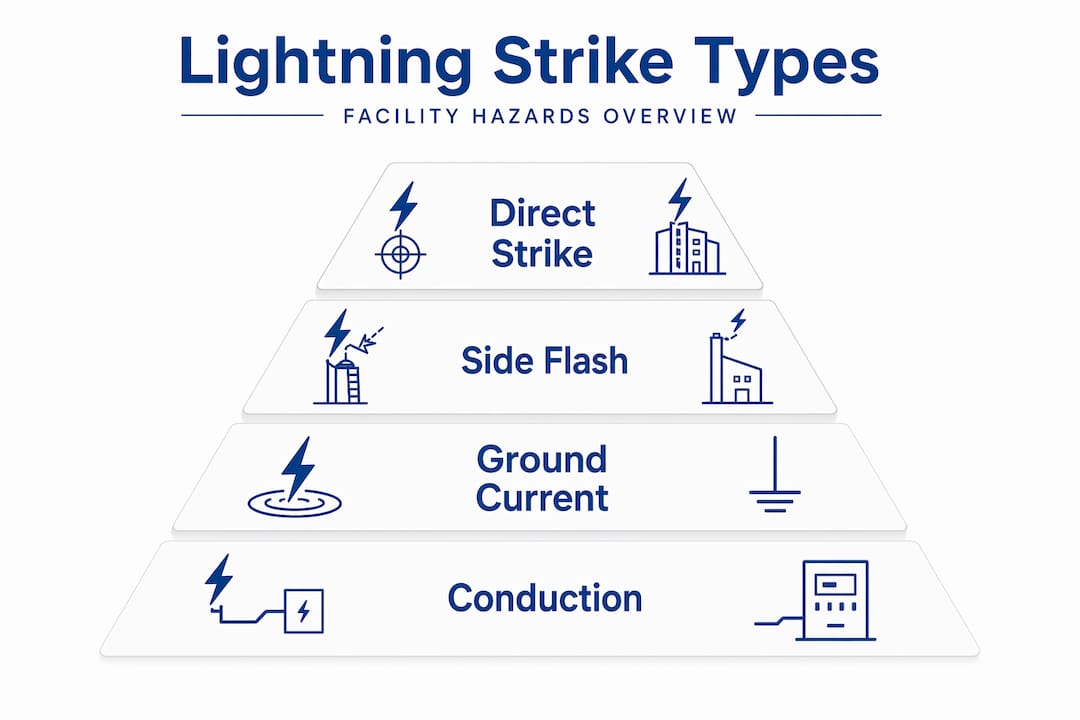
The four main types of lightning strikes that cause injury or damage are direct strikes, side flashes, ground current, and conduction. Each behaves differently and threatens different parts of your site.
| Strike type | How it works | Primary threat on industrial sites |
|---|---|---|
| Direct strike | Current passes directly through a person or structure | Open areas, rooftop equipment, elevated workers |
| Side flash | Current jumps from a struck object to a nearby person or structure | Workers near tanks, towers, or tall machinery |
| Ground current | Current spreads radially from the strike point through soil | Large areas, outdoor workers, buried infrastructure |
| Conduction | Current travels through connected wiring or metal pathways | Control rooms, communication systems, indoor staff |
Ground current is responsible for the majority of lightning fatalities, which surprises most people. The bolt does not need to hit a person directly. A strike into the ground 30 or 40 feet away sends current radiating outward through the earth, and anyone standing in that zone experiences a voltage gradient across their body.
Conduction is the most underestimated indoor threat. Workers sheltering inside a building are not automatically safe if they remain in contact with wiring, metal piping, or equipment connected to outdoor infrastructure. This is especially relevant on sites with extensive process piping, grounding networks, or integrated control systems.
Pro Tip: Review your facility’s lightning safety considerations for each strike type separately, not as a single category. A risk assessment that only asks “do we have a lightning rod?” misses the side flash, ground current, and conduction pathways entirely. Your lightning protection system needs to address all four.
Practical safety measures and lightning protection for industrial sites
Effective lightning strike safety tips are not generic reminders to “go inside when it rains.” For industrial and commercial sites, they are operational protocols that need to be trained, documented, and tested.
- Apply the 30-minute rule without negotiation. When thunder is audible, lightning is already within striking range of your site. All outdoor work must stop immediately, and staff should not return to outdoor work until 30 minutes after the last thunder is heard, not the last visible lightning.
- Map your high-risk zones before storm season. Identify elevated structures, open storage yards, fueling stations, and outdoor loading docks. Each requires a specific shelter plan, not a general instruction to “find cover.”
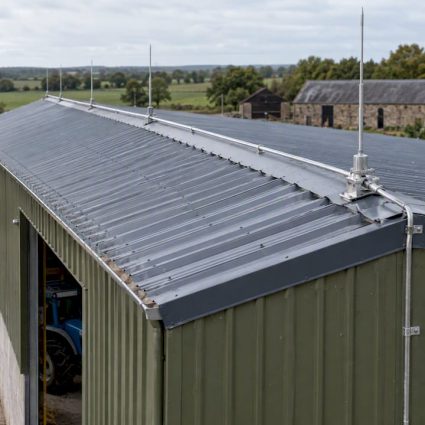
- Inspect and document your lightning protection systems on a regular schedule. A compliant lightning protection system provides protection only when all components, including air terminals, down conductors, bonding, and grounding electrodes, are intact and tested. Corrosion, mechanical damage, or unauthorized modifications can disable the system without any visible sign.
- Establish a site-specific thunder warning protocol. Real-time lightning detection services can give your team 20 to 30 minutes of advance warning before a storm reaches your location, which is enough time to suspend crane operations, secure elevated workers, and initiate pre-storm checklists.
- Train staff on conduction hazards indoors. People sheltering inside need to understand why they should not use corded phones, stand near metal process lines, or work on connected electrical panels during active storms.
- Reference and follow recognized lightning protection standards relevant to your jurisdiction and industry sector. Compliance is not just a legal protection; it reflects the current state of knowledge on what actually works.
Pro Tip: Lightning protection applications differ significantly between a warehouse, a process plant, a fuel storage facility, and a communication tower. Your lightning protection applications should reflect the specific structure, contents, and personnel exposure at each part of your site, not a one-size solution applied across the whole facility.
Rethinking lightning risk management: beyond the basics
Here is an uncomfortable truth we see repeatedly in facility assessments: most sites have some form of lightning protection installed, and most of those systems were designed for the building as it existed years ago, not as it operates today. Process expansions, new equipment installations, added communication infrastructure, and even landscaping changes can all alter the risk profile in ways the original system was not designed to handle.
The other persistent gap is treating lightning as a single event. Lightning is a sequence of electrical discharges that can extend risk over time and space. A multi-stroke flash means that even if the first return stroke is captured by your protection system, subsequent strokes in the same channel can follow in milliseconds, and some will carry even higher peak currents.
The 30-minute rule is valuable, but it is a general guideline derived from population-wide data. On a site with high-value assets, flammable materials, or critical infrastructure, the question is not just “is the storm gone?” but “has the electrical environment fully normalized?” Sites near frequent storm tracks or in high-lightning-density regions may need dynamic risk tools, including real-time lightning warning systems, rather than relying solely on static time rules.
What separates adequate protection from genuinely defensible protection is a regular, structured risk review. The advanced lightning risk strategies that work best treat lightning protection as a living system, updated as your site evolves, not a box that was checked during construction.
How Indelec solutions enhance your lightning protection strategy
With a clear picture of what lightning strikes are, how they behave, and the specific hazards they create at industrial and commercial sites, the logical next step is ensuring your facility’s defenses match that reality.

Indelec has been developing and installing lightning protection systems for industrial and commercial facilities since 1955. The company’s approach starts with a site-specific risk assessment and covers everything from turnkey lightning protection systems designed around your facility’s actual exposure, to full compliance with applicable lightning protection standards across international and regional frameworks. For facilities that need ongoing assurance, Indelec’s professional lightning protection services include installation, periodic inspection, maintenance, and certification to keep your system performing as designed as your site changes over time.
Frequently asked questions
What exactly happens during a lightning strike?
A lightning strike is a rapid electrostatic discharge between a thundercloud and the ground, initiated by a stepped leader descending from the cloud and a positive streamer rising from the ground; when they connect, they form the visible lightning bolt and return stroke.
Why is thunder important for lightning safety?
Thunder is caused by the rapid expansion of air heated to extreme temperatures by a lightning bolt; hearing it at any volume means lightning is close enough to strike your location, and safety actions should begin immediately.
What are the main types of lightning strikes that can cause injuries?
The four main strike types are direct strike, side flash, ground current, and conduction, each creating different exposure scenarios for people and assets at industrial and commercial facilities.
How far can lightning strike away from its parent thunderstorm?
Lightning can strike more than 10 miles away from a storm’s rainfall area, which means outdoor operations should cease when thunder is audible even if skies overhead are still clear.
What is the best practice for facility managers to protect against lightning?
Facility managers should combine a compliant lightning protection system with documented safety protocols, staff training on all four strike types, and regular system maintenance, because proven lightning safety guidelines consistently show that structured, site-specific programs reduce injury and fatality risk significantly.