Step-by-Step Electrical Protection Upgrade: Facility Safety Guide

TL;DR:
- Outdated electrical protection increases fire risk, downtime, and liability, requiring timely upgrades.
- A thorough assessment identifies gaps and informs a prioritized compliance plan aligned with current codes.
- Continuous testing, monitoring, and iterative updates are essential for ongoing safety and protection reliability.
Outdated electrical protection is not just an inconvenience. When a breaker fails to interrupt a fault or a relay misses a surge, you are looking at equipment fires, prolonged downtime, and liability exposure that no insurance policy fully covers. Regulatory pressure adds another layer: NFPA 70B became an enforceable standard in 2023, meaning organizations operating on goodwill and legacy systems now face real enforcement risk. This guide walks facility managers and safety officers through every phase of an electrical protection upgrade, from the initial system evaluation to post-installation verification, so you can protect your people, your assets, and your compliance standing.
Table of Contents
- Assessing your current electrical protection system
- Planning the upgrade and securing compliance
- Executing the upgrade: relay integration and arc flash protection
- Testing, verification, and ongoing maintenance
- Hard-won lessons: what most facility leaders overlook in electrical protection upgrades
- Take your facility’s electrical protection to the next level with expert solutions
- Frequently asked questions
Key Takeaways
| Point | Details |
|---|---|
| Assess before upgrading | A thorough system evaluation prevents costly oversights and ensures code compliance. |
| Plan for code updates | Integrate current NEC and NFPA 70B requirements during planning to avoid delays. |
| Mitigate arc flash hazards | Applying advanced protection can cut incident energy by up to 90 percent. |
| Test and maintain systems | Routine verification and maintenance keep your facility protected and compliant long-term. |
| Upgrades are ongoing | Sustained safety relies on continuous improvement, not one-off fixes. |
Assessing your current electrical protection system
Before you order a single new component, you need an honest picture of what you have. Start by inventorying every protective device in your facility: circuit breakers, fuses, overload relays, ground fault circuit interrupters (GFCI), and arc fault circuit interrupters (AFCI). Note the manufacturer, model, voltage and ampere rating, and installation date for each. Missing or incorrect entries are a red flag before any analysis even begins.
Next, document your system layout and load profile. Load assessment using NEC Article 220 is the recognized method for calculating connected loads and demand factors across circuits. This step often reveals that panels serving expanded production lines are operating at or above their rated capacity, a situation that invites nuisance trips at best and catastrophic faults at worst.
With hardware documented, compare your findings against current codes. Common gaps that surface during this exercise include:
- Missing AFCI protection on branch circuits now required under the NEC
- GFCI devices absent in wet or outdoor locations
- Under-rated equipment that was acceptable under an older code cycle
- Incomplete or missing single-line diagrams
- No formal maintenance records for protective relays
Poor documentation is one of the most underestimated risks. An undocumented system cannot be safely modified, and it almost always fails AHJ (Authority Having Jurisdiction) inspection.
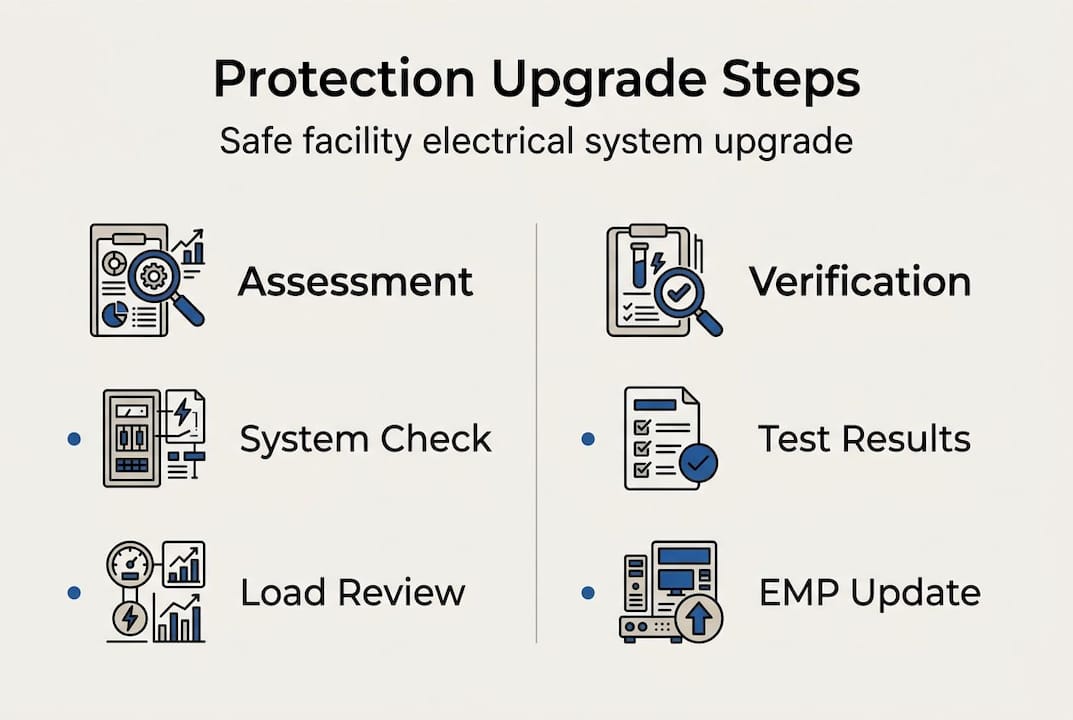
For a systematic approach, structure your assessment as an Electrical Maintenance Program (EMP). NFPA 70B requires a formal EMP that includes an EMP coordinator, qualified personnel, equipment surveys with prioritization, documented inspection procedures, records retention, and a continuous improvement process. Treating your initial assessment as the first cycle of that EMP sets the right tone for everything that follows.
| Assessment area | What to check | Common finding |
|---|---|---|
| Breakers and fuses | Rating vs. actual load | Undersized or oversized devices |
| GFCI/AFCI coverage | NEC-required locations | Gaps in wet or dwelling-adjacent areas |
| Relay settings | Coordination study | Settings never updated after load changes |
| Single-line diagrams | Accuracy vs. field reality | Outdated or missing drawings |
| Maintenance records | Last test date, results | No records or records older than 6 years |
Pro Tip: Cross-reference your industrial electrical safety inventory against your current insurance policy requirements. Insurers increasingly demand proof of NEC/NFPA compliance, and gaps can affect your coverage limits.
Use the completed assessment as the input for every decision that follows. A facility that skips this step routinely discovers mid-project that its service entrance is too small for the upgraded protection scheme, adding cost and schedule delays that a proper assessment would have avoided. A thorough factory safety checklist approach at this stage pays dividends throughout the entire upgrade.
Planning the upgrade and securing compliance
A solid assessment hands you a gap list. Now you need a plan that closes those gaps in the right sequence, with the right approvals in place.
Start with a formal code gap analysis. Compare your documented system against the current NEC edition adopted by your state, NFPA 70B (now enforceable), and NFPA 70E for electrical safety in the workplace. List every deficiency, assign a risk severity, and rank corrective actions by priority. This ranked list becomes the backbone of your project scope.
Permit and approval steps follow a structured path:
- Prepare detailed drawings, including single-line diagrams updated to reflect proposed changes
- Submit permit application to AHJ with drawings and equipment specifications
- Address any AHJ comments or plan revisions before work begins
- Coordinate with your utility for any service-level changes or planned outages
- Schedule inspections at required milestones, not just at final closeout
Utility coordination is a step many facilities underestimate. Service upgrades, temporary disconnects, and metering changes require lead times that routinely stretch four to twelve weeks. Build that into your schedule from day one.
One of the more consequential decisions at this stage is choosing between condition-based and time-based maintenance going forward. NFPA 70B now enforces a condition-based maintenance philosophy, which prioritizes equipment state over fixed calendar intervals. For facilities with continuous monitoring capability, this approach reduces unnecessary downtime while catching real problems earlier. Time-based schedules remain practical for smaller sites without monitoring infrastructure, but they carry the risk of missing developing faults between intervals.
| Maintenance approach | Best suited for | Key advantage | Key limitation |
|---|---|---|---|
| Condition-based | Sites with monitoring systems | Catches faults early, less downtime | Requires monitoring investment |
| Time-based | Smaller, unmonitored facilities | Simple to schedule | May miss faults between intervals |
Always confirm which code standards apply to your jurisdiction before finalizing the plan. Standards vary by state and by facility type, and assuming the wrong edition wastes both time and money. Your system application process should reflect the exact code edition your AHJ enforces.
Executing the upgrade: relay integration and arc flash protection
Approvals in hand, you move to physical execution. Licensed electricians must perform all installation work. This is non-negotiable from both a safety and a permit compliance standpoint.

Protective relay upgrades follow a disciplined sequence. Field verification comes first: confirm current transformer (CT) and voltage transformer (VT) ratios, trace and verify all wiring, and document the existing protection intent. Only then do you develop the retrofit design. Relay upgrade execution includes settings development and coordination studies, production of updated wiring documentation, factory acceptance testing (FAT), site acceptance testing (SAT), and full commissioning with end-to-end testing. Skipping any of these steps is how facilities end up with relays that operate correctly in isolation but fail during an actual fault.
Arc flash risk deserves specific attention at this stage. Several protection strategies can dramatically cut incident energy levels:
- Bus differential protection, which reduces incident energy by 80 to 90%
- Arc flash relays that clear faults in as little as 2 cycles (approximately 35 milliseconds)
- Zone-selective interlocking (ZSI), which speeds up upstream breaker response without sacrificing coordination
- Current-limiting fuses on medium-voltage feeders
- High-resistance grounding systems that limit ground fault current
“Bus differential protection reduces incident energy by 80 to 90%, making it one of the most effective single investments a facility can make for worker safety in medium voltage environments.”
Pro Tip: During relay commissioning, always conduct a full end-to-end test that simulates actual fault conditions, not just bench tests. Wiring errors between CT circuits and relay inputs are a leading cause of protection failures that only show up under load.
Common execution pitfalls include improper isolation during relay removal, outdated settings carried forward without a new coordination study, and missing documentation updates after field changes. Each of these creates a silent vulnerability. A well-executed upgrade also considers step-by-step lightning protection integration, since surge and lightning events are among the top causes of relay and transformer damage. Confirm your compliance and lightning safety posture is aligned with the upgraded protection scheme before closing out the project.
Testing, verification, and ongoing maintenance
Installation complete does not mean project complete. Acceptance testing is a mandatory layer between physical work and energization.
Required post-upgrade tests include:
- Protective relay functional tests: verify trip timing, pickup current, and coordination with upstream and downstream devices
- Transformer acceptance tests: turns ratio, insulation resistance, power factor, and dissolved gas analysis before re-energizing after any fault event
- GFCI/AFCI trip testing at every installed device
- Breaker contact resistance and insulation resistance checks
- Grounding system continuity and resistance-to-earth measurements
For transformers specifically, post-trip analysis per IEEE C37.91-2021 requires turns ratio, insulation resistance, power factor tests, and dissolved gas analysis before re-energizing a unit that has experienced a fault. This prevents energizing a transformer that sustained internal damage during the event that triggered the trip.
AHJ final inspection closes the permit. Prepare a complete package: updated as-built drawings, test reports, equipment data sheets, and a summary of changes from the original installation. Inspectors who receive organized documentation rarely find surprises that delay approval.
| Test type | Standard | Frequency after commissioning |
|---|---|---|
| Unmonitored relay test | NERC PRC-005 | Every 6 years |
| Monitored microprocessor relay | NERC PRC-005 | Every 12 years |
| Transformer insulation resistance | IEEE C37.91 | Per maintenance schedule or post-fault |
| GFCI/AFCI function test | NFPA 70B EMP | Annually or per EMP plan |
Design your ongoing EMP around these intervals. Assign an EMP coordinator, define qualified personnel for each task, maintain test records with enough detail to demonstrate continuous improvement, and schedule annual reviews of the EMP itself. The importance of routine maintenance cannot be overstated: facilities that treat the post-upgrade period as maintenance-free routinely lose the safety margin they worked hard to establish.
Hard-won lessons: what most facility leaders overlook in electrical protection upgrades
After decades of working with industrial and commercial facilities, a pattern emerges. Teams execute technically sound upgrades, pass final inspection, and then treat protection as a solved problem. It is not.
The most dangerous assumption in facility management is that a successful upgrade equals lasting safety. Protection systems drift. Loads change. Process expansions add circuits that were never modeled in the original coordination study. Relay settings optimized for one operating condition become mismatched when a second production shift is added two years later.
Conventional wisdom says install and move on. Experience says the upgrade is the starting point for an iterative process, not the endpoint. Performance-based maintenance, which continuously evaluates equipment condition rather than waiting for a calendar date, catches these drifts before they become incidents. Adapting protection to real-world risks means revisiting your coordination study every time there is a significant load change, not just when a regulator asks.
Major electrical incidents almost always trace back to a small gap: a relay setting never updated after a load expansion, a GFCI device bypassed during a temporary installation that became permanent, or an EMP that existed on paper but was never actually executed. Real safety is proactive and iterative. The facilities with the best safety records treat their EMP as a living management system, not an annual checkbox.
Take your facility’s electrical protection to the next level with expert solutions
Every step in this guide requires not just knowledge but precision execution. Gaps in assessment, planning, or testing create the exact vulnerabilities you are working to eliminate.

Indelec supports facility managers and safety officers through every phase of electrical and lightning protection upgrades, from initial system assessment and gap analysis to installation, commissioning, and EMP design. Our team specializes in customized solutions for industrial and commercial environments where compliance and reliability are not optional. Explore our electrical and lightning protection systems for a clear picture of what a compliant, future-proof setup looks like. Review our lightning compliance guides to confirm your facility meets current standards, and discover how our higher efficiency ESE lightning rods deliver proven, measurable protection. Contact us to discuss your facility’s specific needs.
Frequently asked questions
How often should electrical protection systems be tested?
Unmonitored protective relays should be tested every 6 years, while monitored microprocessor relays require testing every 12 years, per NERC PRC-005. Facility EMPs should align testing schedules to these intervals at a minimum.
Are arc flash upgrades necessary in all facilities?
Arc flash upgrades are especially critical in medium and high voltage environments, where bus differential protection can reduce incident energy by 80 to 90%, significantly cutting injury and equipment risks. Lower voltage facilities should still evaluate exposure as part of their arc flash hazard analysis.
What is the role of NFPA 70B in electrical protection upgrades?
NFPA 70B now mandates formal Electrical Maintenance Programs for electrical safety, integrating with NFPA 70E and the NEC to create a complete compliance framework. It shifted from a recommended practice to an enforceable standard in 2023.
Does every electrical protection upgrade require a shutdown?
Not always. Relay upgrades without outage are achievable through careful isolation, staging, and utility coordination, meaning facilities can often maintain partial operations during the upgrade process.