Role of Isolated Lightning Protection for Facilities
TL;DR:
- An isolated lightning protection system physically separates conductors from the protected structure, eliminating arcing risk. It is essential for explosive atmospheres and sensitive electronic sites, with design governed by IEC 62305 standards. Proper grounding, surge protection, and regular maintenance ensure system effectiveness and compliance.
An isolated lightning protection system (LPS) is defined as a system that physically separates all lightning conductors from the protected structure, preventing direct current contact and eliminating the risk of arcing, fire, or explosion. The role of isolated lightning protection is not optional for high-risk industrial and commercial facilities. It is the difference between a controlled lightning discharge and a catastrophic event. Standards like IEC 62305 govern how these systems are designed, and tools like LPS Manager help facility managers quantify risk. Indelec has been engineering compliant isolated LPS solutions since 1955, serving industrial, energy, and infrastructure sectors worldwide.
How does an isolated lightning protection system work?
An isolated LPS functions by maintaining a mandatory physical separation between lightning interceptors and the protected structure, so no direct current contact occurs. This separation is the defining feature. It is not about disconnecting the system from earth. It is about keeping the high-energy discharge path away from the building fabric itself.
Here is what that means in practice:
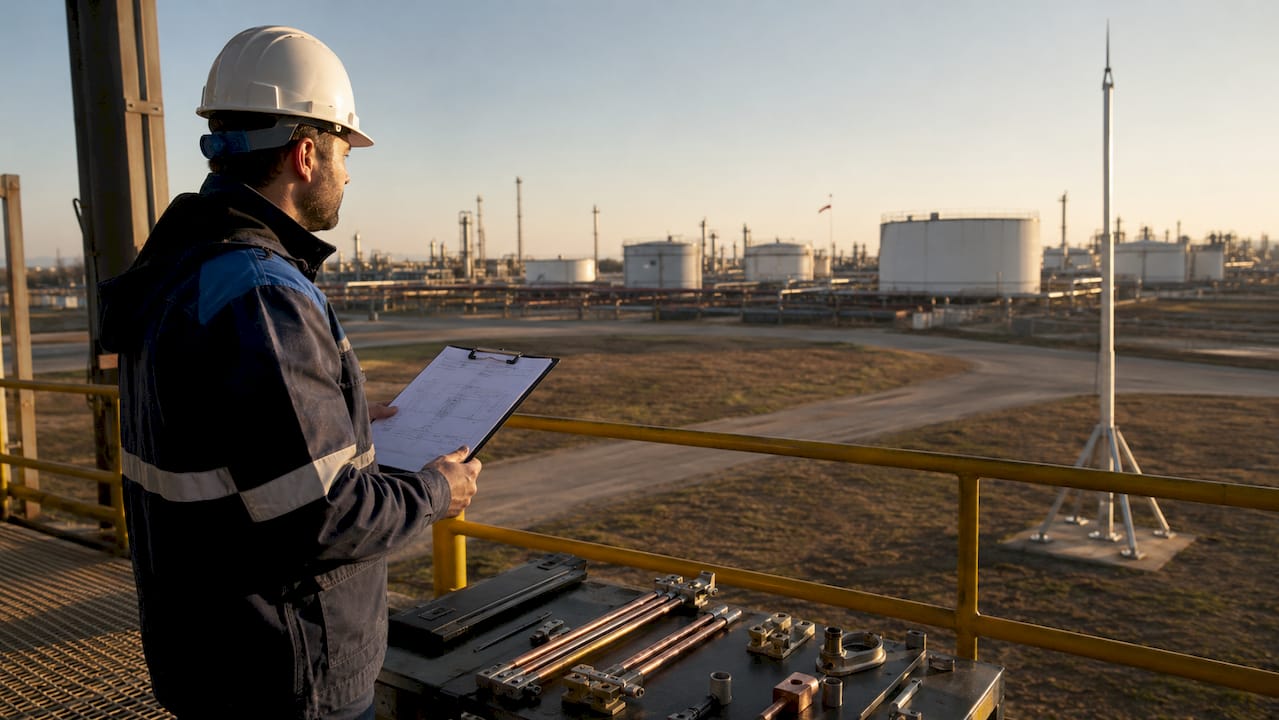
- Air termination: Free-standing masts or poles positioned away from the structure intercept the strike before it reaches the building.
- Down conductors: Routed outside the building envelope, never through walls or structural steel, to carry current to ground.
- Grounding electrodes: Fully earthed, just like bonded systems, but placed to minimize step and touch voltages around personnel zones.
- Separation distance: Calculated per IEC 62305 to prevent side-flashing between the conductor and any metallic building element.
A common misconception is that “isolated” means ungrounded. That is incorrect. Isolated systems are fully grounded but maintain physical separation to prevent sparking. The distinction matters enormously in hazardous areas where a single arc can ignite flammable vapors or dust.
Isolated LPS are the required choice for explosive atmospheres, petrochemical plants, fuel storage facilities, and sites housing sensitive electronic equipment. In these environments, a bonded system that routes current through or near the structure creates unacceptable ignition risk. The isolated approach eliminates that pathway entirely.
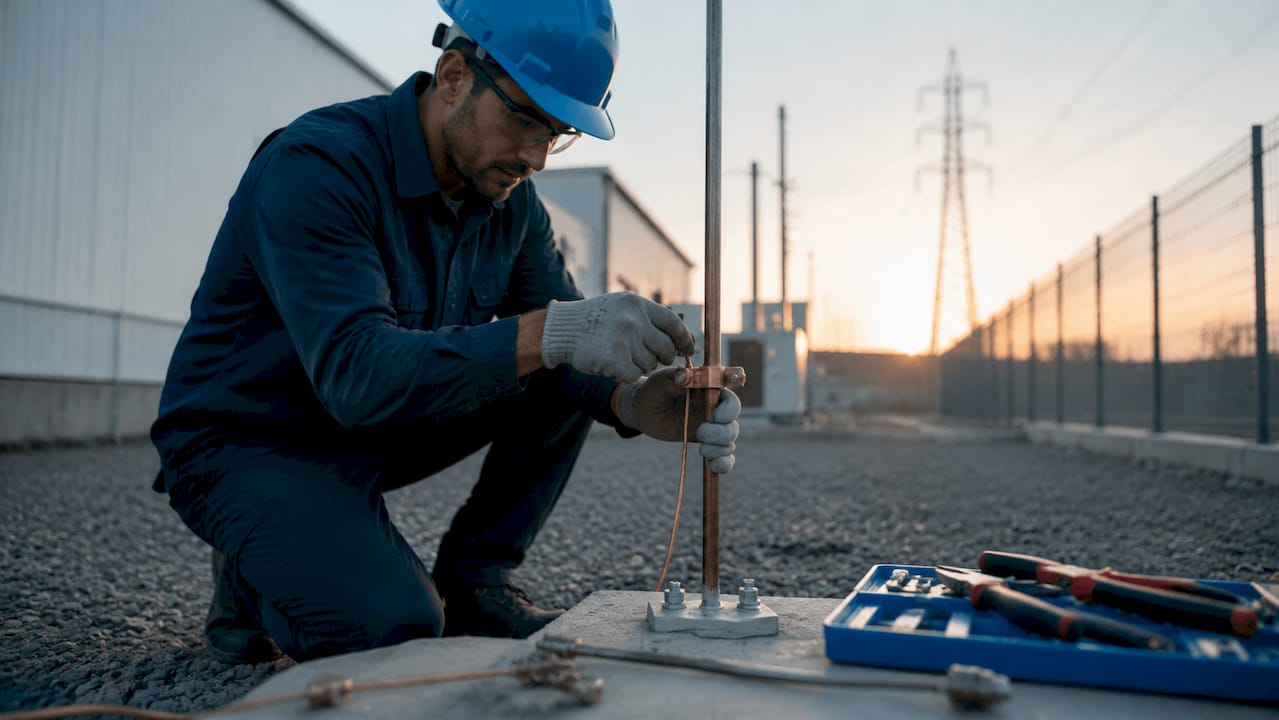
Pro Tip:When specifying separation distances, always calculate based on the worst-case LPL assigned to your site, not the average. Underestimating this figure is the most common design error Indelec’s engineers encounter on industrial retrofits.
What standards and risk assessment methods govern isolated LPS design?
IEC 62305 is the governing international standard for lightning protection system design, and it specifies both the risk assessment methodology and the Lightning Protection Levels (LPL I through IV) that determine system parameters. LPL I represents the highest protection efficiency and is assigned to the most critical or hazardous sites. LPL IV applies to lower-risk structures. Every design decision, including whether an isolated or bonded approach is required, flows from this classification.
The risk assessment process under IEC 62305 Part 2 involves a quantitative evaluation of lightning strike frequency at the site, the tolerable risk threshold for the structure and its occupants, and the consequences of a strike. This is not a checkbox exercise. It is a structured calculation that produces a defensible, documented result.
A practical implementation sequence for facility managers looks like this:
- Commission a site-specific risk assessment using IEC 62305-2 methodology, accounting for ground flash density, structure dimensions, and occupancy type.
- Determine the required LPL based on calculated risk versus tolerable risk thresholds.
- Design the external LPS to meet the LPL, specifying isolated or bonded configuration based on site hazard classification.
- Coordinate surge protective devices (SPDs) at all service entrances and internal panels. External LPS alone cannot prevent internal transient overvoltages from damaging sensitive equipment.
- Commission and test the installed system, documenting grounding resistance and separation distances before sign-off.
“Risk management is a strategic process requiring detailed documentation of network entries and zoning to prioritize protection investment appropriately.” — IEC 62305 Risk Assessment Worksheet, LPS Manager
For mission-critical sites like data centers, installation projects typically follow a 3-month cycle covering detailed planning, installation, and commissioning phases. Facility managers should build this timeline into capital project schedules, not treat it as a last-minute add-on. Indelec’s lightning risk assessment services cover this full process, from initial site survey through final certification.
Isolated vs. bonded lightning protection: which system fits your facility?
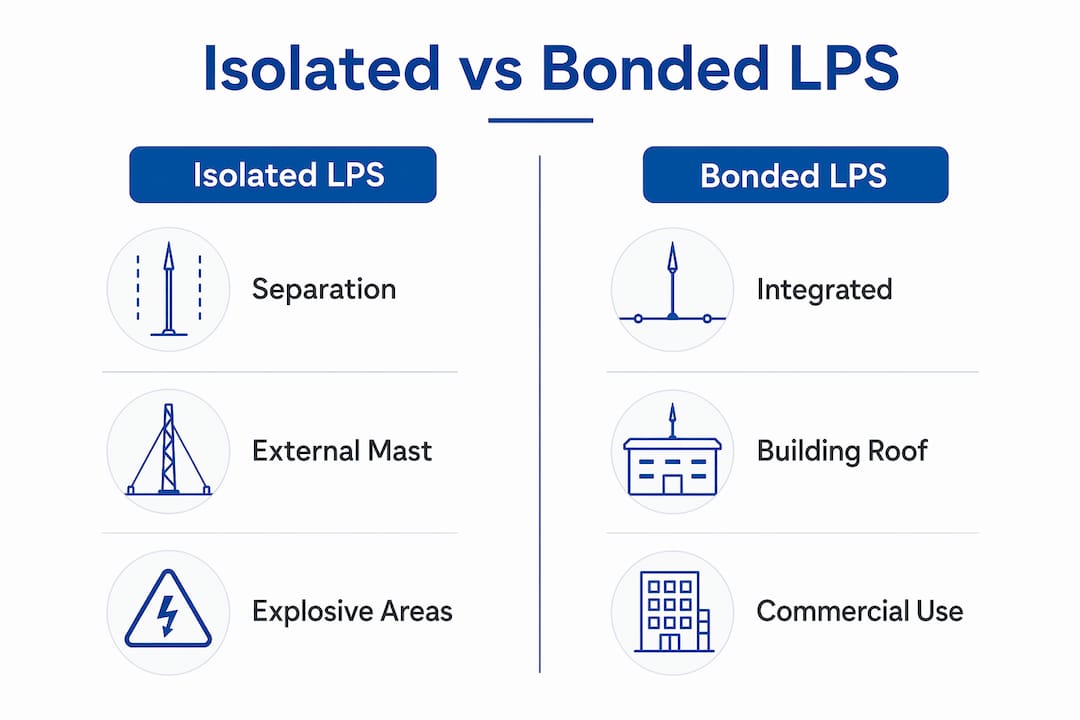
The choice between isolated and bonded lightning protection is not a matter of preference. It is determined by site hazard classification, structural materials, and operational risk tolerance. The table below summarizes the key differences.
| Factor | Isolated LPS | Bonded LPS |
|---|---|---|
| Current path | Routed away from structure via external masts and conductors | Routed through or along the building structure |
| Arcing risk | Eliminated by physical separation | Present if separation distances are not maintained |
| Best application | Explosive atmospheres, fuel storage, sensitive equipment sites | Standard commercial buildings, offices, warehouses |
| Grounding | Fully earthed, external electrode system | Integrated with structural earthing |
| Maintenance complexity | Higher, requires separation distance verification | Lower for standard structures |
| Modification impact | Building changes require re-evaluation of separation distances | Easier to adapt during renovations |
Isolated systems are preferred for explosion risk zones, while bonded systems suit typical commercial buildings where arcing risk is not a primary concern. This is a direct output of the IEC 62305 risk assessment, not a designer’s preference.
Isolated LPS do carry a higher upfront design and installation cost. The external mast infrastructure requires more materials and more precise positioning. However, for a petrochemical facility or a pharmaceutical manufacturing plant, the cost of a single ignition event far exceeds the cost of proper isolation. The math is not complicated.
Pro Tip:If your facility is planning a building extension or process equipment addition, re-run your IEC 62305 risk assessment before construction begins. Changes to structure height, footprint, or occupancy can shift your LPL classification and invalidate your existing LPS design.
Internal electrical safety measures must also be coordinated with the external isolated LPS. SPD coordination under IEC 62305-4 is mandatory to suppress transient overvoltages inside the building. An isolated external system that is not paired with properly rated SPDs at service entrances leaves sensitive control systems and instrumentation exposed to induced surges. Both layers are required for complete protection.
How to implement and maintain isolated lightning protection systems
Effective implementation of an isolated LPS starts well before the first mast goes in the ground. Site assessment, grounding design, and SPD coordination must all be resolved at the planning stage. Retrofitting any of these elements after installation is expensive and often compromises system integrity.
Key steps and considerations for facility managers:
- Site assessment for air terminal placement: Identify all structures requiring protection, map the protection zones, and calculate the required mast heights and positions to achieve full coverage at the specified LPL.
- Grounding electrode design:Voltage gradients around grounding electrodes during a lightning strike depend directly on soil resistance. High soil resistance produces dangerous step and touch voltages. Soil resistivity testing must precede electrode design, not follow it. Indelec’s deep earth grounding solutions address high-resistivity soil conditions that standard electrodes cannot handle.
- SPD selection and placement: Install SPDs at the main service entrance, sub-distribution panels, and at the terminals of sensitive equipment. Coordinate SPD ratings with the LPL assigned to the site.
- Equipotential bonding: All metallic services entering the building, including water pipes, gas lines, and data cables, must be bonded at the point of entry to prevent potential differences during a strike.
- Inspection and testing schedule: Routine inspection and testing of grounding resistance and physical integrity are required to maintain LPS effectiveness. Post-installation testing bridges theoretical design and physical performance, and it is critical for insurance compliance. Annual visual inspections and periodic resistance measurements are the minimum standard.
- Documentation: Maintain a complete record of the as-built system, test results, and any modifications. Regulators and insurers will ask for this documentation. Gaps in records are treated as gaps in protection.
The lightning protection standards published by Indelec provide detailed guidance on inspection intervals and documentation requirements aligned with IEC 62305. Facility managers overseeing multiple sites benefit from standardizing these records across their portfolio.
A frequently overlooked pitfall is the assumption that a compliant system at installation remains compliant indefinitely. Building modifications, new process equipment, soil erosion around electrodes, and conductor corrosion all degrade system performance over time. Treat your isolated LPS as a living system that requires the same scheduled attention as any other critical safety infrastructure.
Key takeaways
Isolated lightning protection systems protect facilities by physically separating the discharge path from the structure, eliminating arcing risk, and requiring coordinated SPDs and grounding to deliver complete protection under IEC 62305.
| Point | Details |
|---|---|
| Isolation means separation, not disconnection | Isolated LPS are fully grounded; the term refers to physical distance from the structure, not electrical disconnection. |
| IEC 62305 drives all design decisions | LPL classification from the risk assessment determines whether isolated or bonded LPS is required. |
| SPDs are mandatory, not optional | External isolated LPS must be paired with coordinated surge protective devices to protect internal equipment. |
| Grounding quality determines system performance | Soil resistivity testing and proper electrode design are the most critical and most overlooked elements of any LPS. |
| Maintenance is a compliance requirement | Annual inspections, resistance testing, and documentation are required to maintain safety and insurance validity. |
Indelec’s view: risk assessment is not a formality
After nearly seven decades of designing and installing lightning protection systems across industrial and infrastructure sectors, the pattern we see most often is this: facilities treat the IEC 62305 risk assessment as a box to check rather than a genuine investigation. That approach produces systems that are technically compliant on paper but poorly matched to actual site conditions.
The IEC 62305-2 methodology rewards honest zoning. When a facility manager accurately maps every network entry point, every hazardous zone, and every consequence category, the resulting LPS design is sharper and more cost-effective than a generic solution applied to a generic risk profile. We have seen facilities over-engineer their external LPS while leaving SPD coordination completely unaddressed. That is not protection. That is theater.
The other lesson we keep relearning is that grounding is where systems succeed or fail. The quality of grounding determines whether a lightning strike is safely dissipated or becomes a damaging event despite a correctly designed air termination system. Soil conditions change. Electrodes corrode. Resistance values drift. Facilities that test their grounding annually catch these problems before they matter. Facilities that do not test find out during a storm.
Coordinated protection, not piecemeal solutions, is the only approach that works. External isolated LPS, internal SPDs, equipotential bonding, and a documented maintenance program are not four separate projects. They are one system. Treat them that way.
— Indelec
Protect your facility with indelec’s isolated lightning solutions
Indelec designs and supplies isolated lightning protection systems built to IEC 62305 standards for industrial, commercial, and infrastructure facilities worldwide.

The Prevectron3 air terminal uses Indelec’s patented OptiMax technology to deliver reliable, early-streamer emission performance in a design that minimizes environmental impact. It is the product of Indelec’s dedicated R&D center and decades of field-validated installations across high-risk sites. For facility managers who need a complete solution, Indelec’s full range of protection services covers risk assessment, system design, installation, and ongoing maintenance. Contact Indelec to discuss a customized isolated LPS for your site.
FAQ
What is an isolated lightning protection system?
An isolated lightning protection system physically separates all conductors from the protected structure using free-standing masts and external down conductors. The system is fully grounded but maintains distance from the building to prevent arcing and fire risk.
When is an isolated LPS required instead of a bonded system?
Isolated LPS are required for explosive atmospheres, fuel storage facilities, petrochemical plants, and sites with sensitive electronic equipment where arcing from a bonded system would create ignition or damage risk. IEC 62305 risk assessment determines which approach applies to your site.
How does IEC 62305 determine the lightning protection level for my facility?
IEC 62305 Part 2 calculates the annual frequency of dangerous lightning events at your site and compares it against tolerable risk thresholds. The result assigns an LPL from I (highest protection) to IV (standard protection), which then drives all system design parameters.
Do isolated lightning protection systems still need surge protective devices?
Yes. External isolated LPS intercept direct strikes but cannot prevent induced transient overvoltages from traveling through incoming electrical, data, and communication lines. SPDs installed at service entrances and internal panels are mandatory under IEC 62305-4 to protect sensitive equipment.
How often should an isolated LPS be inspected and tested?
Annual visual inspections and periodic grounding resistance measurements are the minimum requirement. Post-installation testing and documentation are required for insurance compliance, and any building modification should trigger a full re-evaluation of the system.