How to document lightning protection systems effectively

TL;DR:
- Proper documentation is essential to ensure lightning protection system compliance and avoid costly liabilities.
- Collect, verify, and update key documents like design drawings, inspection reports, and maintenance logs continuously.
- Treat documentation as an ongoing operational process with structured records management, regular reviews, and version control.
Poor documentation after a lightning strike or failed audit can cost a facility hundreds of thousands of dollars in liability, project delays, and forced rework. Facility managers and engineering consultants who treat documentation as an afterthought often find themselves scrambling to reconstruct records that should have been in place from day one. Standards like NFPA 780 and DOD UFGS 26 41 00 make it clear: documentation is not optional. This guide walks you through every step of building, organizing, and maintaining a compliant documentation package for lightning protection systems, from initial design submissions to long-term audit readiness.
Table of Contents
- Understand what needs to be documented
- Gather and organize your base documentation
- Create compliance-ready records and submittals
- Maintain and update records for long-term compliance
- Our expert perspective: What really matters in documentation
- Take the next step in protecting your facility
- Frequently asked questions
Key Takeaways
| Point | Details |
|---|---|
| Document everything | Accurate records are essential for passing compliance audits and legal protection. |
| Follow standards | Use NFPA 780 and DOD UFGS to ensure your documents meet all requirements. |
| Update regularly | Review and maintain your records after every inspection or modification. |
| Be audit-ready | Organize your files for quick access and retrieval before an authority’s review. |
Understand what needs to be documented
Before you can organize anything, you need a clear picture of what a complete documentation package actually looks like. Most compliance failures do not stem from bad installations. They stem from missing paperwork, unsigned forms, or records that do not match field conditions.
The core documents every lightning protection project must include are:
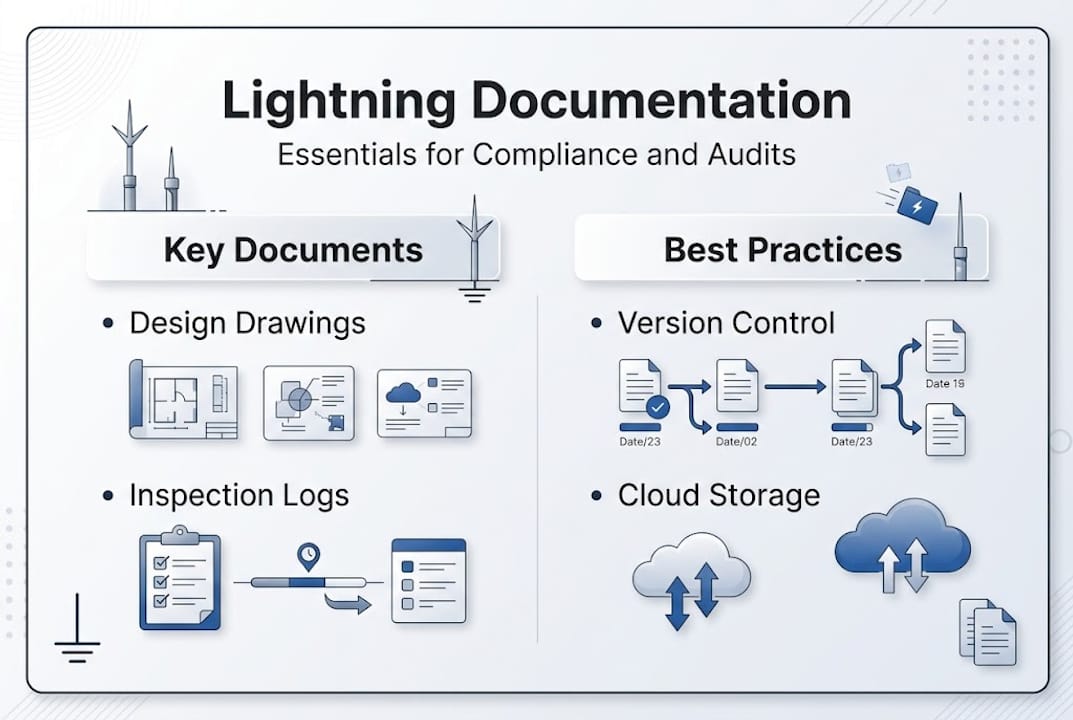
- Design drawings: Scaled plans showing conductor routing, air terminal placement, ground ring layout, and bonding connections
- Installation records: Signed logs confirming work completed, materials used, and any field deviations
- Inspection reports: Dated forms completed by a qualified inspector, tied to specific system components
- Test reports: Measured ground resistance values, continuity data, and bond verification results
- Certificates of inspection: Formal certificates confirming the system meets the applicable standard
- Maintenance logs: Ongoing records of every service visit, repair, or modification
Different industries layer additional requirements on top of this base. A petrochemical facility may require hazardous area classification documents tied to bonding records. A federal government project will demand submittal packages reviewed and approved before installation even starts. Understanding your sector matters because auditors do not just check for a document, they check for the right document in the right format.
The NFPA 780 standard sets the benchmark for design, installation, and inspection documentation in commercial and industrial settings. For federal and defense projects, lightning protection standards align with DOD UFGS, which specifies additional submittal categories. Reviewing compliance examples across sectors shows how these requirements translate into actual project deliverables.
| Document type | Purpose | Required by |
|---|---|---|
| Design drawings | Shows system layout and specifications | NFPA 780, DOD UFGS |
| Installation records | Confirms field execution | DOD UFGS |
| Inspection certificate | Validates compliance | NFPA 780, DOD UFGS |
| Test reports | Proves system performance | NFPA 780 |
| Maintenance logs | Tracks ongoing system condition | NFPA 780 |
Pro Tip: Create a master document index at the start of every project. List every required document, its current status, and who is responsible for it. This single sheet can cut your audit preparation time in half.
Gather and organize your base documentation
Knowing what is required is only half the battle. Actually collecting, verifying, and structuring those documents demands a disciplined process that starts before installation begins and continues well after the final inspection.
Follow these steps to build your foundational documentation package:
- Collect design plans before work begins. Ensure drawings are stamped, dated, and reference the applicable standard edition. Confirm that the engineer of record has reviewed and approved them.
- Log materials and field conditions during installation. Installation records should capture lot numbers, product certifications, conductor sizes, and any deviations from the original design with documented engineer approval.
- Schedule inspections at defined milestones. Do not wait until the job is complete. Inspect during rough-in, before concealment, and at project closeout. Each phase should generate its own signed report.
- Verify as-built conditions match drawings. Walk the system after installation and compare physical routing, terminal placement, and ground connections against the design documents. Update drawings to reflect any field changes.
- Obtain and file the inspection certificate. This is non-negotiable for federal projects. The DOD UFGS specification requires a formal Lightning Protection System Inspection Certificate as part of the submittal package, along with test plans and field quality control records.
- Start the maintenance log on day one. The first entry should be the installation completion date, initial test results, and the certificate issue date.
Common pitfalls include missing sign-offs from the installing contractor, test records that show instrument model and operator but no calibration date, and inspection reports that reference a component description rather than a drawing callout. Each gap becomes a flag during an audit.
“The DOD UFGS specification explicitly requires submittals, quality assurance documentation, a Lightning Protection System Inspection Certificate, test plans, and documented field quality control testing as mandatory project deliverables.”
Review system submittal guidance early in the project cycle so your team understands the format and timing expected before the first document is ever submitted.
Pro Tip: Store digital copies in a cloud folder structured to mirror your document index. Use naming conventions that include the project number, document type, revision number, and date. Retrieving a specific test report under audit pressure takes seconds instead of hours.
Create compliance-ready records and submittals
Organized materials are only useful if they are formatted and packaged in a way that satisfies the reviewing authority. Sloppy submittals, even when technically accurate, get rejected and create delays that ripple through the entire project schedule.
Format requirements vary by standard. NFPA 780 focuses on content accuracy: drawings must show all components to scale, test reports must include measured values and pass/fail criteria, and inspection forms must reference specific standard sections. DOD UFGS adds procedural requirements: submittals must be approved before installation, and any deviation requires formal documentation reviewed by the contracting officer.

Here is how submittal requirements compare across the two primary standards:
| Requirement | NFPA 780 | DOD UFGS 26 41 00 |
|---|---|---|
| Pre-installation submittal approval | Not explicitly required | Required |
| Inspection certificate format | Standard compliant | Government-specified form |
| Test plan submittal | Implied by test requirements | Formal submittal required |
| Deviation documentation | Engineer judgment | Contracting officer approval |
| Version control | Best practice | Mandatory |
To compile and submit a compliant documentation package, follow this sequence:
- Confirm the applicable standard edition and any project-specific amendments before drafting a single document.
- Use templates that embed the required data fields for that standard. Generic forms often miss critical checkboxes.
- Submit for review in stages if the standard allows it. Early approval of design drawings prevents rework downstream.
- Track every submission with a log showing the document name, revision, submission date, reviewer, and disposition. This log is your legal record of due diligence.
- Incorporate reviewer comments formally. Never make verbal-only changes. Every revision needs a new revision number and date.
Version control is worth treating as seriously as the documents themselves. The NFPA 780 framework assumes that the record you present during an inspection accurately reflects the system as it currently stands. An outdated drawing in the active file is a compliance failure waiting to happen. Review infrastructure documentation processes to see how formal version control works in practice. For ongoing work, structured maintenance documentation keeps version histories intact across a system’s full service life.
Maintain and update records for long-term compliance
Submitting a clean package at project closeout is an achievement. Keeping it clean over the next 10 to 20 years is where most facilities fall short. Standards do not consider your documentation complete because you filed it once.
Ongoing practices that keep records current and audit-ready include:
- Annual review cycle: Conduct a desk review of all active documentation every 12 months, regardless of whether any maintenance occurred. Confirm that document dates, revision levels, and system descriptions still match field conditions.
- Post-modification update protocol: Any change to the physical system, even a grounding rod replacement, triggers a documentation update. New as-built drawings, updated test results, and a revised maintenance log entry are all required.
- Archiving policy: Superseded document versions should be moved to a clearly labeled archive folder rather than deleted. Regulatory audits and legal disputes can reach back years, and you need to prove what the system looked like at a specific point in time.
- Pre-inspection checklist: Before any scheduled inspection, pull your document index and verify every item is current, signed, and retrievable. Treat this as a rehearsal, not a formality.
- Staff training on records access: Maintenance personnel who perform routine work should know where records live and how to make a log entry. If only one person can navigate your documentation system, you have a risk.
The NFPA 780 standard treats documentation as a living part of the system, not a one-time deliverable. Building that expectation into your facility operations is what separates compliant facilities from ones that pass their first inspection and fail the second. Reviewing facility lightning safety practices and studying compliance best practices helps teams build sustainable documentation habits rather than reactive ones.
Pro Tip: Build a digital audit trail by timestamping every document action, including creation, revision, review, and retrieval. When an auditor asks for the inspection certificate from three years ago, a timestamped version history is far more convincing than a printed copy with a handwritten date.
Our expert perspective: What really matters in documentation
After decades of working across industrial and commercial lightning protection projects, we have seen a consistent pattern: facilities that fail audits rarely have incomplete installations. They have incomplete records. The gap between a passing audit and a costly remediation is almost always traceable to a document that cannot be found, a signature that was never obtained, or a revision that was made in the field but never reflected on paper.
The most effective thing you can do right now is simulate an audit. Try to locate every required document for your most complex system in under 30 minutes. If you cannot, you are not truly compliant, regardless of how good the installation is. Involving your maintenance team in this exercise reveals gaps that engineers and managers never see from behind a desk.
Another misconception worth addressing: documentation is not a project-phase activity. Facilities that treat it as a project deliverable rather than an ongoing operational responsibility consistently struggle. The facilities that do this well treat their documentation challenges the same way they treat equipment reliability: as something that demands scheduled attention, not just reactive effort.
Mock audits, cross-trained staff, and version-controlled digital systems are not extras. They are the difference between protection and exposure.
Take the next step in protecting your facility
Building compliant lightning protection documentation is not a one-time project. It is an ongoing operational commitment that requires the right processes, tools, and expertise.

Indelec supports facility managers and engineering consultants at every stage, from initial system application services through long-term maintenance and certification. Our technical teams understand the specific documentation requirements of NFPA 780, DOD UFGS, and international equivalents. Whether you need help structuring a submittal package, navigating lightning standards support, or preparing for a compliance audit, we bring the expertise and field experience to make it straightforward. Reach out to our team to request a documentation review or system evaluation tailored to your facility’s specific requirements.
Frequently asked questions
What documents are required for lightning protection system compliance?
Typically, you need design drawings, installation reports, certificates of inspection, and maintenance logs to satisfy NFPA 780 and DOD UFGS requirements. Additional documents like test plans and deviation records may be required depending on the project type.
How often should lightning protection records be updated?
Update records at least annually and immediately after any system modification or inspection. The NFPA 780 framework treats documentation as a continuous requirement, not a one-time task.
Which standards set documentation rules for lightning protection systems?
NFPA 780 and DOD UFGS 26 41 00 are the primary standards defining documentation requirements, with NFPA 780 covering most commercial and industrial applications and DOD UFGS applying to federal and defense facilities.
What common mistakes lead to failed documentation audits?
Missing inspection certificates, outdated as-built drawings, and incomplete test records with no calibration data are the most frequent causes of audit failures in lightning protection projects.
Is digital storage of documentation acceptable for compliance?
Yes, digital records are widely accepted when they are organized, access-controlled, regularly backed up, and include version histories that show when documents were created, revised, and reviewed.