Commercial building lightning safety: 5 proven methods
TL;DR:
- Lightning causes over 1 billion dollars in damages annually to commercial buildings.
- Proper lightning protection systems and regular inspections significantly reduce risks and insurable costs.
- Embedding lightning safety in facility planning and staff training enhances long-term resilience.
Lightning quietly costs commercial building owners more than most realize. US lightning claims topped $1.04 billion in 2024 alone, and that figure doesn’t capture the full operational damage from fires, equipment loss, and extended outages. Yet many facility managers still treat lightning protection as a secondary concern, something to address after a strike rather than before. This guide walks you through the real financial stakes, the core components of a compliant lightning protection system (LPS), what NFPA 780 actually demands, and how to build a training and maintenance program that keeps your facility resilient year after year.
Table of Contents
- Why lightning safety matters for commercial buildings
- Core components of an effective lightning protection system (LPS)
- Meeting standards: NFPA 780 and beyond
- Training, maintenance, and emergency protocols for lightning safety
- The overlooked value of lightning readiness in long-term facility planning
- Protect your facility with proven lightning safety solutions
- Frequently asked questions
Key Takeaways
| Point | Details |
|---|---|
| Lightning risk is high | Commercial buildings face substantial financial and safety threats from lightning strikes each year. |
| Standards guide protection | NFPA 780 dictates the must-have elements and install rules for effective lightning systems. |
| Compliance saves money | Proper systems and audits can reduce insurance costs and prevent major disruptions. |
| Maintenance is essential | Annual checks, staff training, and emergency protocols keep lightning safety reliable. |
| Continuous planning works | Real resilience comes from managing lightning safety as an active, evolving process. |
Why lightning safety matters for commercial buildings
The numbers are harder to ignore than most safety briefings suggest. US lightning claims exceeded $1 billion in 2024, with roughly 70% of damage tied to electronics and electrical surges rather than direct structural strikes. That means most of your exposure is invisible until a surge fries your HVAC controls, building automation system, or server room equipment.
The infrastructure lightning risks extend well beyond repair bills. A single strike can trigger a cascade: a fire suppression system activates unnecessarily, elevators lock out, emergency lighting fails, and your team spends hours diagnosing faults instead of operating the building. Regulatory scrutiny follows when life-safety systems are compromised.
| Claim scenario | Typical cost range | Primary cause |
|---|---|---|
| Electronic/electrical surge | $15,000 to $80,000 | Indirect strike via power lines |
| Structural fire | $50,000 to $500,000+ | Direct strike igniting roofing |
| HVAC or mechanical failure | $10,000 to $60,000 | Surge through control wiring |
| Data/communications loss | $20,000 to $150,000 | Surge through network cabling |
“Lightning-caused losses are not rare events. They are a predictable, recurring cost for commercial buildings without proper protection, and the financial exposure compounds with every unprotected system added to a facility.”
The consequences don’t stop at the insurance claim. Consider what a full operational shutdown means for your tenants, your regulatory standing, and your liability exposure. The lightning safety workflow for most facilities needs to account for both immediate and long-term effects.
Immediate consequences of a lightning strike:
- Power outages affecting all building systems
- Fire risk from direct strikes to roofing or mechanical equipment
- Surge damage to electronics, controls, and communications
- Evacuation requirements and potential injuries
Long-term consequences:
- Increased insurance premiums after claims
- Regulatory inspections and potential citations
- Reputational damage with tenants and occupants
- Deferred equipment replacement costs compounding over time
Now that you’ve seen why the risk is real and substantial, let’s explore exactly how lightning protection standards address these vulnerabilities.
Core components of an effective lightning protection system (LPS)
An LPS is not a single device. It is an integrated system, and every component must work together for the system to perform under real strike conditions. Missing or undersized elements create failure points that negate the entire installation.
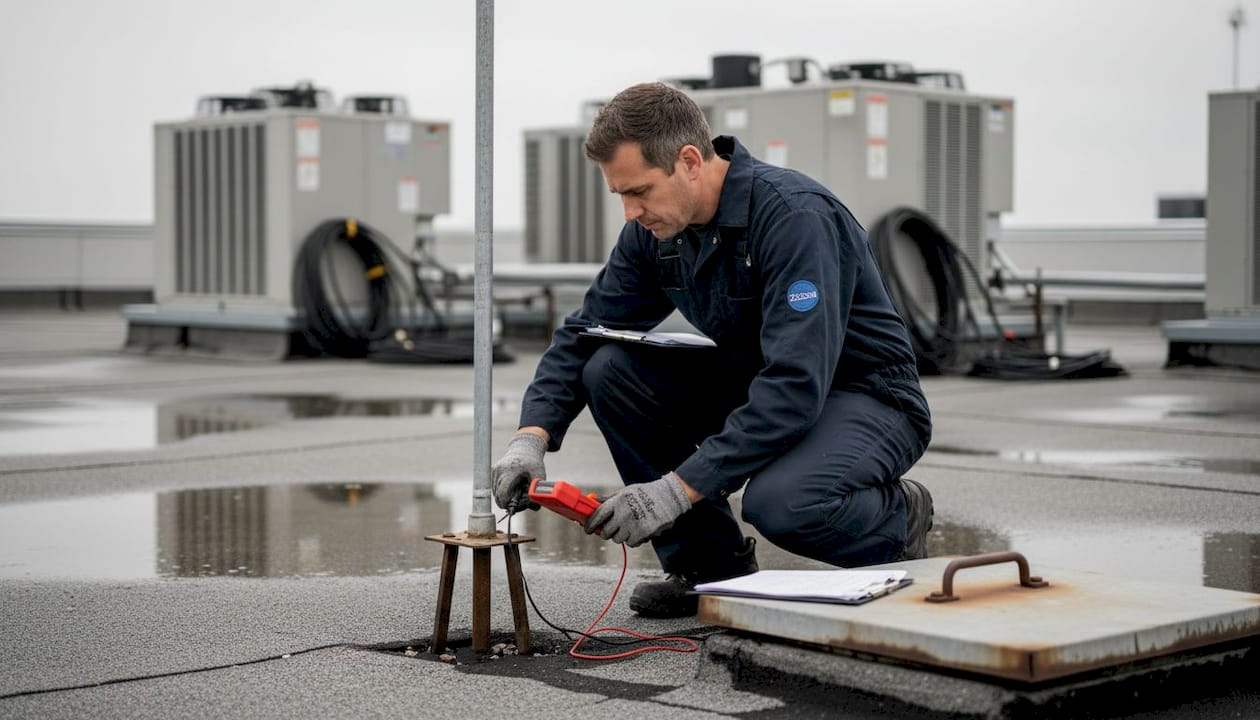
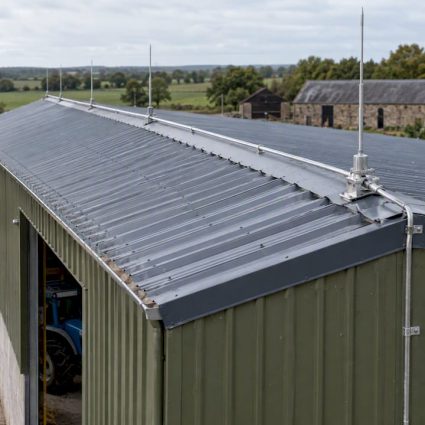
The five core components are air terminals, down conductors, ground electrodes, bonding, and surge protective devices (SPDs). Air terminals, commonly called lightning rods, intercept the strike at the highest points of the structure. Per UFGS 26 41 00, terminals must be positioned at least 10 inches above the surface they protect, spaced 20 feet apart on ridges and 50 feet apart on flat roofs.
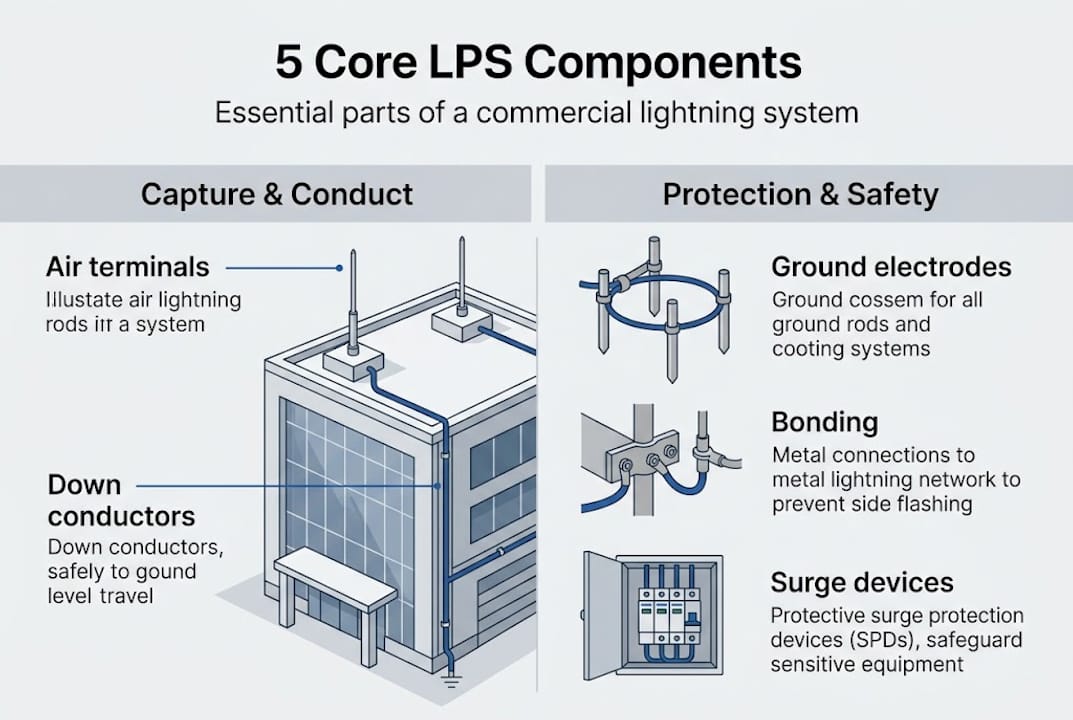
Down conductors carry the captured energy from the air terminals to the grounding system. Their routing matters: sharp bends increase impedance and reduce effectiveness. Ground electrodes dissipate the energy safely into the earth. Bonding connects all metallic building components to the grounding system, preventing dangerous side flashes (voltage jumps between unconnected metal objects during a strike). SPDs at service entrances protect internal systems from surges traveling through utility lines.
| Component | Minimum standard requirement | Key failure risk |
|---|---|---|
| Air terminals | Min. 10 in. above surface; 20 ft ridge spacing, 50 ft flat roof | Gaps in coverage leave roof areas unprotected |
| Down conductors | Direct routing, no sharp bends | High impedance from bends reduces effectiveness |
| Ground electrodes | Low-resistance path to earth | Poor soil contact increases step voltage risk |
| Bonding | All metallic components connected | Side flashes between unbonded metal |
| SPDs | Installed at all service entrances | Surge damage to internal electronics |
Pro Tip: Only use UL-listed components installed by a certified contractor. Substituting unlisted hardware to cut costs can void your insurance coverage and create liability exposure if a strike causes damage.
Steps to verify your LPS meets standard:
- Confirm air terminal placement and height against roof drawings
- Trace down conductor routing for sharp bends or missing segments
- Test ground electrode resistance (target below 10 ohms per NFPA 780)
- Verify all metallic rooftop equipment is bonded to the system
- Confirm SPDs are installed at the main service entrance and sub-panels
Review the NFPA 780 requirements and the complete protection guide to benchmark your current installation against these standards. Understanding these components is critical, but the true value comes from implementing standards fully. Next, we’ll see what industry benchmarks demand.
Meeting standards: NFPA 780 and beyond
NFPA 780 is the primary US standard for installing lightning protection systems in commercial buildings. It specifies component requirements, installation methods, and inspection protocols for air terminals, conductors, grounding, and SPDs. Compliance is not optional for many facility types, and it carries direct implications for your insurance rates and regulatory standing.
Key requirements under NFPA 780:
- Air terminals installed at all roof edges, ridges, and projections
- Conductors sized and routed per material and building height specifications
- Ground ring electrodes for buildings over a defined footprint
- SPDs required at all service entrances and recommended at sub-panels
- Full bonding of all metallic roof-mounted equipment
- Documentation of the installation for inspection and insurance purposes
The audit process matters as much as the installation itself. Review detailed lightning standards to understand what inspectors look for, and align your internal review calendar with your insurance renewal cycle. Many insurers require proof of a current LPS inspection before renewing commercial property policies.
Compliance with system application best practices also affects how your system performs when conditions change. Building additions, new rooftop equipment, and HVAC upgrades can all create unprotected zones if the LPS is not updated to match.
Pro Tip: Schedule your LPS inspection in the same quarter as your insurance audit. Presenting a current, certified inspection report during renewal negotiations gives you documented leverage to request premium reductions. Some insurers discount premiums by 5 to 15% for verified compliant systems.
The compliance guidelines from the Whole Building Design Guide provide additional technical depth for facilities subject to federal or defense-related requirements. After meeting standards, proactive management and staff action complete your facility’s defense. Let’s cover maintaining and testing your system.
Training, maintenance, and emergency protocols for lightning safety
Installing a compliant LPS is the foundation. Keeping it effective requires a structured maintenance program and staff who know exactly what to do when a storm rolls in. These two elements are where most facilities fall short.
Annual LPS inspection schedule:
- Engage a UL-listed lightning protection contractor for a full system inspection
- Inspect all air terminals for physical damage, corrosion, or displacement
- Test ground electrode resistance and document results
- Check all bonding connections, especially at rooftop HVAC and communications equipment
- Test SPDs for functionality and replace any that have absorbed prior surges
- Update system drawings to reflect any building changes since the last inspection
Staff training is often treated as a one-time orientation, but it should be a recurring event tied to your emergency action plan. The staff safety safeguards that matter most are behavioral: knowing when to move people indoors, which areas of the building to avoid during a strike, and how to account for all occupants after an event.
Emergency protocols during a lightning event:
- Evacuate all outdoor areas immediately when lightning is within 6 miles
- Keep occupants away from windows, plumbing, and down conductor pathways
- Avoid using corded phones or equipment connected to utility lines
- Do not shelter under trees or near tall metallic structures outside
- After the event, conduct a system check before resuming normal operations
“Professional installation and regular inspection by a UL-listed contractor are not optional extras. They are the baseline for any facility that takes occupant safety and asset protection seriously.”
Use the risk assessment guide to identify which areas of your facility carry the highest exposure. Facilities near water, on elevated terrain, or with significant rooftop equipment face above-average strike frequency and need more frequent inspection cycles.
The overlooked value of lightning readiness in long-term facility planning
Most organizations treat lightning protection as a one-time capital expense. Install the system, file the certificate, and move on. That mindset is exactly why so many facilities end up with compliant systems on paper that fail in practice.
The real value of lightning readiness shows up over a 10 to 20-year facility lifespan. Fewer unplanned outages, lower insurance premiums, and reduced equipment replacement costs add up to a return that far exceeds the initial installation cost. But that return depends entirely on treating the LPS as a living system, not a static installation.
Every building renovation, rooftop addition, or system upgrade is an opportunity to reassess your protection coverage. Most facilities miss this. A new rooftop unit installed without bonding to the LPS creates a new failure point. A building expansion that leaves a wing unprotected exposes your entire operation. Integrate year-round safety best practices into every project scope, not just the initial build.
Pro Tip: Add “LPS impact review” as a standing agenda item in your capital project planning process. It takes 15 minutes and prevents the kind of costly oversights that only surface after a strike.
The facilities that perform best over time are not necessarily those with the most sophisticated systems. They are the ones where lightning safety is embedded in the culture, the maintenance calendar, and the project planning process.
Protect your facility with proven lightning safety solutions
Understanding the risks and standards is the first step. Acting on that knowledge is where Indelec can help. With nearly 70 years of experience in lightning protection, we provide the technical expertise and certified solutions that facility managers and safety officers need to move from awareness to action.

Our advanced lightning rods are engineered for commercial and industrial applications, meeting the most demanding installation requirements. Explore our system applications to see how protection is designed for different facility types, and review the industry lightning standards we work to every day. Ready to assess your current system or plan an upgrade? Contact our team for a tailored evaluation.
Frequently asked questions
What are the main risks if my building lacks lightning protection?
Major risks include fires, power outages, equipment failure, and costly insurance claims from surges and direct strikes. Operational downtime and regulatory exposure compound the financial impact significantly.
How often should lightning protection systems be inspected?
Inspections should be scheduled at least annually and after any major renovation, rooftop equipment change, or lightning event that may have affected the system.
Does following NFPA 780 lower insurance premiums?
Yes. Many insurers offer premium reductions for facilities with professionally installed, compliant lightning protection systems, particularly when supported by a current inspection certificate.
What is the minimum required height for an air terminal?
Per NFPA 780, air terminals on commercial buildings must be at least 10 inches above the highest surface they protect, with spacing of 20 feet on ridges and 50 feet on flat roofs.