Climate Adaptation Strategies for Robust Electrical Protection

Lightning is no longer a predictable seasonal nuisance. In 2025, the US recorded 252 million lightning events, a 20% jump over the prior year and the highest count in eight years. For facility managers and safety officers, that number is not a weather statistic. It is a direct challenge to every protection system designed under older climate assumptions. This article walks through the science behind rising risk, the standards that govern your response, and the practical adaptation strategies that will keep your infrastructure compliant and resilient as conditions continue to shift.
Table of Contents
- Understanding climate-driven lightning risks
- Core standards for electrical protection
- Hardening electrical infrastructure: Adaptation solutions
- Designing advanced lightning protection for modern risks
- Comparing traditional and smart lightning protection systems
- Expert lightning protection solutions for your facility
- Frequently asked questions
Key Takeaways
| Point | Details |
|---|---|
| Climate risk rising | Lightning events are increasing with climate change, so electrical protection demands urgent adaptation. |
| Follow standards | NFPA 780 and IEC 62305 provide essential guidelines—start with proper risk assessment and system design. |
| Harden and integrate | Combining physical upgrades with fire risk mitigation and smart monitoring delivers the best resilience. |
| Smart systems advantage | AI and IoT-enabled lightning protection systems give extra value for critical and high-risk facilities. |
| Practical next steps | Assess, comply, upgrade—then consider advanced solutions or expert partners to maximize safety. |
Understanding climate-driven lightning risks
The data is no longer ambiguous. US lightning events hit a record 252 million in 2025, with Florida and Texas bearing the heaviest exposure. Climate scientists link this surge directly to warming surface temperatures, which intensify convective storm activity and extend the geographic range of high-frequency lightning zones. What was once a regional concern is now a national infrastructure challenge.
Renewable energy assets face disproportionate exposure. Roughly one-third of wind turbines are struck by lightning annually, and solar arrays present large, flat conductive surfaces with minimal natural shielding. Sensitive electronics in control rooms, substations, and data centers are equally vulnerable, since even a nearby indirect strike can induce transient overvoltages that destroy equipment without leaving visible damage.
The financial consequences are severe. Unplanned downtime from a single lightning event can cost an industrial facility hundreds of thousands of dollars when you factor in equipment replacement, production loss, and regulatory reporting. The facilities most at risk are those still operating under protection designs that assumed a stable, historical lightning density. Adapting lightning protection to current climate realities is no longer optional.
High-risk asset categories to prioritize:
- Wind turbines and solar farms with large exposed surface areas
- Substations and switchgear housing sensitive control electronics
- Communication towers and data centers with continuous uptime requirements
- Chemical and petrochemical plants where a strike can trigger secondary hazards
- Facilities in Florida, Texas, and expanding high-density zones across the Gulf Coast and Midwest
“Climate change is not just increasing the frequency of lightning events. It is expanding the geographic footprint of high-risk zones, forcing a fundamental rethink of where and how protection systems are deployed.”
Core standards for electrical protection
Knowing the regulatory baseline is the first step toward building a defensible protection strategy. Two standards dominate the field: NFPA 780 (2026 Edition) in the United States and IEC 62305 internationally. Both require a structured approach that begins with a Lightning Risk Assessment (LRA) and ends with a fully integrated protection system.
The LRA is not a formality. It quantifies the probability of a damaging lightning event at your specific site, accounting for local ground flash density, structure geometry, occupancy type, and the consequences of a strike. The output directly shapes which protection level (I through IV under IEC 62305) your system must achieve.
IEC 62305 specifies minimum mesh dimensions for air termination networks, maximum spacing for down conductors, and bonding requirements for all metallic services entering the structure. NFPA 780 aligns closely but includes US-specific provisions for special structures like communication towers and hazardous locations.
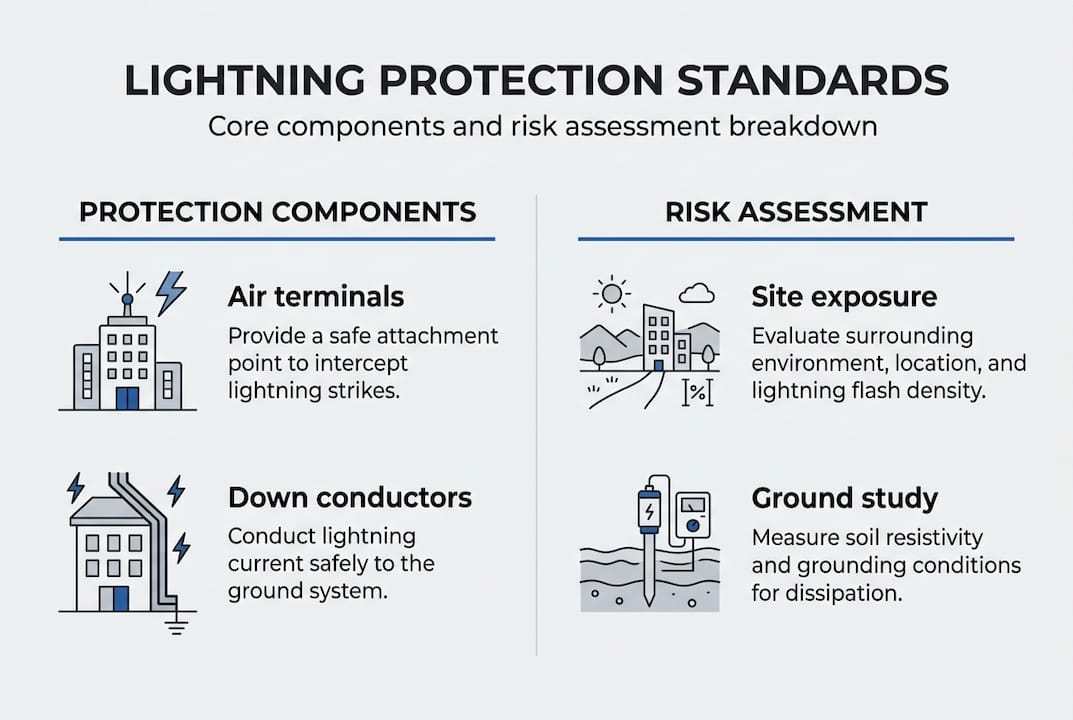
| Component | Function | Standard reference |
|---|---|---|
| Air terminals (lightning rods) | Intercept and capture the lightning channel | NFPA 780, IEC 62305-3 |
| Down conductors | Carry current safely to ground | IEC 62305-3, NFPA 780 |
| Grounding system | Dissipate charge into the earth | Both standards |
| Surge protective devices (SPDs) | Block transient overvoltages on electrical lines | IEC 62305-4, NFPA 780 |
| Equipotential bonding | Eliminate dangerous potential differences | IEC 62305-3 |
Pro Tip: Do not treat the LRA as a one-time exercise. As your facility expands, adds renewable assets, or as local ground flash density data is updated, your risk classification can change. Schedule a reassessment every three to five years or after any major structural modification.
For a practical overview of how these components integrate in real installations, the lightning protection system application resource covers design configurations across industrial and commercial settings. Understanding the components of industrial protection systems in detail will also help you evaluate contractor proposals with confidence.
Hardening electrical infrastructure: Adaptation solutions
Compliance with current standards is the floor, not the ceiling. Climate adaptation requires going further, and the good news is that a clear hierarchy of hardening measures exists. Effective adaptation strategies include lightning arresters, shield wires, undergrounding of critical circuits, and integration with broader wildfire and extreme weather mitigation programs.
Here is a practical sequence for hardening your electrical infrastructure:
- Conduct a gap analysis against NFPA 780 (2026) and IEC 62305 to identify where your current system falls short.
- Install or upgrade surge protective devices at all service entrances, distribution panels, and sensitive equipment connections.
- Add shield wires over exposed overhead lines feeding critical loads to reduce direct strike probability.
- Underground critical feeders where budget allows, particularly those serving control systems, emergency power, and safety-critical equipment.
- Reinforce pole structures and replace aging insulators in high-exposure zones to reduce cascading failures.
- Integrate lightning protection upgrades with fire risk management, especially in regions where dry lightning is a wildfire ignition source.
- Deploy smart monitoring on grounding systems and SPDs to detect degradation before it becomes a failure.
| Hardening measure | Best application | Relative cost | Downtime reduction potential |
|---|---|---|---|
| Lightning arresters | Distribution lines, substations | Low to medium | High |
| Shield wires | Overhead transmission spans | Medium | High |
| Undergrounding | Critical feeders, urban areas | High | Very high |
| Covered conductors | Wildfire-prone overhead lines | Medium | Medium to high |
| Smart SPD monitoring | Sensitive electronics, control rooms | Low | High |
System hardening and predictive monitoring consistently deliver measurable ROI through avoided downtime and reduced equipment replacement costs. The key is sequencing investments by risk priority rather than treating all assets equally.
Pro Tip: When integrating lightning protection upgrades with wildfire mitigation, coordinate with your utility and local fire authority early. Covered conductor programs and undergrounding projects often qualify for shared funding or regulatory incentives that can significantly offset capital costs.
For a structured approach to identifying and prioritizing exposure points, the guide on managing lightning hazards provides a facility-level framework. The lightning safety workflow resource maps the full process from risk identification to system verification.
Designing advanced lightning protection for modern risks
Not every facility fits a standard design template. De-energized lines, ATEX-classified explosive zones, photovoltaic arrays, and wind farms each present unique challenges that require design decisions beyond the base standard. These edge cases demand site-specific engineering, not catalog solutions.
For hazardous zones, the primary concern is preventing a lightning-induced spark from becoming an ignition source. This means bonding all conductive elements within the zone, using intrinsically safe SPDs, and ensuring that the grounding system does not create ground potential rise events that could arc across equipment gaps.
Renewable energy sites require a layered approach. PV arrays need both direct strike protection via air terminals and transient protection on DC and AC circuits, since inverters are particularly sensitive to overvoltage. Wind turbines require blade-mounted receptors, down conductors integrated into the tower structure, and grounding systems designed to handle the high peak currents associated with direct strikes.
AI-assisted risk assessment and IoT-based monitoring are changing how facilities manage ongoing protection. Sensors embedded in grounding systems can detect resistance drift, moisture ingress, and corrosion in real time. AI tools can correlate local weather data with historical strike patterns to generate dynamic risk alerts, allowing maintenance teams to act before a storm season rather than after a failure.
“Combining smart monitoring with nature-based solutions, such as strategic vegetation management around substations, creates a multi-layer resilience approach that no single technology can replicate alone.”
Key design considerations for advanced protection:
- ATEX zones: Use zone-rated components and verify that all bonding connections meet explosion protection standards
- PV systems: Protect both the array structure and the inverter room with coordinated SPD levels
- Wind farms: Design grounding grids to handle multiple simultaneous strikes during storm events
- IoT-connected facilities: Treat every network entry point as a potential transient pathway and install data-line SPDs accordingly
For a deeper look at the factors that separate adequate from excellent protection in industrial settings, the article on critical industrial lightning protection factors covers the engineering decisions that matter most. A sensitive site protection example illustrates how these principles apply in a real design scenario.
Comparing traditional and smart lightning protection systems
The choice between passive and active protection is not purely technical. It involves regulatory acceptance, budget, site complexity, and risk tolerance. Understanding the trade-offs clearly will help you make a defensible investment decision.
Passive systems, including conventional Franklin rods, mesh conductors, and traditional grounding, are well understood, widely accepted under both NFPA 780 and IEC 62305, and straightforward to inspect and maintain. Their limitation is that they are reactive by design. They do not reduce the probability of a strike; they manage the consequences.
Active systems, particularly Early Streamer Emission (ESE) rods and smart SPDs with IoT integration, claim to extend the protection radius and provide real-time system health data. The debate between conventional and ESE systems is ongoing, with NFPA 780 drawing criticism for not fully addressing ESE technology, while IEC standards recognize ESE under specific national annexes.
| System type | Standards acceptance | Protection radius | Maintenance complexity | Best fit |
|---|---|---|---|---|
| Conventional Franklin rod | Full (NFPA 780, IEC 62305) | Fixed by geometry | Low | Standard structures |
| Mesh/cage system | Full | Comprehensive coverage | Medium | Large flat roofs, data centers |
| ESE lightning rod | Partial (national annexes) | Extended claim | Low to medium | Large open sites, renewables |
| Smart SPD with IoT | Emerging | N/A (transient protection) | Medium | Sensitive electronics, critical loads |
Pro Tip: If your facility operates in a jurisdiction that recognizes ESE technology, request independent third-party test data before specifying. The performance claims vary significantly between manufacturers, and the protection radius directly affects how many terminals your design requires.
For facilities prioritizing sustainability alongside performance, eco-friendly protection systems represent an emerging category that aligns protection investment with broader environmental commitments.
Expert lightning protection solutions for your facility
Translating standards and adaptation strategies into a working protection system requires more than technical knowledge. It requires field experience across diverse facility types, climates, and risk profiles.

With nearly seven decades of installations across industrial, commercial, and infrastructure sectors, Indelec brings both the engineering depth and the product portfolio to support every stage of your protection program. From initial lightning protection system design and application to advanced ESE solutions backed by independent performance data, our team can help you move from risk assessment to certified installation. The ESE lightning rod survey findings provide concrete evidence for facilities evaluating whether active protection delivers measurable efficiency gains over conventional systems. Contact us to schedule a site-specific assessment and build a protection strategy that meets 2026 standards while preparing your facility for the climate conditions ahead.
Frequently asked questions
What is the most important standard for industrial lightning protection in the US?
NFPA 780 (2026 Edition) is the primary US standard governing the design, installation, and inspection of lightning protection systems across industrial and commercial facilities.
How does climate change impact electrical protection planning?
Increasing lightning frequency and severity driven by climate change means protection systems designed under older density assumptions may no longer meet actual site risk, requiring updated assessments and hardened infrastructure.
Are smart or IoT-based lightning protection systems worth the investment?
For critical or sensitive sites, yes. AI tools and smart monitoring accelerate risk assessment, detect system degradation in real time, and reduce the probability of undetected failures that lead to costly downtime.
What adaptation steps should facility managers take first?
Start with a current Lightning Risk Assessment against NFPA 780 (2026) or IEC 62305, then close compliance gaps before layering in hardening measures and monitoring based on your site’s specific risk profile.