Building Contractor Safety Guidelines for Lightning Protection

TL;DR:
- Before starting lightning-protection projects, contractors must complete safety orientations, embed design controls, appoint a competent person, and prepare job safety analyses. Facility managers will request signed documents, proof of training, safety plans, and records, which should all be bundled into a digital folder before mobilization. Compliance with standards like NFPA 780, NEC, and OSHA is mandatory, requiring accurate documentation, site-specific controls, and task-level safety measures to ensure safety and legality.
Before mobilizing on any lightning-protection project, contractors must complete five non-negotiable actions: finish a site-specific safety orientation, embed Prevention through Design controls in the bid and contract, designate a named competent person with stop-work authority, complete a Job Safety Analysis for every task, and have current inspection and certification records ready for review. These requirements flow directly from NFPA 780 (the U.S. standard governing lightning protection system installation and acceptance testing) and OSHA 29 CFR 1926, which sets the legal baseline for jobsite safety programs.
Minimum day-one deliverables facility managers will request:
- Signed site-specific orientation roster with training verification
- Proof of current OSHA training cards for all workers on site
- Submitted and approved Site-Specific Safety Plan (SSSP) or Contract-Specific Safety Plan (CSSP)
- JSAs for every first-day task, signed by the designated competent person
- Copies of any existing lightning protection inspection or certification records for the facility
- Evidence of insurance and contractor pre-qualification
Table of Contents
- What does your pre-mobilization compliance checklist need to cover?
- Which U.S. standards and regulations apply to lightning-protection contractors?
- How should site orientations and contract clauses hold contractors accountable?
- What design-phase controls belong in your bids and drawings?
- What task-level controls must contractors apply during lightning-protection work?
- What inspection, testing, and documentation must contractors deliver?
- What does a realistic implementation timeline look like?
- Practical templates: JSA checklist, orientation sign-in, and contract clauses
- How Indelec approaches lightning-protection safety and compliance
- Key Takeaways
- What contractors and facility managers consistently get wrong
- Indelec makes lightning-protection compliance straightforward
- Useful sources and standards for contracting and compliance
What does your pre-mobilization compliance checklist need to cover?
Formal site-specific safety orientation is a contractual requirement at most commercial and institutional facilities, not a courtesy. Orientation must be completed and documented before any worker touches the site. The checklist below covers the minimum acceptable evidence for each item.
| Deliverable | Minimum Acceptable Evidence | Typical Deadline |
|---|---|---|
| Site orientation completion | Signed roster with date and trainer name | Before first day on site |
| OSHA training cards | Physical or digital card copies per worker | At pre-qualification |
| SSSP/CSSP submission | Stamped approval from facility safety manager | — |
| JSAs for first-day tasks | Signed by competent person, task-specific | Day of mobilization |
| Insurance and pre-qualification | Certificate of insurance, ISN or equivalent ID | At contract award |
| Emergency action plan | Written, distributed to all crew members | Before mobilization |
Many large facility owners require contractors to meet pre-qualification criteria including worker badges, documented safety observations, and orientation programs — enforced contractually, not just administratively. Missing or expired training is grounds for removal from site.
Pro Tip:Bundle all pre-mobilization documents into a single digital folder (PDF, labeled by contract number) and submit them together. Reviewers process complete packages faster, and you avoid the back-and-forth that delays mobilization approval.
Which U.S. standards and regulations apply to lightning-protection contractors?
Four frameworks govern this work. Each carries distinct contractor obligations.

| Standard | Contractor Obligation | Typical Deliverable |
|---|---|---|
| NFPA 780 | Install and acceptance-test lightning protection systems per listed criteria | Commissioning report + certificate of conformity |
| NEC (NFPA 70) | Bond lightning protection grounding to building electrical system | Continuity/resistance test record |
| OSHA 29 CFR 1926.20 | Maintain written safety program; designate competent person | SSSP/CSSP on file |
| OSHA 29 CFR 1926.501 | Provide fall protection at 6 feet or more above lower levels on rooftop work | Fall protection plan in SSSP |
| NIOSH PtD | Specify hazard-elimination controls in bids and drawings | PtD checklist in procurement documents |
OSHA 1926.20 places direct legal responsibility on employers to enforce safety programs, provide training, and authorize only qualified workers to operate equipment. Fall protection under 1926.501 requires guardrails, safety nets, or personal fall arrest systems any time workers are at or above 6 feet — a threshold crossed on virtually every rooftop lightning-protection installation.
NFPA 780 covers the full scope of lightning protection system installation: air terminals, conductors, bonding, grounding electrodes, and acceptance testing. The NEC (NFPA 70) picks up where NFPA 780 leaves off, governing how the grounding system connects to the building’s electrical infrastructure. Both must be addressed in the SSSP and reflected in the acceptance testing package.
How should site orientations and contract clauses hold contractors accountable?
A site orientation covers six areas: emergency contacts and evacuation routes, site access and badging, identified hazard zones (electrical panels, rooftop edges, confined spaces), communication protocols during severe weather, PPE requirements by zone, and the orientation sign-in procedure. Every attendee signs and dates the roster.
Contract language is where accountability becomes enforceable. Clauses should require:
OSHA guidance is explicit: a competent person must be named in the safety plan with authority to impose corrective measures, not just referenced as “the site supervisor.” Relying on an unnamed supervisor is one of the most common compliance failures auditors flag.
Pro Tip:Add a clause requiring the contractor to notify the facility manager within one hour of any competent-person change. Turnover mid-project without notification is a gap that creates liability for both parties.
What design-phase controls belong in your bids and drawings?
Prevention through Design means specifying hazard-elimination measures before the first shovel hits the ground. For lightning-protection work, that translates to concrete line items in procurement documents:
- Air terminal locations and mounting details on architectural drawings
- Bonding and ground-loop routing shown on electrical drawings
- Surge protective device (SPD) locations specified in the electrical schedule
- Permanent roof anchor points for future inspection and maintenance access
- EV charger provisions with grounding coordination notes (relevant when commercial EV infrastructure is part of the project scope)
Specifying these items upfront eliminates the retrofit scenarios that drive cost overruns. A ground loop added during design costs a fraction of what it costs to core-drill and retrofit after the building envelope is closed. Capture each PtD item as a separate line in the bid schedule so evaluators can price and approve them individually.
Pro Tip:Label each PtD line item in the bid with the governing standard (e.g., “NFPA 780 §4.13 — bonding to structural steel”). This speeds owner approval and makes the scope defensible during audits.
What task-level controls must contractors apply during lightning-protection work?
Every task gets its own JSA before work starts. A complete JSA includes: hazard identification, control measures, required PPE, tools and equipment list, rescue plan, and competent person signoff. No JSA, no work.
| Task | Top Hazards | Required Control |
|---|---|---|
| Air terminal installation (rooftop) | Falls, electrical contact | Fall arrest system; verify de-energized circuits or approved LOTO |
| Conductor routing and bonding | Electrical shock, tripping | Nonconductive ladders; bonding continuity check before energizing |
| Ground electrode installation | Struck-by, soil collapse | Shoring per excavation depth; deep-earth grounding drilling protocols |
| SPD installation at panels | Arc flash, electrical shock | LOTO on panel; torque connections to manufacturer spec; label device |
| Post-storm inspection | Falls, energized conductors | Two-person team; re-verify LOTO; document findings before re-energizing |
OSHA 1926.501 requires fall protection at 6 feet or more above lower levels — use nonconductive ladders and a full personal fall arrest system on every rooftop task. Lockout/tagout must be verified, not assumed, before any conductor or SPD connection is made.
Hold a daily toolbox talk of 10 minutes or less before work begins. Suspend all rooftop and outdoor work when lightning is within 10 miles of the site, and do not resume until 30 minutes after the last observed strike. Document the suspension and notify the facility manager immediately.
What inspection, testing, and documentation must contractors deliver?
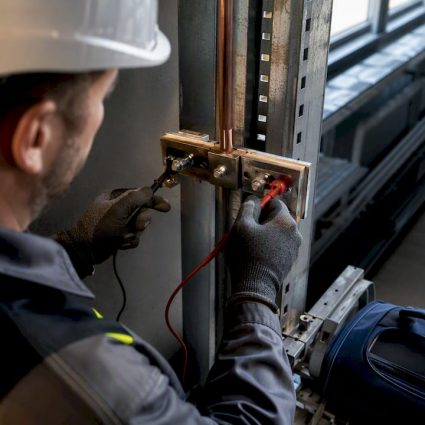
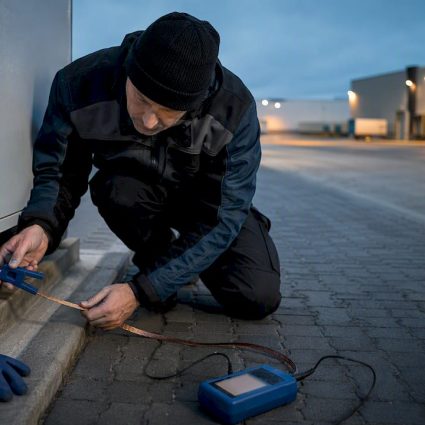
Acceptance testing under NFPA 780 typically includes measured continuity and resistance of all bonding and grounding connections, visual inspection of all air terminals and conductors, commissioning photographs of labeled connection points, and a signed certificate of conformity referencing NFPA 780 acceptance criteria.
| Event | Required Deliverable | Retention Period |
|---|---|---|
| Post-installation acceptance | Continuity/resistance test report + commissioning photos + certificate | Minimum 10 years |
| Annual inspection | Visual inspection report + any corrective action records | Minimum 10 years |
| Post-severe-storm inspection | Written findings + re-test results if damage found | Minimum 10 years |
| System modification | Updated as-built drawings + re-acceptance test | Life of system |
Facility managers should retain all records in a dedicated project file, organized by date and event type, and make them available for insurance audits and permit renewals. Digital records with version control reduce retrieval time significantly.
What does a realistic implementation timeline look like?
| Phase | Typical Duration | Primary Cost Drivers |
|---|---|---|
| Risk assessment and design review | 2–4 weeks | Site complexity, existing system condition |
| Procurement | 2–6 weeks | Lead times for air terminals, SPDs, ground rods |
| Installation | 4 weeks | Rooftop access logistics, soil conditions, building height |
| Acceptance testing | 3 days | Number of test points, third-party witness requirements |
| Documentation handover | — | Certificate preparation, as-built drawing updates |
Soil grounding conditions are the most unpredictable cost driver. Rocky or high-resistivity soil requires deep-earth drilling to achieve the resistance values NFPA 780 specifies, adding both time and equipment cost. Rooftop fall protection rigging, SPD selection for the facility’s surge exposure level, and weather delays during outdoor installation phases are the next largest variables. PtD choices made at design lock in most of these costs before mobilization.
Practical templates: JSA checklist, orientation sign-in, and contract clauses
JSA checklist (lightning-protection tasks):
- Task description and location on site
- Identified hazards (electrical, fall, struck-by, weather)
- Control measures for each hazard
- Required PPE (hard hat, safety glasses, fall arrest, insulated gloves)
- Tools and equipment list with inspection status
- Rescue plan and emergency contact
- Competent person name, signature, and date
Site orientation sign-in fields: worker name, employer, date, trainer name, emergency contact reviewed (Y/N), PPE issued (Y/N), signature.
Fields most commonly audited: dates, signatures, test results, and competent person credentials. Submit documents in this order: SSSP first, then JSAs, then orientation rosters, then test certificates at closeout.
How Indelec approaches lightning-protection safety and compliance
Indelec’s project workflow begins with a formal risk assessment that feeds directly into PtD recommendations, so hazard controls are embedded in the design before procurement opens. Installation includes deep-earth grounding when soil resistivity requires it, air terminal placement per NFPA 780 geometry requirements, and full bonding to the building’s electrical system per NEC.
The Prevectron3 lightning rod is the air terminal at the center of Indelec’s certified installations, backed by a formal certificate of guarantee. Facility owners also receive a maintenance plan that schedules annual inspections and post-storm checks, keeping the system compliant and the records current.
Key Takeaways
Effective building contractor safety guidelines for lightning protection require five parallel tracks: standards alignment, contract enforcement, design-phase controls, task-level JSAs, and documented acceptance testing.
| Point | Details |
|---|---|
| Require PtD in every bid | Specify air terminals, bonding, SPD locations, and roof anchors as line items before procurement closes. |
| Submit SSSP before mobilization | Facilities require approval before work starts; missing this delays the entire project. |
| Name the competent person explicitly | OSHA 1926.20 requires a named individual with stop-work authority in the written safety plan. |
| Deliver acceptance certificates at closeout | NFPA 780 acceptance testing results and a certificate of conformity are the minimum handover package. |
| Indelec as your specialist partner | Indelec provides risk assessment, NFPA 780-compliant installation, acceptance testing, and a certificate of guarantee for every project. |
What contractors and facility managers consistently get wrong
The single most common failure in the field is not a missing document — it is a missing signature. JSAs get written, SSSPs get submitted, but the competent person never signs the JSA before work starts. That gap turns a compliant-looking program into a liability the moment an incident occurs.
Training records are the second pressure point. Facilities are pulling workers from site mid-project for expired OSHA cards. Build a training expiration tracker into your project management system and check it monthly, not at mobilization only.
When severe weather forces a work suspension, communicate the decision to the facility manager in writing — a text or email with the time, reason, and estimated resumption. That record protects both parties and keeps the project schedule transparent.
Indelec makes lightning-protection compliance straightforward
Lightning-protection compliance has real procurement friction: multiple standards, acceptance testing requirements, and a documentation package that facility managers will audit. Indelec eliminates that friction with single-source responsibility — one provider for risk assessment, lightning protection system design, installation, acceptance testing, and the certificate of guarantee that closes the file.

Facility managers get an audit-ready package at handover. Contractors get a specialist partner who knows NFPA 780 and NEC requirements and can support the SSSP with technical documentation. Contact Indelec to request a site assessment and get a project-specific compliance package before your next bid goes out.
Useful sources and standards for contracting and compliance
Core documents to download, cite in contracts, and attach during pre-qualification:
- NFPA 780 — Standard for the Installation of Lightning Protection Systems (required attachment for acceptance testing specifications)
- NEC (NFPA 70) — National Electrical Code, Article 250 (grounding and bonding); required for electrical connection compliance
- OSHA 29 CFR 1926.20 — General safety and health provisions; cite in every SSSP
- OSHA 29 CFR 1926.501 — Fall protection; attach fall protection plan to SSSP
- NIOSH PtD guidance — Prevention through Design; cite in bid specifications and contract PtD clauses
- NIH Contractor Health and Safety Requirements — Model for orientation and hazard analysis requirements; useful template reference
- Indelec lightning standards and certification pages — Product certification details and acceptance testing criteria
Documents typically required as pre-qualification attachments: OSHA training cards, SSSP/CSSP, certificate of insurance, and (at closeout) the NFPA 780 acceptance testing certificate.