Ufer Ground: Concrete-Encased Electrode Design for French Sites
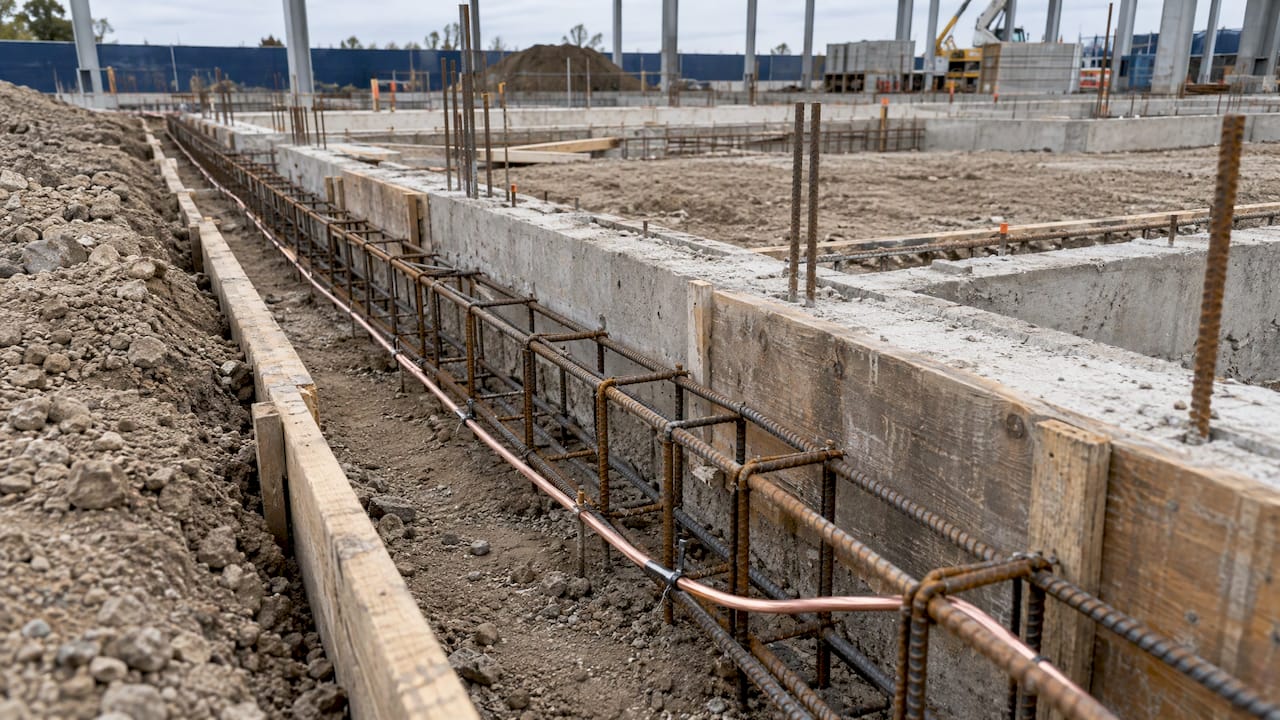
A Ufer ground is a concrete-encased electrode: steel or copper embedded in a foundation, in contact with the earth, and bonded to the building’s grounding system. In France you will meet the same idea under the name prise de terre en fond de fouille (foundation-trench earthing). It can only be built at one moment, before the concrete is poured, so the design decision belongs to the project team at foundation stage. On industrial, commercial and public sites that also means deciding early how the electrode will serve the lightning protection system. We support that decision through lightning risk analysis, technical study, installation and verification.
TL;DR
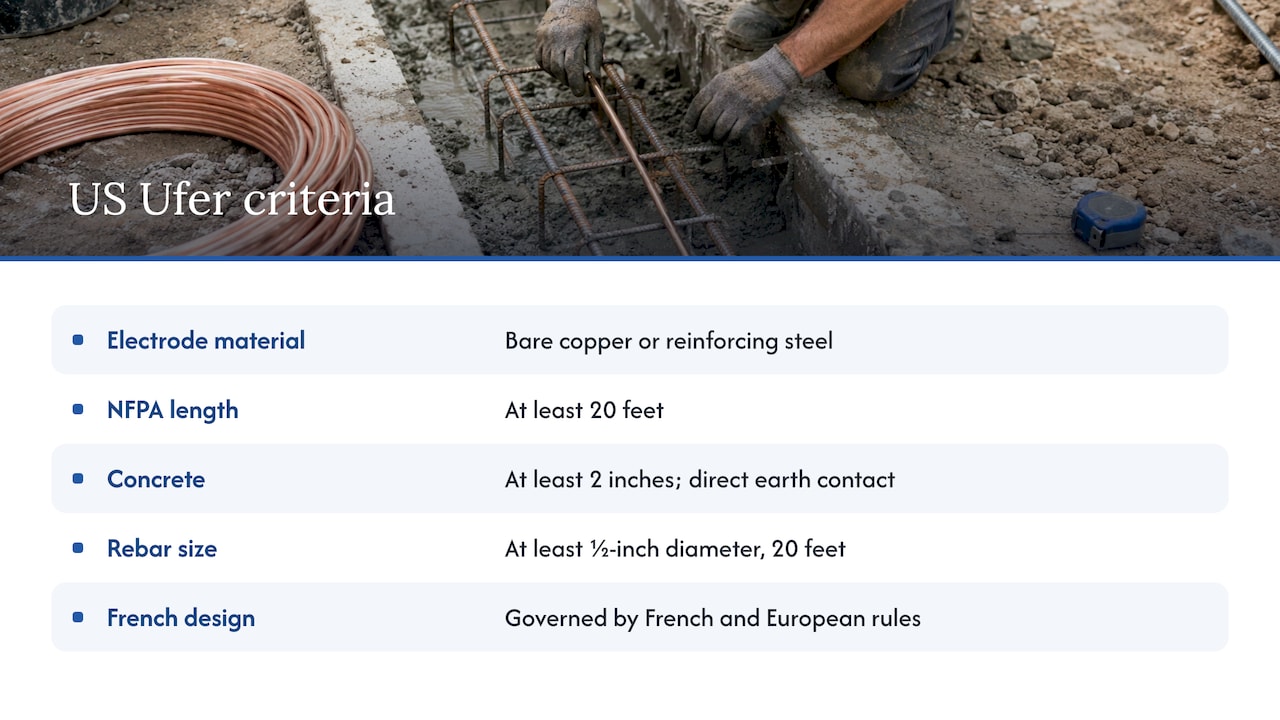
- “Ufer ground” is US slang for a concrete-encased electrode (CCE). The NEC-derived definition is rebar or bare copper, at least 20 ft (about 6 m) long, encased in at least 2 in. (about 5 cm) of concrete in direct contact with earth.
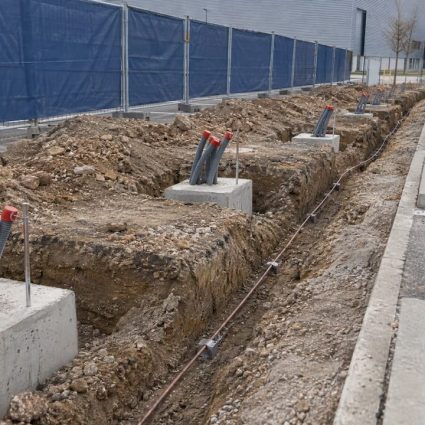
- The French equivalent is the foundation-trench loop required to be laid in contact with soil, not in gravel or similar bedding, and connected to the main earthing terminal.
- It must be installed before the foundations are poured. On existing buildings, driven rods or deep earthing are the practical route.
- On sites with lightning protection, the earth termination, the down conductors and the equipotential bonding have to be designed as one system, with the earth resistance checked after installation.
Table of Contents
- What a Ufer ground is and where the name comes from
- The French equivalent: the foundation-trench loop
- What the French rules require
- Foundation electrode or ground rods
- Designing the foundation earthing: what the team must settle
- Installation mistakes that undermine a concrete-encased electrode
- Inspection and maintenance
- Where we come in
- Our perspective
- FAQ
- Sources
What a Ufer ground is and where the name comes from
In US electrical practice, “Ufer ground” is slang for a concrete-encased grounding electrode: reinforcing steel embedded in concrete that touches the earth, which connects the building grounding system to the soil. The name comes from Herbert G. Ufer, an engineer who helped the US military with ground-resistance problems at Arizona installations in the 1940s, according to the same source.
Why does concrete work as part of an electrode? Below grade, concrete is in intimate contact with a large volume of soil and holds moisture, so a conductor buried in it presents a large contact surface to the earth. That is the practical idea behind using the foundation itself as the electrode, rather than adding a few driven rods after the fact.
The NFPA describes the electrode as bare copper conductor or reinforcing steel, at least 20 feet long, encased in at least 2 inches of concrete in direct contact with earth. A companion reference derived from the NEC specifies reinforcing bars or rods at least ½ inch in diameter and 20 feet long. Those are the figures behind the top search results you see for this term.
These are US figures. A French project is governed by French and European rules, so use them to understand the concept, not as the design basis for a site in France.
The French equivalent: the foundation-trench loop
French practice does not copy the US detail. The standard French solution for new construction is a conductor loop laid at the bottom of the foundation excavation. The French-language Guide de l’installation électrique describes it as the recommended solution for new buildings, with the conductor in intimate contact with the soil, not in gravel, clinker or similar bedding materials.
The same guide adds two points that matter on site:
- The earth loop should not touch the reinforcement of the foundation.
- The reinforcement itself is connected directly to the main earthing terminal.
So the French detail separates two things that a US “Ufer” often merges: a dedicated perimeter loop in the soil, and the rebar bonded for equipotentiality. If a drawing from a US specification lands on your desk, check which of the two it really describes before adopting it.
For a practical contractor-oriented walkthrough, see our guide on foundation trench grounding that meets NF C 15-100.
What the French rules require
The French framework for new dwellings is the ministerial order of 3 August 2016. In its published text it applies to new residential electrical installations and requires an earth electrode, earthing conductors, a main earthing terminal, protective conductors and equipotential bonding.
For industrial, commercial and infrastructure buildings, the earth electrode is then specified by the project’s electrical and lightning protection design. At European level, the 2011 edition of HD 60364-5-54 added annexes describing concrete-embedded foundation electrodes and soil-embedded electrodes. That is context for the design, not a prescription of one particular construction detail.
The construction side is documented separately. The CSTB register of DTUs (the French technical rules for building work) lists NF DTU 13.1 for shallow foundations, NF DTU 13.2 for deep foundations and NF DTU 21 for concrete works as references of their own, and the list does not give electrode rules. The practical lesson: the earthing detail will not appear by itself in the foundation or concrete specifications. Someone has to write it into the package.
Foundation electrode or ground rods
Both are earth-electrode methods, and the real differentiator is project stage. Promotelec’s comparison explains that a foundation-trench conductor encircles the building horizontally and must be installed before the foundations, while rods are driven vertically and are commonly used when renovating an existing building.
| Criterion | Foundation-trench loop / CCE | Driven rods or deep earthing |
|---|---|---|
| When it is installed | Before the foundations are poured | Any time, including on existing buildings |
| Layout | Horizontal, around the building perimeter | Vertical, at one or several points |
| Best fit | New construction | Renovation, extensions, sites where the foundation is not accessible |
| Main risk | Forgotten at foundation stage, cannot be added later | Soil resistivity, spacing and depth |
For the cases where the foundation is no longer accessible, or the soil near the surface is poor, we offer deep earth grounding drilling and a range of earthing products.
Designing the foundation earthing: what the team must settle
The following questions are best settled before the foundation drawings are issued.
1. Who owns the electrode detail?
The structural engineer sizes the foundation, the concrete contractor pours it, and the electrician connects to it afterward. Without a named owner for the earthing detail, the loop is either missed or placed by whoever is on site that day. Put the electrode in the drawings and in the pre-pour checklist.
2. Which electrode layout fits the building?
A perimeter loop suits most new footprints. Large industrial halls, tall masts or sites with sensitive equipment may need additional electrodes or meshing. A lightning risk analysis tells you whether the building needs lightning protection at all and at what level, which drives the earth termination requirement.
3. How will the rebar be bonded?
Following the French guide, the reinforcement connects to the main earthing terminal, and the soil loop stays separate from it. Define bonding points and accessible test points on the drawings, not on site.
4. How will the earth termination serve the lightning protection system?
When the building has air terminals and down conductors, the foundation loop is part of the earth termination those conductors discharge into. The connection points need to exist before the concrete does. Our guides on NF C 17-102 compliance and lightning protection design for French sites show how the earth termination fits the whole design.
5. What value will you verify, and when?
Earth resistance is measured, not assumed. Plan test access, record the first measurement at commissioning, and repeat it on a maintenance schedule. Our earth resistance guide for electricians explains the measurement and how to read it.
Installation mistakes that undermine a concrete-encased electrode
Most failures are decided on the day of the pour:
- Conductor laid on gravel or blinding. The French guide is explicit that the loop must be in intimate contact with the soil, not gravel, clinker or similar bedding.
- Loop touching the reinforcement when the detail calls for them to be separate.
- No accessible connection point. A perfect loop that no one can connect to later is worthless.
- Undersized or unspecified conductor and length. US figures such as 20 ft of ½-inch rebar are a reference point, not a French design value.
- No first measurement. Without a commissioning reading, later drift cannot be judged.
- Earthing left out of the construction package because the foundation and concrete DTUs do not cover it.
For industrial sites, our industrial grounding field guide goes further into bonding and verification practice.
Inspection and maintenance
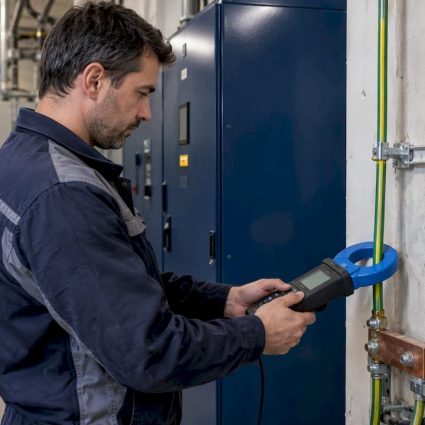
Once the concrete is poured, the electrode is hidden, so everything you can verify is at the access points. Measure the earth resistance at commissioning and at the intervals your lightning protection and electrical maintenance plan sets. Check the continuity of the connections between the electrode, the main earthing terminal and the down conductors. Keep records, because a reading is only meaningful against the earlier ones. Our guide on how to maintain grounding systems sets out a routine.
Where we come in
We design, supply, install, verify and maintain lightning protection systems, and we supply earthing products and deep earthing solutions. Our services cover lightning risk analysis (ARF) and technical study (ET), installation, and verification and maintenance, for industrial, commercial and infrastructure clients. If you are planning a new building or an extension and want the earth termination and the lightning protection designed together, start with our lightning protection services.

To see the earthing components we supply, browse our Mise à la terre range.
Our perspective
A foundation electrode is the cheapest earth termination a project will ever get, and the only one that cannot be added later. That is why we ask for the earthing question at the same meeting as the foundation question.
In our experience of more than 280,000 installations, the sound approach is to treat the earth termination as part of the lightning protection system and not as an electrical afterthought. A lightning risk analysis and technical study tell the team what the building needs. The earthing detail then follows from that, with connection points and test points drawn before the pour.
Where the foundation is not available, because the building exists or the ground is difficult, deep earthing and a properly designed earthing network deliver the same objective: a low, verified earth resistance connected to the whole protection system.
The measure of a good earth termination is a measured value, recorded at commissioning and checked over the life of the building.
INDELEC
FAQ
What does Ufer stand for?
It is not an acronym. The term comes from Herbert G. Ufer, an engineer who helped the US military with ground-resistance problems at Arizona installations in the 1940s, according to Electrical Contractor magazine. Today it is shorthand for a concrete-encased electrode.
Can ground rods be in concrete?
Rods are normally driven into the soil, and a foundation-trench conductor is the method designed to sit in the foundation excavation. Promotelec’s comparison notes that rods are commonly used in renovation, where the foundation cannot be accessed. For the right choice on your site, we can advise through our earthing range.
Where is a Ufer ground required?
In the US, the NEC treats the concrete-encased electrode as part of the grounding electrode system where it is present. In France, the 3 August 2016 order requires an earth electrode for new dwellings, and the foundation-trench loop is the recommended solution for new construction in the French installation guide. For other building types, the project’s electrical and lightning protection design sets the requirement.
Is a Ufer ground better than a ground rod?
For new construction, a foundation loop is the standard approach, and Promotelec describes project stage as the practical differentiator: use the foundation stage to install a perimeter electrode. Where the foundation is out of reach, driven rods or deep earthing are the practical route. Either way, the resistance is verified by measurement.
Sources
- On Solid Ground: Ufer Ground NEC Requirements, Electrical Contractor magazine
- What Is a Ufer Ground? Concrete-Encased Grounding Electrodes, Electrical Contractor magazine
- 8 Items that Form the Grounding Electrode System, NFPA
- Réalisation et mesure des prises de terre, Guide de l’installation électrique
- Arrêté du 3 août 2016 portant réglementation des installations électriques
- HD 60364-5-54:2011 standard preview
- DTU : liste des textes publiés au 31 juillet 2026, CSTB
- Fond de fouille ou piquets verticaux : quelle méthode, Promotelec via Voltimum