IRVE Connection Power: How to Size Your Grid Connection
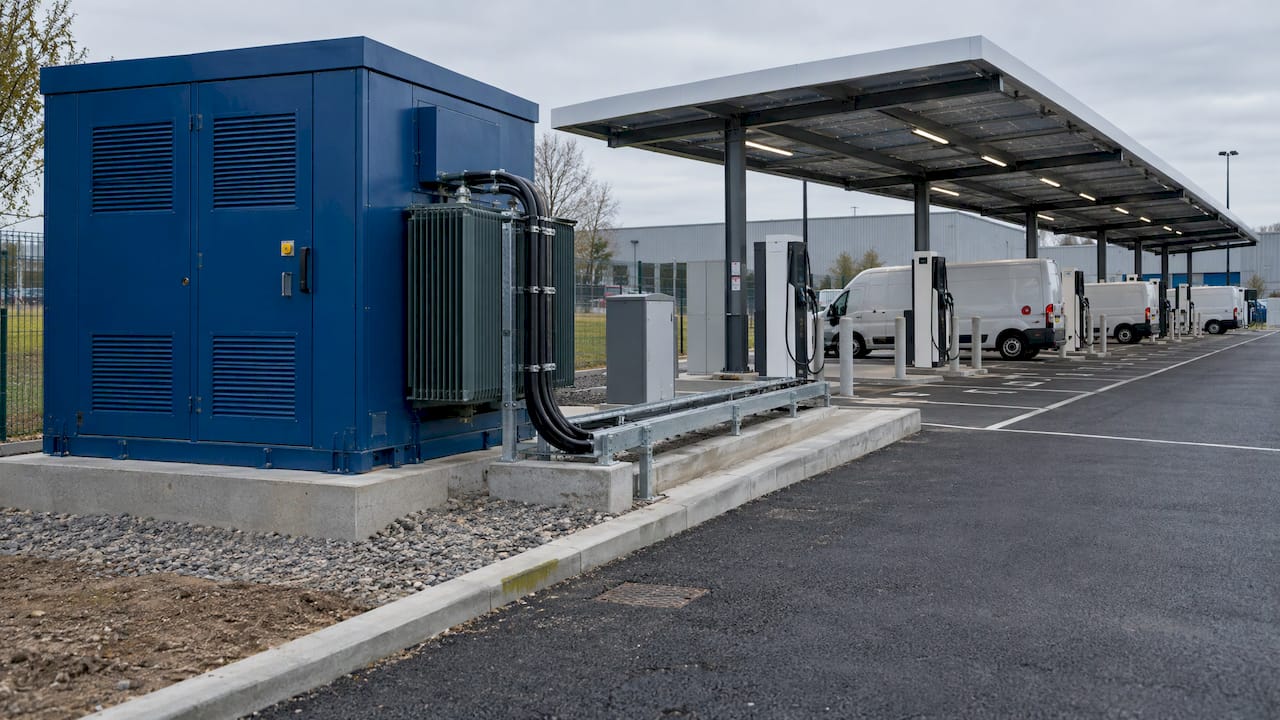
The connection power of an IRVE (a charging infrastructure for electric vehicles) is not the sum of the charger ratings. It is the capacity the grid operator, usually Enedis, agrees to deliver at your delivery point. You size it from the number of vehicles, the charging power per bay, how many will charge at once, and what the site already draws. Up to 36 kVA you follow one grid procedure. At 36 kVA and above, a medium-voltage study is triggered, and the schedule and budget change.
TL;DR
- Connection power (puissance de raccordement) is the capacity granted at the delivery point. A charger’s rated power is only one input to it.
- For a collective site, the regulatory formula is: number of served spaces × reference power × diversity factor. Enedis proposes a factor of 0.4.
- 36 kVA is the key threshold: it separates the simplified procedure from an HTA (medium-voltage) study, and it triggers extra Consuel paperwork.
- Load management lets you serve more bays on a given connection. Plan the first connection so it can absorb expansion.
- Above 3.7 kW, installations open to the public need a qualified IRVE installer.
Table of Contents
- Connection power vs. charger power: what is the difference?
- Calculating the connection power your site needs
- Simultaneous charging, load management and expansion
- The 36 kVA threshold and the 3.7 kW threshold
- When your existing supply is enough, and when it is not
- From request to commissioning
- Safety checks before commissioning
- Choosing the connection power: a short checklist
- Our perspective
- Get your IRVE project sized and protected
- FAQ
- Sources
Connection power vs. charger power: what is the difference?
A charger has a rated power: 3.7, 7.4, 11 or 22 kW in the common AC range. The common AC ratings map to current and phases: 3.7 kW is single-phase 16 A, 7.4 kW is single-phase 32 A, 11 kW is three-phase 16 A per phase, and 22 kW is three-phase 32 A per phase. The vehicle’s onboard charger can also cap what is actually drawn, and load management can reduce it further.
The connection power is a different object. For individual connections up to 36 kVA, Enedis’s general conditions state that the requested power is chosen between 3 and 36 kVA. The sizing power (Pracc) is the first tier of the technical reference that is at or above what you request, and your subscribed power cannot exceed the Pracc written in the connection offer.
In practice, you can install 10 chargers of 11 kW (110 kW of nameplate) on a 36 kVA connection if you control how much they draw together. The connection is sized to the peak you will actually allow, not to the catalog total.
The vocabulary also matters for the regulations. Promotelec defines normal charging as 22 kW or less at the charging point, and fast charging as above 22 kW. Normal charging suits spaces where vehicles stay several hours, such as a company car park or a depot overnight. Fast charging suits public sites with short stops.

Calculating the connection power your site needs
The formula for collective infrastructure
For a car park served by a collective IRVE infrastructure, Enedis’s external note recalls the definition from decree no. 2022-1249 of 21 September 2022:
PIRVE = number of served spaces × reference power (Préférence) × diversity factor
The reference power is set by ministerial order. The diversity factor (coefficient de foisonnement) reflects the fact that vehicles do not all charge at once or at full power.
Where the 0.4 factor comes from
Enedis proposes 0.4, based on a behavioral survey: one in two EV users recharge every two to three days, 33% recharge only once a week, and the average daily distance on a working day is 42 km. The grid distributor serving part of the country, SRD, keeps the same 0.4 value in the absence of field experience, and it may be revised once enough installed infrastructure provides data.

A worked example (illustrative)
Take a 40-space staff car park. Assume, for the arithmetic only, a reference power of 7 kW per space. Check the current value in the ministerial order before you use any figure in a file.
| Step | Value |
|---|---|
| Spaces served | 40 |
| Reference power per space (assumed) | 7 kW |
| Diversity factor | 0.4 |
| PIRVE | 40 × 7 × 0.4 = 112 kW |
That result is well above 36 kVA, so the project will not follow the simplified path. It also shows why the first design decision is not the charger model but the number of bays you intend to equip and when.
Do not forget the rest of the building
Enedis proposes no diversity between IRVE and the classic uses of the building on the shared section. Each is sized for its own diversified power, and the two are added. A site with heavy ventilation, process loads or air conditioning cannot assume the EV load will hide behind them.
Simultaneous charging, load management and expansion
Three levers decide how large the connection must be.
- Simultaneity. How many vehicles are plugged in during the peak window? A depot where every van returns at 6 p.m. behaves nothing like a retail car park.
- Load management. A charging controller shares available power across active chargers. This is how a fleet manager keeps a connection under a threshold. Our article on controlling charging power covers the logic, and our guide to fleet sizing under 36 kVA shows how to build the load profile.
- Expansion. For collective infrastructure, Enedis explains that the initial network works meet PIRVE at the start for at least 20% of the served spaces. Studies are then run regularly to identify the network adaptations needed as more spaces are equipped. Our walkthrough of the 20% rule for parking lots goes through what this means for phasing.
Civil works are where expansion is cheapest. Pulling empty ducts and sizing the main board for the final configuration costs far less than reopening a trench. The same logic applies to sequencing wet and dry utilities on a new development: decide the capacity and routes early, then build in the right order.
The 36 kVA threshold and the 3.7 kW threshold
Two numbers come up in almost every French IRVE project. They are not the same thing.
36 kVA: the grid and conformity threshold
- Grid study. Under Enedis’s study principles, a low-voltage connection or modification needs an HTA study when the power is 36 kVA or more. A HTA connection needs an HTB study with transmission to RTE when the power is 4 MW or more, or 5% or more of the source substation’s subscribed power.
- Portal. Enedis directs your request to one portal for projects at or below 36 kVA and to another for projects above.
- Consuel. Since decree no. 2021-546 of 4 May 2021, commissioning of an IRVE depends on a conformity attestation approved by Consuel. It is mandatory for any new IRVE in a collective housing building whatever its power, and elsewhere (individual housing, ERT/ERP, public domain) when the IRVE power exceeds 36 kW.
- Technical file. According to Consuel’s technical files page, a SC 143 (or SC 143_IRVE) file goes with the attestation when the power at the delivery point exceeds 36 kVA, or when a bidirectional charging point (V2H, V2G) is present at any power.
Adding chargers to an existing site can push you over a line without your noticing. Consuel’s IRVE newsletter says the attestation is also required when a new charging point makes the IRVE power exceed 36 kW or changes the delivery point’s tier, for example from C5 to C4.
3.7 kW: the installer qualification threshold
Qualifelec recalls that the decree of 12 January 2017 requires installer training and company qualification to install IRVE above 3.7 kW accessible to the public. Write this into your tender: ask for the IRVE qualification level that matches your project.
When your existing supply is enough, and when it is not
An existing supply can serve the chargers when the requested power stays within the current Pracc and the network has the capacity. Enedis’s general conditions set the limits for individual connections up to 36 kVA: requested power at most 36 kVA in three-phase (with an imbalance of at most 6 kVA between phases) or at most 6 kVA in single-phase, and not above the installed power on the site.
You need an upgrade or a new connection when:
- the requested power exceeds the existing Pracc;
- the connection power reaches 36 kVA, which triggers the HTA study;
- the network study finds insufficient capacity, through transit or voltage constraints.
The study also takes into account the current state of the network, investment decisions and earlier connection offers that may affect yours. So two neighboring sites can get different answers, and a request filed early can change what is available to the next one.
From request to commissioning
For individual connections up to 36 kVA, Enedis’s procedure runs in four stages:
- Reception and qualification of the request.
- Preparation and acceptance of the connection offer.
- Works and making the connection available.
- Preparation for commissioning.
Above 36 kVA you add the HTA study, and lead times lengthen. Confirm current lead times with Enedis on your own file, as they depend on the network and the works.
Before energization, Article D342-19 of the Energy Code, as cited by Enedis, requires a conformity attestation for any new permanent electrical installation connected to the public distribution network. The same Enedis page states that putting an IRVE above 36 kW into service depends on the attestation, including in the case of an indirect connection, and that re-energization after an increase of the maximum callable power depends on it when the increase exceeds 36 kW.
Safety checks before commissioning
The connection is only half the file. Promotelec’s good-practice sheet points to three frameworks: NF C 14-100 for the connection upstream of the delivery point, NF C 15-100 for circuits downstream, and its own guide for the minimum safety of existing parts of the installation.
Key points from that sheet:
- Each charging point has a dedicated circuit, protected against overcurrent by a circuit breaker and individually by a high-sensitivity RCD of 30 mA or less.
- For modes 1 and 2, use at least Type A or F in single-phase and Type B in three-phase. For mode 3, use Type A or F with disconnection above 6 mA DC fault current, or Type B.
- In an indirect connection, the new load must not reduce existing safety. Check that the existing protections are compatible with the new short-circuit current. Consuel stresses the same point when adding chargers changes the technical tier at the delivery point.
Earthing and surge protection are the two items most often found missing at inspection. See our guides on earthing for IRVE, surge protection that avoids Consuel rejections and the standards for tertiary buildings.
Choosing the connection power: a short checklist
| Question | Why it matters |
|---|---|
| How many bays today, and in five years? | Sets the PIRVE and the expansion margin |
| What charging power per bay? | Overnight depots rarely need more than normal charging |
| Will chargers be load-managed? | Lets you stay under 36 kVA or reduce the subscribed power |
| What does the building already draw at peak? | Added to the diversified EV load |
| Public access? | Triggers qualified-installer rules above 3.7 kW |
| Bidirectional charging planned? | Triggers the SC 143 technical file at any power |
Our perspective
Most delays we see on IRVE projects come from a connection power chosen too late. The charger is picked first, the grid request follows, and the study returns a result nobody planned for.
We start from the other end. We look at how the vehicles are used, set the power the site should really deliver, and design load management and phasing around that figure. The connection request then matches what the site needs, with room to grow.
Electrical protection is part of the same design. A charging site is an outdoor, exposed installation, and earthing and surge protection belong in the first drawing, not in the retrofit. With a history in lightning and surge protection going back to 1955 and more than 280,000 installations, this is the part of the file we know best.
This is how we approach audits and installations for professional fleets: one team looking at connection, protection and commissioning together.
INDELEC
Get your IRVE project sized and protected
If you manage a depot, an office car park or a public site, we can help with the audit, installation and supervision of your charging infrastructure, including the earthing and surge protection around it. See our electric mobility solutions or the full list of services.

For a first read of the cost side, our guide to charging station costs for fleets and sites is a good starting point, and our article on enterprise charger maintenance explains how to plan upkeep after commissioning.
FAQ
What is the difference between kW and kVA for an IRVE?
kW measures the active power a charger delivers to the vehicle. kVA is the apparent power, the unit used for grid connections and subscribed power. For a charging site, the two are close, but the connection request and the 36 kVA threshold are expressed in kVA.
Can I connect several chargers to my existing electrical supply?
Yes, if the total power you allow stays within the existing Pracc and the network can supply it. Load management is the usual way to fit several chargers on a limited connection. If the power you need exceeds the Pracc, you must ask Enedis for a modification.
Is a Consuel attestation always required?
No. For a new IRVE in collective housing, it is required whatever the power. In other locations it is required above 36 kW, and when an added charger pushes the installation over 36 kW or changes the delivery point’s tier. Check your case against Consuel’s current guidance.
What diversity factor should I use?
Enedis proposes 0.4 for collective IRVE infrastructure, and SRD keeps the same value for now. It applies to the regulatory sizing formula for collective infrastructure. For a fleet depot with synchronized returns, build your own load profile rather than assuming that value.
Who can install chargers above 3.7 kW?
For IRVE above 3.7 kW open to the public, the decree of 12 January 2017 requires installer training and company qualification. Ask candidate installers for their IRVE qualification and check that it matches the power of your project.
Sources
- Enedis, General conditions for connection up to 36 kVA
- Enedis, External note on collective IRVE
- CRE, SRD technical reference for collective charging infrastructure
- Enedis, Study principles and technical rules
- Enedis, Connection request procedure up to 36 kVA
- Enedis, Conformity attestation Consuel
- Enedis, Installing one or more charging stations
- Consuel, IRVE newsletter
- Consuel, Technical files
- Promotelec, Good practice for charging station installation
- Qualifelec, IRVE qualification press release
- ElecFrance, IRVE power table