EV Charging Load Management (IRVE) in France: A Guide
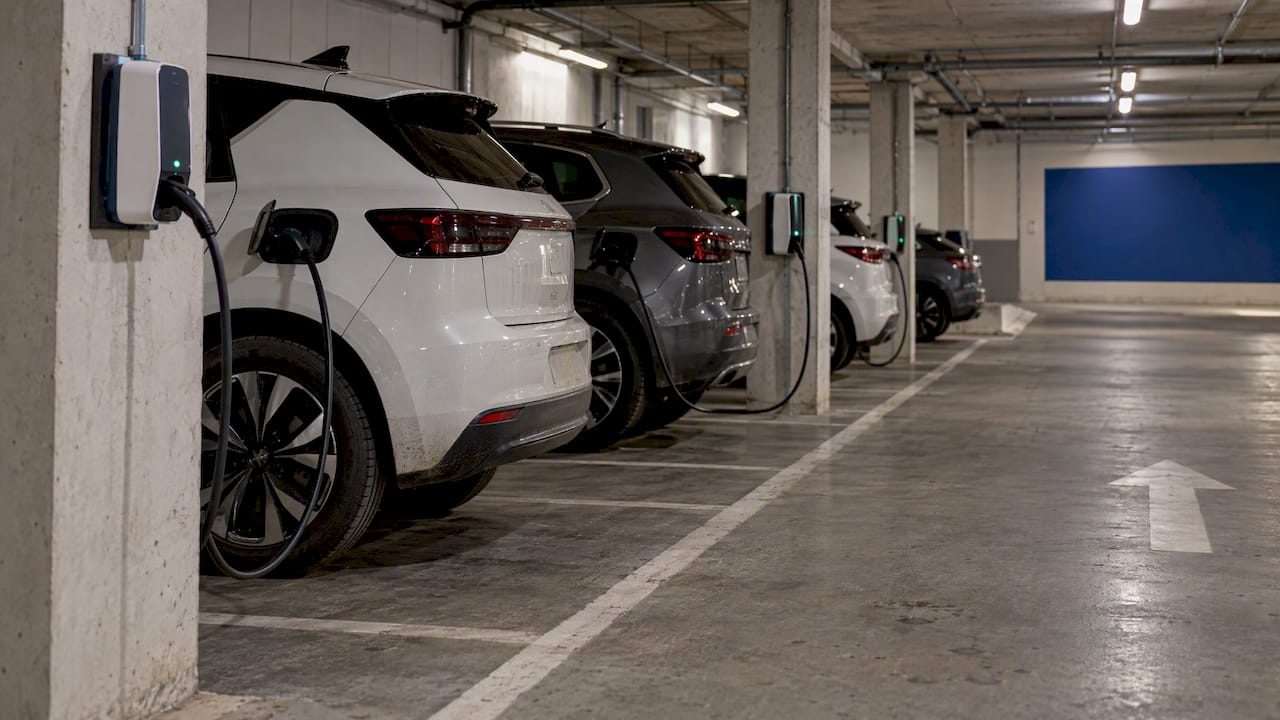
Load management (gestion de charge or pilotage de charge) lets a charging site share a limited electrical supply among several chargers and the building’s other loads, instead of paying for a bigger grid connection. In France, Enedis describes it as scheduling charging in power and/or in time, taking into account the tariff, the building’s uses or other charging sessions. For a facility owner, it is often the difference between a project that fits the existing supply and one that needs costly extra works.
This guide is written for facility managers, contractors, architects and consultancies who must specify an IRVE (infrastructure de recharge pour véhicules électriques) installation. It covers the two main control methods, what equipment is involved, the French regulatory frame, and what to put in a tender.
TL;DR
- Load management modulates charging power or shifts charging in time so the site never exceeds a defined power limit, which can lower the bill and, in some cases, avoid additional grid connection works.
- Static management splits a fixed amount of power among chargers. Dynamic management gives chargers more power when the rest of the site consumes less.
- A reliable system measures total site current in real time and protects essential building loads first, leaving only the remaining power to the chargers.
- French rules on mandatory charging infrastructure explicitly allow a modulable IRVE power through load management.
- Specify open standards, full lifecycle cost and a maintenance plan before signing, and size the system from a measured load profile, not from the number of parking spaces alone.
Table of Contents
- What load management means on an IRVE site
- Why a site needs it
- Static vs dynamic load management
- How the available power is shared
- Sizing: how to assess demand, capacity and power per point
- Equipment, controls and connections
- The French regulatory frame
- Implementation: commissioning, monitoring, maintenance and cost
- Our perspective
- Plan your charging site with us
- FAQ
- Sources
What load management means on an IRVE site
A charging point is a large, flexible electrical load. A single connected vehicle can draw as much power as a small workshop, and a car park with a dozen chargers can draw more than the building it serves. Load management is the control layer that decides, second by second, how much each charger may deliver.
According to the Enedis report on managed charging (April 2024), these systems can modulate power or move the charge in time in response to tariff signals, to the power available on the site, or to photovoltaic production. Two typical behaviors follow:
- Shifting in time: the charge is postponed to off-peak hours, which suits fleets that park overnight.
- Modulating power: the charge continues but is capped so that the site stays under a predefined limit.
The same Enedis report notes that managed charging can reduce the energy bill and, in some cases, avoid additional connection works. That second point is what usually convinces a budget holder: the cheapest kilowatt is the one you do not have to bring to the site.
Why a site needs it
Three situations come up again and again in tertiary and industrial projects.
The supply is already tight. A warehouse, a plant or an office building has a subscribed power sized for its own process, lighting, heating and ventilation. Adding chargers on top without control risks tripping the main breaker or pushing you into a higher subscription tier.
The number of chargers is growing. Pre-equipping parking spaces is one thing. Equipping them progressively as demand appears is another. A load-managed backbone lets you add chargers later without redoing the electrical design each time.
Usage is predictable but not simultaneous. Company cars and light utility vehicles are typically plugged in for hours while employees work or overnight. Since they do not all need full power at once, spreading the energy over the available time is natural. For fleets, this pairs closely with supervision and protocol choices, which we cover in our piece on requiring OCPP 2.0.1 and a profile matrix before signing.
Static vs dynamic load management
The Energy Saving Trust fleet toolkit draws the basic distinction clearly: static management divides a fixed amount of power among the charging points, while dynamic management automatically allocates more power to charging when the site’s electrical demand falls.
| Criterion | Static management | Dynamic management |
|---|---|---|
| Principle | Fixed power budget shared among chargers | Budget varies with the real-time demand of the rest of the site |
| Measurement needed | Usually none beyond the chargers themselves | Real-time measurement of the site’s total current |
| Behavior | Predictable, simple to commission | Adapts as the building’s consumption changes |
| Best fit | Small sites with stable, low background load | Sites with variable loads such as industrial processes, HVAC or other tenants |
| Main risk if poorly set | Unused capacity left on the table | Poor sensor placement or settings leading to inaccurate limits |
Static management is the simplest to design and to inspect. Dynamic management extracts more value from the same supply because it uses the margin that exists when the building is quiet. For most industrial and commercial sites with fluctuating consumption, dynamic control is the better long-term fit, with a static cap kept as a safety floor.
How the available power is shared
The logic described in the Enedis report is straightforward. The system measures the total current drawn by the building and the chargers in real time, then adjusts the power offered to each charging point so that the sum stays under the limit you set. Priority loads such as heating, lighting or an industrial process are protected: chargers only receive the power that remains.
In practice, you define several rules during design:
- The site limit: the maximum power the chargers plus the building may draw, linked to the subscribed power or the connection capacity.
- Priority between chargers: equal sharing, first-come first-served, or reserved power for certain users such as a service vehicle that must leave early.
- Behavior on loss of communication: a safe fallback power level if the meter or the network link fails.
- Time windows: for example, full power allowed overnight, reduced during the day.
The fallback rule deserves attention. A system that stops limiting when the meter signal drops can overload the supply exactly when no one is watching.
Sizing: how to assess demand, capacity and power per point
This is the step most often skipped, and it decides whether the project is affordable. There is no universal ratio, so base the study on your own data rather than on a rule of thumb.
1. Describe the vehicles and their dwell time. How many vehicles, which battery sizes, how long they stay parked, and how much energy they need between arrival and departure. A vehicle parked ten hours needs far less power than one that must be topped up in one hour.
2. Measure the existing load. Get the load curve of the site over a representative period, including seasonal peaks. Your electricity supplier or the network operator can provide metering data for your delivery point. The gap between your subscribed power and your real peak is the margin the chargers can use.
3. Check the electrical installation. Main switchboard capacity, cable sections, protection devices and available space for new feeders all limit what can be added, whatever the load management does.

4. Define the power per charging point. Calculate the energy needed per vehicle per day, divide by the available hours, and compare to the site’s margin. Then decide whether the design needs more chargers at lower power or fewer at higher power.
5. Plan growth. Decide how many chargers you will add in three to five years and design cabling and switchboards to accommodate them.
For the specific case of French car parks and the share of spaces to pre-equip, see our guide to sizing IRVE for French parking lots with the 20% rule.
Equipment, controls and connections
A load-managed installation is more than chargers on a wall. A typical architecture includes:
- Chargers that accept power setpoints and report their status through a standard communication protocol.
- A local controller that computes the limit for each charger. A local controller keeps working if the internet connection drops.
- A measurement point: a current transformer or meter on the main supply that tells the controller what the building consumes.
- Supervision software to monitor sessions, faults and energy used, usually through a standardized protocol so that you are not locked to one hardware brand.
- Protection and earthing: dedicated circuit protection, correct earthing and surge protection, which Consuel inspectors check at commissioning.
Enedis notes that connecting the charging system to the electricity meter facilitates tariff-based management at scale. If your project aims to follow off-peak tariff periods or to react to price signals, ask the integrator how the system receives that information and who maintains the link.
On protection, two of our technical guides are relevant: earthing for IRVE charging stations in France and surge protection to avoid Consuel rejections. Outdoor chargers and long cable runs in car parks are exposed to overvoltages, and a managed system with sensitive electronics is worth protecting.
For a deeper look at control strategies, our article IRVE energy management: how to control charging power goes further into the practical settings.
The French regulatory frame
The obligations on charging infrastructure in buildings come from the Construction and Housing Code. The official Service-Public page on mandatory charging infrastructure (updated 12 June 2026) describes the duties of pre-equipment and installation of charging points, and it refers to an IRVE power that can be modulated through load management. It provides, depending on the case, for pre-equipment of all the relevant residential spaces and of at least 20% of the relevant non-residential spaces.
This matters in two ways for your project:
- Load management is recognized as a legitimate way to meet the requirement. You do not need to provision full simultaneous power for every pre-equipped space.
- The pre-equipment share drives your infrastructure design. Conduits, cable trays and switchboard capacity must be sized for the spaces you must equip, even if chargers are installed gradually.
For public authorities, the 2019 mobility orientation law (LOM) created the option for local authorities and public bodies with the IRVE competence to draw up a master plan for publicly accessible infrastructure, as the government’s guide to the IRVE master plan explains. If you manage public infrastructure, check whether your territory has one before you design.
Technical standards and installer qualifications also apply. We detail them in our IRVE standards guide for tertiary buildings and in why you should check IRVE qualification before you sign.
Implementation: commissioning, monitoring, maintenance and cost
The government’s guide to charging infrastructure procurement recommends a preliminary study of needs and project sustainability, and a full-cost approach covering supply, installation, maintenance and supervision. The same document puts preventive maintenance at 5 to 12% of the purchase price per year, and advises reasoning over the whole life of the infrastructure and planning interfaces based on open standards.
Translated into project steps:
- Needs study and electrical audit: usage, load curve, existing installation, growth.
- Design: architecture, site limit, priority rules, fallback behavior, protocol choice.
- Installation: cabling, switchboards, chargers, measurement point, earthing and surge protection.
- Commissioning: test each rule. Simulate a peak in the building’s consumption and verify that charger power falls as designed. Simulate a communication loss and verify the fallback.
- Monitoring: track faults, session data and the actual power drawn against the limit.
- Maintenance: planned visits, firmware updates and tests of the control logic, not only of the chargers.
On costs, avoid comparing quotes on charger price alone. A quote that omits the measurement point, the supervision license or the maintenance contract will look cheaper and cost more over five years. Our overview of charging station costs and funding for fleets and sites explains how to build the comparison, and our guide on matching maintenance levels MA1, MA2 or MA3 helps you choose the right service scope.
What to write in the tender
- The site power limit and the measurement point, with who supplies and installs the meter or current transformer.
- Required communication standards and the right to change supervision provider.
- Fallback behavior on loss of measurement or network.
- Acceptance tests on the load management logic.
- Maintenance scope and response times.
- Evidence of the installer’s IRVE qualification.
Our perspective
We have been working on electrical protection since 1955, and what we see on sites is consistent: charging projects fail on the electrical basics before they fail on the software.
A load management system is only as dependable as the installation beneath it. Measurement points must be placed correctly, earthing must be sound, and surge protection must be in place, because the controller, the meters and the chargers all contain electronics that a lightning-induced overvoltage can damage. Treat the charging site as part of the building’s protection concept, not as an accessory bolted onto it.
This is why we approach IRVE as an engineering project. We start with the audit, define the site limit and priority rules with you, and then install and supervise the system, with the aim of delivering a result that is compliant and that fits your supply. Our approach to electric mobility for professional fleets covers the audit, the installation and the supervision.
Our advice to owners: size from measured data, ask for open standards, and make the protection of the installation part of the specification from day one.
INDELEC
Plan your charging site with us
If you manage an industrial, commercial or public site and want chargers that fit your existing supply, we handle the audit, installation and supervision of charging infrastructure for professional fleets. Our electric mobility services bring the electrical protection expertise we have built over decades to your charging project.

To discuss your site, start from our services page, and tell us the number of vehicles, the parking layout and your current subscribed power.
FAQ
Is load management mandatory for an IRVE installation in France?
The official guidance on mandatory charging infrastructure refers to a charging power that can be modulated by load management, so it is a recognized way to meet the obligations. Whether you need it depends on your supply and the number of chargers. If the site’s power margin is smaller than the combined power of the chargers, it is the practical solution.
Can load management avoid upgrading my grid connection?
In some cases, yes. Enedis states that managed charging can avoid additional connection works. This depends on your load curve and on how much energy your vehicles need during their parking time, which is why a measured study comes first.
What is the difference between static and dynamic load management?
Static management shares a fixed power budget among the chargers. Dynamic management raises the power available to chargers when the rest of the site consumes less, so it makes better use of the same supply.
What should I ask an installer about load management?
Ask where the measurement point sits, which communication standards the chargers use, what happens if the signal is lost, which tests are performed at commissioning, and what the maintenance contract covers. Also check the installer’s IRVE qualification before signing.
Sources
- Enedis, Le pilotage de la charge des véhicules électriques (April 2024)
- Energy Saving Trust, Load management
- Service-Public Entreprendre, Infrastructures obligatoires de recharge des véhicules électriques
- Ministère de la Transition écologique, Guide du schéma directeur IRVE (2021)
- Ministère de l’Économie, Marchés d’infrastructures de recharge pour véhicules électriques et hybrides rechargeables (2022)