EV Charging in a Company Parking Lot in France (IRVE)
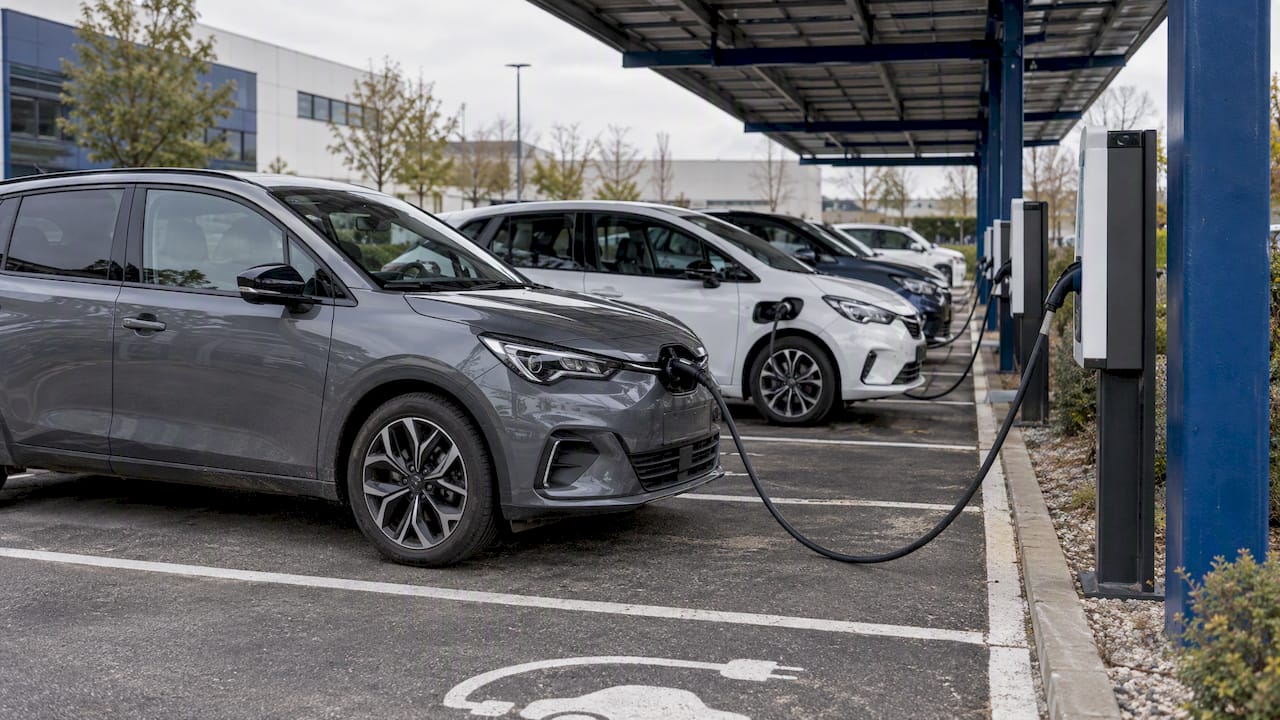
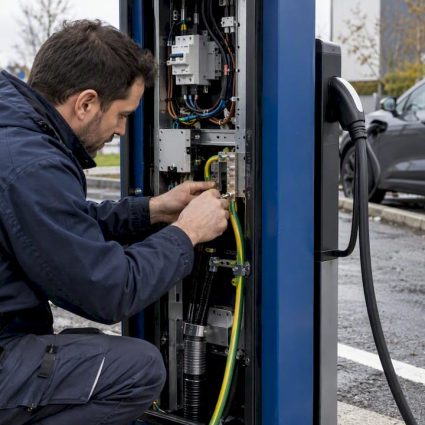
IRVE (infrastructure de recharge pour véhicules électriques) is the full chain that lets a vehicle charge in your car park: the power supply circuits, the charge points, the control cabinets and, where relevant, data, supervision and payment. For a company parking lot in France, your obligations depend on the type of building, the number of spaces, who owns and occupies it, and when the permit was filed. Once those facts are set, the project follows a clear sequence: audit the need, size the electrical supply, hire a qualified installer, commission, then maintain.
This guide walks facility managers, contractors and engineering teams through that sequence, with the French rules that frame it.
TL;DR
- IRVE covers circuits, charge points, control cabinets and, where relevant, supervision and payment, not just the wall box.
- Qualifying non-residential car parks must be pre-equipped for at least 20% of spaces, and some buildings are exempt (see below).
- Each charge point needs its own circuit and a residual-current device of 30 mA or less, and most installations must be done by a qualified professional.
- Size from a real audit of vehicles and employee needs, and plan maintenance and supervision from day one.
- Surge protection and earthing belong in the design, not in a later fix.
Table of Contents
- What IRVE includes in a company parking lot
- Which French requirements apply to your car park
- Size the project from real demand
- From design to commissioning: the main steps
- Electrical safety and accessibility
- Maintenance and supervision: plan the whole lifecycle
- What it costs and what can reduce the bill
- Our perspective
- Let us audit your car park
- FAQ
- Sources
What IRVE includes in a company parking lot
The 2017 decree that created the French framework defines the term broadly. According to the decree no. 2017-26 as in force on 1 March 2026, an IRVE comprises the power supply circuits, the charge points, the management and control cabinets and, where applicable, the data transmission, supervision, control and payment devices.
That definition matters for your budget and your contracts. A quote that covers only the charger leaves out the cable runs, the switchboard work, the load management and the software that make the site usable. When you compare offers, compare the whole chain.
For a company, three usage models usually coexist:
- Fleet charging: pool or company vehicles charged overnight, with predictable schedules.
- Employee charging: staff vehicles parked for a working day, often with billing or a usage policy.
- Visitor or customer charging: spaces open to people from outside, which brings public-access rules and inspection duties.
Each model changes the power per point, the access control and the payment layer. Decide which ones you serve before you size anything.
Which French requirements apply to your car park
The official service-public.gouv.fr guide to mandatory charging infrastructure is the reference to check. It sets out the following for qualifying non-residential parking:
- At least 20% of spaces must be pre-equipped, and 2% of spaces must be dimensioned for people with reduced mobility (PMR).
- Since 1 January 2025, qualifying existing buildings with more than 20 spaces must provide one PMR-accessible charge point, plus one more per 20 additional spaces.
Pre-equipment means the conduits and electrical capacity are in place so that charge points can be added later without breaking open the slab. It is not the same as installing chargers on every one of those spaces.
Exemptions to check
The same official page lists cases where the pre-equipment obligation does not apply:
- Buildings owned and occupied by SMEs with fewer than 250 employees and a balance sheet below €43 million and/or turnover below €50 million.
- Major renovations where the charging and connection costs exceed 7% of the total renovation costs.
These are narrow conditions. Confirm each criterion in writing before you rely on one. Obligations also vary with construction date and with whether the car park is managed under a public contract, so ask your architect or engineering consultancy to document which regime your building falls under. For a deeper walk through tertiary buildings, see our IRVE standards guide for tertiary buildings in France.
Size the project from real demand
The most expensive mistake in a company car park is sizing from a slogan (“20% of spaces”) instead of from usage. ADEME recommends running a fleet audit and an employee electro-compatibility survey to determine how many charge points you need, at what power, and which IT interfaces they require.
In practice, collect these inputs:
- Vehicles: number, battery capacity, daily distance, dwell time on site.
- People: how many employees already drive or plan to drive an electric vehicle in the next few years.
- Access: who may use each space, and whether usage is billed.
- Site: distance from the main switchboard to each bay, trenching conditions, available spare capacity on the incoming supply.
ADEME also notes that automated vehicle booking can enable pooling and help reduce the size of a company fleet. Fewer vehicles mean fewer charge points to buy.
Power, diversity and load management
A vehicle parked for nine hours does not need a fast charger. Slower AC points combined with dynamic load management often serve a workplace better than fewer, more powerful units, and they keep the site’s subscribed power under control.
On diversity, be careful. In its 20 July 2023 note, Enedis says available data do not confirm or quantify any diversity between ordinary building use and EV charging, and proposes not counting on it when sizing the common section. The note concerns collective residential infrastructure, but the lesson carries over: do not assume your chargers and your building loads will never peak together without a documented load study.
For worked sizing examples, see our guides on sizing IRVE for parking lots with the 20% rule and on fleet sizing under 36 kVA. Heavy industrial sites face longer grid lead times, covered in French industrial IRVE and grounding.

From design to commissioning: the main steps
The French Directorate-General for Enterprises recommends an integrated approach covering supply, installation, maintenance and supervision, built on open, clearly defined standards so you can change provider later without replacing everything.
A typical sequence looks like this:
- Needs audit and regulatory check. Vehicles, users, obligations, exemptions.
- Electrical study. Available capacity, switchboard condition, cable routes, load management strategy, earthing and surge protection.
- Grid request. If you need more power, start the connection request with the network operator early, because lead times can be long.
- Tender or consultation. Specify interoperability and supervision, not only hardware.
- Installation by a qualified contractor. See the qualification rule below.
- Conformity check and commissioning. Testing, documentation, and the certificate of conformity your insurer and the network operator may ask for.
- Operation. Supervision, maintenance plan, user rules.
Qualification of the installer
Except for specified installations of 3.7 kW or less, the 2017 decree requires IRVE to be installed by professionals qualified by an accredited qualification body, on the basis of an approved training module. Ask every bidder for their current qualification certificate and check the validity date. Our article on checking IRVE qualification before you sign explains what to request and what the 2026 changes mean for your contracts.
Electrical safety and accessibility
The same decree requires a specialized circuit for each charge point, protected by a dedicated residual-current device rated at no more than 30 mA. Publicly accessible infrastructure must be inspected at least once a year. If you open spaces to visitors or customers, build that inspection into your maintenance calendar from the start.
Accessibility is part of the design brief, not a late adjustment. The 2% PMR-dimensioned spaces in the pre-equipment rule, and the PMR charge point required in qualifying existing buildings, need wider bays, step-free routes and reachable controls. Settle their location on the plan before trenching begins, because moving a conduit later costs far more than placing it correctly.
Surge protection and earthing
Chargers sit outdoors or in semi-open car parks, at the end of long cable runs, and they contain sensitive electronics. A single induced surge can take a charge point offline, and an incomplete protection scheme can also delay the conformity certificate. Two practical points:
- Place surge protective devices at the switchboard feeding the chargers and, where cable lengths require it, close to the charge points.
- Check the earthing resistance of the installation, and bond metallic masts, canopies and charger pedestals properly.
We detail the rules in avoiding Consuel rejections with surge protection on EV chargers and in how French installers avoid IRVE retrofit costs with NF C 15-100 surge rules.
Maintenance and supervision: plan the whole lifecycle
The Directorate-General for Enterprises stresses that a successful project takes a global lifecycle view that integrates maintenance and supervision, rather than focusing on the initial installation cost. A charger that is out of service for three weeks costs you more in lost trust than a maintenance contract would have.
A workable maintenance plan has four layers:
- Remote supervision with alerts for faults and offline units.
- Scheduled preventive visits: visual checks, tightening, testing of protection devices.
- A response time commitment for corrective repairs.
- Annual inspection where the infrastructure is publicly accessible.
Our guide to enterprise EV charger maintenance, matching MA1, MA2 or MA3 levels helps you choose the contract level that fits your risk.
What it costs and what can reduce the bill
Total cost depends on the number of points, AC or DC power, trenching distance, switchboard upgrades, grid connection and supervision. Two projects with the same number of chargers can differ several times over in cost, because civil works and electrical upgrades often outweigh the equipment. For that reason, ask for a quote that separates equipment, installation, connection, supervision and maintenance, and compare line by line.

Financial support exists in France, notably the Advenir program, which has offered premiums to companies and public bodies. Terms, ceilings and eligible uses change, so read the current conditions on the official program page and confirm eligibility before you sign, since in most schemes the order of events matters. Our overview, how to save on French charging station costs for fleets and sites, explains how we approach cost reduction without cutting safety.
Our perspective
We see the same pattern on many sites: the charger is chosen first, and the electrical environment is discovered afterward. The result is a switchboard that cannot take the load, a surge that damages a charge point in its first storm season, or an earthing system that fails inspection.
Our view is that an IRVE is an electrical installation first and a piece of mobility equipment second. That is why we start from the site: capacity, earthing, protection against overvoltages and lightning, and only then the number and type of charge points. Indelec has protected infrastructure against lightning since 1955, with more than 280,000 installations, and we bring that engineering discipline to charging projects for professional fleets.
For facility teams, this means one accountable partner from audit to supervision, with a design that anticipates grid constraints, accessibility and maintenance. We think that is the surest way to avoid retrofit costs, rejected conformity checks and idle bays.
INDELEC
Let us audit your car park
Indelec supports companies, building contractors, architects and public infrastructure agencies with electric mobility solutions: audit, installation and supervision of charging stations for professional fleets, backed by our lightning and surge protection expertise. See our electric vehicle charging services or contact us through our services page to discuss your site.

Bring your single-line diagram, the number of spaces and your vehicle list, and we will tell you what to check first.
FAQ
Does every company parking lot in France have to install chargers?
Not every one. The obligations apply to qualifying non-residential car parks and depend on size, building type and permit date, with exemptions such as buildings owned and occupied by qualifying SMEs. Check the official service-public.gouv.fr page and have your engineering consultancy confirm your case.
Can any electrician install the charge points?
No. Except for specified installations of 3.7 kW or less, IRVE must be installed by professionals qualified through an accredited body. Ask for the certificate and verify its validity before signing.
What is the difference between pre-equipment and a full installation?
Pre-equipment means the conduits and electrical capacity are provided so charge points can be added later. A full installation includes the chargers, their circuits, protection and, where relevant, supervision and payment.
What protection does each charge point need?
The 2017 decree requires a specialized circuit and a dedicated residual-current device of 30 mA or less for each charge point. We also recommend surge protection in the design, so a storm or a switching surge does not take the unit offline.
Sources
- Décret n° 2017-26 du 12 janvier 2017, version en vigueur au 1er mars 2026 (Légifrance)
- Infrastructures obligatoires de recharge des véhicules électriques (service-public.gouv.fr)
- Optimiser ma flotte de véhicules (ADEME)
- Marchés d’infrastructures de recharge pour véhicules électriques (Direction générale des entreprises, 2022)
- Décret n° 2017-26 du 12 janvier 2017, texte publié (AVERE-France)
- Note externe Enedis, 20 juillet 2023