Size IRVE for French Parking Lots With the 20% Rule
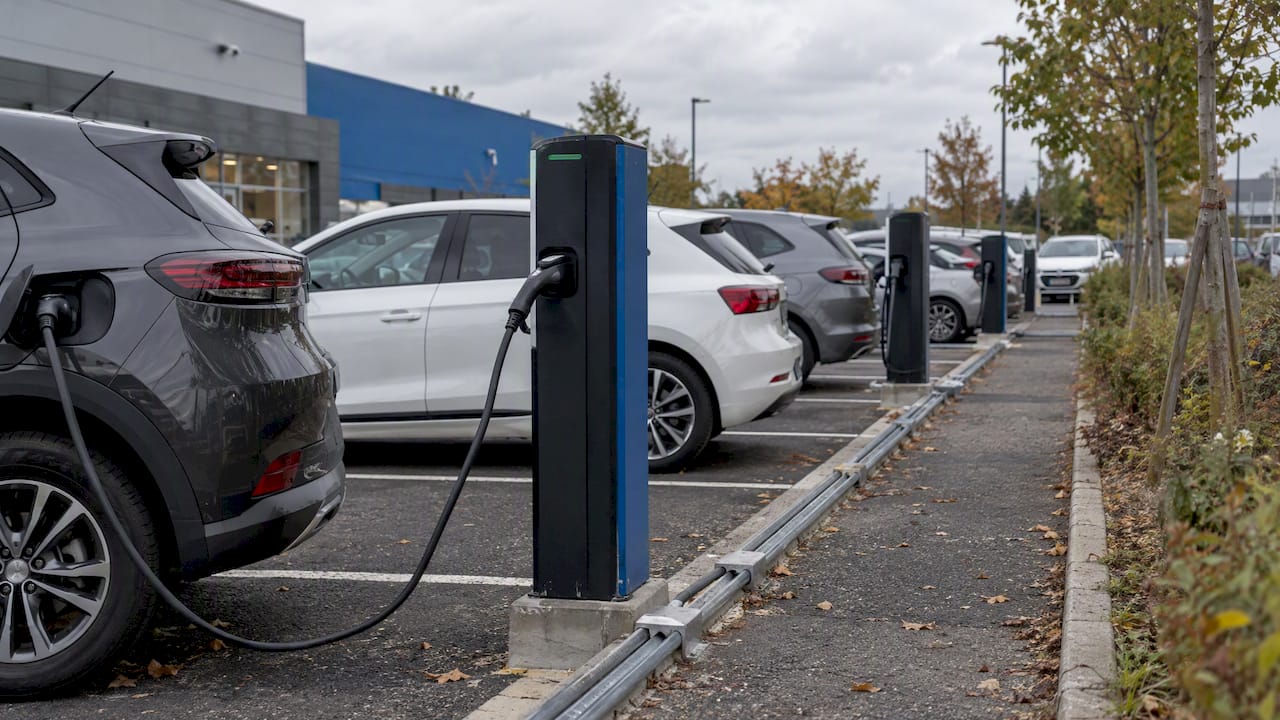
Size your parking-lot charging infrastructure with PIRVE = number of served spaces × reference power × foisonnement. Enedis guidance sets the foisonnement at 0.4 and requires at least 20% of spaces covered at commissioning. For many fleet and tertiary projects, start from a 7.4 kW reference power per point, then compute PIRVE at T0 on that basis.
TL;DR:
- Count only usable spaces within the physically connected, contiguous service area, and track already equipped spaces separately from those awaiting preparation.
- Use 7.4 kW per point for company fleets and overnight parking; short stays may justify higher AC or DC power, increasing reserved capacity.
- A site with 80 spaces needs at least 16 points at commissioning, producing 47.36 kW and prompting an early connection review above 36 kVA.
- Run hourly demand profiles alongside the standard diversity assumption, because fleets charging on synchronized schedules may need more reserved power.
- Centralized load management can cap sitewide demand, while local sharing suits small sites; specify controls in the initial switchboard design to avoid later replacement.
Table of Contents
- How do you calculate PIRVE step by step?
- What do French regulations require for pre-equipment?
- Which reference power should you use per point?
- How does PIRVE affect your connection, subscription and TGBT?
- What civil works should you pre-install?
- How does smart charging reduce grid reinforcement?
- How should you phase commissioning and scale up?
- How do you calculate peak simultaneous load beyond foisonnement?
- How do you integrate lightning protection into EV charging in parking areas?
- Which standards and certifications apply to IRVE?
- What maintenance and verification do EV charging installations need?
- What environmental and safety factors matter for high-power charging?
- Why does robust pre-equipment beat minimal compliance?
- How can we help with your IRVE project?
- FAQ
- Sources
How do you calculate PIRVE step by step?
Every variable in the formula is a decision you make before anything is built. Work through them in this order:
- Count the spaces in the serviced perimeter. The desserte must be contiguous, so count only spaces the infrastructure physically reaches. Spaces already equipped are counted separately from those to be pre-equipped, and a space that is permanently vacant or unusable is excluded from the perimeter, not counted at zero.
- Pick the reference power per point. The arrêté and Enedis tables use 7.4 kVA per point in their sizing grids, as the Enedis guide for new housing shows, and the same figure is a common baseline for company charging.
- Apply the foisonnement of 0.4. This is the statistical simultaneity assumed by the CRE and Enedis framework, as set out in the network sizing rules.
- Fix the number of points for T0. PIRVE at T0 uses the synchronous branchings you request, never fewer than 20% of the places.
Two worked examples, using the 7.4 kW baseline:
- 25 places. The 20% minimum gives 5 points. PIRVE = 5 × 7.4 × 0.4 = 14.8 kW.
- 80 places. The 20% minimum gives 16 points. PIRVE = 16 × 7.4 × 0.4 = 47.36 kW.
Notice what the second result does: it crosses the 36 kVA line that drives subscription and connection choices, which we cover below.
What do French regulations require for pre-equipment?
The framework combines the Code de la construction, the Loi d’Orientation des Mobilizes, decree n°2022-1249 and its arrêté. What matters for your design:
- Pre-equipment obligation: new buildings must provide the infrastructure to host chargers, with a minimum share of places pre-equipped or equipped, as summarized in the Enedis guidance for new housing.
- Power reservation: a minimum IRVE power reserve is set aside at the connection, and PIRVE at T0 can never describe fewer than 20% of the places.
- ERP and public-access sites: when the parking is open to the public, ERP safety rules come on top of the electrical rules. Check the threshold on the number of places open to the public with your design office, because it changes the compliance file.
- Contiguity: the infrastructure must serve a contiguous perimeter. Where PIRVE exceeds what the existing connection can supply, the network operator (GRD) decides the technical solution, which may include network works.
Treat these as design inputs, not paperwork. A reservation you under-declare at T0 is much harder to raise later.
Which reference power should you use per point?
The reference power you choose scales PIRVE directly, so match it to how the space is used. Typical categories from Enedis’s sustainable mobility observatory:
- Household or domestic: about 3.4 kW per point.
- Company or fleet: 7.4 kW per point.
- Public AC: 7.4 to 22 kW.
- Rapid DC: 50 kW and above, up to 350 kW.
For overnight charging, where vehicles sit for hours, a 7.4 kW point is generally ample and smart charging can spread the load. For short-stay commercial parking, dwell times are shorter, so higher AC power or DC points may be justified, but each one weighs heavily in PIRVE.
Statistic callout: 7.4 kW per point is the baseline used for company and fleet charging in French planning guidance, which is why we use it in the worked examples.
Resist the temptation to size every space for the fastest charger you can imagine. Choose the power for the dominant use case, then let the infrastructure leave room to upgrade.
How does PIRVE affect your connection, subscription and TGBT?
PIRVE converts into an electrical architecture. You generally have three options:
- Increase the main subscription, which is the simplest route when the existing installation has headroom.
- Add a dedicated compteur services généraux with its own secondary TGBT, which separates the charging load from the building’s other loads.
- Request a new delivery point, which becomes relevant once the demand outgrows the existing connection.
Above 36 kVA, changes are common, because the low-voltage connection equipment standardized under NF C 14-100 up to 36 kVA no longer covers the need. Supplies above 120 kVA typically call for a direct connection to a transformer substation. In our 80-place example, 47.36 kW already sits in the zone where you must verify the connection rather than assume it.
The Loi LOM treats chargers as an extension of the building’s load, so planning must include a formal audit of existing power reserves to avoid costly grid reinforcement. For fleet sites, our guide on staying under 36 kVA with IRVE fleet sizing details how to stay under that threshold.
Pro Tip:audit the transformer and the supply column capacity at the very start, before the PIRVE file goes to the GRD, so you avoid retrofit escalation and multi-month grid delays.
What civil works should you pre-install?
Civil works are the part you cannot cheaply redo. Pre-install, at minimum:
- Fourreaux of 100 mm diameter along every cable route, sized for the full build-out, not just the first phase.
- Cable paths and pits that let you pull additional circuits without re-digging.
- Sealed socles with a looped cable allowance, so a charger can be fitted or moved without new trenching.
- Earthing provisions in each socle, which keeps the equipotential bonding consistent as points are added.
- PRM and enclosures in monophase or triphase versions as the design requires. For outdoor parking, Enedis imposes constraints on connection equipment to maintain IP and IK ratings, as the connection equipment specification explains. Cabinets that integrate protections with the charger simplify compliance and maintenance.
- Harmonized socle dimensions, with double socles where two adjacent spaces will be equipped, so later expansion needs no new foundation.
Practitioners advise sizing the passive infrastructure for 100% equipment even when only 20% is installed now, as the Enedis external note describes.
How does smart charging reduce grid reinforcement?
The 0.4 foisonnement is a statistical baseline: it assumes not every vehicle draws full power at once. Pilotable charging goes further, because you control when each point draws power, which flattens the peak and lowers the contracted power you need.
Two approaches are worth comparing:
- Local load sharing, where chargers on one circuit divide a fixed power budget. It is simple and cheap, and works well on small sites.
- Centralized pilot systems, where a supervisor allocates power across the whole parking according to priorities and departure times. It costs more but scales, and it is what Enedis recommends: centralized, pilotable systems that balance load across the parking to avoid power saturation, whereas siloed individual chargers often force expensive grid reinforcement.
The benefit is concrete: lower contracted power, a smaller PIRVE-driven reserve, and deferred GRD works. One caution: fleet-heavy sites with synchronized charging windows may need more reserve power than the standard foisonnement assumes, so model the real schedule before relying on pilotage to cut the subscription.
Pro Tip:specify a pilot-capable TGBT and supervision in the initial design, so you can turn on load management later without replacing the switchboard.
How should you phase commissioning and scale up?
A practical rollout looks like this:
- Commission at 15 to 20% of places, with monitoring on from day one, never below the 20% regulatory minimum where it applies.
- Review real load profiles over the first months: peak hour, dwell time, charge energy per session.
- Add one or two expansion phases over 12 to 18 months, using the passive infrastructure you pre-installed.
- Plan higher PIRVE up front for fleets with synchronized charging windows, and model those profiles explicitly instead of relying on 0.4.
Before issuing the tender, assemble a short procurement checklist: the technical brief, the required civil pre-equipment, the selected reference power, and the pilotage requirements. If your project is industrial, our note on avoiding grid delays covers transformer constraints in more depth.
How do you calculate peak simultaneous load beyond foisonnement?
The 0.4 coefficient is a regulatory shortcut, not a load study. For a real design, run these steps:
- Define user groups. Split spaces into residents, employees, visitors and fleet vehicles, because each group has its own arrival and departure pattern.
- Build an hourly profile per group. Estimate how many vehicles plug in each hour, their state of charge on arrival, and how long they stay.
- Compute the energy each vehicle needs. A vehicle that arrives with a low battery and leaves in two hours needs high power. One that stays overnight needs very little.
- Sum the demand hour by hour. The maximum of that sum is your true peak simultaneous load. Compare it with PIRVE, and use the higher figure for the connection decision.
- Apply a diversity factor per group, not a single global one. A fleet depot may have a high diversity factor during a shared charging window, while a mixed public car park may have a lower one.
- Add the building’s existing load. The EV load is added to the building’s own peak, not studied in isolation, and the two peaks may or may not coincide.
- Test with and without pilotage. Run the model once at full power and once with load management capped to a fixed budget. The gap shows what smart charging is worth.
- Add margin for growth. Rerun the model at 100% equipment to confirm the passive infrastructure still holds.
The output is a defensible peak figure you can show to the GRD, rather than a coefficient you hope will be accepted.
How do you integrate lightning protection into EV charging in parking areas?
Open parking areas are exposed. Chargers stand on poles or sockles in the open, connected by long cable runs to a switchboard, and every one of those conductors can carry a surge into electronics. Lightning protection for IRVE is therefore not an afterthought, and it should be designed together with the electrical file.
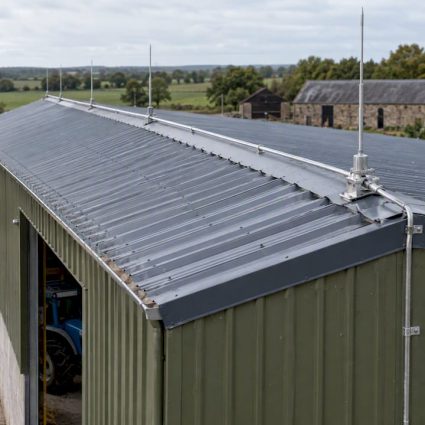
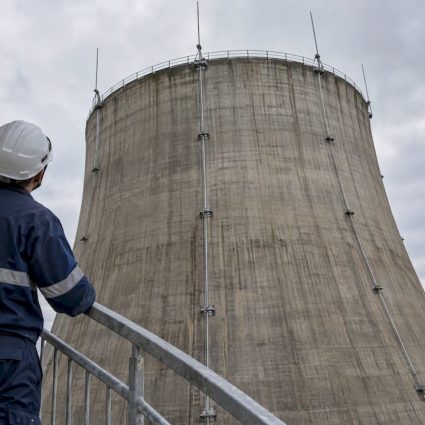
Start with a risk assessment. Whether the site needs an external lightning protection system depends on the building, its surroundings and the consequences of damage, which is what an ARF (analyse du risque foudre) and a technical study establish. A multi-level parking structure, a rooftop deck or a site with a lightning rod nearby changes the answer.
Then handle the three layers together:
- External protection: where a lightning rod or mesh cage is required, the charger positions must respect its separation distances.
- Grounding: every socle needs an earthing path that ties into the site’s equipotential network. Mixed or poorly bonded earths are a common root cause of damage and of failed inspections.
- Surge protection: coordinated surge protective devices at the TGBT and at the charger feeder limit the transient voltage that reaches the electronics.
Surge protection is also a commissioning matter. Our post on avoiding Consuel rejections with surge protection for French EV chargers explains what inspectors look for. For the grounding side, our range of earthing products covers the components used in socle and network bonding.
Which standards and certifications apply to IRVE?
Several layers apply, and each has a different owner:
- NF C 14-100 governs the connection and the equipment up to the delivery point, including the equipment described in the Enedis connection specification.
- NF C 15-100 governs the customer’s internal installation, and its IRVE provisions cover circuits, protections and sockets for charging.
- The pre-equipment arrêté and decree n°2022-1249 set the obligations and the reference values that feed the PIRVE calculation, as described in the Enedis new-housing guide.
- The CRE and GRD sizing rules frame how PIRVE is computed and when network works are triggered, per the published rules.
On the people side, France requires installers of higher-power points to hold the IRVE qualification. Our article on checking IRVE qualification before you sign explains the requirement and what to ask a contractor. Beyond that, the installation is subject to a Consuel conformity certificate where applicable, which is why documentation of protections, earthing and surge devices should be assembled as you build, not at the end.
Keep a single dossier: calculation note, single-line diagram, test reports and equipment datasheets. It speeds up the GRD exchange, the Consuel visit and any later extension.
What maintenance and verification do EV charging installations need?
Protection devices that are never tested are protection you only assume you have. Build a routine around three checks.

Commissioning verification. Before energizing, verify continuity of protective conductors, earth resistance, insulation, the operation of residual current devices and the correct labeling of circuits. Record the values as your baseline.
Periodic inspection. Repeat the earth and bonding measurements on a fixed schedule and after any structural work in the parking, such as resurfacing or new trenching, that could damage a buried conductor. Check surge protective devices for their status indicator, since a device that has absorbed a surge may have reached end of life without any visible fault on the charger.
Event-driven checks. After a nearby lightning strike or a grid disturbance, inspect the surge devices and the affected chargers before returning them to service. A lightning strike counter on a protected site gives you an objective record of events.
Document every visit. A maintenance log that shows measured values over time lets you spot a slowly degrading earth connection before it becomes a safety problem. Our guide on how to maintain grounding systems walks through the measurements, and our verification and maintenance service covers the work on site.
What environmental and safety factors matter for high-power charging?
High-power charging concentrates energy in a small footprint, so design for the failure case, not just the normal one.
- Thermal and fire safety: high currents heat cables and connections. Size conductors and protections for continuous duty, keep ventilation unobstructed, and think about where vehicles and chargers sit relative to combustible materials. In enclosed or underground parkings, consult the fire safety rules that apply to your building type.
- Electrical safety for the public: use enclosures with the required IP and IK ratings outdoors, as the connection equipment specification requires for exposed equipment. Protect cables from vehicle impact with bollards or curbs, and keep emergency stop and signage visible.
- Weather and surge exposure: as noted above, outdoor chargers are the most exposed equipment on the site. Coordinated surge and lightning protection reduces both the safety risk and the replacement cost.
- Environmental footprint: pilotable charging reduces peak demand and the need for network reinforcement, which in turn limits the materials and works the grid must absorb. Sizing the passive infrastructure once for the full build-out avoids repeated excavation.
- Accessibility and circulation: keep cable lengths short enough to avoid trailing hazards, and provide accessible spaces and clear markings for reduced-mobility users.
Treat safety documentation as part of the design. A clear protection scheme, readable labels and an emergency procedure help operators, inspectors and firefighters alike.
Why does robust pre-equipment beat minimal compliance?
We see the same pitfalls repeatedly: a TGBT sized for the first phase only, no provision for pilotage, and sockles that cannot take a second charger. Each one turns a small saving into rework that costs far more, because it means reopening the ground and sometimes renegotiating the grid connection. Our view is that an audit and technical study at the start pays for itself by shortening grid delays and by getting grounding and surge protection right the first time. Design modular cabling and supervision into the first version.
— INDELEC
How can we help with your IRVE project?
We turn the calculation in this guide into an installation you can commission with confidence. Our relevant services are:
- IRVE audits and technical studies, including the check of existing power reserves.
- Installation supervision, from civil pre-equipment to commissioning.
- Grounding and surge protection, designed with the charging layout.
- Verification and maintenance, with recorded measurements.

Contact us before you submit the final PIRVE to the GRD and before the large civil work begins, since both decisions are costly to reverse. The deliverable of an audit is a clear installation brief: the sized PIRVE, the connection route, the civil pre-equipment list and the protection scheme. Start with our mobility solutions and our services overview, then ask us for an audit or technical study to turn your calculations into a brief your contractors can build from.
FAQ
What is the PIRVE formula for parking sizing?
PIRVE equals the number of served spaces multiplied by the reference power and by the foisonnement coefficient. Enedis sets the coefficient at 0.4 for collective infrastructure.
What percentage of parking spaces must be equipped at commissioning?
At least 20% of the spaces must be covered at commissioning for collective infrastructure, as the Enedis external note states. Planning for the full build-out in the passive infrastructure is still recommended.
Which reference power should I use for a fleet parking?
A baseline of 7.4 kW per point is common for company and fleet charging, per Enedis’s mobility observatory. Fleets with synchronized charging windows may need more than the standard foisonnement assumes.
When does a connection above 36 kVA cause problems?
Above that level the standard low-voltage connection equipment often no longer covers the need, so the subscription or delivery point usually has to change. Audit the transformer and column capacity early to avoid delays.
Sources
- Note externe
- Loi LOM et IRVE : calendrier des obligations bornes de recharge 2026-2030 – Parking Actus
- Immeubles de logements neufs :