Fleet Managers: Require OCPP 2.0.1 and a Profile Matrix Before Signing

Fleet-ready supervision means one thing: a CPMS that proves conformance to OCPP 2.0.1 and, where still relevant, OCPP 1.6, with a documented profile matrix, certificate-based security, clock-aligned meter values and ISO 15118 support for Plug & Charge. If your platform can’t produce test evidence for each charger model against that matrix, and can’t map to AFIR’s data obligations, it isn’t fleet-ready. Audit it before you sign anything, and demand the profile matrix in writing.
TL;DR:
- Fleet supervision requires a CPMS that proves conformance to OCPP 2.0.1, including device profiling, certificate security, and ISO 15118 support, tested against each charger model.
- Transitioning from OCPP 1.6 to 2.0.1 involves extensive, non-backward-compatible testing, and mixed fleets must support both protocols without feature loss to avoid billing and operational gaps.
- Security must be aligned with the highest OCPP 2.0.1 profile, including mutual TLS, signed firmware, role-based access, and strict certificate management to prevent vulnerabilities.
- Supervision must incorporate smart charging, Plug & Charge, and V2G capabilities, requiring specific features like energy management integration, live power renegotiation, and bidirectional hardware upfront.
- A comprehensive site infrastructure audit, including grounding and surge protection, is essential before selecting a CPMS to prevent electrical failures and downtime.
Table of Contents
- What Is OCPP and What Does a CPMS Actually Do?
- OCPP 1.6 vs. OCPP 2.0.1: What Actually Changes Operationally
- What Security Controls Should You Require in the Contract?
- How Should Supervision Handle Smart Charging, Plug & Charge, and V2G?
- How Does OCPP Protect Fleets From Vendor Lock-In and Stranded Costs?
- What Does AFIR Mean for Fleet Data Reporting?
- How Do You Audit and Migrate to a New CPMS Without Breaking Uptime?
- What Telemetry Should Your Dashboard Show in Real Time?
- Indelec’s View: Supervision Works Best Tied to Site Resilience
- Three Rules for Auditing or Contracting Fleet Supervision
- Get an Infrastructure Audit Before You Commit to a CPMS
- Sources
- FAQ
What Is OCPP and What Does a CPMS Actually Do?
OCPP, the Open Charge Point Protocol, is the messaging language that lets a charging station talk to a backend system regardless of who manufactured either side. The Open Charge Alliance maintains the standard specifically so fleet operators aren’t locked into one hardware vendor’s proprietary software. The station handles power delivery and safety interlocks. The Charge Point Management System, or CPMS, handles everything else: identity, authorization, scheduling, and the record of what happened during every session.
For a fleet manager, the CPMS is the operational nerve center, not a nice dashboard bolted on afterward. It boots each charger, authenticates the driver or vehicle, meters the energy delivered, and logs every state change for later reconciliation.
That translates into daily fleet functions you actually touch:
- Vehicle readiness checks — knowing before a shift starts whether every charger a route depends on is online and unoccupied.
- Multi-site supervision — one console covering a depot in Lyon and a satellite lot two hundred kilometers away, instead of five vendor portals.
- Exportable session history — meter values and transaction records you can hand to finance or an auditor without a manual reconstruction.
- Remote command execution — resetting a stuck charger from the office instead of dispatching a technician.
If your current system can’t do all four without a workaround, you’re not supervising a fleet. You’re monitoring individual chargers and hoping the pattern holds.
OCPP 1.6 vs. OCPP 2.0.1: What Actually Changes Operationally
The jump from OCPP 1.6 to 2.0.1 isn’t a version bump, it’s a structural rewrite. OCPP 2.0.1 introduces the Device Model, a standardized way for the charger to expose its internal components, variables, and current settings to the CPMS. Under 1.6, diagnosing a fault often meant a technician on-site reading an error code off a screen. Under 2.0.1, the CPMS can query specific variables remotely and narrow the fault before anyone drives out.
Transaction handling changes too. OCPP 2.0.1 lets you configure exactly what starts and stops a billable transaction, whether that’s a cable plug event, an authorization, or a remote command, and it standardizes clock-aligned MeterValues reporting so consumption data lines up across your entire fleet for invoicing and audits.
None of this is backward compatible. The Open Charge Alliance is explicit that 2.0.1 should be treated as a new protocol for planning purposes, not an incremental patch. Practically, that means:
- Every charger-firmware-CSMS combination in your fleet needs its own end-to-end test before you rely on it in production.
- A charger certified for 2.0.1 in isolation may still fail against your specific CPMS build until tested together.
- Mixed fleets running 1.6 and 2.0.1 side by side need a CPMS that can speak both without dropping features on either.
Skip the combination testing and you’ll find out about the gaps during a billing dispute, not during a pilot.
What Security Controls Should You Require in the Contract?
OCPP 2.0.1 defines three security profile levels, ranging from basic authentication up to mutual TLS with signed messages. For any fleet running commercial routes, only the top tier is worth specifying: mTLS plus certificate-based authentication and message signing. Basic password auth over an unencrypted channel might pass a demo. It has no place protecting a depot’s charging schedule or payment data.
Put these items directly into the procurement spec, not left to a verbal assurance:
- Certificate lifecycle management — who issues, rotates, and revokes certificates, and what happens when one expires mid-route.
- Signed firmware updates — so a compromised update channel can’t push malicious code to your chargers.
- Audit logs with security event tracking — the CPMS should log authentication failures and configuration changes, not just charging sessions.
- Role-based user access — a depot technician’s login shouldn’t have the same permissions as your fleet administrator’s.
On the hosting side, ask directly how backups are taken, how a restore is tested (not just claimed), and how long logs are retained. If a dispute lands in front of an insurer or a regulator eighteen months from now, you need forensic access to records from that period, not just the last thirty days.
Pro Tip:Ask the vendor to run a live restore drill during the pilot phase, not after go-live. A backup nobody has ever restored is a theory, not a safeguard.
How Should Supervision Handle Smart Charging, Plug & Charge, and V2G?
ISO 15118 enables Plug & Charge, letting a vehicle authenticate and start a session the moment it’s plugged in, no card, no app, no PIN. For a fleet running dozens of vehicles through a depot each morning, that friction reduction adds up fast. OCPP 2.0.1 was built with native support for ISO 15118, but the CPMS still needs to manage the certificate exchange between vehicle and station correctly, or Plug & Charge sessions will intermittently fail authentication.
Smart charging needs specific CPMS features beyond basic scheduling:
- Charging profiles and schedules that can throttle or stagger sessions across a depot to avoid tripping the site’s electrical capacity.
- Integration with the site’s energy management system, not a bolted-on dashboard that ignores what the building’s actual load looks like.
- Live renegotiation of power limits when grid conditions or tariffs change mid-session.
AVERE France’s white paper on smart charging makes a point worth repeating to anyone specifying a new system: supervision has to be designed alongside the site’s electrical architecture, not layered on top of it after installation. Fleets planning ahead for vehicle-to-grid capability need bidirectional-capable hardware, an aggregator interface for the energy market, and telemetry granular enough to settle payments for energy sent back to the grid. Retrofitting that later is far more expensive than specifying it up front, especially when a project like sizing an IRVE fleet under 36 kVA already has electrical headroom baked into the design.
How Does OCPP Protect Fleets From Vendor Lock-In and Stranded Costs?
A charger that only speaks a proprietary protocol is a stranded asset the day that vendor changes pricing, gets acquired, or discontinues support. OCPP’s entire value proposition is that the hardware and the CPMS come from different vendors and still interoperate, which means switching your management platform shouldn’t require ripping out your chargers.
That protection is only as strong as your contract makes it. Insist on these clauses before signing:
- Migration rights — explicit language allowing you to move to a different CPMS without the incumbent vendor blocking access or charging punitive fees.
- A vendor-supplied profile matrix — the specific OCPP functional blocks each hardware model actually supports, tested, not just claimed on a spec sheet.
- Service credits and liquidated damages tied to measurable downtime, not vague “best efforts” language.
Certification is a floor, not a ceiling. An OCA certificate confirms a device passed conformance testing for the features it was tested against, but optional features that weren’t tested can still be missing entirely. Ask for the matrix and the underlying test report, not just the certificate PDF. That single request has saved fleet buyers from discovering, months into a contract, that a feature they assumed was standard was never actually verified. For context on what unmanaged infrastructure costs versus a properly specified rollout, see how fleets have cut charging station costs by auditing the full stack before committing to hardware.
What Does AFIR Mean for Fleet Data Reporting?
The EU’s Alternative Fuels Infrastructure Regulation (AFIR, Regulation (EU) 2023/1804) sets data availability obligations for publicly accessible charging points, and the European Commission has since gone further. It adopted Implementing Regulation (EU) 2025/655 specifically to standardize how that data gets reported across member states, tightening uniformity and transparency requirements for recharging infrastructure data.
For a fleet operator, this isn’t abstract policy. It affects what your CPMS has to expose and how consistently it exposes it:
- Availability data needs to be accurate and current, not a cached status from four hours ago.
- Clock-aligned meter reporting matters for both AFIR compliance and internal audits, since misaligned timestamps make cross-site reconciliation nearly impossible.
- Raw log access should be contractually guaranteed, not something you request and wait weeks for.
Translate that into SLA targets you can actually measure: a defined availability percentage per site, a maximum time-to-repair for critical faults, and unrestricted access to raw OCPP logs and meter exports for your own audit trail. AVERE’s contractual guidance recommends spelling out who’s responsible for what between operator, installer, manufacturer, and CSMS in writing, precisely because “the vendor handles it” falls apart the moment a dispute needs resolving.
How Do You Audit and Migrate to a New CPMS Without Breaking Uptime?
Migrating a live fleet to OCPP 2.0.1 or swapping CPMS providers is not a weekend cutover. It’s a staged project with a rollback plan at every stage.
- Inventory everything first. Document every charger model, firmware version, connector type, and which OCPP features each one currently uses in production.
- Build a test matrix around representative device families, not every unit. Cover reconnection behavior after a network drop, firmware updates during an active transaction, MeterValues sampling frequency, and configurable transaction start and stop points.
- Run a pilot on a small, real-world subset of chargers before touching the full fleet, with explicit rollback criteria if the pilot fails.
- Propagate certificates and export historical data before cutover, then reconcile transaction records between old and new systems to confirm nothing was lost.
Pro Tip:Set your rollback criteria in writing before the pilot starts, not after you see the results. It’s much easier to agree on what “failed” means when nobody has a stake in a specific outcome yet.
What Telemetry Should Your Dashboard Show in Real Time?
A supervision dashboard that only shows “online” or “offline” is not supervision. A charger can report available while a stuck connector, tripped breaker, or vehicle fault still prevents an actual charge, and only correlated data catches that.
Minimum live telemetry should include:
- Status, occupation, and instantaneous power draw per connector, updated in near real time.
- Meter values and remaining session time, so dispatchers know when a vehicle will actually be ready.
- Remote commands — start, stop, reset, change availability, unlock connector — executable without a site visit.
- CSV or clock-aligned exports for billing reconciliation and audit trails.
Every site visit avoided through remote diagnosis is a technician not driving across town for a problem a reset would have fixed.
Indelec’s View: Supervision Works Best Tied to Site Resilience
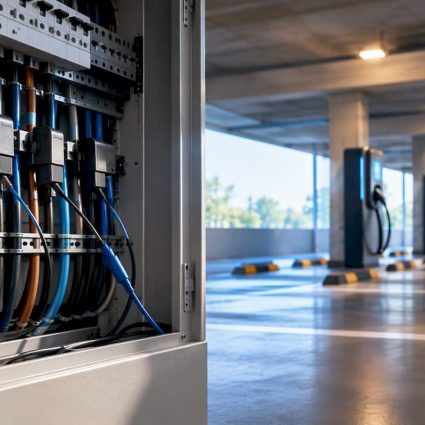
Supervision software alone doesn’t prevent downtime if the electrical infrastructure underneath it fails. Indelec approaches EV charging projects through audit, installation, and maintenance services that treat the CPMS as one layer of a system that also depends on solid grounding and surge protection.
A lightning-induced surge that takes out a charger’s control board doesn’t care how well your dashboard reports uptime. Pairing supervision with proper grounding and surge protection at the site level closes a gap most fleet software specs never mention. Experience in grounding and surge-protection can be applied specifically to fleet charging sites to reduce electrical failure modes beyond software capabilities.
Three Rules for Auditing or Contracting Fleet Supervision
Most fleet buyers get sold on a dashboard demo and skip the fine print. Three things matter more than the interface.
Rule one: demand a profile matrix and certified test results for your specific charger families, not a generic OCA certificate. A certificate proves conformance on tested features. It says nothing about the ones the vendor never tested.

Rule two: require mTLS, signed firmware, and contractual access to raw logs. If a vendor hesitates on log access, that hesitation itself tells you how a future dispute will go.
Rule three: pilot a representative subset with rollback criteria agreed on paper before the pilot starts, never after you’ve seen how it performs.
— INDELEC
Get an Infrastructure Audit Before You Commit to a CPMS
A site audit that checks grounding, surge protection, and electrical capacity alongside the supervision layer provides a practical alternative to specifying a charging fleet on software promises alone. Most fleet buyers evaluate the CPMS and treat the electrical infrastructure as someone else’s problem. That gap is exactly where downtime originates.

Indelec’s electric mobility services cover site study, installation, supervision integration, and ongoing maintenance for fleet charging infrastructure, backed by a company that’s handled electrical protection and grounding work since 1955. If your fleet is planning a CPMS migration or a new depot buildout, request a site audit through Indelec’s services page before you finalize a vendor contract, not after chargers are already in the ground.
Sources
Verify vendor claims against primary sources rather than sales sheets: the Open Charge Alliance’s protocol pages for OCPP specifications and certification, the European Commission’s AFIR implementing regulation for data obligations, and AVERE France’s white papers on smart charging and contractual practice.
- Discover our open standards for future-ready EV charging – Open Charge Alliance
- Supervision Bornes de Recharge | Flotte de Véhicules Electriques — Webfleet FR
- Commission enhances interoperability and transparency of alternative fuels infrastructure data – European Commission
FAQ
What Is OCPP Supervision for a Fleet?
OCPP supervision means using a Charge Point Management System to monitor, control, and report on every charger in a fleet through the open OCPP standard. It covers real-time status, remote commands, and exportable session data across every site, not just a single depot.
Is OCPP 2.0.1 Backward Compatible With OCPP 1.6?
No. The Open Charge Alliance treats 2.0.1 as a new protocol for planning purposes, and every charger, firmware version, and CSMS combination needs independent end-to-end testing before deployment.
Does ISO 15118 Require a Different CPMS?
ISO 15118 enables Plug & Charge authentication, and OCPP 2.0.1 was built with native support for it, but your CPMS still needs correctly configured certificate handling between vehicle and charger for sessions to authenticate reliably every time.
What Should an SLA for Fleet Charging Include?
A solid SLA specifies availability percentage per site, a maximum time-to-repair for critical faults, and guaranteed access to raw OCPP logs and clock-aligned meter exports for your own audits, tied to service credits if targets are missed.
Does Indelec Provide EV Charging Infrastructure Services?
Yes. Indelec offers site audits, installation, and maintenance for electric mobility infrastructure, integrating charging supervision with grounding and surge protection at the site level. Pricing is available on request through Indelec’s services page.