Understand and mitigate the environmental impact of lightning

TL;DR:
- Lightning can cause environmental damage by igniting wildfires and generating nitrogen oxides that affect atmospheric chemistry. These impacts often occur several days or weeks after a lightning strike, especially during dry conditions, posing significant risks to facilities near vegetation. Implementing risk-based lightning protection and monitoring protocols enhances environmental resilience and operational safety.
Lightning rarely gets credit for the environmental damage it quietly leaves behind. Most facility managers rightly focus on the immediate hazards: structural fires, equipment failures, and safety risks to personnel. But the environmental consequences of lightning extend well beyond the point of impact. From triggering large-scale wildfires to disrupting atmospheric chemistry with nitrogen oxide emissions, lightning represents a complex environmental liability that facilities near vegetation, in high-strike zones, or operating under strict sustainability mandates cannot afford to overlook. This article walks through what the science actually shows and what it means for your risk management and environmental compliance strategy.
Table of Contents
- How lightning triggers cascading environmental hazards
- Quantifying lightning’s direct and indirect pollution effects
- Mechanisms and critical factors influencing site risk
- Best practices: Facility protection for environmental and operational resilience
- The overlooked reality: Why comprehensive strategies matter most
- Take action: Enhance your protection and sustainability strategy
- Frequently asked questions
Key Takeaways
| Point | Details |
|---|---|
| Lightning impacts go beyond damage | Strikes trigger wildfires and air pollution, creating complex risks for facilities and the environment. |
| NOx and wildfire effects are measurable | Lightning generates substantial NOx directly and indirectly via fires, each with quantifiable impacts. |
| Site context and flash strength drive risk | Local climate, vegetation, and flash magnitude make some sites more vulnerable than others. |
| Standards and proactive management matter | Applying modern protection and inspection approaches limits environmental and operational fallout. |
| Holistic strategies ensure sustainable resilience | Integrated protection, environmental awareness, and cross-disciplinary planning strengthen sustainability. |
How lightning triggers cascading environmental hazards
Lightning’s relationship with the environment is rarely a single event. It initiates chains of consequences that can unfold over days and weeks after the initial strike. For industrial and commercial facility managers, understanding these cascades is essential, because your operations may sit at the center of them.
The most visible pathway is wildfire ignition. Lightning-caused wildfire risk is projected to increase globally as climate change intensifies, though regional variability means some areas face significantly steeper risk trajectories than others. Dry vegetation, topography, and prevailing winds all determine how a lightning-ignited fire spreads. A strike on your facility’s perimeter or in adjacent open land can escalate from a localized incident to a full-scale wildfire threatening both operations and surrounding ecosystems.
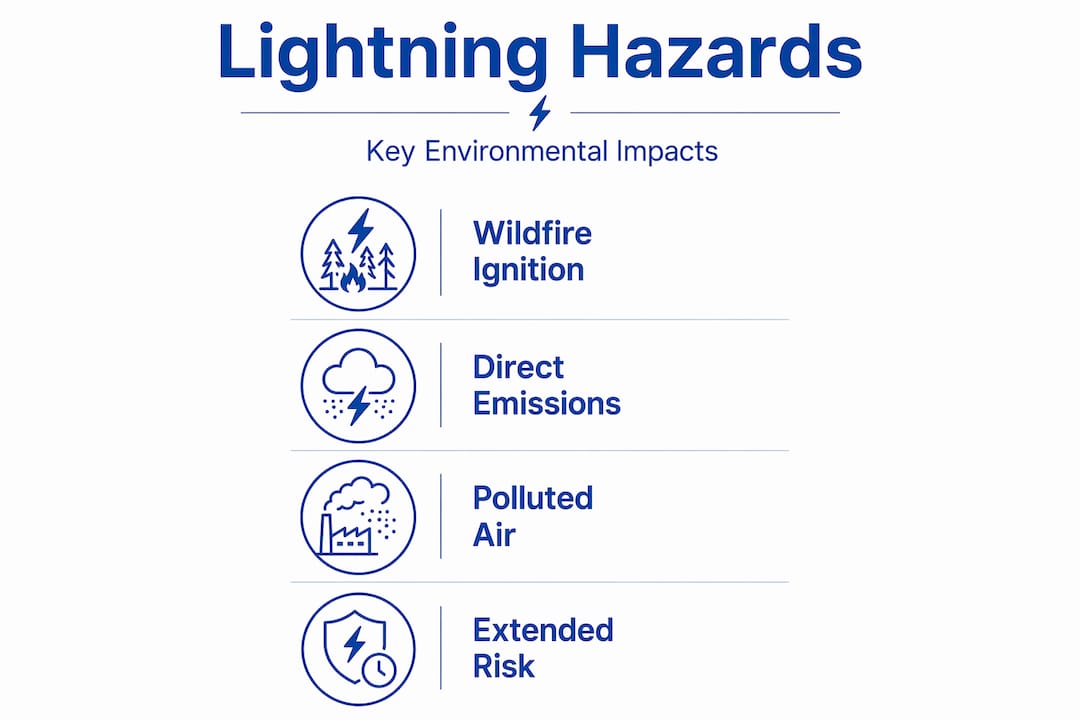
The second pathway is less visible but chemically significant. Lightning generates nitrogen oxides directly in the atmosphere, a phenomenon known as LNOx. LNOx affects atmospheric chemistry by initiating reaction chains that contribute to ozone formation, smog development, and acidification of local ecosystems. This is not a localized event. LNOx disperses across large areas and interacts with existing pollution loads, compounding regulatory challenges for facilities already managing air quality compliance.
Consider the following compounding factors:
- High lightning frequency in your region amplifies both pathways simultaneously
- Drought conditions multiply wildfire risk from each individual strike
- Industrial sites with outdoor storage, pipelines, or open process areas face elevated ignition potential
- Facilities near forests or grasslands bear indirect responsibility if a strike migrates off-site
“The intersection of lightning, drought, and warming temperatures creates a feedback loop that land managers and facility operators have only recently begun to quantify systematically.”
Rising global lightning activity, particularly in climate-sensitive mid-latitude regions, places a growing number of electrical infrastructure lightning protection decisions into environmental risk territory. The strategic response starts with recognizing that lightning is not just a safety hazard but an environmental one.
Quantifying lightning’s direct and indirect pollution effects
Numbers matter when you’re making the case internally for increased investment in lightning protection or reporting environmental risks to regulators. The science provides increasingly precise estimates.
On the LNOx side, NASA’s Aura satellite mission produced some of the most specific numbers available. Using the OMI instrument paired with WWLLN lightning detection data, researchers determined that 180 ± 100 moles of LNOx are produced per lightning flash on average. To put that in context, a single active thunderstorm producing hundreds of flashes can inject thousands of moles of reactive nitrogen into the troposphere over just a few hours.
The fire connection adds another layer. A study analyzing lightning and fire data from Nepal using Vaisala GLD-360 and NASA MODIS datasets found that fire events lag lightning by 5 to 20 days, with an average lag of 11.78 days. That delayed onset is operationally critical: your facility may experience a major lightning event and not see its environmental consequences for nearly two weeks. The same study found that tropospheric NOx increased by an order of magnitude during the pre-monsoon fire season compared to winter baselines, driven by the combined effects of lightning activity and fire.
| Pollution source | Primary pollutant | Onset after lightning | Spatial reach |
|---|---|---|---|
| Direct LNOx production | NO, NO2 | Immediate | Regional to continental |
| Lightning-ignited wildfire | NOx, CO, PM2.5 | 5 to 20 days (avg. 11.78) | Local to regional |
| Secondary ozone formation | O3 | Hours to days | Regional |
| Acidification deposition | HNO3, H2SO4 | Days to weeks | Local to regional |
For facilities subject to air quality reporting or environmental management systems, these time delays represent a gap in conventional monitoring protocols. Most incident tracking focuses on the immediate post-strike period. The data, however, shows that your most significant air quality impact may arrive 10 to 12 days later when a smoldering wildfire reaches full burn.
Pro Tip: Integrate lightning event logs into your environmental incident tracking system. Cross-referencing strike data from your region with subsequent air quality readings gives you an early warning framework for pre-monsoon or dry season periods when wildfire risk is elevated.
Key internal questions to ask your team:
- Do your air quality monitoring protocols account for post-strike fire lag periods?
- Are your environmental reports timed to detect delayed NOx spikes?
- Have you reviewed your lightning standards against the actual strike density data for your region?
Mechanisms and critical factors influencing site risk
Not all lightning flashes carry the same environmental risk. Understanding what drives LNOx production efficiency, and what makes one facility more vulnerable than another, allows you to allocate protection resources intelligently rather than relying on generic benchmarks.

NASA’s research revealed a counterintuitive finding: production efficiency decreases by approximately an order of magnitude for a two-order-of-magnitude increase in flash rate. In plain terms, isolated high-energy flashes produce far more NOx per flash than dense clusters of lower-energy strikes. This matters for facilities in regions that experience infrequent but powerful lightning events, which may represent a higher atmospheric chemistry risk than areas with frequent, weaker storm activity.
On the wildfire ignition side, the Nepal study found that higher-magnitude lightning is significantly more likely to ignite fires. Peak current, duration of the continuing current, and the charge transfer all influence ignition probability. This means a smaller number of high-energy strikes during a dry period carries substantially more environmental risk than a high-frequency, lower-energy storm during wet conditions.
Comparing direct versus indirect emission pathways:
| Factor | Direct LNOx (atmospheric) | Wildfire emissions (indirect) |
|---|---|---|
| Trigger | Each flash (all weather) | High-magnitude flashes in dry conditions |
| Timing | Instantaneous | 5 to 20 days delayed |
| Pollutants | NOx, ozone precursors | NOx, CO, PM2.5, VOCs |
| Facility control | Indirect (external chemistry) | Partial (vegetation management, defensible space) |
| Regulatory exposure | Air quality baselines | Incident reporting, operational permits |
For industrial sites, the layered risk picture looks like this:
- Assess flash magnitude patterns in your region using historical lightning network data, not just strike frequency maps.
- Evaluate surrounding land use within a 10 to 20 kilometer radius, identifying vegetation types and estimated fuel loads that would amplify a lightning-ignited fire.
- Review on-site ignition pathways, including outdoor fuel storage, unmaintained vegetation, and open-top process equipment.
- Apply risk-based protection design using IEC 62305 methods to set a protection level appropriate for your site’s actual exposure, not a generic default.
- Document seasonal risk windows tied to drought indices, pre-monsoon periods, or wildfire season forecasts relevant to your location.
Pro Tip: High-magnitude isolated lightning events often occur outside peak storm season in many temperate regions. Review your historical incident data against local lightning network records to identify if your region follows this pattern. Many facilities discover their highest-risk strikes happen during unexpected periods when environmental conditions are driest.
The industrial lightning protection guide and solutions for lightning protection for complex architecture both provide frameworks for navigating these site-specific nuances.
Best practices: Facility protection for environmental and operational resilience
Translating risk understanding into structured protection requires choosing the right standards framework and building an inspection culture that keeps pace with your facility’s evolving risk profile.
The two dominant frameworks are NFPA 780 and IEC 62305. The NFPA and IEC standards divide along prescriptive versus risk-based lines. NFPA 780 sets fixed requirements regardless of site specifics, making it straightforward to implement but potentially over-engineered for some sites and under-engineered for others. IEC 62305 uses a structured risk calculation to assign a Protection Level (PL I through PL IV), which allows you to scale investment based on actual exposure. For most complex industrial or commercial facilities, the IEC approach produces more defensible and cost-appropriate protection designs.
Key operational practices that directly reduce environmental exposure:
- Engineered grounding and bonding systems that prevent step-and-touch voltage hazards while ensuring strike energy dissipates safely without causing local soil contamination or fire
- Surge protection device (SPD) coordination across all incoming power and data infrastructure to prevent cascading failures that can trigger secondary fire events
- Annual inspection protocols following IEC 62305-3 inspection intervals, with enhanced checks after any significant strike event
- Defensible space management around facility perimeters, coordinated with local fire authority requirements
- Emergency response plans that include the 5 to 20 day post-strike monitoring window for wildfire and air quality effects
“The facilities that experience the most costly lightning-related environmental incidents are almost universally those that treated protection as a one-time installation rather than an ongoing operational discipline.”
Aligning lightning protection investment with your organization’s broader sustainability reporting, whether GRI standards, ISO 14001, or ESG frameworks, creates internal advocates beyond the engineering team. Environmental and sustainability officers increasingly recognize that uncontrolled lightning risk represents a direct threat to emission targets, operational continuity, and community relationships.
Connecting your lightning protection planning steps to your environmental management system closes a gap that most facilities leave open. The lightning protection system application resources provide practical guidance for doing exactly that. For facilities in hurricane or extreme weather zones, storm resilience infrastructure planning adds another layer of protection continuity.
The overlooked reality: Why comprehensive strategies matter most
After nearly seven decades of working with facilities across industries and geographies, our experience consistently points to one recurring gap: facilities treat lightning protection as a compliance checkbox rather than a living risk management system.
The standard approach, install a rod system, document it, pass inspection, and move on, fails in ways that matter most from an environmental standpoint. Climate models are not static. A facility that completed a lightning risk assessment in 2015 using historical data from the 1990s is operating with a fundamentally outdated risk picture. Flash density maps, seasonal storm patterns, and wildfire fuel loads in surrounding areas change faster than most inspection cycles account for.
The deeper issue is organizational. Engineering teams manage the hardware. Environmental teams manage compliance. Operations manages incident response. But almost no one is looking at the intersection of a high-magnitude lightning event, adjacent vegetation conditions, seasonal drought index, and air quality monitoring protocols simultaneously. That cross-disciplinary gap is where the most significant environmental exposures live.
The lightning underestimated danger reality is that most organizations discover this gap after an incident rather than before one. The good news is that the data infrastructure to close it now exists. Regional lightning network data, satellite-based fire detection, and updated climate projections give facility managers the tools to make protection decisions that are genuinely site-specific and dynamically maintained.
The organizations leading in environmental resilience are those that have made lightning risk a standing agenda item across engineering, environment, and operations, reviewed annually against current data rather than a fixed installation date.
Take action: Enhance your protection and sustainability strategy
Translating risk awareness into protective action requires partners who understand both the technical and environmental dimensions of lightning exposure. Indelec has been developing and deploying advanced lightning protection systems since 1955, serving industrial, commercial, and infrastructure clients across demanding global environments.
Our end-to-end offering covers everything from initial risk assessment using IEC 62305 methodologies to engineered design, installation, and certified maintenance programs. Whether you are reassessing protection for a complex industrial site, integrating lightning risk into an ISO 14001 environmental management system, or upgrading aging infrastructure ahead of a seasonal risk period, Indelec’s technical consulting and product portfolio are built to match your specific exposure profile. Connect with our experts to schedule a site risk assessment and begin building a protection strategy that covers both your operations and your environmental obligations.
Frequently asked questions
How does lightning directly affect air quality around industrial facilities?
Each lightning flash produces nitrogen oxides in the atmosphere, which can contribute to ozone formation, smog development, and acidification pathways that directly affect local air quality and regulatory compliance.
How can facility managers assess if their location is at increased risk of lightning-induced wildfires?
Areas with high lightning activity combined with dry, flammable vegetation carry substantially elevated risk, and wildfire ignition risk is projected to increase in many regions globally as climate conditions shift. Reviewing regional lightning network data alongside current drought indices and vegetation fuel load maps provides the most accurate site-specific assessment.
Why does NOx pollution spike after wildfires, and what is the role of lightning?
Lightning ignites fires that release large quantities of NOx and other pollutants as biomass burns, with studies showing NOx increases by an order of magnitude during peak fire season compared to baseline winter levels, often detectable a week or more after the initial strike event.
What is the difference between NFPA and IEC lightning protection standards?
NFPA 780 applies prescriptive fixed requirements regardless of site-specific conditions, while IEC 62305 uses a structured risk-based calculation that allows facilities to tailor protection level selection to their actual exposure, occupancy, and environmental context.