Essential protection system upgrades for safer facilities
TL;DR:
- Choosing the right lightning protection upgrade requires a thorough assessment of your facility’s physical constraints, risk factors, and compliance standards to ensure effective and long-lasting safety measures. External systems like integral, mast, and catenary protect against strikes by channeling current safely to ground, with selection depending on building type and site conditions. Ongoing management, proper testing, and documentation are essential to maintain system integrity and meet regulatory and insurance requirements over time.
Choosing the right lightning protection upgrade is one of the more consequential decisions you’ll make as a facility manager or owner. Get it wrong, and you’re looking at potential equipment loss, liability exposure, failed inspections, and gaps in insurance coverage. Get it right, and your facility gains documented, standards-compliant protection that holds up across decades of use. This article breaks down the key upgrade types available for industrial and commercial buildings, lays out how to compare them, and gives you the framework to move from uncertainty to a confident, well-documented upgrade plan.
Table of Contents
- Key criteria for selecting protection system upgrades
- Main types of external lightning protection system upgrades
- Critical subcomponents and add-on upgrades
- Advanced and alternative protection upgrade approaches
- Making the right upgrade decision: compliance and inspection considerations
- Our perspective: Why upgrade “type” is only half the story
- Explore advanced lightning protection solutions
- Frequently asked questions
Key Takeaways
| Point | Details |
|---|---|
| Selection criteria matter | Evaluate safety needs, standards, and site specifics before choosing a system upgrade. |
| Multiple upgrade types | Integral, mast, and catenary systems each suit specific building risks and configurations. |
| Subcomponents boost safety | Proper down conductors, grounding, and testing extend the effectiveness of any upgrade. |
| Compliance is critical | Adherence to NFPA 780, UL 96A, and local codes is essential for insurance and safety. |
| Holistic approach advised | Long-term safety depends on integration, inspection, and regular re-evaluation. |
Key criteria for selecting protection system upgrades
With the stakes clear, your first step is understanding the criteria every facility owner should consider before evaluating upgrade types.
Before you evaluate a single product or system, you need a clear picture of what your facility actually requires. Lightning protection upgrades are not one-size-fits-all. The right starting point is an honest assessment of your building’s physical constraints, operational environment, and regulatory obligations.
Key criteria to evaluate before choosing any upgrade include:
- Physical site factors: Roof geometry, structural materials, building height, and proximity to other structures all influence which system types are viable.
- Site-specific risk: Local lightning density (measured in lightning ground flash density, or GFD), soil resistivity, and the presence of flammable or hazardous materials all affect risk classification.
- Insurance requirements: Many commercial property insurers require documented, certified lightning protection systems as a condition of full coverage. Verify with your broker before selecting an upgrade path.
- Regulatory mandates: NFPA 780 and UL 96A are the primary standards governing installation and component acceptance in the United States. Component acceptance and compliance are strongly tied to recognized standards and certification/listing practices.
- Integration with existing systems: If your building already has partial protection, bonding, or grounding infrastructure, upgrades must coordinate with those legacy elements to avoid creating new hazards.
Understanding the full scope of applicable lightning protection standards before you start saves significant time and money during installation and inspection. Skipping this step is how facilities end up with systems that pass visual inspection but fail electrical testing.
Pro Tip: Bring in a third-party certified inspector before you finalize your upgrade scope. A qualified inspector can identify existing deficiencies, flag conflicts with current standards, and give you an objective baseline that protects you during the approval process.
Main types of external lightning protection system upgrades
Knowing the selection criteria, let’s look at the main upgrade paths available for your facility’s protection.
External lightning protection systems (LPS) are the primary line of defense. They work by intercepting a lightning strike and channeling the electrical current safely to ground before it can damage your structure or injure occupants. External LPS can be configured in different physical system types, with common upgrade pathways including integral, mast, and catenary systems.
Integral systems are built directly into the structure. Air terminals, conductors, and bonding connections are incorporated into the building’s roof, walls, or framework. This is typically the cleanest-looking solution and suits new construction or major renovations where architectural integration is a priority.
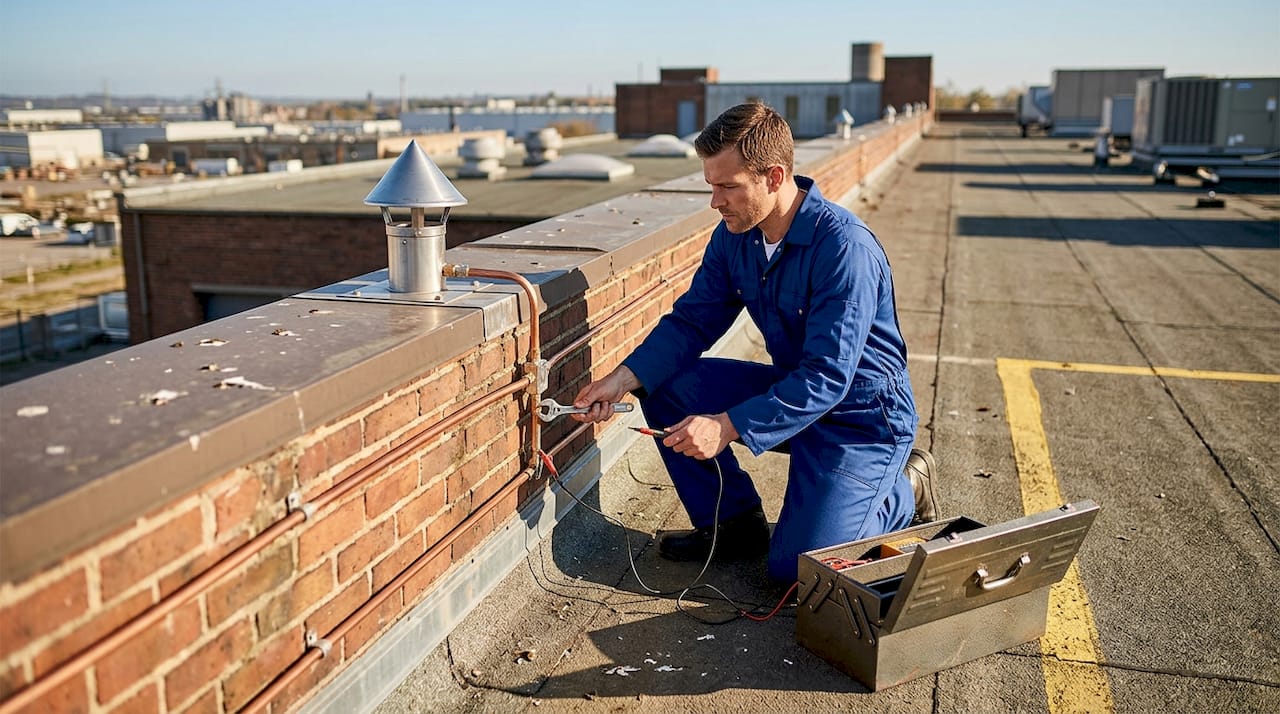
Mast-type systems use free-standing air terminals, often mounted on poles or towers positioned around the perimeter or on the roof. They work well for large open facilities, substations, storage tanks, and structures with complex rooflines where a fully integral solution is impractical. Mast systems offer flexibility since you can reposition or add masts as your facility expands.
Catenary wire systems stretch overhead ground wires between masts or anchor points, creating a protective “canopy” above an area or structure. They’re particularly effective for long, low structures, open yards, transmission infrastructure, and outdoor equipment like transformers or fuel storage. Think of them as an aerial net designed to intercept strikes before they reach the protected zone.
Use cases by system type:
- Integral systems: office towers, data centers, hospitals, new industrial builds
- Mast-type systems: refineries, tank farms, substations, warehouse complexes
- Catenary systems: outdoor equipment yards, rail infrastructure, fuel storage facilities, open processing plants
| System type | Pros | Cons | Best suited for |
|---|---|---|---|
| Integral | Aesthetically clean, fully embedded | Costly to retrofit, complex on existing structures | New builds, high-visibility commercial buildings |
| Mast-type | Flexible, expandable, easier to maintain | Visible hardware, needs structural anchoring | Industrial campuses, large open sites |
| Catenary | Wide area coverage, protects open zones | Requires precise tensioning, periodic re-inspection | Outdoor equipment, transmission sites, tank farms |
You can review practical examples across lightning system applications to see how each type performs in real facility environments before committing to an upgrade direction.
Pro Tip: Whatever system type you choose, maintenance access matters more than most specs sheets suggest. Design in inspection walkways, permanent ground-level test points, and labeled conductor routing from day one. Systems that are difficult to inspect are systems that get neglected.
For a fuller overview of the planning process, the infrastructure lightning protection steps guide walks through each phase in sequence.
Critical subcomponents and add-on upgrades
Beyond the core system type, supporting components and routine upgrades are critical to robust protection.
Selecting a system type is only part of the picture. Even a well-designed integral or mast system will underperform if the supporting components are undersized, improperly installed, or left untested over time.
Down conductors, ground connections, and electrodes are called out as essential components and explicit upgrade paths in recognized standards. Here is what each element does and why it matters:
Down conductors carry the lightning current from the air terminal down to the grounding system. They must be sized correctly for the expected current levels, routed to avoid sharp bends that increase impedance, and physically protected where they pass through areas with foot traffic or mechanical exposure.
Grounding electrodes disperse the current safely into the earth. Soil resistivity varies dramatically by site, and inadequate grounding is one of the most common causes of protection system failure. Options include ground rods, ground rings, concrete-encased electrodes, and deep earth electrodes for high-resistivity soils.
Tie-in points allow new system segments to connect cleanly to legacy installations. When upgrading a building that already has partial protection, these connection points must be engineered to maintain equal potential bonding across the entire facility.
A structured approach to subcomponent upgrades looks like this:
- Test and document existing grounding resistance values before any work begins.
- Identify and map all existing conductors, air terminals, and ground electrodes.
- Specify replacement or supplemental components to current standards.
- Install and bond all new components in a single coordinated effort where possible.
- Retest all ground connections post-installation and document final resistance readings.
- Schedule the next inspection and testing cycle before the job closes.
“Down conductors shall be installed as directly as possible, avoiding sharp bends and loops. Grounding electrodes shall be tested and verified to meet resistance requirements at time of installation.” — DoD UFC Guide Specification 26 41 00
For sites with challenging soil conditions, deep earth grounding solutions can achieve compliant resistance values where standard rod installations fall short. This is especially relevant for industrial sites in rocky or arid regions.
Pro Tip: Always ensure your grounds are traceable and testable after every upgrade. Install labeled, accessible test points at each ground electrode so that future inspections can verify performance without excavation. This one practice alone can cut your long-term maintenance costs significantly.
Additional guidance on managing infrastructure lightning safety tips covers common subcomponent failure modes and how to detect them before they become compliance issues.
Advanced and alternative protection upgrade approaches
For facilities with advanced needs, these alternative or added upgrades may offer tailored solutions.
Some facilities require more than a standard external LPS. Sensitive electronics, high-value equipment, or facilities classified as high-risk by their insurer often need additional layers of protection beyond air terminals and grounding.
Surge protection devices (SPDs) protect equipment from the transient overvoltages that travel through power, data, and control lines after a strike. A lightning strike doesn’t have to hit your building directly to damage a server room or process control system. SPDs intercept these voltage spikes at the service entrance and at internal distribution points, working as a second line of defense behind the external LPS.
Strike preventers and diverters represent a different technical philosophy. Rather than intercepting and conducting a strike, these devices aim to reduce the probability of a direct strike to the protected structure. Acceptance of these technologies varies widely. Some authorities having jurisdiction (AHJs) and insurers recognize them as valid upgrades, others do not. If you are considering this path, verify acceptance in writing with your AHJ and insurer before investing.
Contrasting viewpoints on upgrade types often split between prescriptive LPS plus SPD approaches and specialized strike-prevention or diverter technologies. The prescriptive approach, grounded in NFPA 780 and UL 96A, carries the widest acceptance and the clearest compliance path.
Key considerations when evaluating advanced upgrades:
- SPDs must be coordinated across all entry points: utility, communications, data, and control lines.
- Strike preventer technologies should only be considered after confirming AHJ acceptance.
- Insurer-required upgrades may specify exact product listings; confirm before purchasing.
- All advanced upgrades must integrate with, not replace, the base external LPS.
| Approach | Standard coverage | AHJ acceptance | Suited for |
|---|---|---|---|
| Traditional LPS + SPD | NFPA 780, UL 96A | Universally accepted | Most commercial and industrial facilities |
| Strike preventer/diverter | Varies by product | Jurisdiction-dependent | Specialty sites, insurer-specific requirements |
| ESE air terminals | IEC 62305 in some regions | Accepted in select jurisdictions | High-risk industrial, international projects |
Review electrical protection standards examples for practical scenarios where advanced approaches were successfully applied. Understanding how facility lightning safety strategies align with these choices helps prevent costly mismatches between the upgrade hardware and your compliance requirements.
Making the right upgrade decision: compliance and inspection considerations
Once you’ve matched options to site needs, proper compliance ensures upgrades deliver lasting value and safety.
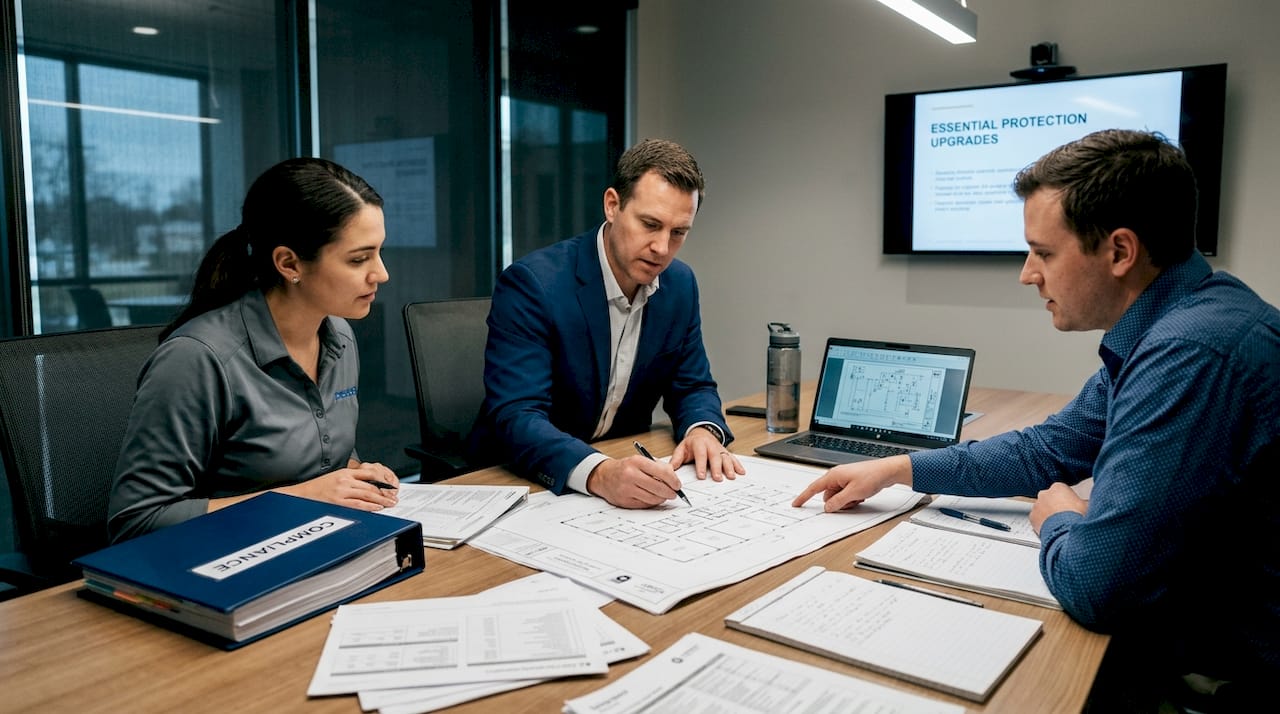
A technically sound upgrade means nothing if it cannot be verified, documented, and accepted by the AHJ and your insurance carrier. Compliance is not a formality; it is the mechanism that ties your investment to actual legal and financial protection.
For upgrades, component acceptance and compliance are strongly tied to recognized standards and certification/listing practices under UL 96A and NFPA 780. Here is how to ensure your upgrade clears every checkpoint:
- Confirm that all specified components carry current UL listing or equivalent recognized certification.
- Submit upgrade plans to the AHJ for pre-approval before breaking ground, especially on complex retrofits.
- Maintain a complete as-built drawing set that reflects every component installed, every conductor route, and every ground electrode location.
- Commission a certified inspector to verify the completed installation against the design documents.
- Obtain written inspection results and retain them as part of your facility’s permanent compliance record.
- Schedule periodic re-inspections on the cycle required by your AHJ or insurer, typically every one to three years.
Standards evolve. NFPA 780 is updated on a regular cycle, and components that met requirements in a previous edition may need evaluation against the current version. Build standard review into your annual compliance calendar so upgrades don’t age out of compliance without your awareness.
The certification process for lightning protection provides a step-by-step breakdown of exactly what inspectors look for and how to prepare your documentation for a smooth approval.
Our perspective: Why upgrade “type” is only half the story
The conversation in most upgrade planning meetings centers on hardware: which system type, which air terminal design, which electrode configuration. That focus is understandable, but experience shows it can lead facility managers toward a false sense of security once the installation is complete.
What we’ve seen across decades of installations is this: the facilities that experience failures aren’t usually running the wrong hardware. They’re running hardware that was never properly integrated with the rest of their facility systems, was tested once and then forgotten, or was rendered partially non-compliant by a building renovation that nobody flagged to the protection system manager.
Contrary to typical advice, integration and ongoing management often matter more than the specific hardware type. A mast system that is inspected annually, tested with traceable ground resistance records, and updated whenever the building footprint changes will outperform a more sophisticated integral system that has been ignored for six years.
Failures trace back to a predictable set of root causes: skipped annual testing, documentation that doesn’t reflect the current as-built condition, or new mechanical, electrical, and plumbing work that inadvertently broke bonding connections without anyone realizing it. These are management failures, not engineering failures.
The better mindset is to treat your lightning protection system as a living facility asset, the same way you treat your fire suppression or emergency power systems. That means lifecycle budgeting, change-management integration, and documented handoffs when facility personnel change. The complete upgrade lifecycle steps framework puts this thinking into a practical structure you can actually use.
One-off upgrades are a starting point, not an endpoint. The real return on your investment comes from the ongoing program you build around them.
Explore advanced lightning protection solutions
Ready to take action? Expert partners can help you turn these choices into effective, standards-compliant upgrades.

Indelec’s team combines over 70 years of field experience with a dedicated R&D program, giving you access to both proven systems and the latest protection technology. Whether you need a full assessment of your current installation, help selecting the right lightning system application solutions, or ongoing support through inspection and certification, the expertise is there to match your facility’s specific risk profile. Stay current with evolving requirements through up-to-date lightning standards, and address challenging ground conditions with professional deep earth grounding services engineered for industrial environments. Every upgrade your facility needs, covered end to end.
Frequently asked questions
What are the main types of lightning protection upgrades for buildings?
The main system types are integral, mast, and catenary systems, each designed for different structural configurations and site-specific risk levels. Selecting the right type depends on your building’s geometry, occupancy, and expansion plans.
Which standards must lightning protection upgrades comply with?
Upgrades must adhere to NFPA 780 and UL 96A, which govern component selection, installation methods, and inspection requirements across the United States. Most commercial insurers and AHJs require documented compliance with both.
Do I need to upgrade my grounding system when upgrading lightning protection?
Yes. Ground connections and electrodes are explicitly called out as essential upgrade paths, and a new or expanded air terminal network is only as effective as the grounding system that receives and disperses the current.
How often should a lightning protection system be tested after upgrading?
Testing is required at commissioning and then periodically thereafter, with NFPA 780 and your AHJ setting the minimum inspection intervals, typically one to three years depending on facility risk classification.
Are surge protection devices (SPDs) required in addition to lightning protection upgrades?
SPDs are part of the prescriptive LPS plus SPD approach recommended for most commercial and industrial facilities, particularly where sensitive electronics or critical control systems need protection from transient overvoltages following a nearby strike.