Surge protection installation: A complete facility guide
TL;DR:
- Proper layered surge protection with Type 1, 2, and 3 devices is essential for effective safety.
- Installation compliance, correct bonding, grounding, and short leads are critical to prevent equipment damage.
- Internal transients and inadequate coordination often cause surge protection failures despite device presence.
A single voltage surge can destroy programmable logic controllers (PLCs) or variable frequency drives (VFDs), leaving your facility offline for 8 to 72 hours. That kind of downtime is not just expensive, it can trigger compliance violations, missed production targets, and costly emergency repairs. Surge protection is not a checkbox. It requires a deliberate, layered installation strategy based on current standards. This guide walks facility managers through every stage: understanding device types, meeting regulatory requirements, executing a clean installation, and handling edge scenarios that standard approaches often miss.
Table of Contents
- Understanding surge protection layers and types
- Key standards and compliance for surge installation
- Step-by-step: Installing surge protection devices
- Special considerations and edge scenarios
- Experience teaches: What really matters in surge protection installation
- How Indelec supports your surge protection strategy
- Frequently asked questions
Key Takeaways
| Point | Details |
|---|---|
| Layered protection is vital | Protecting at every stage—entrance, panels, and equipment—ensures true facility safety and compliance. |
| Compliance drives installation | Following UL, IEC, and NEC standards is critical for lawful and effective surge protection. |
| Installation details matter | Short lead lengths and correct connections significantly improve device performance and prevent failure. |
| Internal surges dominate risks | In industrial facilities, most damaging surges are generated inside the infrastructure, not from outside. |
Understanding surge protection layers and types
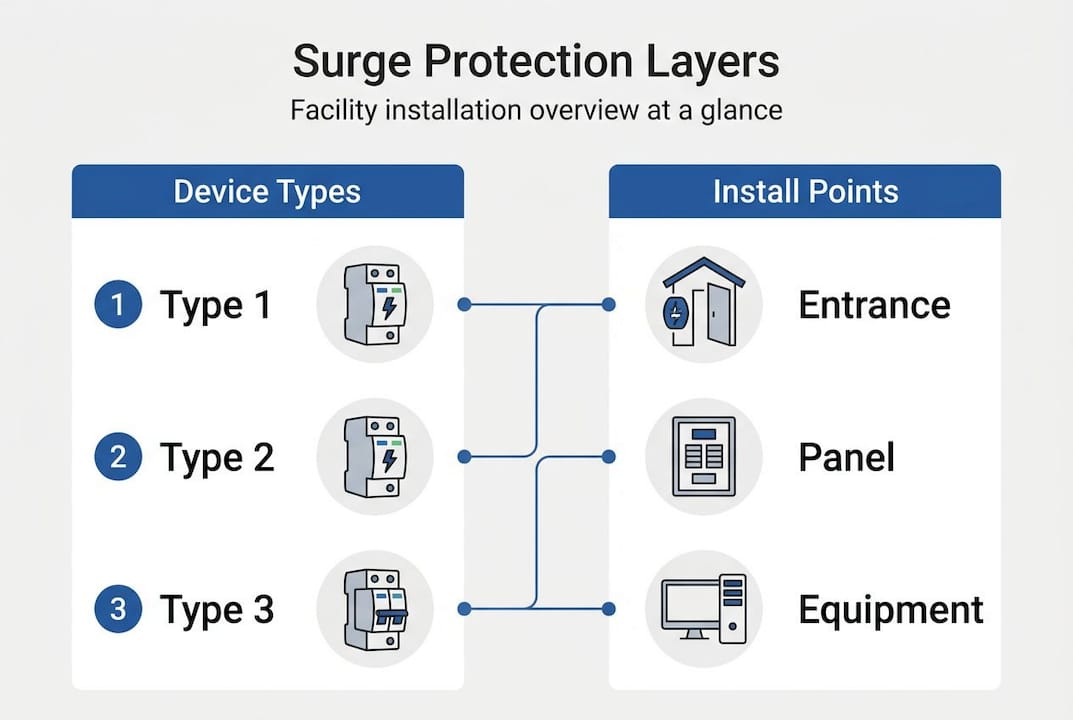
Surge protection works best when it is built in layers. Think of it like a filter system: each stage catches what the previous one missed. A layered SPD strategy uses Type 1, Type 2, and Type 3 devices, each selected by placement, waveform tolerance, and energy ratings. No single device can do everything, and facilities that rely on one SPD leave significant gaps in coverage.
Here is how each type functions in practice:
- Type 1 SPDs are installed at the service entrance, between the utility transformer and the main distribution panel. They handle the highest energy surges, including direct lightning strike currents. These devices are rated for 10/350 µs waveforms.
- Type 2 SPDs are placed at the distribution panel or sub-panel level. They catch residual energy that passes through Type 1 devices and protect branch circuits from switching transients and indirect lightning effects. Rated for 8/20 µs waveforms.
- Type 3 SPDs are installed at or near sensitive equipment, such as control panels, servers, or medical devices. They provide the final layer of fine protection at the point of use.
As NEC guidance confirms, a single SPD is insufficient for industrial or commercial environments because residual energy propagates downstream even after the first device clamps. Coordination between all three types is what creates a truly protected system.
| SPD Type | Location | Waveform | Primary Function |
|---|---|---|---|
| Type 1 | Service entrance | 10/350 µs | Absorbs direct lightning current |
| Type 2 | Distribution panel | 8/20 µs | Clamps switching and indirect surges |
| Type 3 | Point of use | Combination | Fine protection for sensitive loads |
Pro Tip: When selecting SPDs, always verify that the voltage protection rating (Up) of each downstream device is lower than the impulse withstand voltage of the equipment it protects. Mismatched ratings are one of the most common causes of equipment damage even when SPDs are installed.
For a deeper look at how these principles apply in practice, surge protection in industrial facilities covers real-world scenarios that go beyond the basics.
Key standards and compliance for surge installation
After understanding the physical layers, it is critical to align with the governing standards and codes that shape a legally and technically sound installation. Compliance is not optional. Regulatory bodies, insurers, and facility auditors all expect documented adherence to recognized standards.
The primary standards governing SPD installation include:
- UL 1449: The North American benchmark for SPD classification and performance testing. It defines Type 1, 2, and 3 categories and sets minimum clamping performance thresholds.
- IEC 61643-11: The international standard covering low-voltage surge protective devices, specifying test requirements and performance criteria.
- NEC Article 242/285: The National Electrical Code provisions that govern where and how SPDs must be installed in U.S. facilities, including requirements for overcurrent protection and disconnecting means.
- IEEE C62.72: A practical application guide for low-voltage surge protection that bridges the gap between standards language and field practice.
As NEC Article 242 and 285 specify, proper bonding and grounding are not supplementary steps. They are foundational. An SPD that is not correctly bonded to the grounding electrode system will not clamp effectively, regardless of its catalog rating.
Compliance checkpoint: Before energizing any new SPD installation, verify that all ground conductors are bonded to the same reference point, lead lengths are within specification, and all devices carry the required UL listing marks. Document every step for your inspection records.
Here is a quick reference for the standards landscape:
| Standard | Scope | Key Requirement |
|---|---|---|
| UL 1449 | North America | SPD type classification, clamping voltage |
| IEC 61643-11 | International | Test waveforms, performance ratings |
| NEC Art. 242/285 | U.S. installation | Location, overcurrent protection, bonding |
| IEEE C62.72 | Application guide | System coordination, field best practices |
For a structured overview of the regulatory framework, surge protection standards provides a useful reference. Facilities with complex compliance requirements will also benefit from reviewing compliance and lightning safety before finalizing their installation plans.
Step-by-step: Installing surge protection devices
Once standards are met, practical installation can begin. Executed precisely, the following sequence maximizes surge protection effectiveness and reduces the risk of installation-related failures.
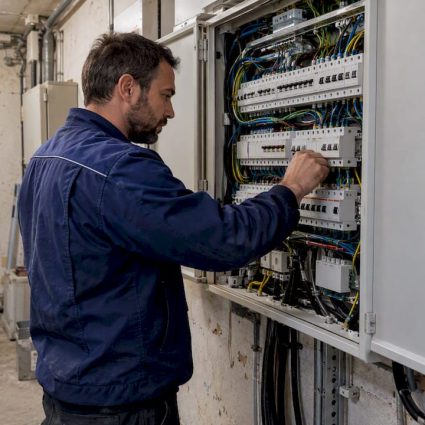
Tools and pre-checks: Gather torque wrenches, insulated screwdrivers, a clamp meter, wire strippers, and appropriate PPE. Confirm that the SPDs you are installing carry the correct UL listing and match the system voltage, frequency, and configuration (single-phase or three-phase).
Installation sequence:
- Shut down and isolate power. Lock out and tag out all circuits per your facility’s LOTO procedure. Confirm zero energy with a calibrated voltage tester.
- Identify installation points. Mark the service entrance, distribution panels, and point-of-use locations. Confirm available space and conduit routing before mounting anything.
- Mount the SPD enclosure. Secure the device as close to the panel as physically possible. Every centimeter of lead length matters.
- Connect with short leads.Leads must not exceed 0.5 meters. Each extra meter of lead can add up to 1,000 volts of inductive drop at 10 kA/µs, which directly degrades the protection level your equipment actually receives.
- Minimize bends and use correct wire gauge. Use minimum 6 AWG copper for ground conductors. Avoid sharp bends in leads, as inductance increases with every curve.
- Verify grounding and bonding. Confirm that the SPD ground terminal connects directly to the panel’s grounding bus, which must tie back to the grounding electrode system.
- Test before re-energizing. Check continuity, verify indicator lights, and confirm no wiring errors before restoring power.
- Monitor and document. Record the installation date, device model, ratings, and initial indicator status. Schedule a post-energization check within 24 hours.
Pro Tip: Route ground leads in a straight, direct path. A lead that snakes around obstacles accumulates inductance and can add hundreds of volts to the protection level, defeating the purpose of a high-spec device.
Long leads and poor grounding are the most common installation pitfalls, degrading the clamping voltage (Up) by hundreds of volts before a surge even reaches the equipment. For a broader view of installation planning, the infrastructure installation steps guide and industrial site safe installation resource are worth reviewing alongside this process.
Special considerations and edge scenarios
Beyond conventional installations, specialized system features and internal phenomena call for extra vigilance and adaptive practices. Not every facility fits a standard template, and the gaps in protection often appear precisely where standard approaches stop short.
Key edge scenarios to plan for:
- Ungrounded systems: Facilities with ungrounded or high-impedance grounded systems present a specific challenge. Line-to-ground voltages are unstable during fault conditions, which means standard SPDs rated for solidly grounded systems may not perform correctly. Specify SPDs explicitly rated for ungrounded configurations.
- PV and DC systems: Photovoltaic arrays require DC-rated SPDs. AC-rated devices will not clamp DC faults safely and may fail catastrophically. NEC Article 690 governs PV-specific surge protection requirements.
- Motor control centers (MCCs) and VFDs: These loads generate significant internal transients during switching. Industrial MCCs and VFDs require Type 2 SPDs installed at or near the equipment, not just at the panel level.
- Internal surges: This is the factor most facility managers underestimate. 65 to 80% of industrial surges originate inside the facility, not from lightning or utility events. Switching large motors, capacitor banks, or HVAC compressors generates transients that travel through your own distribution system.
Field warning: If your facility runs heavy motor loads or frequent switching operations, internal surge protection at the equipment level is not optional. Relying solely on entrance-level SPDs leaves your most vulnerable equipment exposed to the surges your own systems generate.
For guidance on specific system configurations and non-standard scenarios, addressing edge cases and infrastructure safety provide application-specific direction.
Experience teaches: What really matters in surge protection installation
After decades of field work across industrial and commercial facilities, the pattern is clear: most surge-related equipment losses are not caused by a missing SPD. They are caused by a poorly coordinated one.
Facility managers often invest in quality devices but overlook the coordination between Type 1, 2, and 3 layers. An uncoordinated system can actually allow a Type 1 device to absorb a surge while the downstream Type 2 device sees a residual voltage that still exceeds equipment tolerance. The devices are present. The protection is not.
Lead routing and grounding consistently matter more than brand selection or catalog specifications. A mid-tier SPD with a 0.3-meter ground lead will outperform a premium device with a 1.5-meter routed lead every time.
The internal surge reality is the most overlooked issue we see. Facilities that have never experienced a lightning strike still suffer repeated equipment failures because their own motors and drives are generating the surges. Protecting highly sensitive installations requires accounting for internal transient sources, not just external threats.
Finally, monitoring is not optional in high-value settings. LED status indicators and remote monitoring systems turn a passive device into an active part of your maintenance program.
How Indelec supports your surge protection strategy
For those seeking expert guidance or turn-key deployment, Indelec’s tailored solutions provide the next steps your facility needs.

Indelec brings over 70 years of electrical protection expertise to every project. From initial site assessment and SPD selection through installation verification and ongoing maintenance, our team covers every stage of the process described in this guide. We work across industrial plants, commercial buildings, and critical infrastructure, applying both advanced surge protection application methods and the compliance frameworks your auditors expect. Whether you are building a new protection system from scratch or auditing an existing one, lightning protection requirements are non-negotiable, and we are equipped to help you meet them. Contact Indelec to schedule a facility assessment and get a protection plan built around your specific infrastructure.
Frequently asked questions
Where should surge protection devices be installed in a facility?
Surge protection devices should be installed at the service entrance (Type 1), the distribution panel (Type 2), and point-of-use locations (Type 3) for full protection. Each layer handles a different energy level and waveform.
Why is lead length important when installing surge protection?
Shorter lead lengths ensure SPDs operate efficiently. Each extra meter adds up to 1,000V of inductive voltage drop at 10 kA/µs, which directly reduces the protection your equipment receives.
What standards must surge protection installations meet?
Installations must adhere to UL 1449, IEC 61643-11, NEC Article 242/285, and IEEE C62.72 for proper compliance and safety across North American and international projects.
What’s a common cause of surge protection failure in industrial settings?
Improper installation, especially long leads and poor grounding, is a frequent cause of surge protection failure, degrading clamping voltage by hundreds of volts before a surge reaches the device.
How often should surge protection devices be checked?
SPD status should be visually checked after surges and during routine maintenance intervals, using built-in LED indicators where available to confirm operational status.