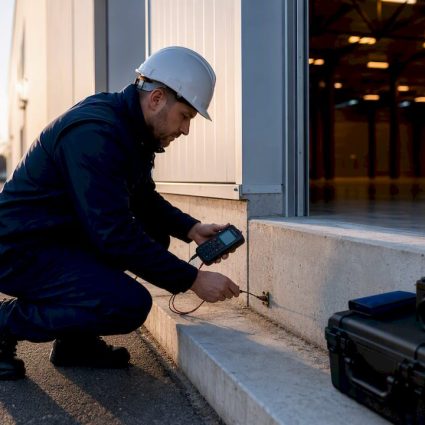
Lightning’s Role in Road Infrastructure: 2026 Protection Guide

TL;DR:
- Lightning poses an underestimated systemic risk to roadside infrastructure and requires comprehensive, site-specific protection.
- Implementing probabilistic risk assessments, verifying bonding, and specifying certified surge protective devices can substantially improve safety and reliability.
Lightning is a systemic operational and safety risk for every distributed roadside asset you manage. Start this week: commission a probabilistic risk assessment, verify bonding continuity on all pole-mounted equipment, and specify surge protective devices (SPDs) and certified air terminals in your next RFP.
Immediate actions:
- Order a site survey covering soil resistivity, bond continuity, cabinet condition, and PoE paths.
- Audit mast arm and cabinet bonding against a tested earth reference.
- Identify in-pavement sensor locations and check coaxial surge paths.
- Specify SPDs rated for roadside environments and require third-party test certificates.
- Issue a contractor bid that references NFPA 780, IEEE grounding guidance, and Indelec as a qualified supplier.
Key standards to anchor your spec: NFPA 780 (air terminals), IEEE 242/1100 (grounding and bonding), and the National Electrical Safety Code (NESC) for utility-connected assets.
Table of Contents
- Why does lightning hit roadside systems harder than buildings?
- How lightning actually damages roadside systems
- How should you assess lightning risk for road assets?
- What mitigation measures work for each roadside asset type?
- What should your procurement package require?
- Which U.S. standards should you cite in your specs?
- What do real Indelec projects show about implementation?
- What drives the cost of lightning protection on roads?
- Key Takeaways
- Indelec’s perspective on what most managers get wrong
- How Indelec protects your road infrastructure
- Authoritative references and further reading
Why does lightning hit roadside systems harder than buildings?
Roadside assets are more exposed, more interconnected, and far more distributed than buildings, which multiplies direct-strike probability, induced surge paths, and ground-potential-rise (GPR) risk across every corridor you manage.
A building sits on a compact footprint with a single grounding system. A highway corridor strings together hundreds of poles, cabinets, in-pavement sensors, roadside units (RSUs), and EV chargers across miles of varying soil. Roadside electromechanical systems face higher exposure than buildings and require a combination of air terminals, engineered grounding, and SPDs specifically evaluated for roadside environments. Building-centric standards simply weren’t written for that geometry.
The practical consequences are immediate:
- ITS cabinets and RSUs: communication failure, data loss, and controller damage from induced surges.
- Traffic signal systems: signal outages that create intersection hazards and require manual traffic control.
- Roadway lighting: pole and driver failures that leave lanes dark during storms.
- EV chargers: power electronics damage and GPR exposure at charging pedestals.
- Pavement:flash-steam explosions from subsurface moisture, creating debris hazards and lane closures.
Pro Tip:Before your next inspection cycle, physically verify bond continuity between mast arms and feeding cabinets. An unbonded mast arm is one of the most common root causes of RSU and signal controller failures after a storm.
How lightning actually damages roadside systems
Four failure modes account for the vast majority of roadside lightning damage: direct strikes, induced overvoltage, ground potential rise, and flash-steam pavement failure.

| Failure Mode | Typical Affected Asset | Common Consequence |
|---|---|---|
| Direct strike to pole or antenna | Luminaire, traffic signal head, communications antenna | Physical destruction, fire, lane closure |
| Induced overvoltage into loops/sensors | In-pavement sensors, loop detectors | Sensor burnout, false counts, SPD failure |
| GPR through cabinet or PoE path | ITS cabinet, RSU, PoE injector | Controller damage, communication loss |
| Flash-steam pavement explosion | Road surface near buried sensors or tree roots | Debris hazard, pavement repair, injury risk |
| Transient-driven communication fault | Fiber/copper backhaul, Ethernet links | Data loss, remote monitoring outage |
The PoE path failure is particularly underappreciated. Tampa Connected Vehicle Pilot investigators traced RSU communication failures directly to lightning arcs entering Ethernet connectors from ungrounded nearby metal structures, burning out PoE splitters. The fix was bonding, not hardware replacement.
Operational impacts that follow these failure modes:
- Unplanned lane closures during or after storms
- Loss of real-time traffic monitoring across entire corridors
- Signal outages requiring officer deployment
- EV charger downtime affecting fleet operators
- Emergency pavement repairs with no advance budget
How should you assess lightning risk for road assets?
Use a probabilistic impact assessment tailored to each asset’s exposure and local lightning density, not a one-size-fits-all checklist. Legacy hardware-only approaches create a false sense of security as assets become more digital and interconnected.
Five-step field methodology:
- Asset inventory and connectivity map. List every pole, cabinet, sensor, RSU, and EV charger with GPS coordinates and interconnect paths (power, data, PoE).
- Local lightning density and historical faults. Pull NOAA ground flash density data for your corridor and cross-reference maintenance records for storm-related failures.
- Exposure scoring. Score each asset by pole height, proximity to water or tall vegetation, soil resistivity, and open-terrain exposure. A Lightning Activity Factor combining density and current amplitude lets you build a spatially differentiated risk map rather than treating the whole corridor uniformly.
- Impact scoring. Weight each asset by safety consequence, operational criticality, and replacement cost. A traffic signal controller at a major interchange scores differently than a mid-block luminaire.
- Prioritization and mitigation mapping. Rank assets by combined exposure and impact score, then assign mitigation tiers (immediate, next maintenance cycle, monitor).
Site survey data to collect:
- Soil resistivity at each grounding point (four-point Wenner method)
- Bond continuity readings on mast arms, cabinets, and sensor conduits
- Cabinet condition and existing SPD type/age
- PoE injector locations and connector insulation condition
- In-pavement sensor conduit routing and local shunting hardware
Pro Tip:Run insulation resistance tests on PoE connector assemblies during your site survey. Degraded insulation is invisible to a visual inspection but creates a direct arc path into RSU electronics during a nearby strike. It’s a 10-minute test that changes your prioritization list.
What mitigation measures work for each roadside asset type?
No single measure is sufficient. Layered protection combining bonding, certified SPDs, proper grounding, and targeted air-terminal deployment is the only approach that holds up across a full corridor.

| Asset Type | Highest-Risk Failure Mode | Recommended Mitigations |
|---|---|---|
| ITS cabinet / controller | GPR, induced surge | Equipotential bonding, cabinet-level Type 1+2 SPD, tested earth reference |
| RSU / PoE-fed device | Arc via Ethernet/PoE path | Bond all nearby metal, SPD on data lines, insulation resistance checks |
| In-pavement sensor | Induced overvoltage, loop surge | Sensor isolation, coax/loop SPD at cabinet entry, local shunting |
| Pole-mounted lighting / signal | Direct strike, mast arm arc | Mast arm bonding, deep grounding electrode, Type 2 SPD at base |
| EV charger | GPR, power electronics damage | Dedicated Type 1 SPD, separate grounding electrode, GPR separation |
| Communications antenna | Direct strike, transient | Shielded cable, antenna-line SPD, isolation transformer |
For in-pavement sensor protection, long-term field studies in central Florida recorded numerous large surges over a decade, ultimately prompting FDOT to replace SPDs at many sites. Budget for SPD replacement as a recurring line item, not a one-time cost.
When specifying air terminals, Indelec’s Prevectron3 and OptiMax technology are options worth including in your RFP spec. Both carry third-party test certificates that satisfy NFPA 780 requirements and can be requested as bid deliverables.
Pro Tip:Log every surge event in your asset management system with date, location, and SPD indicator status. After three recorded surges at a single cabinet, treat SPD replacement as mandatory regardless of visual condition. SPDs degrade silently.
What should your procurement package require?
A solid procurement package must include a probabilistic risk assessment, documented site survey deliverables, test and certification requirements, and a binding inspection and maintenance schedule.
Required design deliverables in every bid:
- Probabilistic risk assessment report with asset-level scoring
- Engineering drawings showing grounding electrode locations and bonding paths
- Soil resistivity test reports (Wenner method)
- SPD type, class, and third-party impulse test certificates
- Air terminal certificates of conformity (NFPA 780 compliance)
- As-built documentation within 30 days of installation
- Maintenance plan with inspection cadence and SPD replacement triggers
Questions to ask every bidder:
- How many roadside ITS or RSU installations have you completed, and can you provide references?
- Are your SPDs tested to recognized impulse levels by a third-party lab?
- Do you have deep grounding drilling capability for high-resistivity soils?
- What is your guaranteed response time for post-event emergency repairs?
- Can you provide Prevectron3 or OptiMax test certificates if specified?
Red flags to reject outright:
- Vague grounding method with no soil resistivity data
- No third-party SPD certification or missing impulse test reports
- Absent as-built drawing commitment
- Maintenance schedule described as “as needed”
- Proposal that relies entirely on legacy counterpoise without probabilistic justification
Lifecycle items to track: annual grounding resistance tests, SPD replacement after threshold surge counts, surge-event logs retained for five years, and integration of inspection records into your asset management platform.
Which U.S. standards should you cite in your specs?
Cite NFPA 780, IEEE 242/1100, relevant IEEE surge standards, and NESC where assets connect to utility infrastructure. Require third-party lab reports for every SPD and air terminal in the bid.
- NFPA 780 (Standard for the Installation of Lightning Protection Systems): governs air terminal placement, grounding, and bonding. Require bidder compliance documentation and certificates of conformity for all air terminals. Indelec’s lightning standards resource maps these requirements to roadside applications.
- IEEE 242 / IEEE 1100: grounding and bonding guidance for electrical systems; use as the basis for cabinet and controller grounding specs.
- IEEE C62 series: surge protective device application and testing standards; require bidders to cite the applicable C62 standard for each SPD class.
- NESC: applies where roadside assets share utility poles or connect to utility supply; confirm applicability with your utility contacts.
- FDOT/ROSAP SPD test procedures: FDOT-sponsored research produced specific test-lab procedures for roadside SPDs and maintenance reporting protocols. Reference these in acceptance criteria even outside Florida.
RFP pass/fail language to use: “Bidder shall provide third-party impulse test reports for all SPDs to IEEE C62 standards, certificates of conformity for all air terminals to NFPA 780, and soil resistivity test reports using the four-point Wenner method. As-built documentation is required within 30 days of project completion.”
What do real Indelec projects show about implementation?
Indelec has been delivering lightning protection for infrastructure since 1955, with projects spanning highways, energy facilities, and sensitive industrial sites across multiple continents, including a milestone U.S. installation completed in 2020.
Three applied lessons from Indelec project experience:
- Bonding-first remediation: On connected vehicle pilot sites where RSU communication failures were traced to unbonded metal structures, correcting bonding to a tested earth reference restored functionality without replacing the RSUs. The hardware was fine; the grounding wasn’t.
- Prevectron3 deployment on exposed corridor assets: For pole-mounted equipment in open terrain with high ground flash density, Prevectron3 air terminals with OptiMax technology provide an early streamer emission option that can be specified with third-party test certificates and a documented protection radius.
- SPD test program outcomes: Agencies that implemented structured SPD test programs, as recommended by FDOT research, reduced maintenance costs and improved reliability across their roadside equipment fleets.
Trust signals to require from any bidder: site-survey report with soil resistivity data, third-party SPD impulse test certificates, detailed bonding drawings, and a signed maintenance schedule.
What drives the cost of lightning protection on roads?
Costs vary primarily with site complexity, soil resistivity, asset density, SPD class and quantity, and the depth of grounding required. There is no flat per-pole figure that holds across different soil and corridor conditions.
Primary cost drivers:
- Site survey depth: a full probabilistic assessment with soil resistivity testing costs more upfront but prevents over- or under-specification.
- Deep grounding boreholes: high-resistivity soils require deep earth grounding drilling rather than shallow counterpoise, which is the single largest variable in installation cost.
- SPD class and placement: Type 1 SPDs at service entry points cost more than Type 2 devices but are required where direct strike current must be diverted.
- Labor and traffic control: roadside work requires lane closures, flagging, and sometimes night shifts, which can exceed equipment costs on high-volume corridors.
- Documentation and testing: third-party SPD testing, as-built drawings, and soil reports add cost but are non-negotiable for a defensible installation.
For lifecycle budgeting, plan for periodic grounding resistance tests, SPD replacements after threshold surge counts, and post-event emergency repairs. Small corridor projects (under 20 assets) can typically be surveyed, designed, and installed within 8–12 weeks. Large multi-mile corridors with deep grounding requirements should budget 6–12 months from survey to as-built sign-off.
Key Takeaways
Lightning is the most underbudgeted systemic risk in roadside infrastructure management, and the gap between a compliant installation and a failed one almost always comes down to bonding, grounding, and SPD specification.
| Point | Details |
|---|---|
| Run a probabilistic assessment first | Asset-level exposure and impact scoring prevents over-spending on low-risk poles and under-protecting critical ITS nodes. |
| Bonding failures cause most RSU damage | Unbonded metal near RSUs creates arc paths through PoE connectors; verify bond continuity before any storm season. |
| Specify SPDs with third-party test certs | Require IEEE C62-compliant impulse test reports and NFPA 780 air terminal certificates in every RFP. |
| Budget for SPD lifecycle replacement | SPDs degrade silently after repeated surges; log surge events and replace on threshold counts, not visual inspection. |
| Indelec for spec-ready roadside solutions | Indelec provides site surveys, probabilistic assessments, Prevectron3 air terminals, OptiMax technology, and deep grounding drilling for U.S. road infrastructure projects. |
Indelec’s perspective on what most managers get wrong
The most common mistake infrastructure managers make is treating lightning protection as a one-time hardware purchase rather than a lifecycle program. A Prevectron3 air terminal installed without a verified grounding system and documented bonding plan is not a protection system. It’s a component.
Since 1955, Indelec has seen the same pattern repeat: an agency installs SPDs after a damaging event, skips the soil resistivity testing, and then wonders why the next storm causes the same failures. The probabilistic assessment isn’t bureaucratic overhead. It’s the step that tells you which three assets on a 200-asset corridor are actually at critical risk and where to spend the budget.
When you engage Indelec for a road infrastructure project, the engagement starts with a site survey and ends with as-built documentation, a maintenance schedule, and test certificates you can file against your asset management records. That’s the standard, not an upgrade.
How Indelec protects your road infrastructure
Indelec delivers the full protection stack for U.S. road infrastructure managers: probabilistic risk assessments, site surveys with soil resistivity testing, Prevectron3 air terminals with OptiMax technology, certified SPDs, deep grounding drilling, installation, and long-term maintenance contracts.

Where other providers hand you a hardware quote, Indelec starts with a documented risk assessment and ends with as-built drawings and third-party test certificates your procurement team can actually use. For corridor projects with high-resistivity soils, Indelec’s deep grounding drilling capability removes the most common technical gap in competitive bids.
Request a site assessment or ask Indelec to review your draft RFP spec. Contact Indelec through the lightning protection system application page to get started.
Authoritative references and further reading
- Tampa Connected Vehicle Pilot RSU lightning damage investigation (ITS Deployment Evaluation, USDOT): field investigation of PoE arc paths and bonding failures in connected vehicle infrastructure; essential reading for ITS and RSU spec writers.
- FDOT/ROSAP: Damage to ITS, traffic control and roadway lighting from transient surge and lightning (Harvey, FAMU-FSU): SPD test-lab procedures, maintenance reporting recommendations, and protection design guidance for roadside equipment.
- Long-Term Field Study of Lightning Surges Through In-Pavement Sensors (IEEE Transactions on Industry Applications): decade-long Florida field data on surge frequency and magnitude through traffic monitoring sensors.
- Probabilistic impact assessment for critical infrastructure lightning protection (IJEPES, 2023): the methodological basis for moving beyond legacy hardware approaches to asset-condition-aware probabilistic scoring.
- Refined risk assessment and differentiated protection of distribution lines (Frontiers in Energy Research, 2024): Lightning Activity Factor methodology for spatially differentiated protection; directly applicable to corridor prioritization.
- Damage to highway electromechanical systems from lightning (IOP Conference Series): technical case for combined air terminal, grounding, and SPD protection on roadside systems.
- Lightning strike that made road explode (Newsweek): documented pavement explosion from flash-steam; useful for safety briefings and exposure assessment justification.