Surge Protective Device Selection: A Guide for French Sites
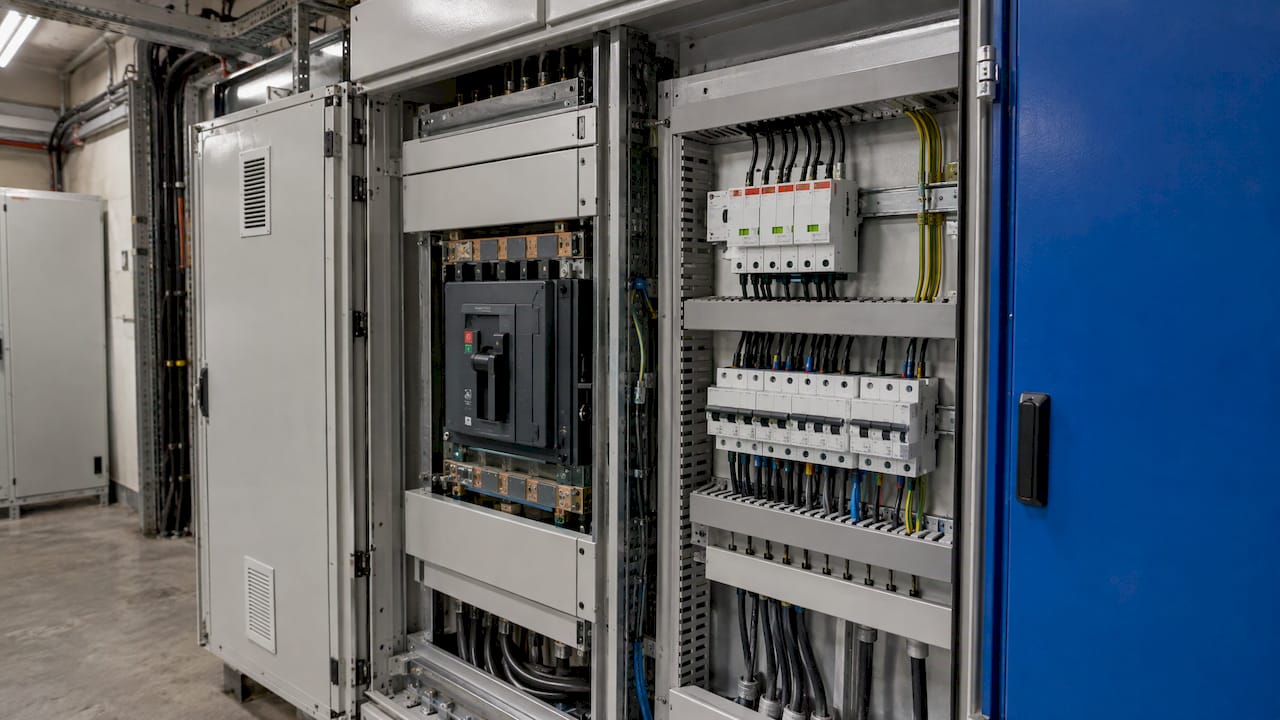
Selecting a surge protective device (SPD, called a parafoudre in France) is a design decision, not a catalog pick. The right choice follows from three things: whether the building has an external lightning protection system, how the power and data lines enter the site, and how far the sensitive equipment sits from the main board. Get those three facts documented first and the type, the ratings and the coordination mostly follow. At Indelec, lightning risk analysis, technical study, installation and inspection sit alongside our surge protection range, so the specification and the site survey stay in one place.
TL;DR
- Choose the SPD type from the site: Type 1 at the origin when the building has a lightning rod or a direct-strike risk, Type 2 at main and sub-distribution boards, Type 3 only close to a sensitive load and never alone.
- Do not confuse the type (1, 2, 3, which is about the tests passed) with the protection level (I to IV, which is about efficiency).
- Check Uc, Up, In or Iimp, the disconnector, the number of poles, the earthing arrangement and the short-circuit current against the real installation.
- Keep connection conductors as short as possible, around 0.50 m in total, and coordinate upstream and downstream devices when cable runs are long.
- Power SPDs do not protect data or signal lines: those need their own devices.
Table of Contents
- Start with the site, not the datasheet
- Type 1, Type 2 and Type 3: what each does and where it goes
- Type is not protection level
- The ratings to check against the installation
- Coordination: when one SPD is not enough
- Installation details that decide whether the SPD works
- French rules and what they mean for specification
- Highly sensitive installations
- Our perspective
- Getting the selection done once
- FAQ
- Sources
Start with the site, not the datasheet
A datasheet tells you what a device can do. Only a survey tells you what the site needs. Before you specify or replace an SPD, a designer or facility manager should be able to answer these questions from documents and a walk-through:
| Information to gather | Why it drives the choice |
|---|---|
| Lightning flash density or thunderstorm exposure of the location | Sets how likely and how severe the surges are |
| Is there an external lightning protection system (lightning rod, mesh cage)? | Decides whether a Type 1 is needed at the origin |
| Overhead or underground supply, and the length of external lines | Defines the paths surges take into the building |
| Earthing arrangement (TT, TN, IT) and the neutral system | Determines the number of poles and the Uc rating |
| Prospective short-circuit current at the board | Must not exceed what the SPD and its backup protection can handle |
| Distance from the main board to sensitive equipment | Decides if a second, downstream SPD is required |
| Metallic lines leaving or entering the building (telecom, alarm, gate, pump, photovoltaic) | Each needs its own protection and equipotential bonding |
| Switching sources: large motors, capacitor banks, generators | These create internal surges that lightning-oriented selection can miss |
For an industrial or infrastructure site, the exposure question is best handled through a formal lightning risk analysis. In France, that is the analyse du risque foudre (ARF), which evaluates the risk to a structure and its services and tells you what protection measures are justified. Our lightning risk assessment guide explains how that analysis feeds the protection design, and the surge protection chosen should trace back to it.
If the exposure, the supply arrangement, the earthing arrangement or the presence of a lightning rod are not confirmed on paper, the selection is not finished. Guessing any one of them is how an undersized Type 2 ends up behind a rod that required a Type 1.
Type 1, Type 2 and Type 3: what each does and where it goes
Low-voltage SPDs are classified under the NF EN 61643-11 standard by the test wave they withstand. According to a French electrical course, the three types break down as follows:
| Type | Test wave | Role | Typical location |
|---|---|---|---|
| Type 1 | 10/350 µs | Discharges part of a direct lightning current | Origin of the installation, when the building has a lightning rod |
| Type 2 | 8/20 µs | General-purpose protection against induced and distribution surges | Main or sub-distribution board, downstream of a Type 1 when one exists |
| Type 3 | Combined 1.2/50 µs and 8/20 µs | Fine protection with low discharge capacity | Right next to a sensitive device, always behind a Type 2 |
Combined Type 1+2 and Type 2+3 products exist and save space in a board. Communication lines are a separate family: their protectors are not Type 3 devices.
The practical rules that follow:
- A lightning rod on the building means a Type 1 at the origin. The 10/350 µs wave represents a direct strike current, and only a device tested to it is suited to share that current with the earthing system. Our article on when the Type 1 rule applies goes through the cases.
- Type 2 is the workhorse. It covers most boards in commercial and industrial buildings, and it is the device most often specified first.
- Type 3 never works alone. It protects the last meter before a sensitive load and relies on a Type 2 upstream. If you specify one, read the datasheet closely; we list four checks in our Type 3 datasheet guide.
For a wider view of device families used in industry, see our engineer’s guide to industrial surge solutions.
Type is not protection level
Specifiers regularly mix these up. The French INERIS FAQ for the QUALIFOUDRE scheme, version of 30 November 2023, makes the distinction: the protection level (I, II, III or IV) expresses how effective the protection is, while the type (1, 2 or 3) relates to the tests the device went through.
In practice, this means a specification line such as “Type 2” is incomplete. It should state the type, and separately the protection level and the voltage protection level Up that the equipment downstream can tolerate. A device that suits the test class but lets through a residual voltage above the withstand of your equipment does not do the job.

The ratings to check against the installation
Once the type is set, match the ratings to the real network. For a 230/400 V, 50 Hz low-voltage installation in France, check these in order:
- Uc, maximum continuous operating voltage. It must be suited to the network and to the earthing arrangement. A wrong Uc on a TT, TN or IT system is a common reason for early failure.
- Up, voltage protection level. The lower it is, the lower the residual voltage on the equipment. Public reference points often quoted for general specification are Up of 2.5 kV or below, Type 2 nominal discharge current In of at least 5 kA, and Type 1 impulse current Iimp of at least 12.5 kA, according to a French buyer’s guide. Treat them as floors, not targets: critical process equipment often justifies higher discharge ratings.
- In or Iimp, discharge capacity. In for Type 2 (8/20 µs), Iimp for Type 1 (10/350 µs). Size them to the exposure, the number of incoming lines and the expected service life.
- Number of poles and mode of protection. It depends on the neutral system; the datasheet should state the wiring scheme it is valid for.
- Disconnector and backup protection. The SPD must be paired with the circuit breaker or fuse the manufacturer specifies, so that an end-of-life short circuit is cleared safely.
- Short-circuit current. The prospective short-circuit current at the point of installation must not exceed the short-circuit withstand the manufacturer declares for the device with that backup protection.
One point that often gets missed on the reference table: the ratings apply to the exact product reference. If the associated backup protection is not given for the exact reference, the selection is not complete.
Coordination: when one SPD is not enough
A single SPD at the main board only protects equipment close to it. The course cited above refers to a 10 m conductor length beyond which protection by the main device alone is no longer guaranteed, because oscillation and reflection on the cable can double the residual voltage at the load. Beyond that distance, add a downstream SPD near the equipment.
A supplementary SPD is also called for when:
- the Up of the main device is too high for the impulse withstand of the equipment;
- switching surges are identified, for example from large motors, capacitor banks or a generator set;
- circuits leave the building, such as lines to outbuildings, pumps, gates or external lighting.
On large sites, think in terms of a cascade: Type 1 or 1+2 at the origin, Type 2 at sub-boards feeding long runs, Type 3 or a Type 2+3 at critical racks or controllers. Devices from different manufacturers are not automatically coordinated with each other. Energy sharing between stages works when the manufacturer has verified it, which is a reason to take a cascade from one range with stated coordination rules.
Data, signal and telecom lines
Power SPDs do not belong on a communication line. Copper telecom, xDSL, alarm, gate and sensor lines need protectors chosen for their working voltage, bandwidth, connector and line type, and bonded to the equipotential system with the same care as the power SPD, as the same buyer’s guide points out. A surge-protected power strip does not replace the SPD at the board either. Sites with automation, SCADA or process instrumentation should list every metallic line crossing the building envelope and assign each one a protector.
Installation details that decide whether the SPD works
A correctly selected device installed badly protects badly. The points that matter most:
- The 50 cm rule. The total conductor length from the tap point to the disconnector, to the SPD, and to earth should stay within 0.50 m. Each meter of wire adds roughly 1 µH and develops several hundred volts under a fast current rise, and that voltage adds to Up. The same course notes that the 2024 edition kept this rule.
- Conductor cross-sections. The course reports minimum copper sections raised in the 2024 edition: 6 mm² to earth for a Type 2 and 16 mm² for a Type 1, with 2.5 mm² and 6 mm² respectively on the live conductors. Confirm the figures against the current standard text and the manufacturer’s installation sheet.
- Backup protection. Use the breaker or fuse in the SPD branch specified by the manufacturer, rated for the short-circuit current at that point.
- Earthing quality. An SPD can only divert a surge into a low-impedance earth. Poor earthing undermines everything upstream. See our notes on maintaining grounding systems.
- Status indication. A red indicator, or a remote contact where fitted, means the installation is no longer protected. After a significant storm, check it and replace the module as the range requires.
Our complete facility guide to surge protection installation covers the sequence on site in more depth.
French rules and what they mean for specification
In France, the NF C 15-100 installation standard defines when SPDs are required in buildings, based on a lightning-exposure classification (AQ1 and AQ2 zones), the type of supply and the presence of a lightning rod. In summary form, one practical overview states that a lightning rod on the building makes an SPD, Type 1 at minimum, mandatory. The UTE C 15-443 guide covers the choice and installation of SPDs in low-voltage installations.
For industrial, classified or infrastructure sites, the lightning risk analysis and the technical study can set requirements that go beyond what the minimum building rules ask for. Your risk analysis, the insurer’s requirements and the equipment manufacturers’ withstand data should all be reconciled in the specification. Our page on lightning standards lists the references we work from. Check the edition in force of each standard before you issue a specification, because editions change.
Highly sensitive installations
Data centers, control rooms, medical and telecom sites tolerate far less residual voltage than a standard warehouse. Here, selection is about low Up, multiple coordinated stages, and an earthing and bonding design built around the equipment. We describe our approach in our work on the protection of highly sensitive installations and in a design example for a highly sensitive site.
Our perspective
Surge protection fails most often at the interface between design decisions, not inside the device. A Type 2 is bought for a building that has a lightning rod. A downstream device is forgotten on a 40 m run to a control cabinet. A perfectly rated SPD is wired with a loop of cable that cancels its performance.
This is why we treat surge protection as part of the whole lightning protection system. Indelec was established in 1955, and we work from the risk analysis and technical study through to supply, installation, verification and maintenance. Our R&D center develops the technical solutions, and our experience covers more than 280,000 installations worldwide.
Our view is simple: specify the SPD once the exposure, the lightning rod, the earthing and the line routes are documented, and then have the installation checked as built. A selection that follows the site is both safer and easier to maintain than one that follows a price list.
INDELEC
Getting the selection done once
If you manage an industrial, commercial or public site, we can carry out the lightning risk analysis and technical study, supply the surge protection devices, install them and take on the periodic verification. That puts the survey, the specification and the as-built check under one responsibility. Start from our lightning protection services or our surge protection range.

For sites with several buildings, long cable runs between them, or a lightning rod already in place, ask for the risk analysis first: it turns the questions in the table above into documented answers.
FAQ
What is the difference between a Type 1 and a Type 2 SPD?
The difference is the test wave. A Type 1 is tested with a 10/350 µs wave that represents a direct lightning current, so it goes at the origin of an installation when the building has a lightning rod. A Type 2 is tested with an 8/20 µs wave and protects boards against induced and distribution surges. Many products combine both as Type 1+2.
Can I use a Type 3 SPD on its own?
No. A Type 3 has a low discharge capacity and is designed for fine protection near a sensitive load, behind a Type 2 at the board. On its own it cannot take the energy a surge brings into the installation.
How do I know when an SPD must be replaced?
Check the status indicator or remote contact. A red indicator or a module out of service means the installation is no longer protected, and the device should be replaced according to its range. It is good practice to check after any significant storm and during scheduled maintenance inspections.
Do I need a second SPD near my equipment?
Often yes, when the equipment is far from the main board (around 10 m of conductor or more), when the Up of the main device exceeds the equipment’s withstand, or when switching surges from motors, capacitor banks or generators are present. A lightning risk analysis and a review of the cable routes settle the question for your site.
Sources
- Parafoudre et protection contre la foudre : cours, installation-renovation-electrique.com
- FAQ QUALIFOUDRE, INERIS, version of 30 November 2023
- Choisir un parafoudre de tableau électrique, ElecFrance
- Parafoudre obligatoire : règles NF C 15-100, Bâtir Moins Cher