Chemical Grounding Backfill: Choosing and Specifying It for Industrial Sites
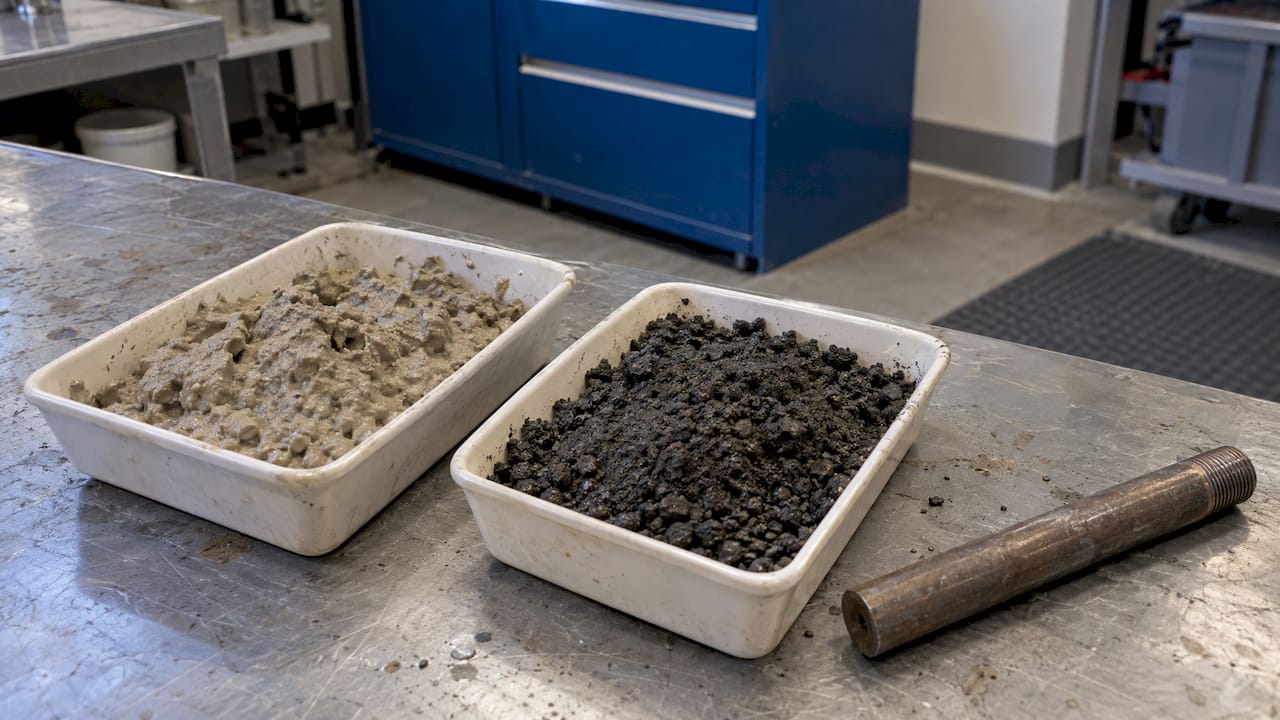
Chemical grounding backfill is a conductive material placed around an earth electrode to lower its contact resistance with the surrounding soil. It works best when it is chosen as part of a designed earthing system: soil resistivity measured first, the compound selected against that soil, and the result verified after installation. At Indelec, our earthing work starts from the site, not from the bag of compound, and this article follows the same order.
It is written for facility owners, contractors, architects, maintenance teams and engineering consultancies who have to specify or approve a grounding solution. It covers what the materials do, how the main families differ, which standard applies and what to check on site.
TL;DR
- A backfill (also called a ground enhancement material, GEM, or earthing compound) enlarges the effective surface of the electrode and holds a conductive path to the soil.
- The main families behave differently: bentonite depends on moisture, chemical salts act fast but can corrode and leach, and carbon-based or cement-based compounds are less sensitive to moisture.
- IEC 62561-7:2024 is the reference standard for earthing compounds. It requires testing for corrosion and now includes pH measurement.
- The right choice depends on measured soil resistivity, moisture behavior across the seasons and the electrode layout, not on the product name.
- A verified earthing system needs design, installation and periodic measurement. That is the work we do at Indelec.
Table of Contents
- What chemical grounding backfill actually does
- The main backfill families compared
- When a French site should consider a ground enhancement material
- What to verify when you specify a backfill
- Placement and maintenance in practice
- A worked example: choosing between three options
- Where Indelec fits
- Our perspective
- FAQ
- Sources
What chemical grounding backfill actually does
An earth electrode, usually a rod, a plate or a buried conductor, dissipates fault and lightning current into the soil. Most of the resistance you measure sits in the first few centimeters of soil around the electrode, because the current spreads out from a small surface. Ordinary soil in that zone can be dry, stony or sandy, and therefore poorly conductive.
A backfill replaces that zone with a better conductor. Academic reviews explain that enhancement materials reduce contact resistance by increasing the effective diameter of the electrode, which reduces the dispersion resistance. Put simply, the electrode behaves as if it were a much thicker rod in direct contact with the ground.
Three terms describe the same family of products:
- Chemical grounding backfill is the usual search phrase and often refers to compounds containing salts or other conductive additives.
- Ground enhancement material (GEM) is the term used in the standard and by most manufacturers for any compound placed around an electrode to lower earth resistance.
- Conductive concrete is a cement-based mix with conductive additives, used for the same purpose and increasingly studied for substations.
The backfill does not replace a correct earthing design. It improves the interface between a correctly sized electrode and a difficult soil.
The main backfill families compared
A 2026 systematic review in MDPI’s Technologies compares the main material families. Its figures are useful for orientation, with one caution: they come from different tests, soils and electrode setups, so they rank behavior and do not predict the result on your site.
| Material family | Reported resistivity reduction | Behavior that matters on site |
|---|---|---|
| Bentonite (natural clay) | About 60% | Stable and low in corrosivity, but depends on available moisture |
| Chemical salts | About 85%, fast | Quick result, but corrosion and loss of effectiveness over time are reported |
| Hydrogels and polymers | 80% to 90% | Work by retaining moisture |
| Zeolite, biochar (natural options) | Up to 94% and 89% | Studied as alternatives to conventional compounds |
| Marconite (carbon-based conductive aggregate) | About 99% | Higher cost |
These figures are reported in the 2026 review of ground enhancement materials.
Bentonite and moisture
Bentonite is a sodium-activated clay that swells strongly with water. According to Androvitsaneas and colleagues in IET Generation, Transmission & Distribution, it can absorb up to 13 times its dry volume in water, it is chemically inert and non-corrosive, and it reduced earthing resistance by up to 60% in the presence of water. The same paper stresses that its performance depends on the water available in the surrounding soil, and that results can fall short in very dry environments if it loses its water retention.
The mechanism explains why. A 2019 study published by AIP found that in bentonite water in the pores bridges the particles for current flow, so its resistivity is lower when wet than when plastic or solid. In Marconite, direct contact between particles dominates, which makes its resistivity almost independent of moisture. The same study measured 2.4 Ω·m for very wet MX80 bentonite against 0.44 Ω·m for Marconite, and observed more corrosion of aluminum discs in the bentonite.

In practice: bentonite suits sites where the soil keeps some moisture through the year, such as clay or loam with a stable water table. Where soil dries out for long periods, a moisture-independent compound is the more predictable specification.
Chemical salt mixes
Salt-based mixes lower resistivity quickly, which is why they feature in so many quick fixes. The review above reports the fast 85% reduction and also flags corrosion and loss of efficacy as the concerns. For a facility with a 30-year design life, that second point decides the question: an earthing system is expected to hold its value without repeated intervention, so the long-term behavior of the compound counts for more than the first measurement after installation.
Conductive concrete
Cement-based conductive mixes are a growing research area. A 2024 doctoral thesis from the Université du Québec à Chicoutimi on electrically conductive concretes and geopolymers found that such systems outperform traditional substation grounding, notably in high-resistivity soils. The key design parameters it identifies are the cross-section and resistivity of the conductive concrete and the diameter of the reinforcement bars. This is close in spirit to the concrete-encased electrode, which dates back to Ufer’s work in 1942, when he found that concrete conducts better than most soils. We cover the design side of that approach in our guide to the Ufer ground for French sites.
When a French site should consider a ground enhancement material
A backfill is a candidate when the soil, not the electrode layout, is the limiting factor. Typical situations on industrial and infrastructure projects in France:
- Rocky, sandy or gravelly ground, where moisture drains away and rods struggle to make good contact. Mountain sites, quarries and coastal sand are common examples.
- Limited footprint, where you cannot lay long horizontal conductors or drive enough rods to reach the target resistance.
- Seasonal swings, where measured resistance changes between a wet winter and a dry summer, or where frost layers the soil.
- High-consequence facilities, such as chemical storage, data rooms, telecom masts or EV charging depots, where a low and stable earth resistance is part of the protection concept.
Assess the site before choosing a product
The questions to settle, in order:
- What is the soil resistivity, and how does it vary with depth? A Wenner-type measurement at several spacings gives the profile. A resistive top layer over a conductive deeper layer points to deeper electrodes rather than more backfill.
- How does moisture behave through the year? Look at drainage, the water table, vegetation and the site’s rainfall pattern.
- What is buried nearby? Reinforced foundations, metallic pipes and cathodic protection systems all interact with the new electrode. Corrosion limits matter most here.
- What target value does the protection concept set? The lightning risk analysis and technical study define it, not the product.
- What are the ground conditions for the structure itself? Foundation and soil investigations for the building often already hold resistivity and groundwater data. Design guidance such as geotechnical design under Eurocode 7 explains how soil parameters are established for that purpose, and the same investigation can inform the earthing design.
Only after these answers does the choice of compound make sense. In many cases the best result comes from combining solutions: a deep electrode reaching a wetter, more conductive layer, with a compatible backfill at the contact zone. We drill and install such electrodes through our deep earth grounding drilling service.
What to verify when you specify a backfill
The standard that governs these materials is IEC 62561-7. Androvitsaneas and colleagues note that international standardization of commercial compounds only arrived in 2012 with this standard and its test standards. The current version is IEC 62561-7:2024, the third edition, published on 22 February 2024. It sets out requirements and tests for earthing enhancement compounds that produce a low-resistance earth termination. It replaces the 2018 edition, and its listed technical changes include a simplified figure A.1 that clarifies the high and low corrosion-load limits, and the introduction of pH measurement.
For a specification, that translates into a short checklist:
- Reference the current edition of IEC 62561-7 in the tender documents and ask for the test report against it.
- Check corrosion behavior against the electrode material (copper, galvanized steel, stainless steel). The compound and the electrode must be compatible.
- Check pH and leaching results, which matter for groundwater, nearby concrete and metalwork.
- Check the declared resistivity and the conditions under which it was measured, especially its dependence on moisture.
- Match the compound to the lightning protection standard used for the project. Our overview of the IEC 62305 deliverables lists what the documentation must contain.
A frequent mistake is to specify a compound on its resistivity alone. A very low figure measured in a laboratory pit says little about how the material will behave in a dry summer, in contact with galvanized steel, or beside a reinforced slab.
Placement and maintenance in practice
The general principles of placement are the same across products, and manufacturers’ datasheets give the exact quantities and mixing instructions for each compound, which must be followed.
- Vertical electrodes are installed in a drilled hole wider than the rod. The compound is introduced around the electrode, with the rod agitated or the mix worked so that no voids remain.
- Horizontal conductors are laid in a trench on a bed of compound, covered with a further layer, then backfilled and compacted with care.
- Connections must be accessible and protected. A low-resistance electrode is wasted if the clamp or the conductor joint corrodes. Our earthing product range includes clamps and connection components for this purpose.
- Test chambers let you measure the electrode later without excavation.
Maintenance depends on the family. A moisture-dependent compound calls for periodic measurement across seasons, so you can see whether resistance drifts in dry months. Any compound benefits from a scheduled resistance check and a visual inspection of connections. The routine is the same one we describe in our guide on how to maintain grounding systems.
A worked example: choosing between three options
Take a logistics depot on sandy soil that needs a telecom mast and a lightning protection system. The risk analysis sets a target earth resistance, and the first soil survey gives a high resistivity in the top two meters.
- Option A: more rods. The footprint is limited and the resistance only falls slowly with each added rod, since the rods share the same resistive soil.
- Option B: bentonite around the rods. Resistance drops, but the sand drains quickly. The result depends on how much moisture the pit retains through summer, so seasonal measurements become part of the maintenance plan.
- Option C: a deeper electrode with a moisture-independent compound at the contact zone. The survey shows lower resistivity below the sand. A deep electrode reaches it, and the compound improves contact in the upper layer.
The point is the method: measure, compare, then specify. The best option can differ even between two sites a few kilometers apart.
Where Indelec fits

For an industrial facility, public infrastructure or a building project, the question is rarely “which bag of compound?” It is “which earthing system meets the protection concept and stays within spec for decades?” Our offer covers the whole chain: lightning risk analysis and technical study, installation, and verification and maintenance, along with deep earth electrodes and earthing products. Indelec has been in lightning and earthing protection since 1955, and we state more than 280,000 installations worldwide.
If you are preparing a specification or a tender and need the soil, the electrode and the compound to be consistent with each other, start from our services overview and describe the site to us.

Our perspective
Backfill is a tool, and a good one, when it is applied to a measured problem. On the projects we handle, the useful question is what limits the earth resistance on this site: the soil near the electrode, the depth, the footprint or the connections.
We design earthing as a system. The risk analysis sets the target, the technical study defines the electrode layout, and the installation is followed by verification. When the soil near the surface is the limit, a compound that suits the electrode material and the moisture behavior of the ground is part of the answer. When a deeper, wetter layer is within reach, a deep earth electrode often gives a more stable result across the seasons.
Our R&D center and our experience across industrial, commercial and infrastructure sites inform these choices. What we ask of every compound and every electrode is the same: a documented, compliant and measurable result, today and at each periodic inspection.
INDELEC
FAQ
What is the difference between chemical grounding backfill and ground enhancement material?
The two terms overlap. “Ground enhancement material” is the term used in the standard and in technical literature for any compound placed around an electrode to lower earth resistance. “Chemical backfill” is the everyday phrase, often applied to the same products, whatever their composition.
Is bentonite or Marconite better for grounding?
It depends on the soil. Bentonite is stable and non-corrosive, but its conductivity relies on moisture. Marconite is carbon-based and its resistivity is nearly independent of moisture, which suits dry ground, at a higher cost according to the 2026 review. Measuring the soil’s moisture behavior across the year settles the choice.
Can conductive concrete replace a conventional earth electrode?
In some designs, yes. Research on conductive concrete in substations shows good results in high-resistivity soils, with the concrete section and reinforcement diameter as the main parameters. For a given project, the earthing study must confirm the layout and the target value, and the design must follow the applicable standards.
Which standard applies to grounding backfill?
IEC 62561-7 sets requirements and tests for earthing enhancement compounds, and the 2024 edition is the current one. It covers corrosion limits and includes pH measurement. Your tender documents should reference it and request the corresponding test report.
How often should an earth electrode with backfill be checked?
Check it at the interval set by your lightning protection standard and maintenance plan, and also after any major work near the electrode. Measuring in both wet and dry seasons shows whether resistance stays stable, and our verification and maintenance service covers this routine.
Sources
- Ground Enhancement Materials for Grounding Systems: A Review (MDPI Technologies, 2026)
- Research and applications of ground enhancing compounds (IET Generation, Transmission & Distribution, 2017)
- Bentonite and marconite for electrical grounding (AIP Conference Proceedings, 2019)
- The use of enhancement material in grounding system: a review (IJEECS, 2019)
- Contribution au développement des nouvelles méthodes de mise à la terre (UQAC thesis, 2024)
- IEC 62561-7:2024