EV Depot Grid Capacity: Size It Before You Order Chargers
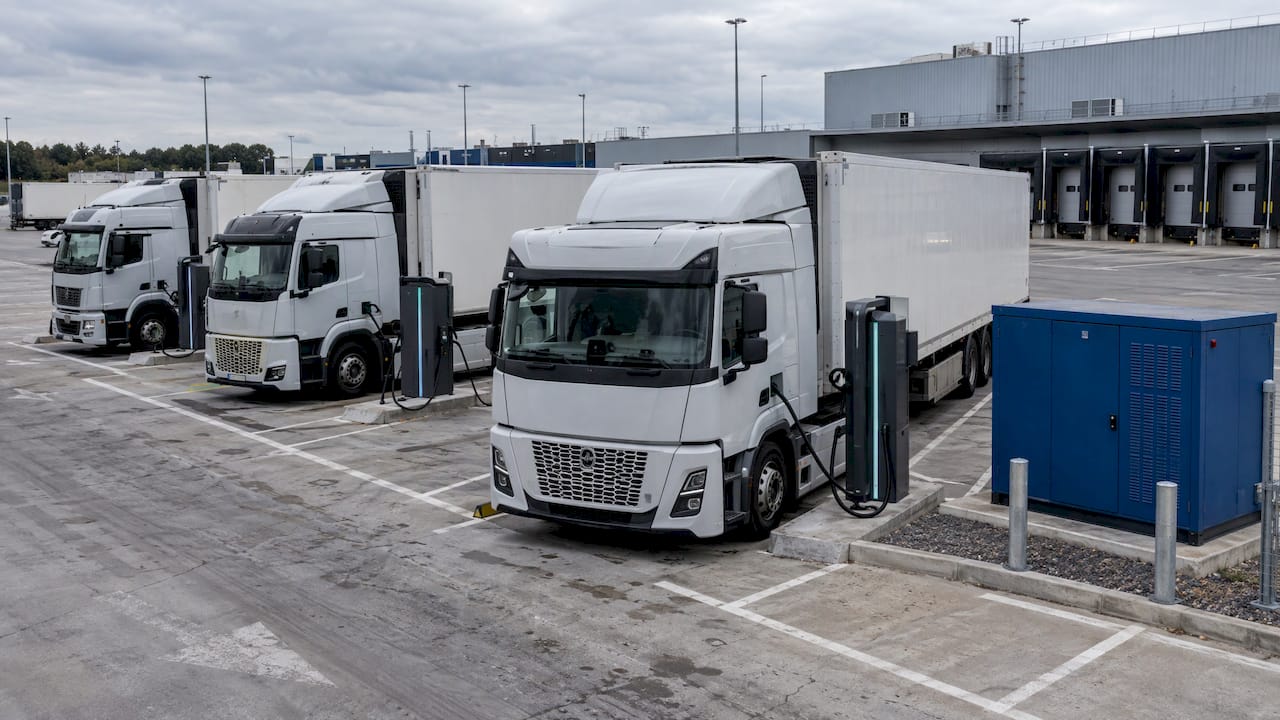
An EV depot rarely fails because of the chargers. It fails because the grid connection, sized on the wrong assumption, cannot feed them when the vehicles come back. The capacity you need is not the sum of the charger ratings. It is set by how much energy each vehicle needs, how long it stays parked, and how well charging is spread across the night and the shifts. Get those three right and you can often connect fewer kilowatts, later and cheaper. We design and supervise fleet charging sites, and this is the order of work we follow.
TL;DR
- Grid capacity is the power your site can draw at the same moment. It is not the number of chargers multiplied by their rating, because vehicles do not all charge at full power together.
- The base calculation is daily energy per vehicle divided by dwell time. Doubling the charging speed doubles the power you must secure.
- Coordinating charging can cut the connection capacity required by up to 75% compared with uncoordinated charging in one 2026 study. Scheduling matters more than storage in that study.
- Above certain thresholds, Enedis bills the connection differently and on quotation, so settle your power target before choosing hardware.
- Surge protection, earthing and civil works belong in the first design, not in a later amendment.
Table of Contents
- What grid capacity means for a depot
- Sizing from energy and dwell time
- What the evidence says about scale
- Scheduling beats oversizing
- When storage helps
- The French connection process
- What the electrical design must include
- A planning sequence for your depot
- Our offer for fleet depots
- Our perspective
- FAQ
- Sources
What grid capacity means for a depot
Two numbers are often confused. The first is the nameplate power of your chargers: ten chargers of 150 kW add up to 1.5 MW on paper. The second is the connection power that the distribution network operator (in most of France, Enedis) must make available at your delivery point. The two are linked by simultaneity: how many vehicles actually draw power at once, and at what level.
The AVERE/ADVENIR guide notes that the network operator applies a theoretical diversity factor when sizing installations, because charging sessions naturally complement each other over time. It also defines smart charging (V1G) as the ability to modulate the power drawn or schedule the session, which lets you cap peaks by setting a maximum power the chargers cannot exceed.
That cap is the key design lever. A depot with a hard limit of, say, 400 kW and a controller that shares it among connected vehicles needs a 400 kW connection, however many plugs are on the wall.
Sizing from energy and dwell time
The basic reasoning is short. Take the energy each vehicle uses on its round, divide by the hours it is parked and plugged in, and add the vehicles that overlap.
Here is an illustrative example. The figures are assumptions for the demonstration, not measurements. A heavy truck returns after a long round and needs to recover about 400 kWh.
| Dwell time at the depot | Average power needed per truck | Reasoning |
|---|---|---|
| 9 hours (overnight) | about 44 kW | 400 kWh ÷ 9 h |
| 4 hours (short turnaround) | 100 kW | 400 kWh ÷ 4 h |
| 2 hours (double shift) | 200 kW | 400 kWh ÷ 2 h |
The same truck, the same battery, and a power requirement that varies by a factor of four to five depending on the schedule. Multiply by the number of trucks that return in the same window and you see why a fleet manager who plans only the vehicles and not the timetable ends up with an oversized connection.
The AVERE France fleet electrification study of July 2025 makes the same point from the operator side: analyze usage and parking habits before sizing. Charging that is too slow hurts productivity, while power that is too high creates avoidable site-power costs when most vehicles charge overnight.
Data to collect before you calculate
- Daily distance and energy use per vehicle type, in kWh, including winter and loaded conditions.
- Arrival and departure times for each vehicle on each shift, over several typical weeks.
- The number of vehicles present at the same time, by day type.
- The vehicles you will add over the next five to ten years, so the civil works and the connection can be prepared for them.
- The existing subscribed power and the margin available on the current meter.
If you are adding electric trucks, the insurance terms for them are typically reviewed at the same time as the charging plan, for instance with electric truck insurance cover in the same budget discussion.
What the evidence says about scale
Individual sites are small compared with the national picture, which is useful for a planner because it shows the network is not the obstacle in most cases. In its December 2025 report on depot and warehouse charging for electric heavy trucks, Enedis estimates that mainland France could need 11.8 TWh a year for electric heavy-truck charging in 2035 and 24.1 TWh in 2050. Depots and warehouses account for 8.3 TWh and 16.8 TWh respectively, about 70% of the total.
The same report puts the associated power peak at 2.4 GW in 2035 and 4.8 GW in 2050, spread across more than 7,300 logistics zones analyzed. Enedis concludes the impact on structural network assets stays limited, with draw above 10 MW per primary substation by 2035. It also says some concentrated logistics areas will need coordinated planning between Enedis, local authorities and local players.
What this means for you: your depot is most likely a local connection question, not a national one. Still, if you are in a dense logistics area, talk to the operator early.
Another figure shows the risk of leaving charging unmanaged. RTE’s Mobility volume of the 2024 forecast report indicates that “natural” charging without optimization could cause a demand peak of up to 9 GW at 7 pm nationally. Smart charging can contribute significantly to limiting capacity needs by 2035. The same logic applies inside your fence: unmanaged arrival-time charging creates your own 7 pm peak.

Scheduling beats oversizing
A 2026 paper presented at the EMOB conference by a DTU researcher, Linking fleet operations to grid requirements, modeled depots for a fleet of 120 trips. Fully electrifying it with uncoordinated charging needed at least 2,800 kW, which is 2.5 times more than an optimized plan. An optimization model reduced the required connection capacity by up to 75%. Adding a battery gave only a marginal further reduction, because the optimized charging was already spread through the day. In that study, the mix of shifts was the dominant factor: when the objective was to keep connections to a minimum, depots approached a nearly constant load.

The practical reading is that timetable planning comes before storage. The French government’s guidelines on depot charging say the same in operational terms: optimize by using night hours and driver breaks, including the time spent loading and unloading goods.
Load management in practice
A load management system does three jobs: it caps the total site power, it distributes that power among the connected vehicles, and it prioritizes vehicles by departure time. The right priority rule is the one that matches your timetable. A truck leaving at 5 am gets its energy before one leaving at noon.
Enedis, in its April 2024 report on smart charging, states that control solutions must be defined with the players involved to fit different use cases and configurations. For a depot, that means the dispatcher, the maintenance team and the electrical engineer define the rules together, rather than leaving a default configuration in place. Our guide to EV charging load management in France covers the control logic in more depth.
When storage helps
A stationary battery can supplement the grid supply when the available connection power is insufficient, and it can help where upgrading the connection would take years. Enedis has operated a flexibility platform (flexibilites.enedis.fr) since 2024, and the Mayenne energy union’s 2025 report on batteries and territories identifies storage used as local flexibility to manage network congestion as a recognized use.
A sound order of decisions:
- Fix the schedule and the charging windows.
- Set the site power cap and the load management rules.
- Only then test whether a battery closes the remaining gap between the cap and the peak.
In the DTU modeling, that remaining gap was small once charging was well planned. Storage earns its place when your shifts leave no long parking window, or when the connection upgrade lead time blocks your fleet transition.
The French connection process
The power you request determines the procedure and the way costs are billed. Three points to hold on to.
Check the existing meter first. The first question is whether the chargers can be connected to the current delivery point, given its subscribed power and the margin available, or whether a dedicated delivery point with separate consumption tracking is better. A dedicated point makes the charging cost visible on its own.
Mind the 36 kVA line. Below 36 kVA, a site stays within a simpler low-voltage logic. Our guide on staying under 36 kVA for fleet sizing explains how facility managers use load management to remain under it, and our article on IRVE connection power shows how to size the connection request.
Understand how medium-voltage connections are billed. The Enedis connection billing scale (version dated 28 October 2026) sets out the following for HTA, the medium-voltage level:
- The connection power is expressed in kW and must exceed the subscribed power and any forecast overruns.
- For connections up to 500 kW located less than 400 m from the nearest HTA network, billing covers only the newly created HTA extension works, under a simplified cost formula.
- Above 500 kW, or beyond 400 m, billing also includes modifications to HTB/HTA substations and HTB works, with costs on quotation.
The framework behind this scale is the one published by the energy regulator, the CRE, which fixes the billing rules for connections to the public distribution network operated by Enedis.
The consequence is plain. A request for 480 kW and one for 520 kW are not neighbors in cost or in timing. If load management and a well-built timetable let your depot stay under a threshold with margin, say so in the application and size the request deliberately, not by rounding up.
Lead times and costs
Connection is generally the longest variable in a charging project, and it can run beyond the time needed to select and install equipment, especially when upstream network extension is needed. We do not quote a duration here because it depends on the delivery point, the transformer need and the distance to the network. Submit the application during the study phase, before the hardware is chosen, so the operator’s answer can shape the design. For the cost side of a project, our article on charging station costs for fleets and sites sets out where the budget goes.
What the electrical design must include
Capacity is only one line of the design. Three others protect the capacity you pay for.
- Civil works. Trenches, ducts and foundations are cheaper to build once, with spare ducts for later phases. See our guide to EV charging civil works.
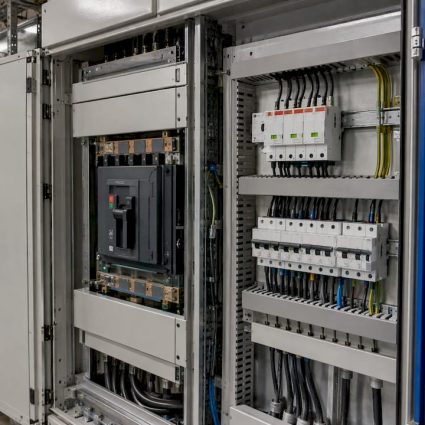
- Surge protection. A depot is a large, exposed electrical installation with expensive power electronics. Surge protection devices on the low-voltage side limit the damage from lightning-induced overvoltages and switching surges, and affect the Consuel inspection outcome. Our article on surge protection for French EV chargers explains how to avoid rejections, and our range of surge protection devices covers the equipment.
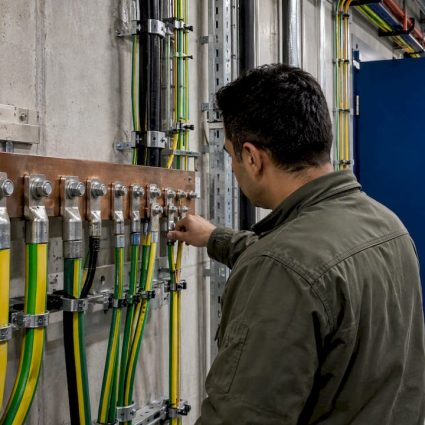
- Earthing. A stable earth connection protects people and equipment. See our earthing range.
Then think about availability. A site sized to the kilowatt has little spare margin when a charger goes down, so maintenance contracts and uptime targets belong in the plan. We cover this in EV charging uptime and in the guide to matching MA1, MA2 or MA3 maintenance.
A planning sequence for your depot
- Record the fleet’s rounds, energy needs and parking windows.
- Compute average power per vehicle from energy and dwell time, then sum the overlaps.
- Define the site power cap and the load management priorities.
- Check the existing subscribed power and margin on the meter, and decide between the current delivery point and a dedicated one.
- File the connection application at the study stage, with the target power and the expansion phases.
- Specify civil works, surge protection and earthing in the same design.
- Choose the chargers last, to fit the plan.
Our company parking lot guide for IRVE applies the same sequence to smaller sites.
Our offer for fleet depots
Indelec’s electric mobility services cover the audit, installation and supervision of charging infrastructure for professional fleets. Our teams also bring the electrical protection side that these sites need: surge protection, earthing and lightning protection, in the same project. If you are preparing a depot, start with the electric mobility services, or see the full range on our services page.

Our perspective
Most depot projects we see discussed start with a charger count. We start with the timetable. The kilowatts you need are a consequence of when vehicles are parked and how deliberately you share the power between them.
That is why an audit comes before a purchase order. Once the rounds, shifts and parking windows are on paper, the connection request becomes a number you can defend, and load management becomes a design decision instead of a patch.
The electrical protection belongs to the same decision. Chargers, controllers and transformers are costly, and they sit outdoors on large, open sites. Surge protection and earthing built into the first design are part of what keeps the capacity you paid for available. Since 1955, protecting installations from the effects of lightning has been our work, and we bring that discipline to EV charging sites.
Our advice is to treat the grid connection, the civil works and the protection as one package, specified once, supervised once.
INDELEC
FAQ
How much grid capacity does an electric truck depot need?
It depends on the energy each vehicle needs and the time it is parked. Divide daily energy by dwell time to get the average power per vehicle, then add the vehicles that overlap. In our illustrative case, a truck recovering 400 kWh needs about 44 kW over 9 hours but 100 kW over 4 hours.
Is the connection power the sum of all charger ratings?
No. Not all vehicles charge at full power at the same time, and the network operator applies a theoretical diversity factor. With load management you also set a maximum site power that the chargers cannot exceed, so the connection can be smaller than the total nameplate power.
Does a battery solve a limited grid connection?
It can supplement the supply where the connection power is insufficient. In a 2026 modeling study, however, optimized scheduling delivered most of the reduction and a battery added only a marginal gain, so plan the timetable first.
What changes above 500 kW or 400 m from the network?
Per the Enedis scale, HTA connections up to 500 kW and less than 400 m from the nearest HTA network are billed on the newly created extension works under a simplified formula. Beyond either limit, billing also includes substation modifications and HTB works, with costs on quotation.
Sources
- AVERE/ADVENIR guide on charging installations
- AVERE France fleet electrification study, July 2025
- Enedis report on depot and warehouse charging, December 2025
- RTE, Mobility volume of the forecast report, 2024
- DTU/EMOB 2026, Linking fleet operations to grid requirements
- French government depot charging guidelines, 2026
- Enedis report on smart charging, April 2024
- Mayenne energy union report on batteries and territories, 2025
- Enedis connection billing scale
- CRE, Enedis connection scale, 2024