Lightning Protection Cost in France: What Drives the Budget
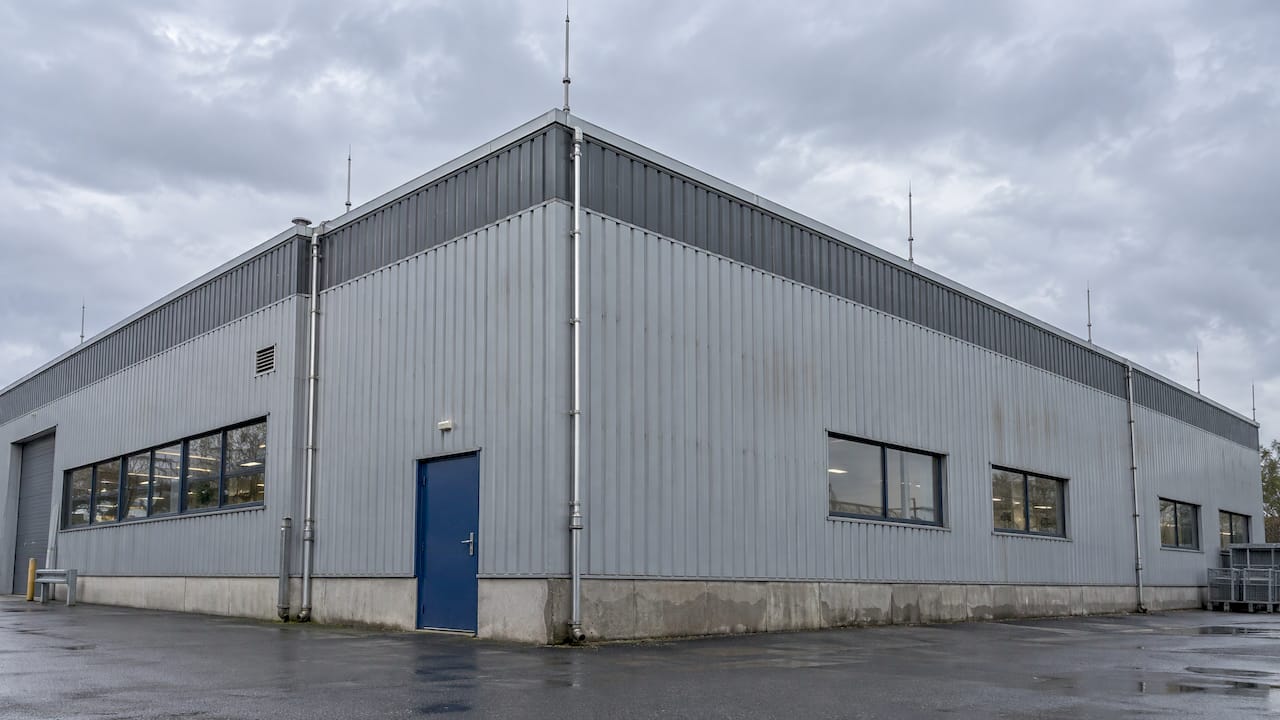
There is no single price for lightning protection in France, because the cost of a lightning rod installation depends on the risk analysis, the building and the earthing. Published figures for a single lightning rod on a house run from about €1,500 to €3,000 installed. For an industrial, commercial or public site, the budget comes from a lightning risk analysis and a technical study, and the figures below are only a floor. The most reliable way to fix a budget is to start with that analysis and then price what it requires.
This guide is for facility owners, managers, contractors, architects and consultancies who need to put a realistic number in a project budget. It shows what the public price ranges cover, which factors move the total, which rules make protection mandatory, and what a complete quote should list.
TL;DR
- Public price guides for a single lightning rod on a house cite €1,500 to €3,000 for a full installation by an electrician. Tertiary, industrial and public sites sit well above that range because the scope is different.
- The big cost drivers are the lightning risk analysis result, the height and footprint of the structure, the number of down conductors, the earthing work and the surge protection needed inside.
- Since August 2025, surge protection is mandatory in many tertiary and industrial buildings, so a lightning budget now has two lines: external protection and surge protective devices.
- A usable quote lists the analysis, the study, the equipment, the installation, the earthing measurements, the lightning strike counter and the verification and maintenance plan.
- Fix the budget after the analysis, not before: it tells you which protection level, and therefore which scope, you must pay for.
Table of Contents
- What the public price ranges actually tell you
- Why a facility budget starts with the risk analysis
- The cost factors that move the total
- Surge protection is now part of the budget
- When lightning protection is mandatory
- Order-of-magnitude budget by site type
- What a complete quote should include
- Lowering cost without lowering protection
- Our perspective
- From analysis to a signed scope
- FAQ
- Sources
What the public price ranges actually tell you
Most prices you find online describe a detached house. The French regional daily coverage on France 3 (July 2025) puts a full lightning rod installation by an electrician at €1,500 to €3,000. A technical advice sheet from a French lightning protection body, based on the AFNOR guide FD C 17-109 (March 2019), says complete protection of a detached house under 500 m² generally costs less than €5,000 including VAT and takes one to two days to install.
Breaking this down by component, a price guide for individual houses lists a simple lightning rod at €400 to €450, a surge arrester alone at €150 to €250, and an early streamer emission (ESE) air terminal at €1,250 to €3,000. Another house-focused guide gives €250 to €400 for the stainless steel rod, €450 to €700 for a telescopic mast and €1,000 to €1,500 for professional labor, depending on access and ancillary work.
Two points matter for a professional reader:
- These are residential figures. A warehouse, a plant, a school or a logistics hub has a larger perimeter, more equipment to protect and stricter requirements.
- They are indicative. Prices change with the cost of copper and steel and with site access, so treat any figure as a reference point and never as a quote.
In short, residential prices show the order of magnitude of one air terminal. They do not size a system for a facility.
Why a facility budget starts with the risk analysis
For a commercial or industrial site, the first cost is not hardware. It is the lightning risk analysis (analyse du risque foudre, or ARF): a calculation that evaluates the risk from a lightning strike to the structure and defines the protection level needed. For classified installations (ICPE) subject to authorization, the order of 4 October 2010 requires the analysis to be carried out by a competent body. A technical study then defines the protective measures, where they go, and how they will be verified and maintained.
The analysis matters to the budget for a simple reason: it decides the scope. A site whose risk is low may need targeted measures. A site with explosive atmospheres, critical processes or high occupancy may need a higher protection level, more down conductors, additional earthing and several levels of surge protection. If you price the hardware first, you risk paying twice: once for a system that does not match the requirements, and again to correct it.
Indelec provides the lightning risk analysis and the technical study as services, followed by installation and then verification and maintenance. Having these in one chain means the quantities in the quote follow from the study. For more on method, see our lightning risk assessment guide.
The cost factors that move the total
Building height, footprint and roof type
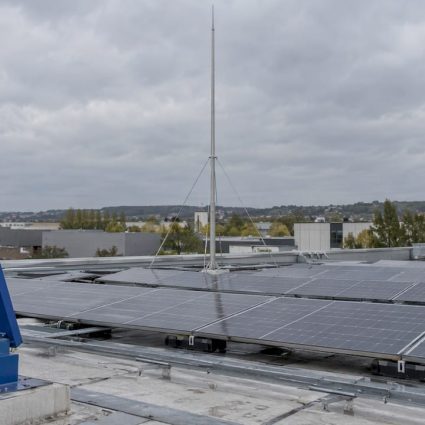
The air terminals must stand above the highest points they protect. Technical requirements summarized by Cahiers Techniques du Bâtiment include tips rising at least 2 m above the high points. A large flat roof with rooftop equipment, a tall stack or a metal frame structure needs more masts, supports and fixings than a simple pitched roof. Where there is no suitable fixing point, a dedicated mast beside the building may be needed, with its own foundation. That is why mast, mast fixing and mesh cage components appear as distinct lines in a professional quote.
Number and routing of down conductors
The same technical article specifies two tinned copper down conductors of at least 50 mm² per lightning rod. Conductor length is therefore a cost line: the taller or more spread out the building, the more cable, clamps, test joints and protective sleeves you need. Routing around facades, cladding and cable trays adds labor, not just material. Our guides on down conductors and down conductor connections explain what to specify.
Earthing and soil conditions
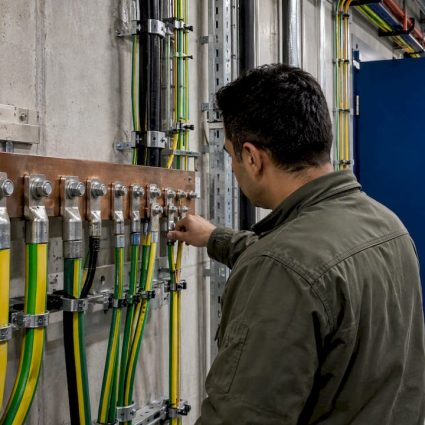
The earthing system is often the biggest unknown. The requirement cited is an earth termination with a resistance below 10 ohms. In favorable soil, a ring or foundation earth may do it. In rocky, dry or sandy ground, you may need additional rods, longer trenches or deep drilling. House-level guides note that the price excludes extra earthing work when the ground demands it, so the same applies, at larger scale, to a plant. Indelec lists earthing products and deep earth drilling among its offers, which lets that work be specified with the rest of the system: see earthing products and deep earth grounding drilling.
Type of air terminal
Whether the design uses simple rods, a mesh cage or an ESE air terminal changes the number of components and the installation effort. The French documents cited put ESE air terminals at the higher end of single-device prices, but they can cover a larger area with fewer points, which is why the design choice has to be made in the study and not on a price list. If you want to see how Indelec’s range is built, look at the Prevectron3 air terminal and our page on lightning rod placement.
Lightning strike counter
For an ESE air terminal, the cited article notes a lightning strike counter on the down conductor is mandatory under the order of 15 January 2008. It is a small line in a budget but one that has to be in the quote. It also gives the maintenance team a record of events to check against inspections.

Surge protection inside the building
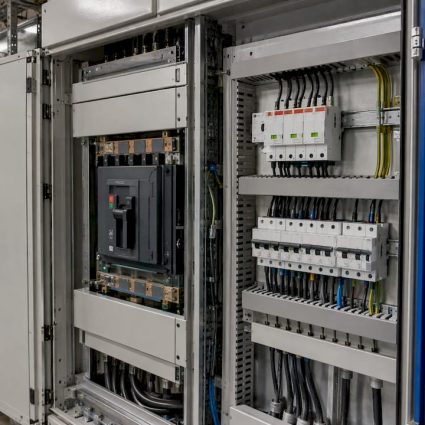
External protection controls the strike. It does not stop surges traveling through power and data lines. Protective devices are installed in the electrical panel and sometimes at equipment level, and their number depends on the site’s layout and distances. This leads to the rules that now affect most tertiary and industrial budgets.
Surge protection is now part of the budget
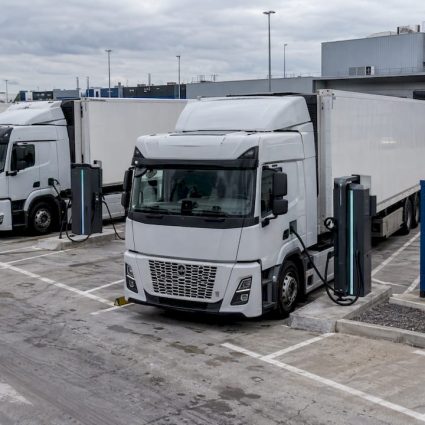
French rules on surge protection have changed. GIMELEC, the French electrical industry association, published a reference brochure in March 2026 stating that since August 2025, new obligations apply to tertiary and industrial buildings. Surge protection is required in healthcare facilities, schools and universities, hotels, offices, public-access buildings, shops and shopping centers, public service and heritage buildings, and industrial and agricultural buildings. It also covers publicly accessible EV charging points, video surveillance, fire alarms and telecom installations. An additional device is needed beyond 10 m of distance, with switching surges, or to coordinate between protections.
The revised NF C 15-100 standard, in force since 23 August 2024, makes surge protection mandatory in these buildings depending on occupancy, the nature of the activity, risks to human life and explosion risks for ICPE. Without a risk analysis, installing surge protectors becomes mandatory. It also integrates an updated lightning density map linked to climate change.
For a budget, that means the electrical panel work belongs next to the roof work. Compliance with standards and local obligations is also a topic for fire and life-safety planning, and a general view of fire protection standards and scope helps to see how these obligations sit alongside each other. Indelec supplies surge protection products and cabinets: see surge protection devices and our surge protection installation guide.
When lightning protection is mandatory
Not every building must have an external system, but many categories must. According to France 3’s summary, a lightning rod is mandatory for certain public-access buildings (ERP) such as mountain hotels-restaurants and refuges and places of worship, for high-rise buildings (IGH) over 28 m, for installations handling electrical currents or storing flammable products, for ICPE, nuclear installations and silos. A supplementary surge arrester is recommended in some situations under NF C 15-100.
For your budget, this changes the question from “should we?” to “at which level, and when?”. On an ICPE site under authorization, the order of 4 October 2010 also sets deadlines: installation follows the technical study, no later than two years after the risk analysis, with exceptions. Plan the analysis early enough that the works fit that window. Our pages on lightning standards and the complete guide to lightning protection for buildings give the wider frame.
Order-of-magnitude budget by site type
The table below does not give prices for facilities, because no honest public figure exists without a study. It shows what is in each budget and what drives it.
| Site type | Main budget lines | Main cost drivers |
|---|---|---|
| Detached house, under 500 m² | Air terminal, two down conductors, earthing, surge arrester | Roof access, soil. Public guides cite under €5,000 incl. VAT for complete protection |
| Office or retail building | Risk analysis, air terminals or mesh, down conductors, earthing, surge protection in panels | Roof layout, number of panels, distances between them |
| Warehouse or logistics site | Analysis, study, perimeter masts or mesh, long down conductor routes, earthing | Footprint, steel structure, ground resistance |
| ICPE or industrial plant | Analysis, technical study, protection for sensitive zones, coordinated surge protection, verification plan | Protection level, explosive atmospheres, process continuity |
| Public infrastructure | Analysis, study, masts, earthing, surge protection, maintenance contract | Dispersed assets, access, regulatory requirements |
Use this as a checklist of budget lines. The amounts come from the study and the quotes.
What a complete quote should include
As the same technical advice sheet says, the work should go to a competent, qualified company that can certify compliance, because effective protection combines a lightning rod with surge arresters and protects the structure, people and electrical installation. A quote you can compare line by line has these items:
- Lightning risk analysis (ARF) with the resulting protection level.
- Technical study (design, positions of air terminals, routing of conductors, earthing layout, surge protection architecture).
- Equipment, with references: air terminals, masts and fixings, conductors, joints, counters, earthing components, surge protective devices.
- Installation, including access means such as lifts or roof safety provisions.
- Earthing work and measurement of earth resistance after installation.
- Surge protection at the main panel and sub-panels, with the coordination between stages.
- Documentation and commissioning: as-built drawings, test reports, certificate of compliance.
- Verification and maintenance plan, with intervals and who performs them.
A quote missing items 1, 2 or 7 may look cheaper but leaves the real cost to appear later: a protection level that was never defined, or no document to show an inspector, an insurer or a client.
Lowering cost without lowering protection
The savings are in the sequence, not in cutting scope.
- Run the analysis first. It tells you where protection is needed and where it is not, which avoids over-specifying.
- Coordinate with other works. Roof refurbishment, facade work or an electrical upgrade already provide access, scaffolding or open trenches. Planning the lightning scope into the same site saves mobilization costs.
- Design the earthing early. In new builds, the foundation trench earth is cheap when it is done before the concrete. See our guide on foundation trench grounding that meets NF C 15-100.
- Keep one point of responsibility. When the analysis, study, installation and maintenance follow each other, quantities, standards and documents stay consistent.
- Budget for maintenance. A system that is verified over time keeps its compliance and its value. Our guide on maintaining grounding systems shows what regular checks cover.
A regional electrician quoted by France 3 observes that the installation cost is low compared with the damage a fire causes. For a facility whose production, data or occupants depend on the building, that ratio is even clearer.
Our perspective
We see lightning protection as an engineering chain, not a list of parts. The cost of a system is decided long before anyone orders a rod: by the risk analysis, by the technical study and by how the earthing and surge protection are designed.
That is why we organize our services in that order: analysis and study, installation, then verification and maintenance. Each step feeds the next, and the quantities in a quote come from the study, not from a catalog guess. With more than 280,000 installations behind our experience and a dedicated R&D center, our approach is to adapt the solution to each site: its structure, its soil, its activity and its standards.
For facility owners, this gives a budget you can defend to a board, an insurer or an inspector, because every line traces back to a requirement. With surge protection obligations extending to more building types since August 2025, we think the sensible move is to treat external protection, earthing and surge protection as one project with one set of documents.
INDELEC
From analysis to a signed scope
Indelec supports industrial, commercial and public infrastructure clients from the lightning risk analysis and technical study through installation, verification and maintenance. Our product ranges cover lightning rods, earthing, down conductors, lightning strike counters and surge protection. To scope a project for your site, start from our lightning protection services.

You can also see how an installation is organized in our step-by-step guide to infrastructure lightning protection and in the lightning protection system application page.
FAQ
What does a lightning protection system cost in France?
For a detached house, public sources give about €1,500 to €3,000 for a complete lightning rod installation, and under €5,000 including VAT for full protection of a house under 500 m². Facilities cost more and depend on the risk analysis, the structure and the earthing. A quote based on a technical study is the only reliable figure.
How much does lightning rod installation cost?
A house-level guide lists labor at €1,000 to €1,500 on top of the equipment, and an ESE air terminal at €1,250 to €3,000 with equipment and installation. On a larger building, add down conductors, earthing, a strike counter and the study.
Is lightning protection a legal requirement?
It is mandatory for several categories, including certain public-access buildings, high-rise buildings over 28 m, ICPE, nuclear installations and silos. Since August 2025, surge protection is also required in many tertiary and industrial buildings under the revised NF C 15-100. For a house, it is recommended rather than required.
Does the price include surge protection?
Not necessarily. A lightning rod controls the strike, while surge protective devices protect the electrical and data networks. Ask for both to be listed as separate lines so you can see what is covered and what is not.
Sources
- Orages violents : faut-il équiper sa maison d’un paratonnerre ? (France 3, 2025)
- Fiche conseil : foudroiement d’une maison (apfoudre.fr)
- Prix d’installation d’un paratonnerre et parafoudre (travaux-electrique.fr)
- Paratonnerre : prix d’installation en maison individuelle (electriciteguide.com)
- Le paratonnerre, protection normalisée contre la foudre (Cahiers Techniques du Bâtiment)
- Arrêté du 4 octobre 2010 (Légifrance)
- Protéger vos bâtiments contre la foudre : brochure GIMELEC (2026)
- La nouvelle NF C 15-100 depuis le 23 août 2024 (Batirama)
- Fire protection standards and scope (FourPoint)