Lightning Protection ROI: How to Calculate It for a French Site

Lightning protection pays back when the cost of the protection measures plus the losses that remain is lower than the losses you would face with no protection. That is the logic of the international lightning standard, and it is the simplest reliable way to build the business case for a plant, a warehouse, a public building or a logistics hub in France. This guide shows the formula, the cost lines to include, the site factors that move the result and a worked example you can adapt.
TL;DR
- A protection project is economically justified when residual losses plus the cost of protection measures are lower than the total loss without protection (CRL + CPM < CL).
- The ROI case is built on avoided losses: downtime, repairs, restart costs, insurer requirements and risk profile, not only damaged equipment.
- Site factors such as lightning flash density, structure height, metallic lines and rooftop equipment change the value of what you avoid.
- Installation, verification and maintenance belong in the calculation, because a system only keeps its value if it stays compliant over time.
- For French classified sites (ICPE), a lightning risk analysis is a regulatory step, so the economic calculation often decides how to protect, not whether to.
Table of Contents
- The formula behind lightning protection ROI
- What counts as an avoided loss
- Site factors that change the numbers
- A worked example with illustrative figures
- Lifecycle costs: study, installation, verification, maintenance
- When French rules make the calculation a requirement
- Our perspective
- From calculation to a project
- A checklist for your business case
- FAQ
- Sources
The formula behind lightning protection ROI
Most ROI articles invent their own model. The better starting point is the one already written into the standards. The Ukrainian adoption of EN 62305-1 describes the economic justification as an assessment of the risk of economic loss, called R4. Protection is cost-effective when the residual loss cost with protection (CRL) plus the cost of the protection measures (CPM) is lower than the cost of the total loss without protection (CL).
In plain terms:
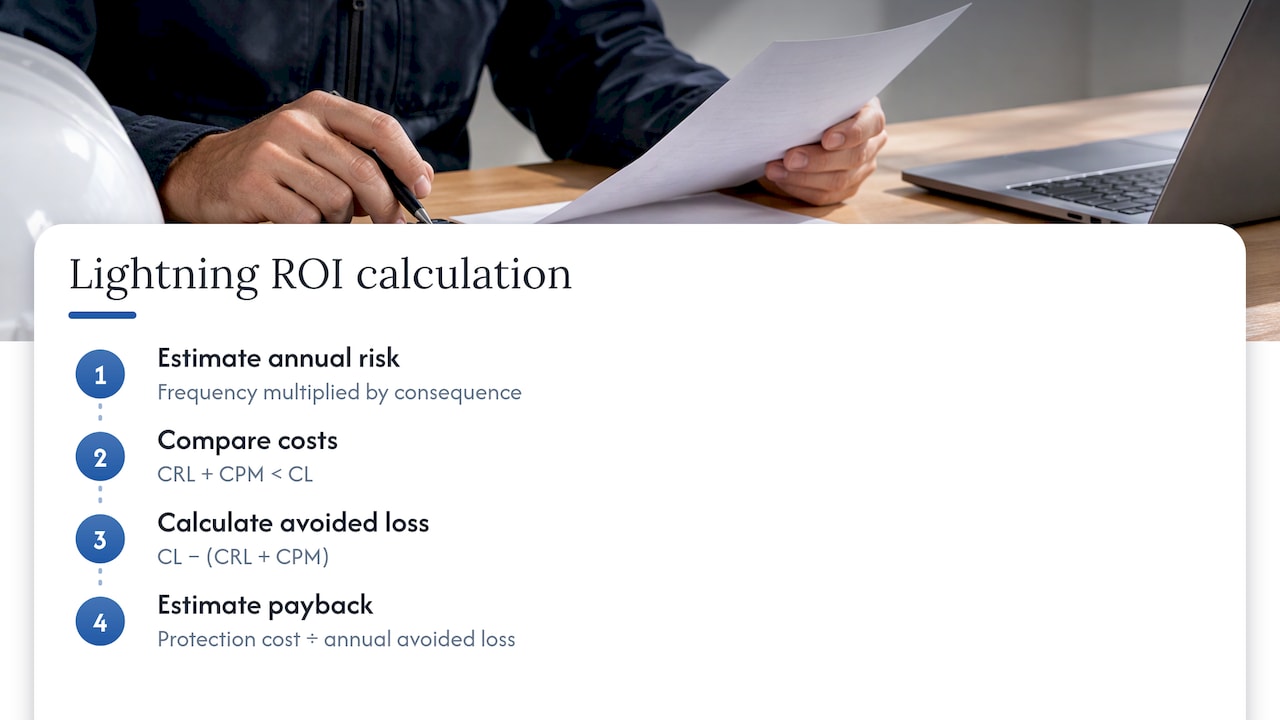
CRL + CPM < CL
The difference between CL and (CRL + CPM) is your potential saving. If it is positive over the period you evaluate, the investment pays. If you want a payback figure, divide the cost of protection by the annual avoided loss.
The companion standard on risk assessment goes further. IEC 62305-2 includes a procedure for evaluating the cost-effectiveness of protection measures, with annexes on estimating losses and their costs. It defines typical loss categories: loss of human life, loss of public service, loss of cultural heritage and economic loss. For a business ROI calculation, the economic loss category is the one you monetize, but the others can drive the legal requirement.
The current edition of the standard defines risk as the probable average annual loss in a structure due to lightning, depending on how often damage occurs and how large the consequential losses are. That definition is useful because it forces you to think in annual terms: frequency multiplied by consequence.
What counts as an avoided loss
The most common mistake is to count only the damaged equipment. A strike on an industrial site rarely costs just the part that burned.
A risk advisory page from Marsh France lists the financial consequences of lightning as operating losses, repair costs, restart costs, a worse site risk profile and stricter insurer prevention requirements. Turn that into a cost sheet:
| Cost line | What to quantify | Where the data comes from |
|---|---|---|
| Production or service downtime | Hours of stoppage times margin lost per hour | Finance, production planning |
| Equipment repair or replacement | Drives, PLCs, sensors, transformers, IT, telecom | Asset register, supplier quotes |
| Restart costs | Scrap, requalification, overtime, expedited deliveries | Operations |
| Data and control loss | Recovery time, reconfiguration, lost records | IT and automation teams |
| Insurance consequences | Deductibles, premium changes, prevention conditions | Broker, policy documents |
| Regulatory and safety consequences | Investigations, corrective actions, stoppage orders | EHS, compliance |
French public data shows why the last lines matter. The ARIA study from the French ministry of ecological transition on lightning and industrial installations notes that consequences can include major internal material damage running into millions of euros. It also identifies the absence or non-update of lightning studies as a cause in several industrial accident cases.
For surge protection in particular, the argument is the same: to justify the investment, put a number on unavailability, replacement costs and data loss, so that avoided losses become measurable indirect costs rather than a vague idea of damage.
Thinking about downtime like an operator
If your site runs continuous, energy-intensive equipment, you already know how to cost an hour of stoppage. Operations that track the full maintenance and downtime costs of equipment fleets illustrate the discipline: every hour offline, every repair and every restart gets a line in the budget. Apply the same rigor to a lightning scenario and the avoided-loss figure usually grows well beyond the replacement cost of the damaged parts.
The national context
A French synthesis document on lightning protection cites roughly 2,000,000 lightning strikes a year in France, about 20,000 claims and 15,000 fires, and puts the financial losses in the tens of millions of euros annually. Those are national orders of magnitude, not a forecast for your site. They are useful to show a finance committee that the event is not exotic, and the site-specific calculation does the rest.
Site factors that change the numbers
Two plants with the same equipment can have very different ROI. The risk analysis looks at the parameters that raise or lower the frequency and the severity of damage.
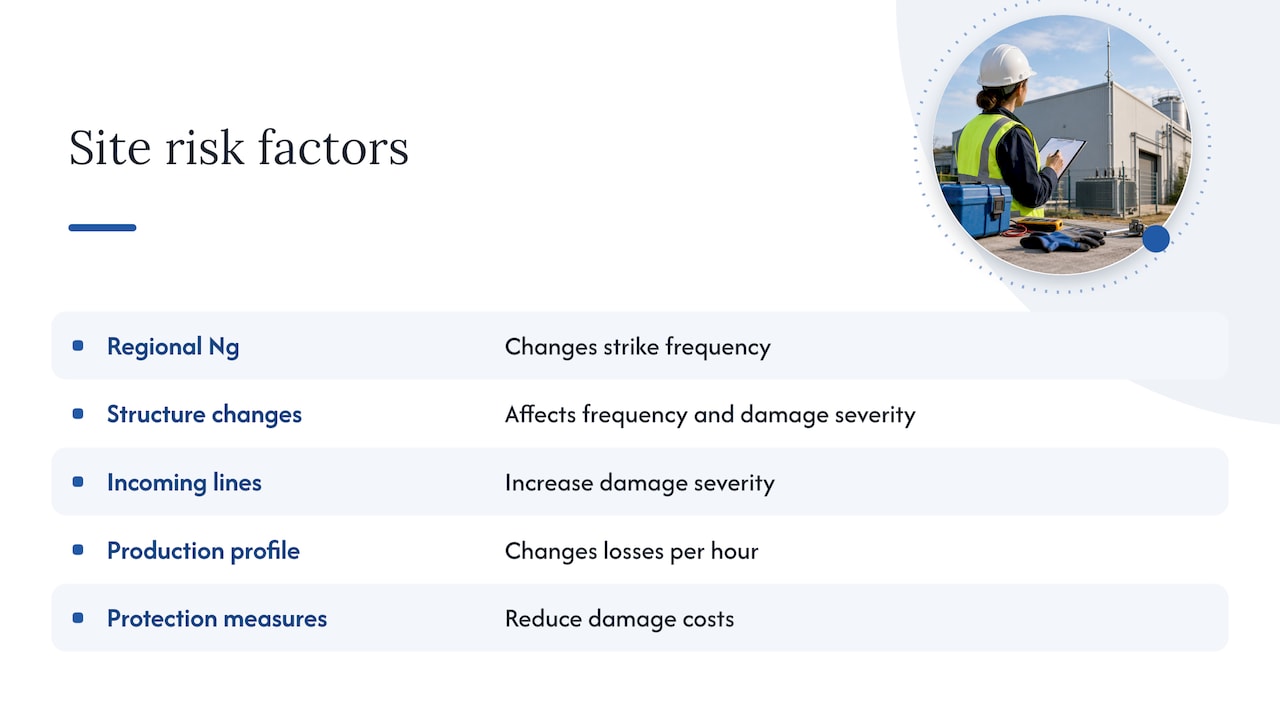
Lightning flash density (Ng). It is the environmental parameter used in lightning risk analyses in France. A technical page on the topic explains that Ng is used in risk analyses, with an approximate relation to the keraunic level (Nk, thunderstorm days) of Ng = Nk/10. Your regional Ng feeds directly into the expected annual frequency of strikes.
Structure height and configuration. Taller or more isolated structures collect more strikes.
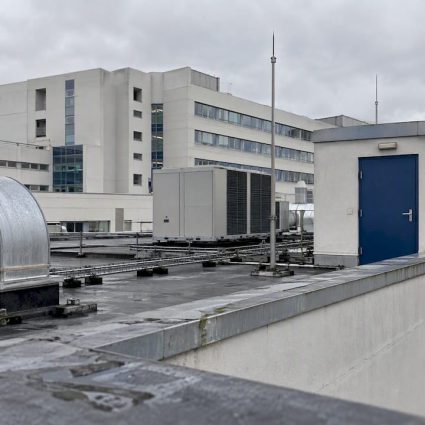
Changes on site. The INERIS report on lightning protection for classified installations lists the modifications that should trigger an update of the analysis: raising the structure, extensions, new equipment, added metallic lines or pipes, or a change of activity. Rooftop additions such as photovoltaic panels, HVAC units and antennas are the typical case: more exposed equipment means more value at risk.
Incoming lines. Power, data and process lines entering the building carry surges inside, which is why surge protection and earthing are part of the calculation and not accessories to the lightning rod.
What the site produces. A distribution center with temperature-controlled stock, a plant with continuous processes and a data-dependent operation do not lose the same amount per hour.
The same INERIS report notes that the risk analysis can recommend optional measures that significantly reduce the cost of damage in case of a strike and help set investment priorities. That is the ROI tool in practice: you do not have to choose between everything and nothing.
A worked example with illustrative figures
The numbers below are invented for demonstration. They are not Indelec prices and not a benchmark. Replace each line with your own data.
Imagine a mid-sized production site with a credible worst-case lightning scenario.
| Item | Symbol | Illustrative amount |
|---|---|---|
| Total loss without protection (downtime, repairs, restart, data) | CL | €1,200,000 |
| Residual loss with protection in place | CRL | €150,000 |
| Cost of protection measures over the evaluation period (study, equipment, installation, verification, maintenance) | CPM | €220,000 |
Test: CRL + CPM = €150,000 + €220,000 = €370,000, which is lower than CL (€1,200,000). The potential saving is €830,000 over the period, so the condition is met.
The example shows three things:
- The comparison is between a loss scenario and a protected scenario, not between a cost and zero.
- The residual loss is never nil. Be honest about it in your model, because the standard’s logic includes it.
- Maintenance sits in CPM. Leave it out and the protected scenario looks better than it will be in reality.
To make this robust for a committee, run it three times: a conservative loss, an expected loss and a severe one. If the investment is justified even in the conservative case, the decision is easy to defend. Our guide on procurement-ready lightning protection ROI for French facility owners goes deeper into how to present this to purchasing.
Lifecycle costs: study, installation, verification, maintenance
The protection cost (CPM) is not a single purchase. In France, the cycle for a regulated site follows a sequence: lightning risk analysis (ARF), technical study (ET), installation, then periodic verification. Each stage has a cost and a function.
- ARF and ET. They set the required protection level and define the measures that achieve it. Their cost is small compared with the cost of protecting the wrong way, either too little or too much.
- Installation. Air terminals, down conductors, earthing and surge protective devices, sized according to the study.
- Verification and maintenance. The INERIS report explains that the verification and maintenance notice is written during the technical study, once the protections are defined, and serves as the basis for verifications. In ROI terms, it ties the system to a documented, continuing compliance.
Two practical consequences for your model. First, spread inspection and upkeep over the evaluation period rather than treating them as surprises. Second, a well-documented system is easier to show to an insurer. Our article on the insurer two-year rule for French ICPE sites explains what insurers look for, and the guide on how to maintain lightning rods covers routine upkeep.
When French rules make the calculation a requirement
For many sites, the question is not only “does it pay” but “what is required”. INERIS recalls that for ICPE (classified installations), the lightning risk analysis and the technical study are mandatory under the arrêté of October 4, 2010, as amended by the arrêté of July 19, 2011. The ARF is based on NF EN 62305-2, and the requirements are applied through ARF, ET, installation and verification by recognized competent bodies. The ARF is updated in defined cases, including notable modifications requiring a new authorization, the five-year review of the hazard study for certain installations, and changes affecting the ARF input data.
For other establishments, including public-access buildings, a synthesis source indicates the risk analysis can use the full method of NF EN 62305-2 or the simplified method of guide FDC 17-108. The result is expressed as a protection level from I to IV, and the risk of loss of human life (R1) is a central output, as described by Cahiers Techniques du Bâtiment. The UTE provides the Jupiter software to evaluate the required level.
Practical reading for your business case: where the analysis requires protection, the ROI calculation guides the choice among compliant solutions and the order of investments. Where it is not mandatory, it shows whether the project is worthwhile on economics alone. For the compliance side, see our compliance guide for ICPE sites.
Our perspective
We have worked in lightning protection since 1955, and we claim more than 280,000 installations worldwide. The pattern we see in ROI discussions is consistent: the projects that are easiest to justify start from a proper study, not from a product list.
A lightning risk analysis turns an abstract fear into a number. It tells you which structures, lines and equipment drive the risk, and it lets you rank measures by the loss they avoid. That is why we put the analysis and the technical study first, then installation, then verification and maintenance, as one continuous service.
Our R&D center works on solutions that follow changing climate conditions and evolving standards. For a facility owner, this means a system designed for the site in front of it, with earthing, down conductors, air terminals and surge protection engineered to work together, rather than components added one by one.
Our advice: calculate over the lifecycle, include downtime and restart costs from the start, and keep the verification record up to date. A protection system that is documented and maintained is the one that keeps its value.
INDELEC
From calculation to a project
If you have a first estimate of your loss scenario, the next step is a site-specific analysis. We provide lightning risk analysis and technical study, installation, and verification and maintenance for industrial, commercial and public infrastructure, along with the hardware: lightning rods, earthing, down conductors and surge protection.

To start with the study and get a protection plan tied to your site’s actual risk, see our lightning protection services, or contact our team through Indelec.
A checklist for your business case
Use this order to build a calculation a finance director can approve.
- Define the scope. List the structures, equipment and incoming lines concerned, and any recent or planned changes such as extensions or rooftop additions.
- Get the risk analysis. Base it on NF EN 62305-2 and your local flash density. For an ICPE, it is already a regulatory deliverable.
- Build the loss scenarios. Conservative, expected and severe, with every line from the cost table: downtime, repairs, restart, data, insurance, compliance.
- Cost the protection. Study, equipment, installation, verification and maintenance over the evaluation period.
- Estimate residual loss. What remains at risk with the protection in place.
- Test CRL + CPM < CL. Compute the saving and, if needed, the payback period.
- Rank options. Use the analysis to separate required measures from optional ones and sequence the budget.
- Document everything. Keep the study, installation and verification records. Our guide to the documents that prove lightning conformity lists what to keep.
If your project goes through a tender, the CCTP checklist for lightning protection tenders helps you write requirements that are comparable across bids.
FAQ
What is a good payback period for lightning protection?
There is no universal figure, because it depends on the value at risk and the strike exposure of your site. The standard’s test is simple: the protection is justified when residual losses plus protection costs are lower than the loss without protection. Compute the annual avoided loss and divide your protection cost by it to get your own payback.
Does lightning protection reduce insurance costs?
We cannot promise a premium change, since that is decided by your insurer. What is documented is that insurers increasingly set prevention requirements for lightning risk, so a studied, installed and verified system supports your position. Discuss it with your broker using your study and verification records.
Do I need a lightning risk analysis before calculating ROI?
Yes, in practice. The analysis provides the frequency and consequence inputs that make the calculation credible. For ICPE sites in France, the ARF and the technical study are mandatory anyway, so the same work serves both compliance and the business case.
Which costs do companies forget most often?
Restart costs, data and control system recovery, and the cost of verification and maintenance over the years. Add the effect on your insurance relationship as well. Leaving them out understates the avoided loss on one side and the protection cost on the other.
Sources
- ДСТУ EN 62305-1:2012, Protection against lightning, Part 1
- IEC 62305-2, procedure for cost-effectiveness of protection measures
- IEC 62305-2:2024, risk management
- Marsh France, Foudre : évaluer le risque et renforcer la protection
- ARIA, Impact de la foudre sur les installations industrielles
- INERIS, Rapport Omega3, Protection contre la foudre des ICPE
- Lightning Protection in France, synthesis document
- Densité de foudroiement et niveau kéraunique
- Cahiers Techniques du Bâtiment, Le paratonnerre, protection normalisée contre la foudre
- Mining maintenance costs: ASIC and GPU fleets