Lightning Protection for Road Tunnels: A Practical Guide
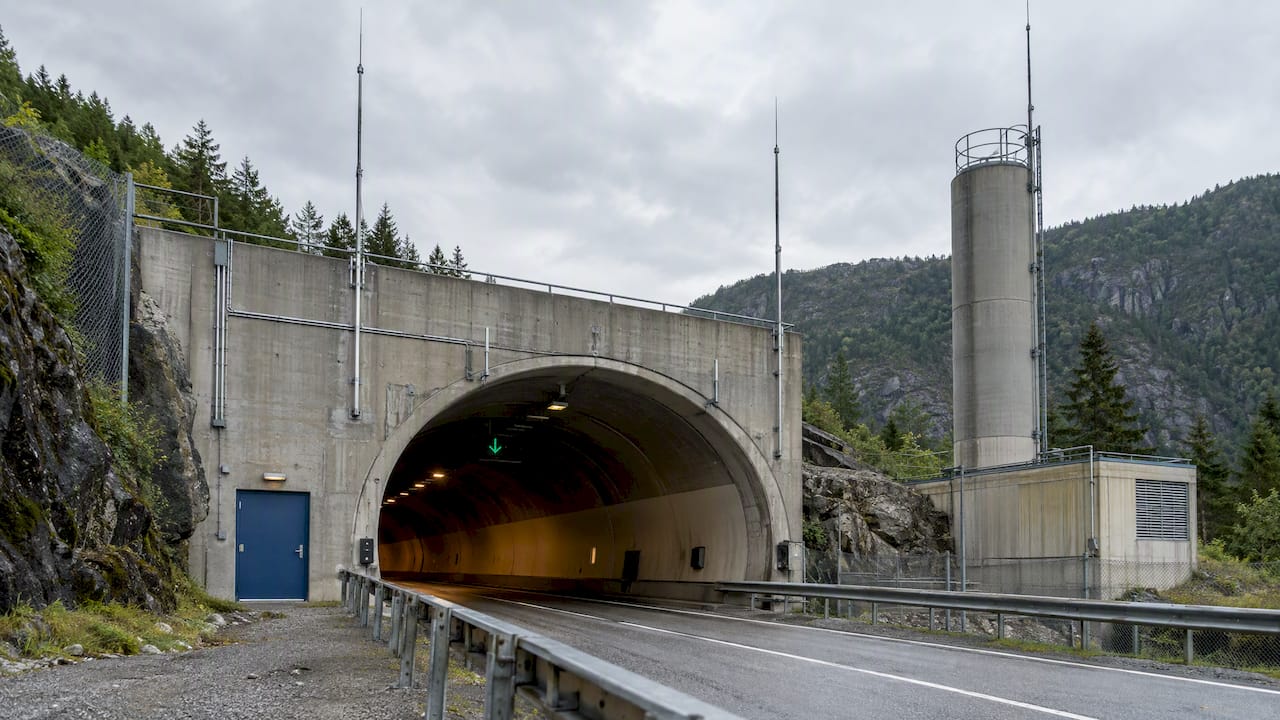
A road tunnel is rarely hit directly by lightning, yet it is one of the most exposed places for lightning damage. The danger lies in its electronics: long cable runs, ventilation, lighting, emergency call stations, traffic signals and a control room all depend on power and data lines that carry surges from the portals into the heart of the structure. Protecting a tunnel means doing four things in order: assess the lightning risk, protect portals and outdoor structures against direct strikes, bond and ground everything as one system, and fit coordinated surge protection on every power and signal line. Then you inspect it on a schedule and keep records.
This guide is written for tunnel owners, operators, contractors and engineering consultancies working in France. It follows the NF EN 62305 series that French guidance relies on, and explains where the decisions are made.
TL;DR
- The main lightning threat to a tunnel is indirect: surges entering through power, data and control cables at the portals, ventilation plants and technical rooms.
- Start with a lightning risk analysis based on NF EN 62305-2, then a technical study. Do not specify products first.
- Direct-strike protection (NF EN 62305-3) covers portal buildings, masts, ventilation stacks and gantries. Surge protection (NF EN 62305-4) covers the electrical and control systems inside.
- One bonded, low-impedance grounding network across portals, technical rooms and the tunnel itself is what makes the rest of the protection work.
- Plan periodic verification and a logbook from day one. Protection that is not checked degrades silently.
Table of Contents
- What lightning does to a road tunnel
- The regulatory and standards framework in France
- Step 1: Lightning risk analysis and technical study
- Step 2: Protect against direct strikes
- Step 3: Grounding and equipotential bonding
- Step 4: Surge protection on power, control and data lines
- Step 5: Verification, inspection and maintenance
- Our perspective
- How Indelec supports tunnel and infrastructure projects
- What to put in a tunnel lightning protection specification
- FAQ
- Sources
What lightning does to a road tunnel
A tunnel looks well shielded: a concrete or rock envelope, buried for most of its length. That intuition is only half right. The structure itself is not the weak point. The weak points are everything that crosses its boundary or sits outside it.
Direct strikes at the portals and outdoor structures
Portal buildings, technical shelters, ventilation stacks, lighting masts, camera poles, variable message sign gantries and antenna masts are the tallest or most isolated objects on the site. These are where a strike attaches. A direct strike on a building housing switchgear or a control room can injure staff, start a fire and destroy equipment in a single event.
Induced and conducted surges
Most of the damage comes from somewhere else. A strike near the tunnel, on a nearby overhead line or on the ground, injects current into cables and raises the potential of the local ground. That energy travels along any conductor entering the tunnel: medium-voltage and low-voltage feeders, fiber and copper data links, loop detectors, sensor cabling, emergency telephone lines. Tunnel cabling runs for kilometers, so it works as a collector.
US guidance on roadway detector installations makes the same point in general terms: currents induced on cables need a fast, easy path to ground through protective devices such as lightning arresters, varistors and gas-tube arresters. The principle is the same in a tunnel, at a larger scale and with more at stake.
Why the consequences are different in a tunnel
In an office building, a surge damages equipment and the cost is financial. In a tunnel, the same surge can take down ventilation control, lighting, traffic signaling, detection or communications at the moment they are most needed. An operator who loses supervision may have to close the tube. That is why tunnel protection is treated as a safety function, not as asset protection alone.
French tunnel safety rules for the national road network come from an interministerial circular of 2000 (see the CETU documentation on tunnel closure, which refers to it). Those rules focus on fire, evacuation, ventilation and emergency response. They all depend on equipment that lightning can disable, which is why the lightning study belongs inside the safety file rather than beside it.
The regulatory and standards framework in France
Be precise about what applies, because this is where specifications go wrong.
NF EN 62305: the working basis
The NF EN 62305 series is the reference for lightning protection design in France. Three parts matter for a tunnel:
| Standard part | Subject | Use in a tunnel project |
|---|---|---|
| NF EN 62305-2 | Risk management | Decides whether protection is needed and at what level |
| NF EN 62305-3 | Physical damage and life hazard | Air terminals, down conductors, grounding at portals and structures |
| NF EN 62305-4 | Electrical and electronic systems | Surge protection and bonding for power, control and data systems |
The French circular of April 2008 that accompanies the order on lightning protection of classified installations cites exactly these three parts for risk assessment, direct effects and indirect effects.
What the 2008 order does and does not cover
The order of January 15, 2008 concerns certain classified installations (ICPE), not road tunnels as such. We do not present it as a tunnel regulation. It is still a useful template, because it sets out a sequence that tunnel owners and their consultancies commonly adopt as good practice: a lightning risk analysis, a technical study, installation, and then verification. Its text provides for an annual visual check by a competent body, and the circular describes periodic inspections, a logbook and updated plans. For a given tunnel, the applicable requirements are those set by the owner’s technical specifications, the safety file and the supervising authority. Confirm them with the contracting authority before design.

A note on early streamer emission air terminals
The 2008 circular allowed early streamer emission (ESE) air terminals, with a protection zone reduced by 40% compared with the July 1995 version of NF C 17-102, and a coefficient C5 of 10, pending revision of that standard. The circular is dated, so check which version of NF C 17-102 and which conditions your project’s specification calls for today. The choice between ESE rods, Franklin rods, meshed cages or catenary wires depends on the structure, and the risk analysis should justify it.
Step 1: Lightning risk analysis and technical study
The risk analysis (ARF in French practice) is the first deliverable, and it should come before any equipment list. In NF EN 62305-2 terms, it considers what could be lost (human life, public service, economic value), the sources of damage (direct strikes to the structure, strikes near it, strikes to or near connected lines) and the consequences.
For a tunnel, the analysis should treat each part as a separate zone rather than the tunnel as one object:
- Portal buildings and technical shelters at each end.
- Ventilation plants and stacks, which are often exposed, high and connected to heavy power feeders.
- The tunnel tube with its lighting, detection and emergency equipment.
- The control room or supervision center, which may be remote.
- Each incoming line: power, telecoms, sensor and control cabling, with its length and type of routing.
The analysis gives a protection level and tells you which measures are justified. The technical study (ET) then turns that into drawings, equipment locations, cable routing, bonding details and a specification a contractor can price. Skipping this step is the most common source of both over-engineering and gaps.
Step 2: Protect against direct strikes
Direct-strike protection under NF EN 62305-3 has three elements: air terminals that intercept the strike, down conductors that carry the current, and a grounding system that disperses it.
Air terminals on portals and outdoor structures
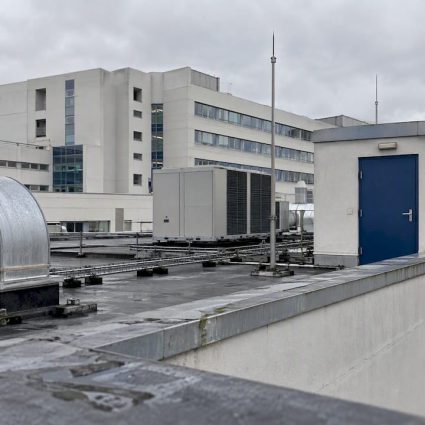
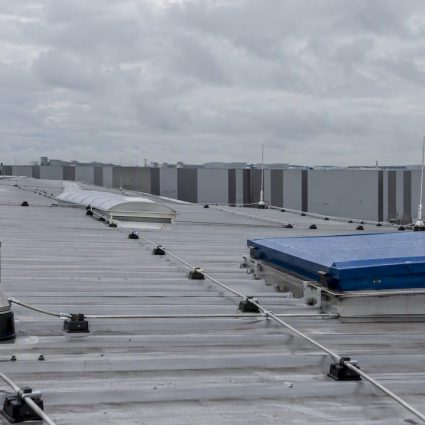
On portal buildings, shelters and stacks, the options are lightning rods, meshed cages, horizontal conductors or a combination. Masts and poles that carry cameras, antennas or signs can often be given their own rod or be integrated into the system. Where a mast stands near a building, the separation distance and the bonding between the two need to be designed, not improvised.
Gantries and tall poles at the approach are a frequent oversight. They are exposed, they carry electronics, and they are cabled to the tunnel’s control system. Treat them as part of the protected perimeter.
Down conductors and connections
Down conductors should follow short, direct paths and use connectors rated for the current and the environment. Tunnel portals combine road salt, humidity and vibration, so corrosion resistance and mechanical fixing details matter as much as the conductor section. Test joints, where each conductor meets the grounding network, give inspectors a way to measure continuity later.
Lightning strike counters
A strike counter on a down conductor records events. For an operator, this has a practical value: after a storm, you know whether the system was struck and can target inspection of surge protectors and electronics, rather than guessing.
Step 3: Grounding and equipotential bonding
Grounding is where tunnel projects most often compromise. The goal is a single, low-impedance, interconnected network, so that during a lightning event all metallic parts rise in potential together instead of developing dangerous differences between them.
In practice, this means:
- Ground electrodes at each portal and technical building, interconnected with each other and with the tunnel’s existing earthing.
- Bonding of metallic structures: cable trays, ventilation ducts, railings, reinforcement where accessible, pipework and equipment frames.
- Short, direct bonding conductors from surge protectors to the equipotential bar, because conductor length directly reduces how well a protector clamps.
- A design that accounts for soil resistivity at each portal. Rock, scree and clay behave very differently, and a mountain portal may need deep or specialized electrodes where surface resistivity is high.
The question to ask of any design is whether a person or a device can end up between two points that rise to different potentials. If so, bond them.
Step 4: Surge protection on power, control and data lines
NF EN 62305-4 treats the electrical and electronic systems with a zoning concept: protect at the point where each line enters a zone, and bond those zones together. For tunnels, that translates into layers.
Coordinated protection by layer
| Location | Typical purpose | What to specify |
|---|---|---|
| Main incoming power at portals and substations | Handle the highest-energy surges | Heavy-duty surge protection devices at the main distribution board |
| Sub-distribution in technical rooms and shelters | Reduce the residual voltage | Coordinated devices downstream of the first layer |
| Equipment-level (PLCs, controllers, sensors) | Protect sensitive electronics | Fine protection close to the equipment |
| Data, telecom and sensor lines | Block surges on signal conductors | Devices matched to the signal type and voltage |
Coordination matters because devices from different layers must work together. Installing a robust device at the main board and nothing else leaves sensitive controllers exposed to residual voltage. Installing fine protectors without a first layer means they will be overwhelmed.
Lines that are easy to forget
Protect every conductor that leaves or enters the protected zone, including emergency telephone lines, detection loops, fire detection cabling, public address, radio re-broadcasting feeders and the supply to remote stations. A single unprotected line is a path for the surge.
Where fiber is used, fiber itself carries no surge, but any metallic armor, strength member or powered media converter does. Bond metallic parts at the entry point.
Uninterruptible power and backup
Surge protection does not replace the power-continuity measures required for tunnel safety, and it does not fix a backup supply that was never tested. Check that protection devices are installed on the supply side and on the load side of UPS systems and generators, in line with the design.
Step 5: Verification, inspection and maintenance
A lightning protection system is a measurable system, and it degrades. Conductors corrode, joints loosen, surge protectors sacrifice themselves absorbing events, and new equipment is connected without being bonded.
The guidance behind the 2008 framework calls for periodic inspection of all lightning protection components, visual and detailed, with a logbook and updated plans. Applied to a tunnel, a sound program includes:
- Initial verification after installation: continuity measurements, ground resistance, bonding checks, confirmation that the as-built drawings match the site.
- Annual visual inspection of air terminals, conductors, fixings, joints and surge protector status indicators.
- Periodic detailed inspection with measurements, at an interval set by the protection level and the owner’s requirements.
- Post-event checks after a significant storm, driven by the strike counter reading.
- Change control: any modification to the tunnel’s electrical systems triggers a review of bonding and surge protection.
Keep the logbook with the technical file. When an inspector or the supervising authority asks what has been done and when, the answer should be in one place.
Work in a tunnel also brings access constraints: lane closures, night work, work at height at portals and stacks. Plan inspections alongside the operator’s existing maintenance windows rather than creating separate closures.
Our perspective
We have designed and installed lightning protection since 1955, and the same pattern recurs on infrastructure projects: protection is specified late, split between contractors, and nobody owns the interface between the lightning system and the electrical and control systems. In a tunnel, that interface is the whole problem.

Our view is that the sequence matters more than any single product. Do the risk analysis first, let the technical study define the zones, and design the direct-strike protection, grounding and surge protection as one system with one responsible party. Where a site has difficult ground at a portal, treat the grounding as an engineering problem to be measured and designed, not as an item to be added at the end.
We also push owners to think about the next ten years, not only commissioning. A tunnel is operated for decades, and the protection should come with a verification plan, a logbook and a clear maintenance routine. We have installed more than 280,000 systems worldwide, and the failures we see most often are not exotic: missing bonds, surge protectors at the wrong layer, and installations nobody has inspected since handover.
— INDELEC
How Indelec supports tunnel and infrastructure projects
We cover the full chain on one contract: lightning risk analysis and technical study, supply of lightning rods, grounding systems and surge protection, installation, then verification and maintenance. Deep grounding electrodes are available for portals where surface ground is poor.

If you are preparing a specification or a tender for a tunnel, send us the site description and the electrical schematics through our services page and we will scope the study with you.
What to put in a tunnel lightning protection specification
A clear specification saves cost at tender stage. Include the following:
- The risk analysis as an input document, with its assumptions and chosen protection level.
- A zone drawing showing each portal, shelter, stack, gantry and the tube.
- The list of incoming lines per zone, with type, length and routing.
- The required standards, by part and version, including NF EN 62305-2, -3 and -4.
- The grounding design, with soil resistivity data per portal.
- A coordination scheme for surge protection by layer.
- Acceptance tests and the content of the as-built file.
- The inspection frequency, the logbook format and who holds it.
If the specification leaves any of these out, bidders will fill the gap differently and the offers will not be comparable.
FAQ
Does a road tunnel need lightning protection?
It depends on the risk analysis and on the owner’s technical requirements. The tube itself is not usually the exposed part. The portals, ventilation stacks, masts and above all the cables carrying surges into safety systems are. For that reason most operators treat surge protection and bonding as a baseline.
Which standard applies to lightning protection of a tunnel in France?
The NF EN 62305 series is the working reference: part 2 for risk, part 3 for direct strikes and part 4 for electrical and electronic systems. The 2008 order on classified installations is not a tunnel regulation, but it follows the same sequence. Confirm the exact requirements with the contracting authority.
Can lightning shut down a tunnel’s safety systems?
Yes, through surges conducted on power, data or control cables, which can damage ventilation control, lighting, detection or communications equipment. Coordinated surge protection, equipotential bonding and a good grounding network are the measures that reduce this risk.
How often should the protection be inspected?
The 2008 order for classified installations provides for an annual visual check by a competent body, with more detailed inspections periodically. For a tunnel, set the frequency in the specification based on the protection level, and add a check after any severe storm.
Sources
- Circulaire du 24/04/08 relative à l’arrêté du 15 janvier 2008 (AIDA, INERIS)
- Arrêté du 15 janvier 2008 relatif à la protection contre la foudre de certaines installations classées (Légifrance)
- Traffic Detector Handbook, Third Edition, Volume II (FHWA)
- Fermeture des tunnels routiers (CETU)