Surge protection for data lines: choosing and installing SPDs
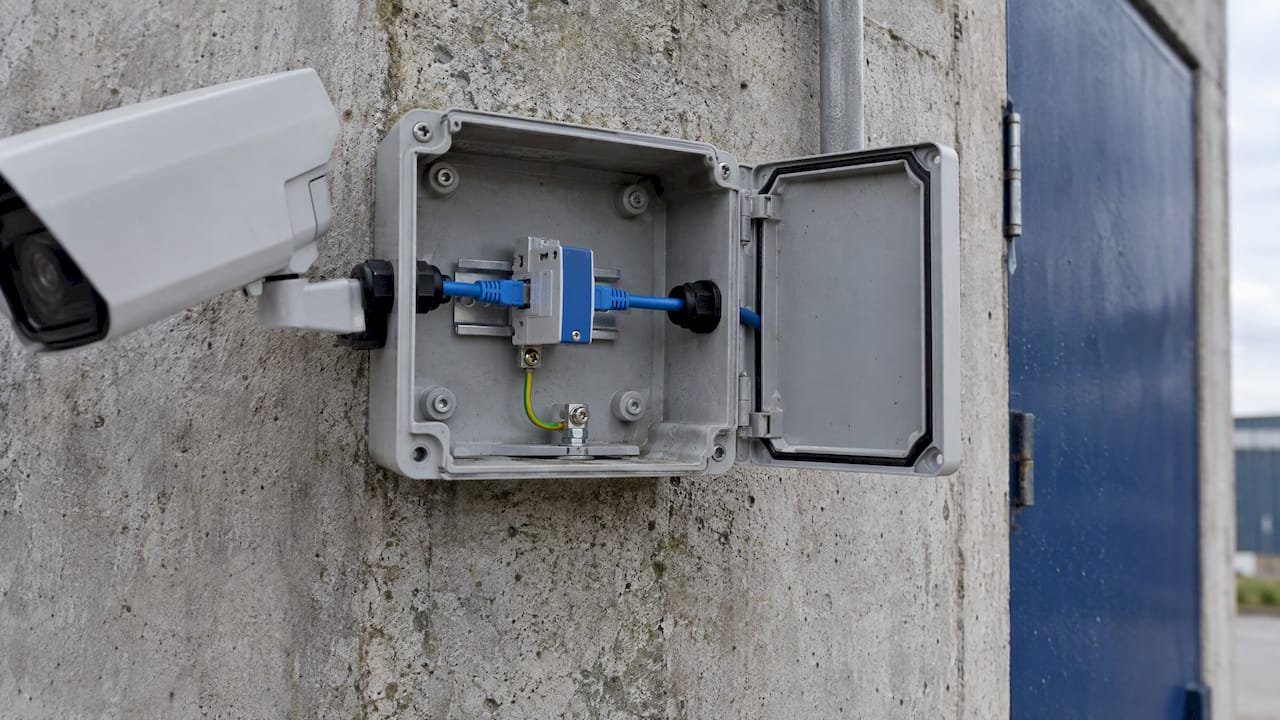
A surge protective device (SPD) for data lines, called a parafoudre pour lignes de données in France, clamps the overvoltage that travels along Ethernet, PoE, coax, telephone or signal cables before it reaches the equipment at the end. It does not work alone. It needs a short, low-impedance earth connection, shielded cabling that is correctly bonded, and a layout that keeps data cables away from power cables. This guide covers when you need one, how to choose it, and how to install it so it actually protects.
TL;DR
- Power-line SPDs do not protect network ports. Copper data cables bring their own surges into cameras, access controllers, switches and PLCs, so they need dedicated protection.
- Select the SPD by line type (Ethernet, PoE, coax, 4-20 mA, RS-485), by data rate and by the performance categories in IEC 61643-21, now in its 2025 edition.
- In France, the NF C 15-100 series addresses SPDs on communication networks. On industrial sites, a lightning risk analysis (ARF) is the benchmark for deciding what to protect.
- Wiring and earthing decide the result: short earth leads, shielding bonded at both ends where appropriate, equipotential bonding between buildings, and separation of data and power cables.
Table of Contents
- Why data lines need their own surge protection
- What the regulations say in France
- Which standard governs the device
- Choosing an SPD for a data line
- Where to install: the zone approach
- The installation mistakes that defeat an SPD
- Special case: EV charging and PoE equipment
- Our perspective
- Maintenance and verification
- How Indelec can help
- FAQ
- Sources
Why data lines need their own surge protection
Lightning rarely has to hit a building to damage its electronics. A strike nearby, or on a cable run, couples energy into every metallic conductor that leaves the building: power, telephone, Ethernet, coax, sensor loops. The power board SPD limits what comes in through the power cable. It does nothing for a cable that enters through a different path.
That gap matters more every year. Video surveillance, access control, fire detection, building management and badge readers all sit on copper networks, often with cameras and access points on outdoor walls or poles. The INRS notes that companies frequently underestimate lightning risk, focusing on people while neglecting material damage and business continuity. A dead switch or a burnt camera port is usually a continuity problem before it is an equipment cost.
The typical failure pattern is easy to recognize: after a storm, several Ethernet ports are dead, one or two cameras are down, and the power supplies are fine. The surge went in through the data cable, found the weakest interface, and stopped there.

What the regulations say in France
Two layers apply: the electrical installation standard and, for industrial sites, the environmental regulations.
NF C 15-100 and communication networks
The NF C 15-100 series covers SPDs on copper communication networks, with different rules for residential and for commercial or industrial buildings. The September 2024 revision is summarized in a manufacturer’s news page, but the exact obligations depend on building type and on the current text, so check the standard itself or your designer before you specify. In broad terms, the obligation is tied to sensitive occupancies (healthcare, public service buildings), to sites that already have a lightning rod, to explosion-risk areas and to sites with critical safety equipment such as video surveillance or fire detection.
The practical consequence is that cameras, access control and detection systems are now commonly treated as critical equipment. If your building has a lightning protection system, plan for SPDs on the data lines that cross the building envelope at the same time as the power SPDs.
ICPE sites and the lightning risk analysis
For classified installations (ICPE), lightning protection is a legal matter. The INRS explains that protection is mandatory in France for high-risk industrial installations, while for other installations the decision should weigh the cost of protection against potential losses. There is no blanket duty for every building. The INRS also points to the lightning risk analysis (ARF), carried out by a competent body, as the reference for deciding where and which SPDs are needed.
If you manage a classified site, our guide to lightning protection for ICPE sites explains how the ARF and the technical study fit together, and what insurers expect on French ICPE sites shows why the paperwork matters beyond compliance.
Which standard governs the device
The product standard for SPDs on telecom and signaling lines is IEC 61643-21. According to the IEC, the 2025 edition replaces the 2000 edition and its amendments and applies to devices connected to networks with nominal voltages up to 1,000 V RMS AC or 1,500 V DC. It explicitly covers modern interfaces such as Power over Ethernet. The earlier consolidated version remains listed in the IEC catalogue as a reference for products tested under the older text.
When you read a datasheet, look for three things: the test standard (IEC/EN 61643-21), the test categories the product passes, and the performance figures at the installation point. A product that lists only a connector type and a voltage is not enough to specify from.
Choosing an SPD for a data line
Start from the line, not from the catalog. A short checklist avoids most mistakes.
| Criterion | What to check | Why it matters |
|---|---|---|
| Line type | Ethernet, PoE, coax (CCTV, SAT), telephone/xDSL, RS-485, 4-20 mA, fieldbus | Each interface has its own signal levels and failure modes |
| Data rate and category | 100 Mb, 1 Gb, 10 Gb; Cat 5e, 6, 6A | A poorly matched SPD adds attenuation and breaks the link |
| PoE class | PoE, PoE+, PoE++ and the current carried | The SPD must pass the power as well as the data |
| Nominal voltage and current | Maximum operating voltage of the line | The SPD must not clamp during normal operation |
| Protection level | Residual voltage the device lets through | Must be below what the equipment port can withstand |
| Connectors and shielding | Shielded RJ45, metal housing, screen continuity | A plastic housing cannot carry the screen to earth |
| Mounting | DIN rail, rack, wall, inline | Determines how short the earth lead can be |
| Environment | Indoor or outdoor, temperature, humidity | Outdoor devices need the correct IP rating |
Match the SPD to the equipment’s tolerance
The cleanest approach is to check what the protected port can withstand. Industrial controllers and cameras give an immunity level in their documentation. Choose an SPD whose let-through voltage is clearly below that figure, then verify the pair is compatible on data rate and PoE class.
Plan for coordination
If the same site has SPDs on the power lines and the data lines, the two stages must be thought through together. Technical guidance cited by the INRS stresses the coordination of the SPD, the grounding network and the cable shielding. Each element reduces electromagnetic effects, and none replaces the others. An excellent SPD on a badly earthed rack gives mediocre protection.
For the power side of the same coordination, see our explanation of surge protection in industrial facilities and the range of surge protection devices.
Where to install: the zone approach
Put the protection where the cable crosses from one lightning zone to the next, and as close as possible to the equipment you are protecting.
- Building entry. Every copper line that enters from outside (telephone, coax, outdoor Ethernet) gets an SPD at the point where it penetrates the envelope, close to the main earth terminal.
- Between buildings. Links between a main building and an annex, a gatehouse or a pole-mounted camera are the most exposed. Protect both ends.
- At the sensitive equipment. For critical loads such as a server rack or a fire detection panel, add a second stage at the equipment, since induced surges also arise inside the building.
- Outdoor devices. Cameras and access points on masts need an SPD at the pole base or at the device, plus a clear path to the mast earthing.
If a site has lightning rods, the nearby cable runs are especially exposed because a direct strike raises the earth potential around the down conductors. Keep data routes away from them. Our industrial lightning protection guide shows how external and internal protection are planned together.
The installation mistakes that defeat an SPD
Most of what goes wrong happens after the purchase. These are the points we see overlooked on real sites.
Long or looped earth leads
The voltage the equipment sees is the SPD’s let-through voltage plus the voltage drop along its connecting leads. During a surge, every extra meter of earth conductor adds hundreds of volts. Mount the SPD next to the earth bar, use the shortest and straightest connection possible, and never coil the excess length.
Data and power cables run together
A data cable laid alongside a power cable picks up energy by coupling, bypassing the SPD entirely. Manufacturers’ wiring guides consistently ask for separation between communication and power wiring, in separate trays or ducts where possible, and for crossings at right angles. Apply the separation distances in your equipment documentation and in the applicable standards.
Unbonded or poorly bonded shields
If the SPD has shielded connectors, the cable screen must be continuous through it and tied to earth at the device housing. A screen interrupted at a patch panel is no longer a screen.
Ground loops between buildings
Two buildings with separate earthing and a shielded data cable between them form a loop that carries surge current along the screen. The usual remedy is equipotential bonding between the earthing systems, with a stranded conductor along the cable route, or, where bonding is impractical, a fiber link which removes the metallic path altogether.
Corroded contacts
In humid or corrosive industrial environments, a painted or oxidized contact is a resistive joint. Clean the surfaces, make a metal-to-metal connection and protect it against corrosion. Our guide on how to maintain grounding systems covers inspection routines that catch these joints before a storm does.
Special case: EV charging and PoE equipment
Charging stations add data lines you may not think about: communication with the back office, payment terminals, load management and meter links. These are often forgotten when the power side is protected. A UK-focused guide explains surge protection for EV chargers under the UK inspection regime, and the principle carries over: the data and communication wiring needs thought alongside the supply. On professional fleet depots in France, we audit both the power and communication paths when we study a charging infrastructure project.
PoE deserves the same attention. A PoE switch in a cabinet feeding outdoor cameras places a powered, long copper line directly in the path of induced surges. Use SPDs rated for the PoE class in use, not simple data-only devices.
Our perspective
We have been in lightning protection since 1955, and the pattern repeats: sites invest in lightning rods and power SPDs, then lose cameras, access control or a network switch because nobody looked at the data cables. We think of data-line protection as part of a single system, not as an accessory.

That is why we start with the lightning risk analysis and the technical study, before choosing any product. The study tells you which lines are exposed, what the equipment can withstand and how the earthing must be arranged. Only then does the choice of SPD make sense. A device selected from a catalog without that analysis may be correct on paper and still be badly placed.
Our recommendation to facility managers is simple. List every copper line that leaves a building. Mark the ones that feed safety or continuity equipment. Protect those first, check the earthing they rely on, and put the whole thing in your maintenance plan, because SPDs wear with each surge they absorb.
— INDELEC
Maintenance and verification
An SPD is a consumable. Each surge degrades it a little, and eventually it fails open or short. Some models carry a status indicator or a remote contact. Others need testing. Build the following into your routine:
- check status indicators after every major storm and during the annual inspection;
- measure earth resistance and continuity of bonding conductors on schedule;
- re-inspect shield terminations and contacts in damp or corrosive areas;
- keep a register of what was installed, where, and when it was last checked.
Our guide to why regular maintenance matters explains how to turn this into a plan, and the deliverables facility managers should keep list the documents an inspector or insurer will ask for.
How Indelec can help
If you are responsible for an industrial, commercial or public site, we can handle the whole chain: lightning risk analysis and technical study, supply of SPDs and earthing products, installation, then verification and maintenance. You get one party accountable for the coordination between the SPD, the earthing and the cabling, which is where most failures begin. Start with our lightning protection services or browse the surge protection range.
FAQ
Do I need an SPD on Ethernet cables if the electrical panel already has one?
Yes, in most cases. A panel SPD limits surges on the power cable only. Ethernet, coax and telephone lines carry surges by their own path, so the network ports need dedicated protection, especially on cables that leave the building or serve safety equipment.
What is the 50 cm rule for connecting SPDs?
It refers to keeping the connecting leads of an SPD as short as possible, with the combined length of the leads commonly kept under 50 cm. Long leads add voltage during a surge and reduce the protection the device gives. Follow the manufacturer’s installation instructions for the exact figure.
How much does a data line SPD cost?
The price depends on the line type, the data rate, PoE class and the number of lines, and the cost of installation and earthing comes on top. We do not publish prices, because they depend on the site. A lightning risk analysis lets us quote based on what the site actually needs.
Is a data line SPD mandatory in France?
It depends on the building. The NF C 15-100 series requires or recommends SPDs on copper communication networks in certain situations, and classified sites are subject to specific lightning rules. For anything beyond a simple case, ask a competent designer to check the current text for your building.
Sources
- IEC 61643-21:2025, SPDs for telecommunications and signaling networks
- IEC 61643-21:2000+AMD1:2008+AMD2:2012 consolidated version
- INRS, La protection des installations contre les effets de la foudre
- INRS, Attention aux coups de foudre !
- INRS, Guide de la protection contre les effets de la foudre