Avoid 6–12 Month Grid Delays: French Industrial IRVE and Grounding

An industrial IRVE project starts with three non-negotiables: a certified installer (IRVE qualification level P1, P2, or P3), full compliance with NF C 15-100 and UTE C15-722, and a documented site power audit coordinated with your grid operator. Skip any of these, and you risk an installation that cannot be legally commissioned. The first move is straightforward: book a technical site audit before you spec a single charger.
TL;DR:
- A comprehensive site audit must occur before designing the infrastructure to accurately size power requirements and avoid costly transformer upgrades.
- Standard standards NF C 15-100 and UTE C15-722 apply to all installations regardless of size, requiring certified installers at P1, P2, or P3 levels for complex projects.
- For fleets over 15 trucks, a 900 kW charging hub needs a 1.5 to 2 MVA transformer, with upgrades potentially taking 6 to 12 months to implement.
- Load management strategies like dynamic power sharing and scheduling are essential to prevent demand charges exceeding expectations, especially during peak site usage.
- Proper grounding, surge protection, and cybersecurity measures are critical for safety and operational security, especially for outdoor DC hubs exposed to environmental risks.
Table of Contents
- What Does IRVE in an Industrial Setting Actually Cover?
- What Regulations and Standards Apply to Industrial IRVE?
- How Do You Plan and Size an Industrial IRVE Project?
- Which Charging Architecture Fits a Heavy-Use Industrial Fleet?
- What Should You Expect From Installation and Commissioning?
- How Do You Manage IRVE Operations Day to Day?
- What Drives IRVE Costs and Which Incentives Apply?
- What Safety Protocols Does Industrial IRVE Require?
- How Does IRVE Integrate With Existing Industrial Energy Systems?
- Does Industrial IRVE Change Your Peak Demand Charges?
- What Training Do Site Staff Need for Industrial IRVE?
- How Secure Are Industrial IRVE Supervision Systems?
- The Industrial Protection Layer Most IRVE Plans Miss
- How Indelec Supports Industrial IRVE Projects
- Sources
- FAQ
What Does IRVE in an Industrial Setting Actually Cover?
IRVE, or infrastructure de recharge pour véhicules électriques, is the standard French industry term for EV charging infrastructure, and in an industrial context it means far more than a wall box and a cable. A complete installation includes the charge points themselves, upstream power distribution and switchgear, circuit protections, remote supervision, and the civil works that tie it all together: trenching, cable trays, foundations, and enclosures rated for outdoor or heavy-traffic use.
Scope matters because industrial usage patterns differ sharply from retail or residential charging. A logistics yard charging 20 trucks overnight needs a different design than a plant running opportunity charging between shifts, or a mixed-use lot where employee cars and fleet vehicles share the same feeder. Each pattern drives different decisions on power class.
AC charging (slow, 7 to 22 kW, or accelerated up to 43 kW) suits overnight depot charging where vehicles sit for hours. DC fast charging (50 kW and up) fits opportunity charging during short breaks. Depot-scale hubs pushing several hundred kilowatts to a megawatt are increasingly common for large truck fleets, and that’s where the project stops looking like an EV install and starts looking like a substation project.
What Regulations and Standards Apply to Industrial IRVE?
Non-residential parking facilities fall under the Loi d’Orientation des Mobilités (LOM), and the obligations are specific, not optional. Since 2025, any site with a parking facility over 20 spaces must equip at least 5% of those spaces with charging points, with a minimum of one space accessible to people with reduced mobility (PMR). Every installation covered by this obligation must also meet the technical standards below.
Two standards anchor the electrical side of any industrial project:
- NF C 15-100 governs low-voltage electrical installations generally, covering circuit design, protective devices, and safe commissioning practices.
- UTE C15-722 is the guide specific to EV charging infrastructure, addressing circuit sizing, protections, and how charge points integrate into the broader installation.
Both standards apply regardless of whether you’re installing two AC points or a 40 point depot hub.
Installer qualification is not a formality; many businesses rely on specialized electrician SEO services to connect with certified professionals in their area. Industrial IRVE technicians handle site audits, power dimensioning, cable routing, final connection, commissioning, and ongoing maintenance, and for anything beyond a simple single-point install, P1, P2, or P3 certification under the Qualifelec framework is typically required. P3 in particular covers the complex, high-power, multi-point systems common in industrial sites.
The formal deliverables that close out a compliant project include conformity certificates, commissioning reports, and the IRVE validation step itself, the acceptance milestone that legally allows the installation to go into service. Skipping or rushing this step is one of the most common reasons industrial projects stall at the finish line.
How Do You Plan and Size an Industrial IRVE Project?
A rushed audit is the single biggest source of budget overruns on industrial charging projects. Poor dimensioning at the outset doesn’t just cause headaches later, it can raise your subscribed power costs and blow through the regulatory timelines LOM compliance demands. The audit has to happen before design, not alongside it.
A proper industrial site audit covers:
- Fleet duty cycles. When do vehicles arrive, depart, and sit idle? Overnight depot charging and daytime opportunity charging require different power profiles entirely.
- Minimum required state of charge. What charge level does each vehicle need by its next dispatch, and how much slack does that give your charging window?
- Simultaneity. How many vehicles will realistically charge at once, versus the theoretical maximum if every point ran flat out?
- Parking geometry. Where vehicles park relative to available power sources determines cable runs, trenching costs, and where DC cabinets can physically sit.
- Available transformer capacity. This is the constraint that decides everything else.
A useful rule of thumb: a yard running 15 to 20 trucks overnight typically needs roughly 4 to 7 MWh of energy delivered per night, which a 900 kW charging hub can usually cover, provided the site has a 1.5 to 2 MVA transformer to feed it. If your audit shows you’re short on that capacity, a transformer upgrade with your grid operator is often a 6 to 12 month lead time item, not a paperwork formality. That single number should drive your entire project schedule, and it’s worth checking our fleet sizing guidance for how to translate fleet size into point count and power per point.
Pro Tip:Contact your grid operator (DSO) the moment you have a rough power estimate, even before final design. Early engagement lets you model simultaneity with them directly, which helps avoid late-stage transformer upgrades that add months and significant civil works cost.
If your audit shows sustained demand above roughly 500 kW across the site, that’s usually the trigger point for considering a containerized DC hub or a 1500 V DC architecture instead of scaling up AC points one at a time.
Which Charging Architecture Fits a Heavy-Use Industrial Fleet?
Three architectures cover most industrial deployments, and the right choice depends on scale more than preference.

Distributed AC clusters work well for smaller fleets or mixed-use sites: individual 7 to 22 kW points spread across a parking area, each with its own circuit back to a shared distribution board. Simple to install, simple to maintain, but it doesn’t scale efficiently past a few dozen points.
Containerized DC hubs package power conversion, cooling, and switchgear into a factory-built enclosure that gets dropped on a prepared pad. This shortens on-site electrical work considerably and suits sites that need fast deployment without months of custom civil engineering.
Split DC architectures with a central power cabinet feed multiple dispensers from shared power modules, using dynamic power sharing to allocate output based on which vehicles actually need it at a given moment. Above roughly 500 kW aggregate demand, a 1500 V DC bus becomes the practical choice, since it cuts conductor size and losses compared to lower-voltage DC buses feeding the same power.
Whichever architecture you land on, three things aren’t optional. First, surge protection at the point of connection and at the charging cabinets themselves, since industrial sites already carry elevated exposure to switching transients and, depending on location, lightning-induced surges. Second, grounding practices that tie the charging infrastructure into the site’s existing earthing system rather than creating an isolated ground, with attention to the principles in NF EN 62305 where lightning risk assessment applies. Third, mechanical robustness: waterproofing, IP and IK ratings, and systems integration all need to match the environment, whether that’s a dusty logistics yard or a coastal site with salt exposure. DC cabinets generate real heat under sustained load, so cooling and ventilation design isn’t optional, and cable trays need capacity for both current fleet size and the expansion you’ll inevitably want in three years.
EMC concerns deserve a mention too: high-power DC conversion equipment can introduce electrical noise that affects nearby sensitive industrial equipment if grounding and shielding aren’t handled correctly during design, not retrofitted afterward.
What Should You Expect From Installation and Commissioning?
A certified installer’s job doesn’t end when the last cable is connected. The commissioning phase is where compliance either gets locked in or falls apart.
Expect these deliverables from any qualified industrial installer:
- As-built wiring diagrams reflecting exactly what was installed, not just what was designed.
- Documented protection settings for every circuit breaker and surge protection device.
- A commissioning report covering insulation resistance tests, earth continuity, and functional tests of each charge point.
- Conformity certificates confirming compliance with NF C 15-100 and UTE C15-722.
- The final IRVE validation sign-off, the step that formally conditions legal commissioning of the site.
Acceptance testing should happen on site, with the installer and a facility representative both present to confirm the system performs as specified under load, not just at idle. Get this documented in writing; it’s your reference point for any future warranty or maintenance dispute.
The most common industrial installation pitfalls aren’t exotic. Incorrect civil routing that ignores future expansion, cable trays sized for today’s fleet with no spare capacity, and inadequate ventilation for DC cabinets that later trip on thermal protection during summer peak load. All three are cheap to fix on paper and expensive to fix after the concrete is poured, which is exactly why the audit and design phases matter more than the installation phase itself. Our mobility services page covers what a full installation scope typically includes.
How Do You Manage IRVE Operations Day to Day?
Once an industrial charging system goes live, the work shifts from construction to supervision. This is where uptime and energy cost either get controlled or slowly erode.
Supervision typically runs through an OCPP-based backend (Open Charge Point Protocol), which handles telemetry, alarm policies, and remote diagnostics, and can often plug into existing fleet management systems so dispatchers see charge status alongside vehicle location and schedule.
Load management is where the real savings live:
- Dynamic power sharing distributes available power across active charge points in real time, rather than provisioning each point for its theoretical maximum.
- Priority scheduling, increasingly handled through OCPP 2.0.1, lets you rank which vehicles charge first based on dispatch time, letting a delivery van due out at 6 AM take priority over one parked until noon.
- Both strategies help you avoid increasing contracted power with your utility, which is usually the single most expensive lever you can pull.
Pro Tip:Run a maintenance cadence that treats charge points like the industrial equipment they are, not consumer electronics. Quarterly inspections, an on-hand spare parts kit for connectors and contactors, and a clear decision on in-house maintenance versus an external service level agreement will save far more downtime than reactive repairs ever will.
What Drives IRVE Costs and Which Incentives Apply?
Four things drive most of your budget: charger power class, civil works (trenching, foundations, cable trays), any transformer or grid upgrade, and the ongoing software and operations and maintenance contract. Of these, transformer upgrades are the wildcard that can double a project’s cost if the site audit misses them.
On the funding side:
- ADVENIR grants remain a primary subsidy source for professional charging infrastructure in France, covering a share of equipment and installation costs depending on power class and use case.
- Regional grants layer on top of ADVENIR in some territories, and it’s worth checking current eligibility before finalizing your budget.
- Amortization schedules for charging equipment can improve payback timing depending on your accounting treatment, which is worth a conversation with your finance team early rather than after purchase.
For fleet operators specifically, centralized depot charging with dynamic power sharing and contract-driven utilization can cut total cost of ownership by up to roughly 10% compared to diesel operations, when utilization is high and charging is scheduled rather than random. That gap between “good ROI” and “mediocre ROI” almost always comes down to utilization, not equipment choice. Our breakdown of French charging station cost drivers walks through the specific line items in more detail.
What Safety Protocols Does Industrial IRVE Require?
Industrial charging sites carry risks that a retail parking lot simply doesn’t: heavy vehicle traffic near charging equipment, higher voltages and currents at DC hubs, and 24/7 operation in some logistics environments. Risk management has to be built into the design, not bolted on afterward.
Physical protection starts with bollards or barriers around exposed charging equipment in any area where forklifts, trucks, or trailers maneuver. Emergency stop provisions need to be clearly marked and reachable, and staff who work near the charging area need to know where they are without hunting for a sign. Arc flash risk at DC power cabinets deserves the same respect given to any high-power switchgear on site: restricted access, appropriate signage, and lockout/tagout procedures for anyone doing maintenance.

Fire risk management matters more at DC hubs than most facility teams initially assume, given the energy density involved. Spacing requirements, fire suppression compatibility, and clear access for emergency responders should all be confirmed during design, not discovered during an insurance review.
Electrical isolation procedures need to be documented and drilled, not just written down and filed. Anyone performing maintenance on a charge point needs a clear, verified process for isolating that circuit before touching it, and that process should be tested during commissioning, not assumed to work because it looks correct on paper.
Grounding and surge protection tie directly into safety here too: a well-grounded system reduces shock hazard risk during fault conditions and protects both equipment and personnel from transient overvoltages during grid disturbances or lightning activity in the area.
How Does IRVE Integrate With Existing Industrial Energy Systems?
An industrial charging system rarely operates in isolation. It sits on the same electrical backbone as production equipment, lighting, HVAC, and whatever other loads your site already runs, and that backbone has limits.
Integration starts with your existing energy management system, if you have one. Modern IRVE supervision platforms can often feed charging data into the same dashboard that already tracks production line consumption, giving facility managers a single view of total site demand rather than two disconnected pictures.
The harder integration challenge is coordinating charging load with existing peak demand patterns. If your production schedule already pushes demand close to your contracted power ceiling during certain hours, adding uncoordinated EV charging on top of that is asking for trouble. This is where load management systems earn their cost: they can automatically throttle charging during periods when other site loads spike, then release full power to the chargers once demand elsewhere drops.
Grid infrastructure on the utility side matters just as much as anything inside your fence line. Sites planning depot-scale charging, especially anything approaching the megawatt range, need to treat this as a coordinated grid planning exercise involving redundancy planning (N+1 configurations are common for critical fleet operations) rather than a simple equipment purchase. Bringing your utility into the conversation early, before final design, consistently produces smoother projects than treating the connection request as a late-stage formality.
Does Industrial IRVE Change Your Peak Demand Charges?
Yes, and often more than facility managers expect going in. Adding a 500 kW or larger charging load to a site that already runs close to its contracted power ceiling can push demand charges up significantly if the charging isn’t scheduled intelligently.
Utility tariffs in France (and most industrial markets) charge not just for total energy consumed but for peak demand, the highest power draw recorded during a billing period. An uncoordinated fleet all plugging in at once, right at shift change, can spike that peak dramatically even if total daily energy use barely changes.
This is exactly what dynamic power sharing and priority scheduling are built to solve. Instead of every charge point drawing maximum power simultaneously, the system spreads demand across the available charging window, keeping the peak lower even though the same total energy gets delivered. A fleet that needs eight hours to fully charge overnight rarely needs all points running at full power for all eight hours.
The financial upside of getting this right is direct: avoiding a demand charge increase, or avoiding the need to renegotiate a higher contracted power tier with your utility, can be worth more over a year than any equipment discount you’d negotiate on the chargers themselves. This is also where time of use tariff structures come into play. If your utility offers off peak rates during overnight hours, and most French industrial tariffs do, scheduling depot charging to align with those windows compounds the savings from load management on top of the demand charge benefit.
What Training Do Site Staff Need for Industrial IRVE?
Charging infrastructure introduces new operational responsibilities for staff who may have zero background in EV systems, and skipping training is a common reason otherwise well-designed installations run into avoidable problems.
Facility and maintenance staff need at minimum a working understanding of the supervision platform: how to read alarm states, what a fault code actually means operationally, and when an issue requires calling the installer versus when it’s a simple reset. This doesn’t require electrical certification, but it does require dedicated onboarding time, not a five-minute walkthrough on install day.
Dispatchers and fleet coordinators need training on priority scheduling logic if the site uses it, since a dispatcher who doesn’t understand why a vehicle isn’t fully charged by its scheduled departure will escalate a non-issue as an emergency.
Anyone performing hands-on maintenance, even basic tasks like connector inspection, needs training aligned with the installer’s documented procedures, and this training should be refreshed periodically, not treated as a one-time event at commissioning.
Change management matters as much as technical training here. Staff who’ve operated a diesel fleet for twenty years will have habits and workarounds that don’t map cleanly onto electric charging logistics, and a rollout that ignores that friction tends to generate resistance that has nothing to do with the technology itself. Building in a transition period, with clear communication about why charging windows and scheduling matter, tends to smooth adoption far more than a purely technical rollout ever does.
How Secure Are Industrial IRVE Supervision Systems?
Charging supervision platforms are networked systems, and that means they carry the same cybersecurity exposure as any other connected industrial equipment on your site, sometimes more, since many charge points connect to public or semi-public networks by design.
OCPP based backends communicate over network connections that, if improperly secured, can expose both operational data and, in poorly designed systems, a path toward other systems on the same network. Segmenting the charging network from core production and IT systems is a baseline precaution, not an advanced one, and it should be part of the initial network design rather than an afterthought.
Data privacy considerations apply too, particularly where charging data ties back to specific vehicles, drivers, or schedules. If your supervision system logs which vehicle charged where and when, that data has value and carries responsibility, especially if driver identity is linked to charging sessions for billing or scheduling purposes. Access controls on who can view or export that data matter as much as the physical security of the charging cabinets themselves.
Firmware updates for charge points and backend software need a defined process, not an ad hoc one. Unpatched charging infrastructure sitting on a network for years is a known weak point in industrial cybersecurity generally, and EV charging equipment is not exempt from that pattern simply because it’s new.
The Industrial Protection Layer Most IRVE Plans Miss
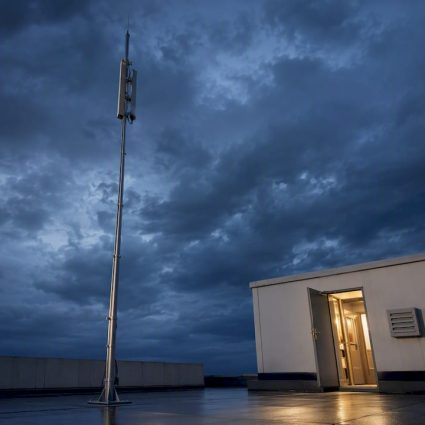
Most IRVE conversations focus entirely on power electronics and grid capacity, and almost none of them mention that industrial charging cabinets are exposed electrical assets sitting outdoors, often in open yards, often in the same footprint where lightning risk assessments already flag exposure for other equipment. That’s a gap worth closing before commissioning, not after a surge takes out a DC hub mid-shift.
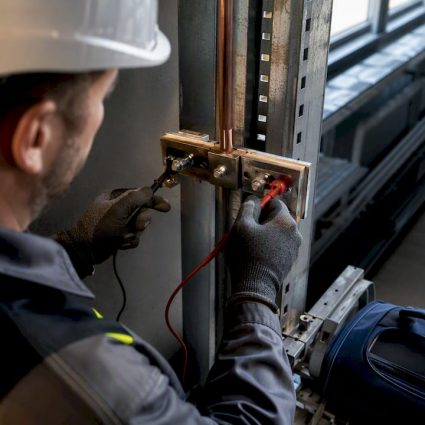
Grounding done right protects more than the charger. It protects the vehicles connected to it and the staff standing nearby during a fault. Any industrial IRVE project should include a surge protection review at the design stage, not as an add-on after a failure. A joint maintenance contract covering both the charging infrastructure and the site’s lightning protection and grounding systems catches degradation in either system before it causes downtime in the other.
— INDELEC
How Indelec Supports Industrial IRVE Projects
A specialized approach applied to lightning protection is brought to electric vehicle charging infrastructure for professional fleets. That means one point of contact for the site audit, the installation, and the ongoing upkeep, instead of juggling separate contracts for charging equipment and the electrical protection it depends on.

Our mobility services cover the full IRVE project cycle: technical site audit, power dimensioning, installation by qualified technicians, and commissioning documentation that satisfies NF C 15-100 and UTE C15-722. Because grounding and surge protection are core to our business, not a bolt on service, we build them into the charging design from day one rather than flagging them as a gap after the fact. Our technical training program keeps our teams current on both electrical protection standards and evolving IRVE requirements, and our lightning protection services pair naturally with any industrial charging project where outdoor equipment needs both a power connection and a protection plan. If you’re planning an installation and want an installer who takes electrical risk seriously on both sides of the meter, request a site audit and project proposal.
Sources
The claims above draw on current French regulation and industry technical guidance. For direct verification:
- LOM law 2025 (izix)
- Certification Qualifelec IRVE (jcsm)
- Industrialisation borne de recharge (SIAM Industrie)
- 900kW split-type DC charger for logistics (MIDA EV Power)
FAQ
What Regulations Govern Industrial IRVE Installations?
Industrial IRVE must comply with NF C 15-100 for general electrical safety and UTE C15-722 for charging-specific circuit design, and non-residential parking facilities over 20 spaces fall under LOM obligations requiring at least 5% of spaces to have charging points with PMR accessibility.
Can Employees Charge Their Electric Vehicles at Work?
Yes, provided the employer’s charging infrastructure complies with applicable electrical standards and any usage policy addresses billing, access, and priority between employee vehicles and fleet vehicles.
Who Is Qualified to Install an Industrial IRVE System?
Installers need IRVE certification at the P1, P2, or P3 level under the Qualifelec framework, with P3 typically required for complex, high-power, multi-point industrial installations. Qualified technicians typically work within this qualification structure for fleet and site projects.
What Are the IRVE Classification Levels?
IRVE qualifications are tiered as P1, P2, and P3, reflecting increasing complexity: P1 covers basic single-point installations, while P2 and P3 cover more advanced multi-point and high-power systems typical of industrial and depot-scale deployments.
How Long Does an Industrial IRVE Project Take From Audit to Commissioning?
Timelines vary by scale, but any project requiring a transformer or grid capacity upgrade should budget 6 to 12 months for utility lead time alone, on top of design, civil works, and commissioning.