Annual Protection Review Checklist for Facility Safety

TL;DR:
- An annual protection review checklist verifies lightning and electrical safety systems meet industry standards and regulations. Regular inspections, including thermal imaging and grounding resistance tests, prevent costly faults and ensure compliance with NFPA 70B, NFPA 780, and OSHA. Proper records and systematic procedures reduce liability, penalties, and equipment failures.
An annual protection review checklist is a structured inspection tool that verifies all lightning protection and electrical safety systems in your facility meet current industry standards and regulatory requirements. Facility managers and safety compliance officers who skip or rush this process face OSHA penalties reaching $16,131 per serious violation, gaps in insurance coverage, and undetected faults that can trigger fires or equipment failures. Standards like NFPA 70B for electrical preventive maintenance and NFPA 780 for lightning protection grounding define exactly what a complete annual review must include. This guide gives you a working framework to execute that review without missing a critical step.
What does an annual protection review checklist require by standard?
The annual protection review checklist draws its authority from three primary regulatory sources: NFPA 70B, NFPA 780, and OSHA. Each one defines specific inspection tasks, documentation requirements, and acceptable performance thresholds. Knowing which standard governs which system prevents you from treating a monthly walkthrough as a substitute for a full annual review.
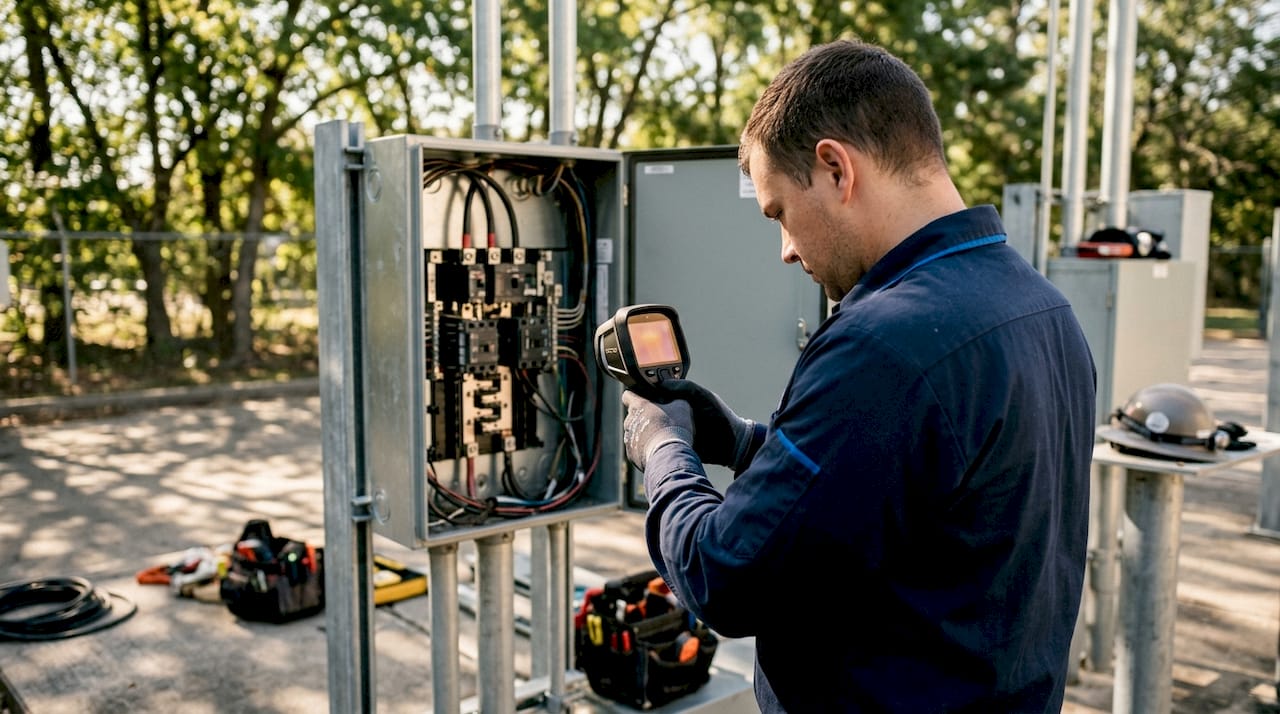
NFPA 70B governs electrical preventive maintenance. It mandates annual thermal imaging scans of panels, switchgear, and transformers to catch overloaded conductors and loose connections before they fail. Thermal imaging detects up to 83% of critical electrical faults before failure, at a cost of $400–$800 per session versus $15,000–$80,000 for failure remediation. That cost gap alone justifies the scan.
NFPA 780 governs lightning protection systems. It sets the maximum allowable grounding resistance at 25 ohms, with a best-practice target at or below 10 ohms. Resistance must be measured annually as part of every safety audit. Ground rods must be driven at least 8 feet deep and connected with exothermic welds or listed clamps to down conductors. Any connection that fails this test requires immediate corrective action before the facility can be considered compliant.
NFPA 70E adds arc flash risk assessment requirements. Arc flash assessments must be reviewed every 5 years or after any major system change, with personnel training updated every 3 years. Electrical equipment must display arc flash warning labels specifying incident energy levels and required PPE categories.
Key documentation retention requirements by system type:
- Fire extinguisher records: retain for at least 1 year
- Fire alarm test reports: retain for at least 1 year
- Emergency lighting logs: retain for at least 1 year
- OSHA injury and illness records: retain for 5 years
- Lightning protection inspection certificates: retain per NFPA 780 and local authority requirements
Maintaining accessible digital records allows rapid retrieval during regulatory visits. Facilities that rely on paper files routinely fail audits not because the work was not done, but because the proof cannot be found quickly.
What tools and tests belong in a protection plan audit?
A thorough protection plan audit uses specific instruments and testing methods for each system type. Generic visual checks are not enough. The following numbered sequence covers the core testing protocol for lightning and electrical systems.
- Thermographic infrared scan of all electrical panels, transformers, motor control centers, and bus connections. Flag any component showing a temperature differential above 10°C compared to similar components under the same load.
- Grounding resistance measurement at each lightning protection grounding electrode. Use a fall-of-potential test or a clamp-on ground resistance meter. Record results and compare against the NFPA 780 threshold of 25 ohms maximum, targeting 10 ohms or below.
- Visual inspection of air terminals and down conductors. Check for physical damage, corrosion, loose fittings, and missing bonding connections. Indelec’s lightning protection system application guidelines specify that all air terminals must be mechanically secure and free of oxidation at connection points.
- Arc flash label verification. Confirm that every piece of electrical equipment carries a current arc flash warning label with incident energy values and PPE category. Labels must reflect the most recent arc flash study.
- Emergency lighting functional test. NFPA 101 requires a 30-second monthly test and a 90-minute full-discharge annual test. Document both pass and fail results with timestamps.
- Fire suppression and hydrostatic testing. Verify that all fire suppression system components have been tested within their required intervals and that inspection tags are current.
The table below summarizes the primary tests, the applicable standard, and the acceptable result threshold.
| Test | Standard | Acceptable Result |
|---|---|---|
| Thermographic scan | NFPA 70B | No hot spots above 10°C differential |
| Grounding resistance | NFPA 780 | ≤25 ohms; target ≤10 ohms |
| Arc flash label review | NFPA 70E | Labels current, PPE category displayed |
| Emergency lighting discharge | NFPA 101 | 90-minute full discharge passed |
| Air terminal visual check | NFPA 780 | No corrosion, damage, or loose bonds |
Pro Tip:Schedule thermographic scans during peak load hours. Faults that are invisible at 40% load become clearly visible at 80% load, which is when most electrical fires actually start.
How to execute a safety review process step by step
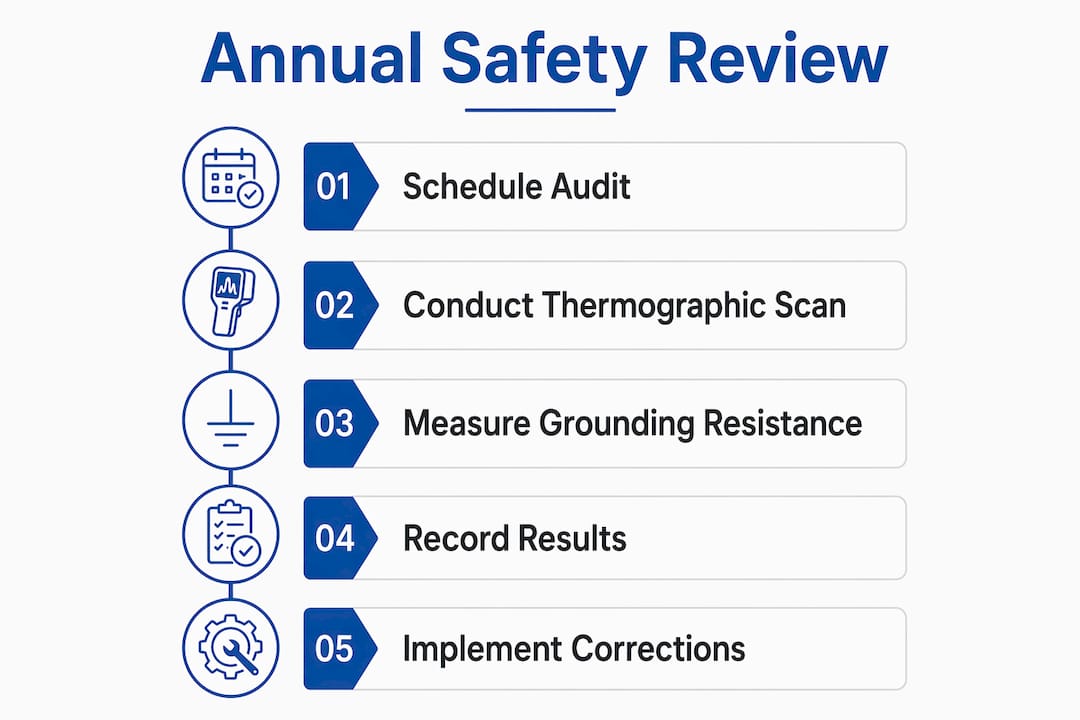
A structured safety review process prevents the most common failure mode: completing inspections in the wrong order and missing dependencies between systems. Follow this sequence for a complete annual review.
Gather documentation and assemble your team. Pull the previous year’s inspection reports, corrective action logs, and equipment maintenance records. Identify any outstanding deficiencies from the last review cycle. Assign a qualified electrical inspector and a lightning protection specialist to the team.
Review and close prior findings. Before starting new inspections, verify that every corrective action from the previous annual review has been completed and documented. Open items from prior cycles are the first thing regulators check.
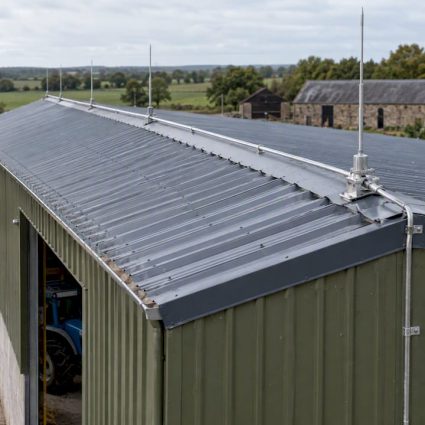
Conduct visual inspections of all lightning protection components. Walk the roof and perimeter to inspect air terminals, bonding conductors, and grounding electrode connections. Reference Indelec’s grounding compliance standards to confirm that each connection method meets NFPA 780 requirements.
Perform grounding resistance measurements and thermal imaging. Run fall-of-potential tests at each grounding electrode. Conduct the infrared scan of all electrical distribution equipment simultaneously to minimize system downtime.
Document findings with photos and corrective work orders. Every deficiency requires a photo, a GPS or location stamp, and a work order number. Verbal notes do not satisfy OSHA or NFPA documentation requirements.
Key documentation items to capture during the review:
- Equipment identification numbers and locations
- Test instrument model numbers and calibration dates
- Measured resistance values at each grounding electrode
- Thermal images with temperature readings and equipment IDs
- Names and credentials of all inspectors
Verify compliance paperwork and certifications. Confirm that all inspection certificates, arc flash study reports, and lightning protection system certifications are current and stored in an accessible digital system.
Schedule follow-up actions and update your maintenance management system. Assign due dates and responsible parties for every corrective action. Set automated reminders for the next annual review cycle and any interim quarterly or monthly checks.
Pro Tip:Use a computerized maintenance management system (CMMS) to log every test result, photo, and work order. A CMMS creates an automatic audit trail that satisfies both OSHA and insurance underwriter requests without any manual assembly.
What common pitfalls undermine an annual risk assessment?
The most damaging mistake in any annual risk assessment is treating it as a checkbox exercise rather than a genuine fault-finding process. Facilities that rush through inspections to produce paperwork, rather than to find problems, accumulate hidden deficiencies that surface as failures during peak demand or severe weather.
- Conflating routine checks with annual reviews. Monthly walkthroughs and quarterly equipment checks do not substitute for a full annual review. NFPA 70B and NFPA 780 define specific tests, instruments, and documentation that only the annual cycle requires.
- Overlooking grounding electrode connections. Exothermic weld connections corrode over time, especially in acidic or high-moisture soils. A connection that passed last year may read above 25 ohms this year. Test every electrode, not just a sample.
- Missing thermographic scan windows. Insurance underwriters increasingly mandate annual thermographic scans as a condition of commercial electrical coverage. A missed scan can void coverage for the following policy year.
- Failing to retain records in retrievable formats. Paper binders stored in a maintenance closet do not satisfy audit requirements when a regulator needs a specific test result in under five minutes. Digital storage with indexed search is the standard expectation.
- Skipping arc flash program training updates. NFPA 70E requires personnel training every 3 years. Facilities with high staff turnover often fall out of compliance between formal review cycles without realizing it.
Facilities that face 4 to 7 regulatory inspections annually fail most often not because the work was not done, but because the documentation cannot be produced quickly and completely. A well-organized digital record system is as important as the inspection itself.
Pro Tip:After each annual review, send a one-page summary of findings and corrective actions to your insurance carrier. Documented preventive maintenance programs, including annual thermographic scans and grounding tests, can reduce insurance premiums.
Key Takeaways
A complete annual protection review checklist integrates NFPA 70B electrical maintenance, NFPA 780 lightning protection grounding tests, and OSHA documentation requirements into a single, auditable process.
| Point | Details |
|---|---|
| Standards define the scope | NFPA 70B, NFPA 780, and NFPA 70E each specify required tests, intervals, and documentation for a complete annual review. |
| Grounding resistance is non-negotiable | Test every lightning protection grounding electrode annually and target a resistance at or below 10 ohms. |
| Thermal imaging prevents costly failures | Annual infrared scans detect up to 83% of critical electrical faults before failure, at a fraction of remediation cost. |
| Documentation is the audit | Digital records with photos, GPS stamps, and calibration data satisfy OSHA and insurance requirements simultaneously. |
| Missed reviews create liability | Skipped inspections lead to insurance coverage gaps and OSHA penalties up to $161,323 per willful violation. |
Indelec’s view on what annual checklists actually reveal
After working with facilities across industrial, commercial, and infrastructure sectors since 1955, Indelec has seen a consistent pattern: the facilities that treat the annual protection review as a genuine diagnostic exercise, rather than a compliance formality, find problems that would otherwise cost them far more than the review itself.
The most revealing moment in any annual review is the grounding resistance test. A system that looked fine during last year’s visual inspection can show resistance values well above the NFPA 780 threshold after a single season of soil movement or corrosion. That finding, caught during a scheduled review, costs a few hours of corrective work. Caught after a lightning strike, it costs equipment, downtime, and potentially lives.
Thermal imaging tells a similar story. The hot spot on a bus connection that shows up at 80% load is invisible at 40% load. Facilities that schedule their scans during low-demand periods miss the faults that matter most. Indelec recommends coordinating scan timing with peak operational hours, even when that requires after-hours scheduling.
The ongoing evolution of standards, including updates to NFPA 70B and the growing emphasis on lightning protection compliance, means that a checklist from three years ago may no longer cover everything a regulator expects to see. Staying current with standard revisions is not optional. It is the difference between a review that protects your facility and one that only looks like it does.
— Indelec
Indelec lightning protection for your annual review
Indelec has designed and installed lightning protection systems for industrial, commercial, and infrastructure facilities since 1955. Its systems are built to meet NFPA 780 and international lightning protection standards, with full documentation support for annual compliance audits.

Every Indelec installation includes technical documentation that maps directly to annual review checklist requirements, including grounding electrode specifications, conductor routing, and air terminal placement records. Facility managers who use Indelec systems enter each annual review with a complete baseline record already in place. For facilities evaluating their current lightning protection coverage or preparing for an upcoming audit, Indelec’s lightning protection system application page details the full range of system types, design criteria, and compliance documentation available. Indelec’s risk assessment and maintenance services also provide certified inspectors who can conduct grounding resistance tests and system audits as part of your annual review cycle.
FAQ
What is an annual protection review checklist?
An annual protection review checklist is a structured inspection document that verifies all lightning protection and electrical safety systems meet NFPA 70B, NFPA 780, and OSHA requirements. It covers grounding resistance tests, thermal imaging scans, arc flash label reviews, and compliance documentation.
How often must grounding resistance be tested under NFPA 780?
NFPA 780 requires grounding resistance to be measured annually. The maximum allowable resistance is 25 ohms, with a best-practice target at or below 10 ohms for lightning protection systems.
What does NFPA 70B require for electrical maintenance inspections?
NFPA 70B mandates annual electrical inspections that include thermographic infrared scans of panels, switchgear, and transformers. Thermal imaging detects up to 83% of critical electrical faults before failure, making it the most cost-effective preventive maintenance tool available.
How long must facility inspection records be retained?
Retention requirements vary by system. Fire alarm test reports and emergency lighting logs must be kept for at least 1 year, while OSHA injury and illness records require 5-year retention. Digital storage with indexed search is the most reliable way to meet retrieval requirements during audits.
What OSHA penalties apply for missed or incomplete inspections?
OSHA penalties reach $16,131 per serious violation and $161,323 per willful or repeat violation. Facilities that cannot produce complete inspection documentation during a regulatory visit face the same penalty exposure as facilities that never conducted the inspection at all.