Workplace EV Charging Policy in France: What to Write
A workplace EV charging policy in France is a short written document that sets who may charge, in what order, for how long, at what price, and who acts when a charger fails. It only works if the installation underneath it is sized, qualified and protected correctly. A rule that promises every employee a charging slot on a circuit that cannot deliver one is a conflict waiting to happen. We recommend writing the technical baseline and the user rules together, and having the installation designed by a specialist who knows the French IRVE rules (the acronym for electric vehicle charging infrastructure).
TL;DR
- No French text gives employees an enforceable right to charge at work: the employer decides who has access, and the rules should be written down and applied evenly.
- Legal duties sit on the building: pre-equipment of parking spaces, and from 1 January 2025 an accessible charging point for existing non-residential car parks of more than 20 spaces.
- Letting employees charge personal vehicles at work creates no taxable benefit in kind, under rules extended to 31 December 2027.
- Size the policy to the installation: subscribed power, load management, civil works and a maintenance plan decide how many people you can actually serve.
- Use IRVE-qualified installers and protect the equipment (earthing, surge protection) so the policy is not undone by outages.
Table of Contents
- Start with the legal baseline, not the user rules
- Tax and payroll: why free charging is a safe default
- What the policy itself should cover
- Size the installation before you promise access
- Installer qualification and technical compliance
- Operations: faults, maintenance and records
- A sample policy skeleton
- Where we come in
- Our point of view
- FAQ
- Sources
Start with the legal baseline, not the user rules
Most policy templates start with badges and tariffs. For a facility owner, the first question is different: what does the law already require of the car park? The policy then covers what the law leaves open.
Pre-equipment and accessible charging points
According to Service-Public Entreprendre, pre-equipment means conduits with a clear square passage of at least 100 mm, power and safety devices, a supply sized to serve at least 20% of the spaces, a layout compatible with later load control, and a protective earth conductor on every circuit downstream of the delivery point. In non-residential buildings with more than 10 spaces, at least 20% of spaces must be pre-equipped. Of these, 2% (at least one) must be sized for accessible use, and at least one accessible space must be equipped for charging. Above 200 spaces, at least two spaces must be equipped, one reserved for people with reduced mobility.
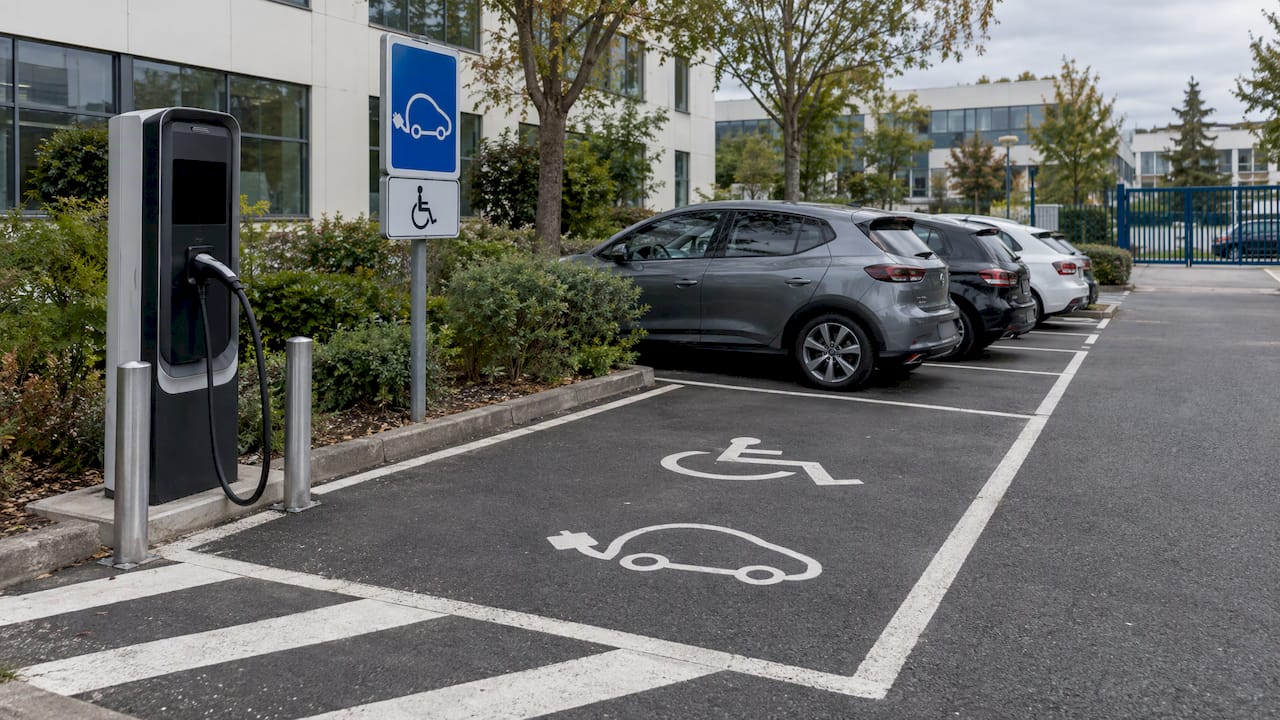
For existing buildings, the same page states that since 1 January 2025, non-residential car parks of more than 20 spaces covered by the rule must have at least one charging point accessible to people with reduced mobility, then one more per additional block of 20 spaces. The obligation can be adapted where major work on the electrical network would be required. Sytral Mobilités cites the Construction and Housing Code (articles L113-13 and L113-14) for these rules and notes that car parks of buildings both owned and occupied by small and medium enterprises are excluded.

For new buildings or heavy renovations with a permit filed from 11 March 2021, Avere France recalls that non-residential car parks of more than 10 spaces must pre-equip 20% of spaces and include an accessible charging point.
This matters for the policy because your first reserved spaces are not a perk to allocate: at least one is legally earmarked for accessible use. The policy should say so.
What the law does not require
Nothing obliges an employer to hand every employee a charger. The French Labor Code (article L.2242-17) only requires companies with 50 or more employees to negotiate on commuting mobility during annual bargaining, without requiring chargers. Within the legal baseline, the employer chooses the rules. The more the rules are formal and neutral, the fewer disputes follow.
Penalties
Financial penalties for non-compliance can reach €100,000, with a daily penalty of up to €1,500, according to Les Echos. Treat the legal baseline as the first line of your policy.
Tax and payroll: why free charging is a safe default
Employers often worry that free charging counts as a taxable benefit. For personal vehicles charged on a workplace charger, it does not. Under the ministerial order of 25 February 2025, which replaced the order of 10 December 2002 and applies to periods of activity from 1 February 2025, the benefit in kind from non-professional use of a charger installed at the workplace is nil, electricity costs included. The same source states these rules run through 31 December 2027, so the policy should be reviewed before then.
The same page covers a charger installed at an employee’s home and kept after the contract ends. The employer can exclude 50% of actual purchase and installation costs from contribution bases (ceiling €1,043.50) if the charger is five years old or less, or 75% (ceiling €1,565.20) beyond five years.
Sytral Mobilités adds that offering free charging is legal, and that an environmental rationale can justify it, much like a sustainable mobility allowance. In practice, it advises employers to define conditions in internal rules, or even to charge, to keep things fair among employees.
What the policy itself should cover
Keep it short. A two-page document that people read beats a twenty-page one they do not. Each clause below answers a decision someone will otherwise make on the spot.
| Clause | Decision to make | Typical options |
|---|---|---|
| Eligible users | Who may charge | Employees, company vehicles, visitors, contractors |
| Priority | Who goes first when spaces run short | Accessible space first for people with reduced mobility, company vehicles, long commuters, first come first served |
| Time limits | How long a vehicle may stay plugged in | Maximum connection time, obligation to move the car after charging |
| Pricing | Who pays and how | Free, fixed fee, actual cost via individual metering |
| Equipment use | What users may and may not do | Own cable only, no extension cords, report damage |
| Faults | Whom to call and what happens meanwhile | Named contact, fallback space, response target |
| Breaches | What follows a violation | Reminder, then suspended access for repeated abuse |
| Review | When rules are revisited | After a trial period, then yearly |
The policy can live in your internal rules, a service memo or a company agreement. Where staff representatives must be consulted for your company, do it before publication, and run a trial period of a few months to adjust rules against measured use.
Access and priority
The cleanest approach is to define user categories first, then assign badges by category. Individual named badges make it possible to know who consumed what and to withdraw access without touching the hardware. Keep an up-to-date list and retain session records, which become your evidence if payroll, accounting or an inspector asks a question.
A real-world model helps. The ENS de Lyon charter for its charging sockets sets weekday access hours (7 a.m. to 7 p.m., Monday to Friday), a mandatory sticker, a monthly fee set by decision of the president and billed twice a year, priority for lighter vehicles when requests exceed capacity, and the possibility of load shedding without notice if electricity supply is constrained. Not every clause fits an industrial site, but the structure shows how much can fit on a page: access, identification, price, priority and an explicit power-shortage rule.
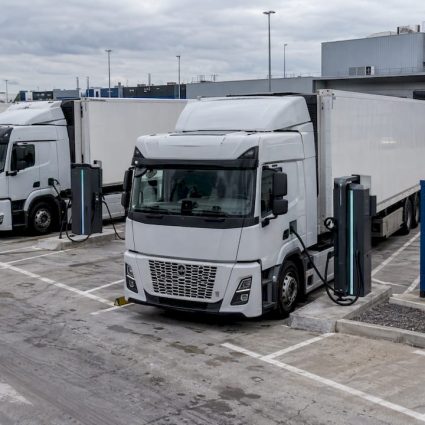
For industrial and logistics sites, add two points a template will not give you: shift patterns (a 6 a.m. to 2 p.m. shift and a 2 p.m. to 10 p.m. shift can share the same bays if the policy sets handover times) and safety zones (chargers should not sit in forklift or truck traffic lanes).

Pricing and reimbursement
Three models cover most cases. Free charging is simplest and, per the rules above, carries no benefit-in-kind consequence for personal vehicles. A fixed fee needs little hardware but is blunt. Actual-cost billing needs individual metering so that each invoice can be defended. Whatever the model, decide what happens to employees who cannot access a charger: a flat reimbursement or a rotation of bays are the usual answers.
If you bill, the meter must be accurate enough to stand behind an invoice. Settle this at design stage, because retrofitting meters into finished boards costs more than specifying them at the start.
Size the installation before you promise access
A policy is a promise on capacity. Break it, and the policy fails in the first winter.
Sytral Mobilités recommends defining beneficiaries precisely (employees, company vehicles, outside users) so the system is sized as tightly as possible. It also advises checking that the subscribed power in the supply contract is compatible with the chargers’ power, at the risk of tripping the installation. It points out that civil works can exceed the cost of the chargers themselves, and that in the most demanding cases, with several high-power chargers adding up to hundreds of kW, a contract change may not suffice and heavy work by the grid operator may be needed.
A practical sequence:
- Count vehicles by category. Employees’ personal cars, company vehicles, visitors. Note dwell times: a vehicle parked nine hours needs a different charger than a van returning for forty minutes.
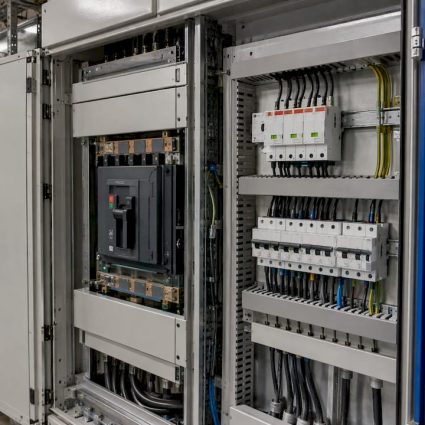
- Check the electrical headroom. Compare subscribed power and main board capacity with the chargers you intend to run at the same time.
- Plan load management. Dynamic load control shares available power among connected vehicles so you can serve more bays without upgrading the supply. Our guide to EV charging load management in France explains how it works.
- Choose locations around the trench. Cable runs drive cost. See our notes on civil works for EV charging, and on sizing around the 20% rule.
- Write the policy for the capacity you will really have, and name the review point at which you will add bays.
For a broader view of the parking-lot case, see EV charging in a company parking lot and the IRVE standards for tertiary buildings.
Installer qualification and technical compliance
The policy should name who may touch the equipment. Since decree no. 2017-26 of 12 January 2017, any company installing or maintaining charging stations must hold IRVE qualification, as Avere France recalls, through training approved by a body with a ministerial accreditation such as QUALIFELEC or AFNOR. Check the certificate before signing: we explain what to verify in IRVE qualification in France.
The technical reference is section 7-722 of standard NF C 15-100, which governs the electrical installation for EV charging. In practice, each charging point gets its own dedicated circuit with appropriate residual-current protection, and the details depend on the charging mode and equipment. Have your designer confirm the current edition in the design file rather than relying on a template.
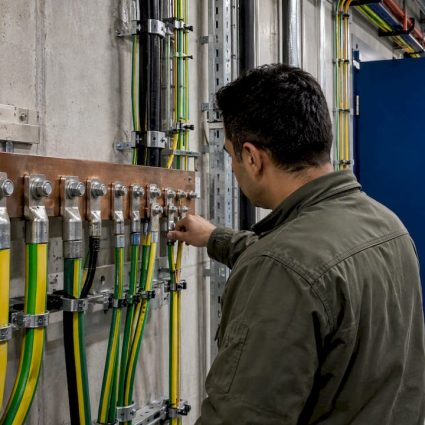
Two technical elements prevent the most irritating outages. Earthing: a poor earth makes protection trip unpredictably, see earthing for IRVE. Surge protection: outdoor chargers on long cable runs are exposed to transient overvoltages, and a missing or wrong device can also cause a Consuel rejection, see surge protection for French EV chargers. Consuel is the body that certifies electrical installations before power-up.
Operations: faults, maintenance and records
The fault procedure is the clause users test first. Name a single contact and number, a response target and a fallback (an alternative bay, a temporary reimbursement). State that users report damage and do not use damaged cables.
For maintenance, the policy should reference a plan, not a vague intention. A preventive visit typically covers visual inspection of the charger, cables and connectors, a check of electrical protections and software updates. Match the contract level to the site: our guide on enterprise charger maintenance with MA1, MA2 or MA3 shows how.
Keep a maintenance log, session records and the compliance documents together: qualification certificate, Consuel certificate where applicable, test report. If an incident ever raises an insurance question, you will want them in one folder.
A sample policy skeleton
Adapt this to your own rules and have your HR or legal department validate it.
- Purpose and scope: which sites and bays are covered.
- Eligibility: categories of users, badge allocation, accessible bays.
- Priority and booking: order of priority, any booking or rotation.
- Time limits: maximum plug-in time, move-on obligation.
- Cost: free, flat fee or actual cost, with the metering method.
- Use of equipment: own cable only, no extension cords, report damage.
- Power shortage: right to reduce or interrupt charging when supply is constrained.
- Faults and contacts: who to call, fallback.
- Breaches and sanctions: reminder, suspension.
- Review: date, data used (sessions, waiting times, complaints).
Where we come in
Indelec offers audit and installation of electric vehicle charging infrastructure for professional fleets and sites, alongside earthing, surge protection and lightning protection products and services. Established in 1955, we cite more than 280,000 installations worldwide, and our R&D center keeps our technical solutions in line with current standards. For a workplace policy, this means the electrical baseline, the earthing and the protection against overvoltages can be handled together with the charging installation.
If you are scoping a site, our services page describes our electric mobility solutions, and our surge protection range and earthing range cover the protection side.

For funding questions, see our overview of reducing charging station costs for fleets and sites.
Our point of view
We see the policy and the installation as one project. A policy that sets access rules without knowing the available power, the state of the earthing or the protection against surges will be rewritten after the first outages.
Our advice is to start from the site: how many vehicles, how long they stay, how much power is really available, and where the trenches can run. Then write the rules for that capacity, with a review date, instead of the capacity you wish you had.
Protection matters as much as the charger. Earthing and surge protection are what keep a charging bay in service during storms and grid disturbances, and our work on lightning and overvoltage protection starts from that principle. An IRVE-qualified installation, documented and maintained, is also what makes your policy defensible with employees, insurers and inspectors.
INDELEC
FAQ
Do we have to offer charging to employees?
No text gives employees an enforceable right to charge a personal vehicle at work. The Labor Code only requires companies with 50 or more employees to negotiate on commuting mobility. Your car park may still have legal pre-equipment or accessible-point duties, so check those first.
Is free charging for employees a taxable benefit?
Not for personal use of a charger installed at the workplace. The order of 25 February 2025 sets the benefit in kind at nil, electricity included, and the rules are extended until 31 December 2027. Review your policy before that date.
Where should the policy be written?
In your internal rules, a service memo or a company agreement, in writing and applied evenly to everyone. Consult staff representatives where your company must, and test the rules during a trial period of a few months before locking them in.
Who is allowed to install the chargers?
A company holding IRVE qualification, delivered through training approved by an accredited body such as QUALIFELEC or AFNOR. The requirement comes from decree no. 2017-26. Ask for the certificate before the contract is signed.
Sources
- Service-Public Entreprendre: mandatory EV charging infrastructure
- Sytral Mobilités: electromobility at work
- Avere France: legal FAQ on fleet electrification
- FNTP: benefits in kind, vehicles and charging stations since the order of 25 February 2025
- Les Echos: charging station obligations for companies
- ENS de Lyon: charter for EV charging sockets