Continuous Protection Improvement Steps for Facilities

TL;DR:
- Continuous protection improvement involves a structured PDCA cycle to identify hazards, implement controls, and verify results.
- Focusing on one high-impact process each quarter improves safety and creates reusable templates for ongoing efforts.
Continuous protection improvement steps are the structured actions facility managers and safety officers take to systematically identify hazards, prioritize fixes, implement controls, and verify results in industrial settings. The process mirrors what ISO 27001’s Clause 10.1 mandates for information security: documented corrective actions with root cause analysis and verified effectiveness. The same discipline applies to physical and electrical protection programs. Without a repeating cycle, safety gains erode as equipment ages, operations change, and new threats emerge. This article gives you a practical, step-by-step framework for building that cycle into your facility’s daily operations.
What are the essential continuous protection improvement steps?
Continuous protection improvement is the industry term for what safety professionals also call a Plan-Do-Check-Act (PDCA) cycle applied to hazard control. The PDCA model runs at multiple concurrent timescales: daily inspections, quarterly audits, annual reviews, and multi-year capital programs all feed the same improvement engine. That layered cadence is what separates a living safety program from a compliance checkbox.
Before you can improve anything, you need a baseline. A thorough hazard identification survey maps every credible threat in your facility, from electrical surge exposure to lightning strike probability for outdoor infrastructure. Research confirms that systematic hazard identification and control implementation can reduce extreme and high risks significantly. In one industrial case, 79% of extreme and high risks dropped to moderate or low after controls were applied. That figure shows what structured identification, not guesswork, actually delivers.
The foundational tools you need before starting
Two tools anchor every effective improvement program:
- Risk register: A living document that logs every identified hazard, its current severity, the control in place, and the residual risk score after that control.
- Impact vs. Effort matrix: A prioritization grid that plots each identified issue by its potential harm against the resources needed to fix it. High-impact, low-effort items move first.
- Baseline monitoring data: Continuous sensor readings, inspection logs, and incident reports give you the numbers to measure against after changes are made.
- Safety management system (SMS): A digital or paper-based platform that centralizes all records, assigns ownership, and tracks completion status for every corrective action.
Organizational commitment determines whether these tools get used or ignored. Safety officers need explicit authority to halt operations when a critical hazard is confirmed. Facility managers need budget lines tied to improvement cycles, not just reactive repairs.
| Prerequisite | Why it matters |
|---|---|
| Hazard identification survey | Establishes the full scope of risks before prioritization |
| Risk register | Creates a single source of truth for all active hazards |
| Impact vs. Effort matrix | Directs limited resources to the highest-value fixes first |
| Safety management system | Tracks ownership, deadlines, and verification evidence |
| Organizational commitment | Converts plans into funded, accountable actions |
How do you map, analyze, and redesign processes to reduce risk?
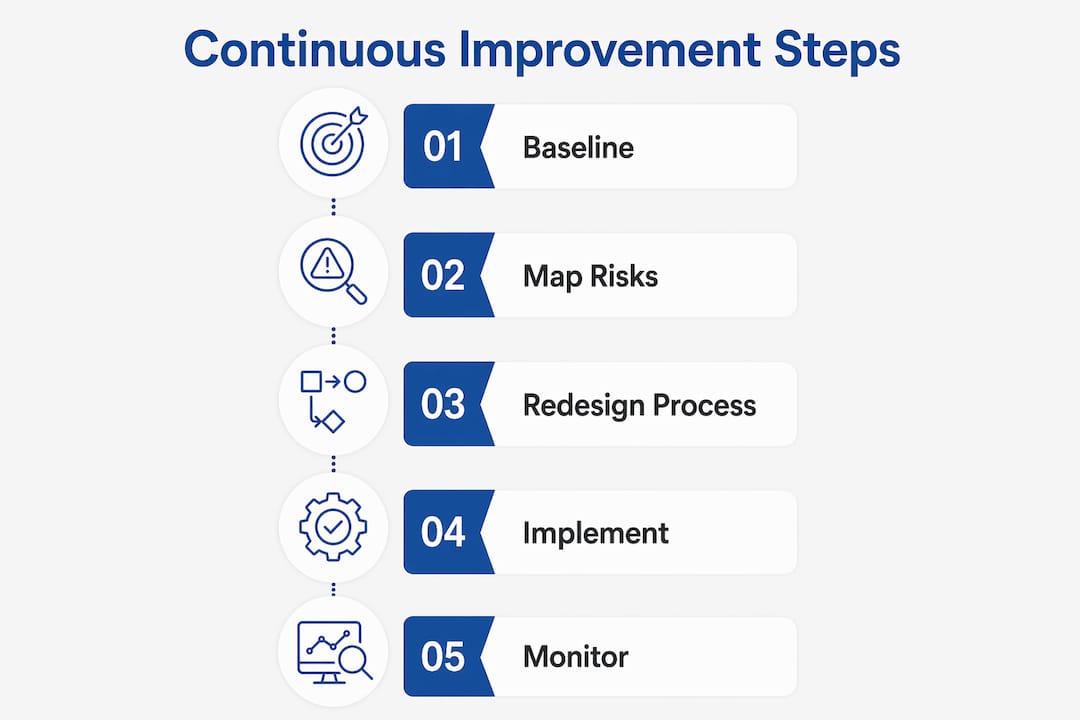
Process mapping is the step most facilities skip, and it is the reason improvement efforts stall. You cannot fix what you have not drawn. Start by walking every critical workflow from start to finish and recording each step, decision point, handoff, and piece of equipment involved. For lightning and electrical protection, that means tracing the path from an incoming strike through your lightning protection system down to grounding termination.
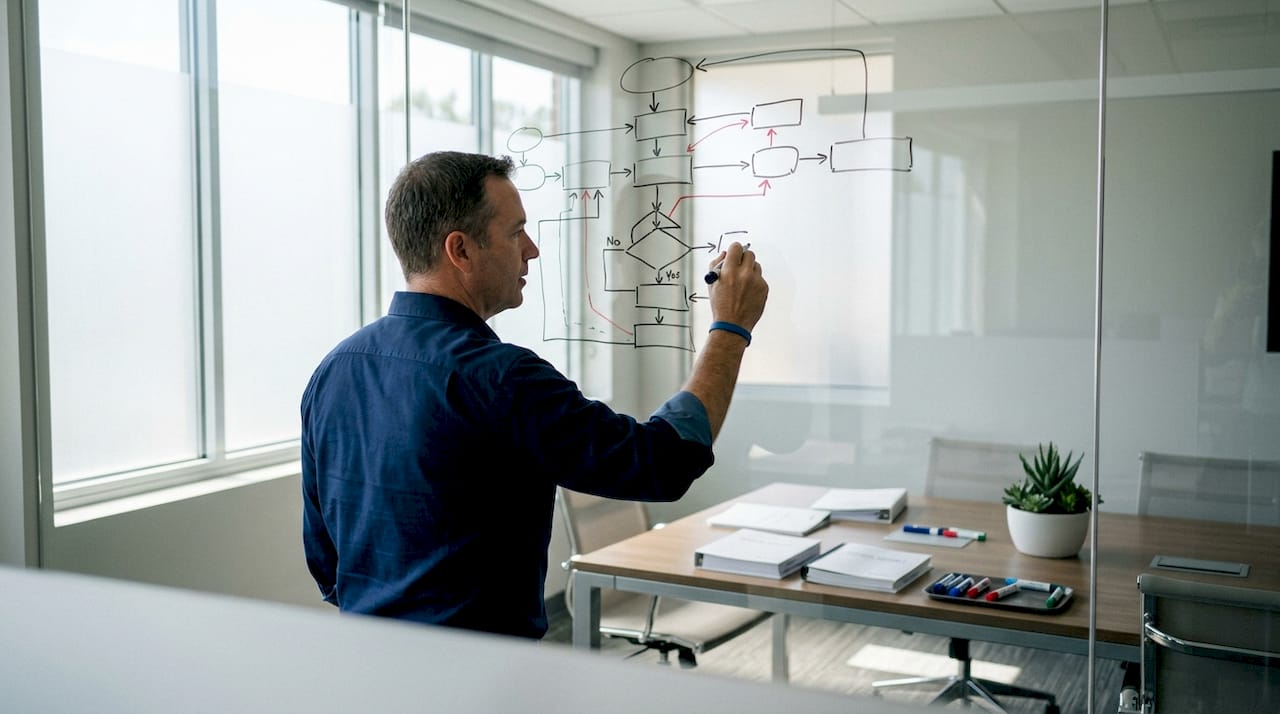
Once the map exists, analyze it for three categories of weakness: bottlenecks where delays concentrate risk, handoff gaps where ownership is unclear, and single points of failure where one broken component disables the entire protection chain. Risk data from your baseline monitoring will highlight which of these weaknesses has caused incidents or near-misses in the past twelve months. Focus analysis there first.
Redesign follows analysis. The goal is not to rebuild everything at once. The goal is to remove the specific failure mode you identified and verify that the redesign does not introduce a new one. Most mid-market teams face more than 20 broken processes but can only effectively fix two per quarter. That constraint is not a failure. It is a governance reality that forces discipline.
- Select one process. Use your Impact vs. Effort matrix to pick the single highest-value target for the current quarter.
- Document the current state. Map every step, input, output, and responsible party in writing before changing anything.
- Identify the root cause. Ask why the failure mode exists at least five times before proposing a fix. Surface causes rarely match root causes.
- Design the improved state. Write the new process with clear ownership at every step and a measurable success criterion.
- Pilot the redesign. Run the new process in a controlled section of the facility before full deployment. Collect data during the pilot.
- Refine before scaling. Use pilot data to close gaps, then roll out to the full facility with documented procedures.
Pro Tip:Focus on one high-impact, low-effort process per quarter. Completing it fully creates a reusable template and builds team confidence for the next cycle, rather than leaving five half-finished projects with no clear owner.
How do you implement, validate, and monitor improvements effectively?
Implementation fails most often because of ownership gaps. Every corrective action needs a named individual, a deadline, and a defined success metric before work begins. Effective mobilization requires role-appropriate guidance integrated into existing workflows, not a separate safety project that competes with production priorities.
Phased rollout reduces risk during implementation. Start with the section of your facility that has the lowest operational impact if something goes wrong during the transition. Collect performance data from that phase before expanding. This approach also gives you a natural comparison group: the unchanged sections of the facility serve as a baseline while you measure the pilot area.
Validation must test real conditions, not theoretical ones. Continuous testing frameworks that embed validation into daily operations can reduce mean time to remediation from weeks to days. For lightning protection, that means periodic discharge testing, grounding resistance measurement, and visual inspection of air terminals and down conductors, not just a paper review of installation records.
- Assign named ownership: Every open corrective action has one accountable person, not a team or a department.
- Set measurable success criteria: Define what “fixed” looks like in numbers before work starts (e.g., grounding resistance below 10 ohms).
- Build feedback loops: Schedule a formal review 30 days after implementation to compare actual results against the success criterion.
- Automate where possible: Integrate corrective action tracking into your existing work order or ticketing system to prevent backlog.
- Document everything: ISO 27001 Clause 10.1 requires evidence of completed improvements and verification that actions were effective. That documentation also protects you during audits and insurance reviews.
Pro Tip:Do not wait for the annual audit to validate improvements. Schedule a 30-day post-implementation check for every corrective action. Small, frequent validations catch drift before it becomes a failure.
What challenges slow down continuous improvement cycles?
Governance fatigue is the most common reason improvement programs collapse after the first cycle. The initial hazard survey generates a long list of findings. Teams work hard to close the top items. Then the list grows again at the next assessment, and the effort feels endless. Without visible progress metrics, teams disengage.
Prioritization paralysis follows closely. When every finding is labeled “critical” by automated scoring tools, nothing is actually critical. AI-driven decision support systems are emerging to address this by accounting for human behavior, equipment condition, management context, and environment simultaneously. Until those tools are widely deployed, the Impact vs. Effort matrix remains the most reliable manual filter.
Resistance to process change is real and predictable. Operators who have followed the same procedure for years will push back on redesigns, especially when the safety rationale is not explained in operational terms. Safety officers who translate risk data into language that connects to production outcomes, not just injury statistics, get faster adoption.
- Combat governance fatigue by publishing a monthly one-page scorecard showing how many findings were closed, how many remain, and what the residual risk score looks like compared to last quarter.
- Break prioritization paralysis by limiting your active improvement list to five items at any time. New findings enter a backlog and are reviewed monthly for promotion.
- Address resistance by involving operators in the redesign step, not just the announcement step. People support processes they helped create.
- Prevent backlog buildup by connecting corrective actions to your existing work order system. A warehouse security checklist approach, where every risk category has a predefined response protocol, reduces the decision load on individual managers.
Focusing on one high-impact project at a time creates reusable templates and avoids the governance overhead that kills multi-methodology programs. Depth beats breadth every time in continuous improvement.
How do standards and 2026 innovations shape protection improvement?
Industry standards define the minimum floor for continuous improvement, not the ceiling. ISO 27001’s continual improvement clauses require organizations to act on nonconformities, analyze root causes, and verify that corrective actions worked. The same logic applies to physical safety programs governed by IEC 62305 for lightning protection and NFPA 70E for electrical safety. Reviewing lightning protection standards annually against your current installation confirms whether your system still meets the protection level your risk assessment requires.
The most significant 2026 development in protection improvement is the shift from annual assessments to continuous validation. Programs embedded in operational workflows provide ongoing evidence of protection effectiveness through AI-driven exploit validation, attack chain simulation, and prioritized remediation guidance. For physical infrastructure, the equivalent is continuous sensor monitoring of grounding systems, surge protection devices, and air terminal performance rather than relying solely on scheduled inspections.
| Approach | Frequency | Key benefit |
|---|---|---|
| Annual assessment only | Once per year | Meets minimum compliance requirements |
| Quarterly audit cycle | Four times per year | Catches seasonal and operational drift |
| Continuous sensor monitoring | Real time | Detects failures before incidents occur |
| AI-assisted risk prioritization | Ongoing | Reduces false positives and prioritization paralysis |
Ergonomic and behavioral safety programs also show measurable results when integrated into continuous improvement cycles. Facilities that combine physical hazard controls with behavioral training see compounding risk reductions across successive cycles. Indelec’s R&D-backed protection methods for critical installations reflect this integrated approach, combining physical system design with compliance verification and ongoing technical support.
Key Takeaways
Continuous protection improvement requires a repeating PDCA cycle anchored by hazard identification, named ownership, measurable success criteria, and verified corrective actions at every stage.
| Point | Details |
|---|---|
| Start with a baseline | Conduct a full hazard identification survey before prioritizing any corrective actions. |
| Use the Impact vs. Effort matrix | Focus each quarter on the one fix that delivers the highest risk reduction for the least resource cost. |
| Assign named ownership | Every corrective action needs one accountable person, a deadline, and a measurable success criterion. |
| Validate in real conditions | Schedule a 30-day post-implementation check for every improvement, not just an annual audit. |
| Document for compliance | ISO 27001 Clause 10.1 and equivalent physical safety standards require evidence that improvements were completed and verified. |
Indelec’s perspective on building improvement programs that last
The hardest part of continuous protection improvement is not the first cycle. The first cycle runs on urgency. The hardest part is the fourth cycle, when the obvious hazards are gone, the team is tired, and the remaining risks are harder to quantify. That is where most programs quietly stop improving and start coasting.
What I have seen work, across decades of protecting industrial and infrastructure facilities, is integrating improvement into daily operations rather than treating it as a separate project. When a grounding resistance check is part of a technician’s weekly routine rather than a quarterly event, the data is richer and the anomalies are caught earlier. When corrective actions live in the same work order system as routine maintenance, they do not compete for attention. They are just work.
The other trap is methodology overload. Running ISO 27001, PDCA, Six Sigma, and a proprietary safety program simultaneously creates more governance meetings than actual improvements. Pick one framework, apply it consistently, and build your templates from real completed projects. The reusable template from one well-executed improvement cycle is worth more than five half-finished ones.
Continuous improvement also means continuous learning. The threat environment changes. Climate patterns shift lightning frequency and intensity. New equipment introduces new failure modes. A protection program that was fully adequate three years ago may have gaps today. The facilities that stay ahead are the ones that treat their annual standard review, not as a compliance exercise, but as a genuine question: does our current system still match our current risk?
— Indelec
How Indelec supports your protection improvement program
Indelec has specialized in lightning and electrical protection since 1955, giving facility managers and safety officers a single technical partner for assessment, installation, and ongoing verification.
The Prevectron3 air terminal with OptiMax patented technology is Indelec’s flagship product for facilities that need verified, standards-compliant lightning protection as part of a continuous improvement program. Indelec’s full service offering covers deep earth grounding, surge protection, technical training, and certification, giving you the documentation trail that ISO and IEC audits require. For facilities managing complex or sensitive infrastructure, Indelec’s technical team provides site-specific consultation to identify gaps in your current system and recommend phased improvements aligned with your risk register. Contact Indelec to schedule a protection assessment and build a continuous improvement cycle that holds up under audit and real-world conditions.
FAQ
What is the first step in a continuous protection improvement program?
The first step is a baseline hazard identification survey that maps every credible risk in your facility. Without that baseline, prioritization is guesswork and improvement cannot be measured.
How often should protection improvements be reviewed?
The PDCA cycle runs at multiple timescales: daily checks, quarterly audits, and annual reviews all feed the same program. Relying on annual assessments alone misses seasonal drift and equipment degradation between cycles.
What does ISO 27001 require for continuous improvement?
ISO 27001 Clause 10.1 requires documented corrective actions with root cause analysis and retained evidence that each action was completed and verified as effective.
How do you prevent corrective action backlogs from building up?
Connect every corrective action to your existing work order or ticketing system and assign a named owner with a deadline. Automated tracking prevents items from sitting unassigned until the next audit.
Why does focusing on one process at a time produce better results?
Most teams can only effectively complete two process improvements per quarter. Completing one project fully creates a reusable template and builds team confidence, while spreading effort across many projects leaves all of them unfinished.