Stadium Lightning Protection: Risk, Design and Upkeep
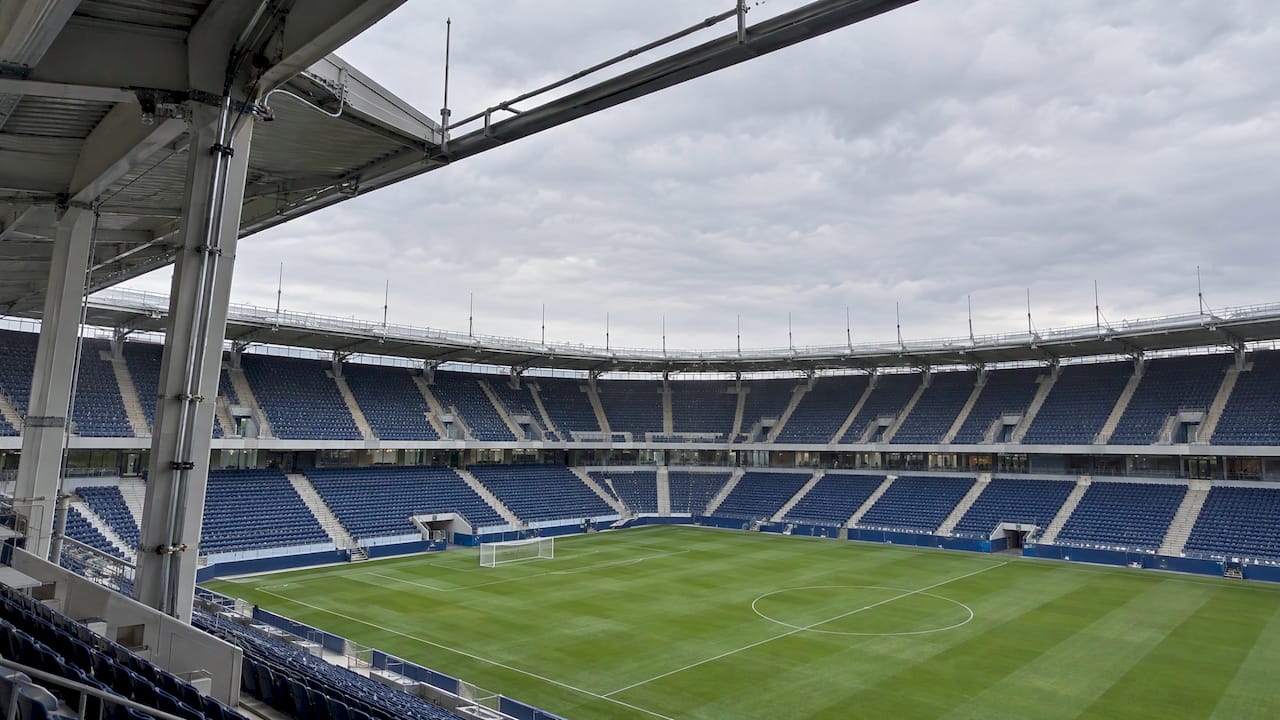
A stadium combines tall steel structures, floodlight masts, thousands of people in the open and dense electronics. Protecting it means starting from a documented lightning risk assessment, then designing external protection, earthing, equipotential bonding and surge protection as a single system, and keeping it verified over time. We handle that chain at Indelec, from the risk analysis to installation and maintenance, so one party answers for the whole system.
TL;DR
- Start with a lightning risk assessment: it defines which losses matter (human life, service, economic) and which protection level the stadium needs.
- In France the reference is the NF EN IEC 62305 series, in its October 2024 editions, and, for regulated sites, the ARF then ET process.
- External protection, earthing, bonding and surge protection must be designed together, including floodlights, scoreboards and communications lines.
- Protection only holds if it is inspected and maintained: keep a verification dossier and confirm intervals from your applicable regulation.
- A stadium can be hit without a direct strike: nearby flashes and strikes on incoming lines can damage electronics.
Table of Contents
- Why stadiums are a particular lightning problem
- The French framework: standards and the ARF/ET chain
- Step 1: Run the risk assessment on the right losses
- Step 2: Design external protection
- Step 3: Earthing and equipotential bonding
- Step 4: Internal protection against surges
- Step 5: Verification and maintenance
- Who should coordinate it
- Our perspective
- From study to commissioning
- FAQ
- Sources
Why stadiums are a particular lightning problem
A stadium is a large, open and often isolated structure. Its floodlight masts, roof trusses and flagpoles are the highest points around. Thousands of spectators and staff gather in the stands, on the concourses and on the pitch. Inside, the building depends on ticketing, CCTV, public address, evacuation lighting, broadcast and network systems.
The 2024 edition of the risk standard EN IEC 62305-2 frames the hazards well: lightning can damage structures and their contents, injure people in or close to a structure, and cause failure of electrical and electronic systems. It also treats flashes to connected lines and nearby flashes as part of the exposure. For a stadium, that means three questions:
- People. Where can spectators, staff and players be exposed, and for how long before an event is stopped?
- Structure. Which roofs, masts, stands and façades can take a direct strike and carry the current safely to earth?
- Systems. Which cables, power feeds and data lines can bring a surge into the building from outside?
The German professional body VDE publishes guidance for spectator facilities saying that sports venues should assess the lightning danger to people and document the measures required, taking into account differing work and use conditions. Operations teams building the event safety plan will find the same logic in event safety planning guidance: hazards identified first, responsibilities and timelines fixed in writing.
The French framework: standards and the ARF/ET chain
Standards in force
The NF EN IEC 62305 series has four parts: general principles, risk assessment, physical damage and danger to life, and electrical and electronic systems. The CSTB catalogue of February 2026 lists all four parts in their October 2024 editions. AFNOR gives 26 November 2024 as the publication date of Part 2 on risk assessment. For an overview of the four parts and what the third edition changed, see our IEC 62305 summary and our page on lightning standards.
For systems using early streamer emission air terminals, the French standard NF C 17-102 remains listed by AFNOR as in force, and includes verification provisions.
ARF, then ET
When a site falls under the French regime for classified installations (ICPE), the process is regulated. INERIS, in its Qualifoudre FAQ of 30 November 2023, describes an Analyse du risque foudre (ARF, the lightning risk analysis), followed where needed by an Étude technique (ET, the technical study that defines the measures). The ICPE rubrics decide whether an establishment is subject to the 4 October 2010 order. A site visit is indispensable for an ARF, except for a project-stage installation where neighboring installations are not expected to influence the result.
Most stadiums are not ICPE sites. Even so, the ARF/ET sequence is a sound method for a public venue: assess, define, install, verify. It is the sequence we follow, as described in our guide to the ARF, ET and installation chain. Whether a given stadium is within a regulated regime is a question for the owner, the operator and the competent authority at the project basis stage.

Step 1: Run the risk assessment on the right losses
The standard ties risk to three things: lightning exposure, the probability of damaging events and the extent of consequential loss. Exposure includes strikes to the structure, nearby strikes, and strikes to or near connected power and telecom lines (EN IEC 62305-2).
A good stadium study does not treat the venue as one asset. The assessment published for the London Olympic Park stadium, a UK project report from 2015, considered human-life risk separately from public-service loss and economic consequences. It calculated the unprotected direct-strike risk to the pitch at 3.19 × 10⁻⁷, about 1 in 31,900,000. That figure belongs to that stadium. It is not a number to reuse, but it shows why the study must define its own zones and loss categories.
Practical inputs to gather before the study:
- Dimensions, roof geometry and materials, mast heights and positions
- Ground flash density and soil resistivity at the site
- Zones: pitch, stands, concourses, technical rooms, hospitality, broadcast areas
- Incoming services: power, telecoms, fiber, CCTV, ticketing networks
- Occupancy patterns and event evacuation procedures
Where it goes wrong: a desk study based on plans alone, with approximate mast heights and no soil data. A site visit gives the real earthing, the as-built cable routes and the metal elements that can serve as natural components. Our lightning risk assessment and technical study service starts there, and our risk assessment guide explains the inputs in more detail.
Step 2: Design external protection
External protection captures the strike and carries it to earth. For a stadium it usually involves:
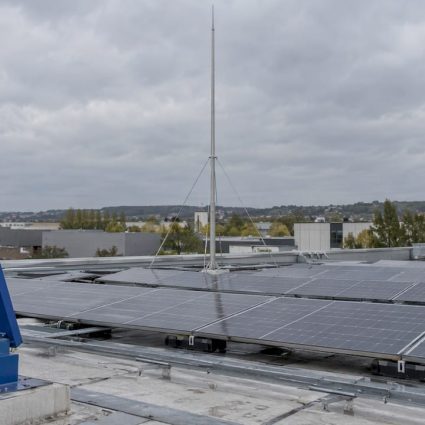
- Air terminals on roofs, and on floodlight masts and other tall elements where the study requires them. See our lightning rods.
- Masts and fixings to place terminals at the height the design needs.
- Meshed cage or conductors on the roof where a mesh approach suits the geometry.
- Down conductors routed along the structure to the earthing, with the connections and fixings that keep the path continuous. See down conductors.
- Strike counters that record events and help you plan verification after a storm. See lightning strike counters.
The protection level is a result of the study, not a default. In the Olympic Park report the assessment required external protection at level III for the stadium but no catenary system over the pitch, and applied internal protection to the building rather than the pitch. That configuration came from that project’s calculation: yours must come from yours.
For floodlight masts, the key design point is that the mast carries both a conductive path and cables. A strike or nearby flash can inject current into the lighting circuits, so the air terminal, the earthing of the mast and the surge protection of the lighting feeder are designed together.
Our page on sport arena lightning protection design sets out our approach for venues, and the Allegiant Stadium project shows a stadium protected for the 2024 Super Bowl.
Step 3: Earthing and equipotential bonding
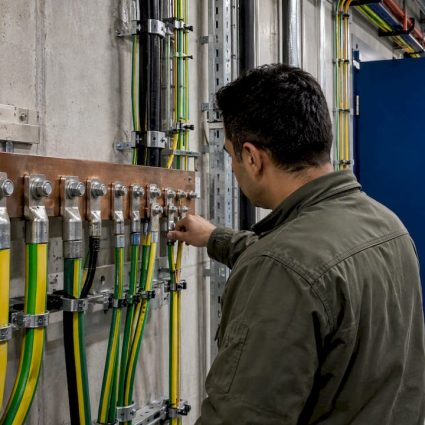
The earthing system dissipates the current. In a stadium with long cable runs, a large footprint and varied soils, the earthing must be designed with soil resistivity measured on site. Where surface conditions do not give a good result, deep earthing can be an option: see our deep earth grounding drilling service and the earthing product range.
Bonding links metal parts so that no dangerous potential differences appear between them during a strike. The INERIS FAQ discusses lightning equipotential bonding, separation distances, earthing and surge protective devices on incoming lines as parts of the technical study, and says the ET should define the measures, including, where justified, the use of existing and natural protection. In a stadium that means concrete reinforcement, steel stands and roof structures are assessed as possible natural components rather than ignored or duplicated blindly.
Step 4: Internal protection against surges
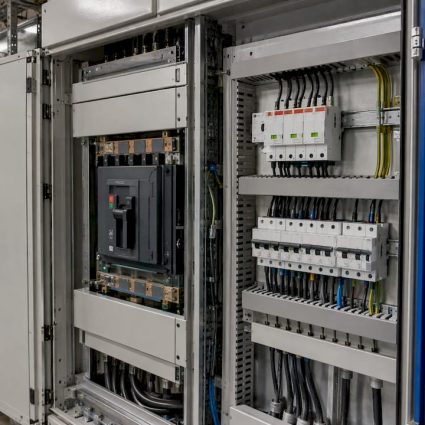
Many stadium losses are electronic. The 2024 risk standard explains that strikes to or near power and communication lines can induce overvoltages and cause system failure even without a direct strike to the building. So internal protection has to address every incoming service and the coupling between systems.
The standard also notes that protection measures are intended to comply with the IEC 62305 series, the IEC 61643 series (surge protective devices) and IEC 62793, as applicable. In practice, a stadium needs:
| Location | What to protect | Typical measure |
|---|---|---|
| Main incoming supply | Distribution boards, transformers | Type 1+2 surge protection at the origin |
| Sub-distribution | Lighting, HVAC, lifts | Type 2 devices coordinated with upstream |
| Floodlight feeders | Lamp drivers, controls | Surge protection at mast base and board |
| Data and signal lines | CCTV, ticketing, PA, broadcast | Protection on each entering line |
The choice and placement of devices come from the study. Browse our surge protection devices, including Type 1+2 and Type 2 low-voltage ranges.
Step 5: Verification and maintenance
A system installed in year one can be compromised by year five: a roof refit cuts a conductor, a new antenna is added, corrosion reaches a joint. For systems in the regulated ICPE framework, the INERIS FAQ points to these routines:
- Keep an updated verification-and-maintenance notice and an installation dossier.
- Inspect the whole system, even where structural elements provide natural protection.
- Verify required surge protective devices and components against the technical study.
- Function-test early streamer air terminals at the initial and full verification, using the manufacturer’s method; they must be testable on site.
- Carry out an annual visual verification, which a competent operator may perform under the stated conditions.
Confirm the exact interval from the regulation and project basis that applies to your stadium rather than assuming one interval for every venue. Our verification and maintenance service covers this follow-up, so the record in the dossier stays current as the stadium changes.
Who should coordinate it
A stadium project involves architects, structural engineers, electrical contractors, lighting suppliers and the operator. The weak point is the interfaces: the floodlight contractor earths a mast one way, the electrician protects the feeder another. Having one party carry the risk assessment, the design, the installation and the verification keeps these decisions consistent. Contractors can find a practical overview in our building contractor lightning guide, and facility managers in our guide to building lightning safety.
Our perspective
We design lightning protection as one chain, not a catalog of parts. A stadium shows why: the pitch, the stands, the masts and the control room all have different consequences if lightning strikes, and a single mast with a single arrester does not answer them.
Our work starts from the risk analysis and the technical study, then moves to supply, installation and verification. Our R&D center develops air terminals and earthing solutions, and our experience spans more than 280,000 installations worldwide. That experience is why we insist on a site visit, on measured soil data and on documenting every component in the dossier.
For a stadium owner or design team, the benefit is a defined scope: one study, one design basis, and a system that is verified against it over its life.
INDELEC
From study to commissioning
If you are planning a new stadium, a roof renovation or a floodlight upgrade, we can take on the risk analysis, technical study, installation and maintenance of the lightning protection. Our lightning protection services cover each stage, and you can see our full services and product ranges, from earthing to lightning rods.

Send us the plans, the mast layout and the list of incoming services, and we will tell you what the study needs to cover. Start from indelec.com.
FAQ
Does a stadium need lightning protection by law in France?
It depends on the regime the site falls under. For establishments within the ICPE rubrics, the 4 October 2010 order requires an ARF where lightning may present a major risk. For other venues, the owner and designer set the protection from a risk assessment under the NF EN IEC 62305 series. Confirm your status with the competent authority.
Can a stadium be damaged without a direct strike?
Yes. The IEC 62305-2 risk framework counts nearby strikes and strikes to or near connected power and telecom lines as sources of damage, because they induce overvoltages. Surge protection at each incoming line addresses this.
Does the whole pitch need a catenary system?
Not automatically. In the Olympic Park stadium report the assessment did not require a catenary system over the pitch. The answer for your stadium comes from its own risk assessment.
How often should the system be inspected?
For ICPE systems, INERIS describes an annual visual verification alongside full verifications, with a maintained dossier. Confirm the interval from the regulation and project basis that apply to your stadium.
Sources
- EN IEC 62305-2, 2024 edition
- VDE: lightning protection for spectator facilities
- INERIS Qualifoudre FAQ, 30 November 2023
- CSTB electrical installations catalogue, February 2026
- AFNOR Norm’Info: NF EN IEC 62305-2
- AFNOR Editions: NF C 17-102
- Queen Elizabeth Olympic Park stadium lightning risk assessment